Springtime Of Our Lockdown

Britain, climate, conservation, Coronavirus, counter-culture, Covid-19, crisis, death, earth, environment, fate, free will, future, Hinduism, human mind, Liberalism, Life, Lifestyle, meditations, natural world, nature, neglect, pandemic, People, philosophy, Planet Earth, Political Culture, Politics, Reflections, thoughts

While we wither indoors, out there something profound is happening. Nature is back with a bloom. Can anyone remember it being so resplendent? So full of seasonal promise?

I’m asking myself how an annual event can seem to take on another dimension. Yet spring is springing with a wicked spring in its tail. Animals have returned to wander down paths long blocked to them. Goats window shopping in abandoned Welsh seaside towns; boars doing the passeggiata down silent streets in Bergamo; dolphins nosing around now crystal-clear canals in Venice in the absence of gondoliers sticking their bloody oars in everywhere. Hell! Even the tender shoots of first budding look that bit more sharp-suited, greener than usual. The sky, not so anaemic. The signs, far from being ominous to any life form other than us, are encouraging. If this is what the world’s end looks like, I’m signing up to it. The whole thing is beginning to feel like a massive teleological event: a reckoning that pits us against each other, and ourselves. What did Churchill once say? “Now this is not the end. It is not even the beginning of the end. But it is, perhaps, the end of the beginning.”

Can it be that Humanity pulls off a civilisational coup, foreclosing on the disastrous Age of Kali (see William Dalrymple’s 1998 travelogue for explanation, or else anyone of eight hundred million Hindus) for a gentler, more enlightened epoch? Could the pandemic be the hidden catalyst for it? Probably not, but the thought is a fitting one given the wonder show that nature puts on while we succumb to fear of personal extinction in our homes under the curfew of self-isolation. While a wholesale regeneration of purity in nature at the expense of human resource rape-&-pillage might be a bit much to hope for, certainly the lockdown can generate a paradigm shift in how people work, and in how we spend our few precious days on this Earth.

Yesterday I stopped by a glade of glistening wild garlic by the roadside. Ordinarily, cars would be humming past with such regularity that no one in their right mind would have pulled over on their bicycles to pick a bunch of nature’s own – a little crop of green goodness that went into the making of wild garlic pesto. In the absence of pandemic, would i have so much as done this? No. Am I better for having done so? Categorically, yes.

This reckoning, by which one refers to a near cessation of frenzied (and highly destructive) activity, which has come to characterise the Human Project over the past forty years, enables a beleaguered and frankly overwhelmed world a chance to hit reset. That great ferris wheel of civilisation that turns ever faster, drawing in and spitting out hapless human victims all the time, has ground to a halt for (shall we say) a spot of maintenance. While it lays motionless, finally we get the chance to stop being mesmerised by its whirring circulation, and start taking in the 360 degree view that was perilously neglected all the while.

Now is the springtime of our being (unless you live in the southern hemisphere in which case you’re on for a revolutionary autumn). Those who are in the gutter looking up at stars over cities that are not only shining but coruscating for the first time in the modern age, will they necessarily want a straight return to an orange-sodium sky above their heads, planes roaring overhead? Those realising that the job they are doing from home unexpectedly through lockdown can be done from home post-lockdown, will they desire an immediate return to crammed commuter lines full of sleepy, barely-approachable worker drones? All of us who may take our one hour of daily exercise (which in reality morphs into about four as the conditions are so favourable, and as time has taken on a more elastic property), we who can stroll down lanes untrammelled by the impatient thud of footsteps, do we want necessarily to cash in the quietude for a ride on the capitalist wheel of fortune again?

The spectre of death clears the field. If there were ever a moment to stop and smell the roses, it is now. If there were ever a moment to ask ourselves: what do each of us want from this fleeting life, and what are we prepared to leave behind when the fire goes out? Now is the time. A gift has been offered to us in the form of mass global quarantining. From this renewal nature may stand a fighting chance while for our part we may gain absolution from mass collective sin. Now I don’t quite know what kind of force is behind these weird developments, but whatever orchestrated them is giving Humanity an open window for opportunity to refashion ourselves into a life force that goes with the seasons, instead of one that signifies such damage and ecological destruction that the seasons themselves cease to be what they were. That window will all but certainly blow shut with the first shunt of summer wind against the pane. While we’re all locked down, let’s make room for the other tenants that call Earth their home, too. When the time comes to fling open our doors again, let goodness flow out and everywhere.

Whatever Happened to the Sunshine after the Rain?

Britain, British Isles, climate, conservation, developing world, earth, environment, extreme weather events, natural history, natural world, nature, Ocean, Oddities, People, philosophy, Planet Earth, thoughts, weather, Wildlife

Life, so they say, can be stranger than fiction. This fact, or rather this fiction, can be evident in everything from the unexpected to the plainly weird. We see it when we view the world as a stage full of actors, props, scripts, and backdrops. You only have to cast an eye back to Macbeth (life…the poor player that struts and frets his hour upon the stage) to know that even the Bard agreed with me on this score. Life as theatre; landscape as backdrop; weather as atmosphere. It’s hard sometimes to frame even the most staid human life without the injection of a little dramatic licence. The actor’s role may be minor, his input stuttering at best, but life being theatre the director can always throw in a little squall of wind and rain from the rafters to enliven the backdrop, as well as to defy Shakespeare by making life signify something instead of nothing.

The unnamed stage director – the identity of who or what is behind all this is a question for the ages – has seen fit to sprinkle onto his now dreary play that pixie dust that might help pick up the pace. With the play in a lull, and with not a great deal to stir the protagonist into something approaching life, attention turns to props that fill the backdrop so as to crank up the drama. In a near-perfect mirror image of one man’s life and its fictional mise-en-scène, the backdrop outside my window more than compensates for a dearth in action on stage. Outside an ill wind throttles trees, horizons are blighted by the murk of an uncertain present time, and what falls as rain falls always. In the theatre of fiction, even there they’d struggle to keep up with the scene out there.

The same rain that hath come, goes not. Like a burrowed cancer it refuses to yield. I thought the apocalypse was the sole bringer of incessant rain. In the Blade Runner an ecocide caused by meddling Man has bruised the sky such it bleeds rain unceasingly. In Apocalypse Now, Marlow’s painted face is washed unclean by a tropical downpour as he creeps upon Colonel Kurtz to deliver the bloody coup-de-grace. In the Old Testament, God sends the almighty heavens to wash away the sins of Man, but not before Noah can construct an Ark of salvation for the innocents. How wrong can a man be? This is no apocalypse now. This is an island but not unto itself. Rather, it sits on the edge of a vast, churning ocean of grey. That ocean has a big old surface area and on that surface the water temperature is creeping up such that the water cycle is heating up. More prone to evaporation in the warmer winter months, more driven by a stronger Jet Stream, the quantities of rain are becoming prodigious. The frequency of this natural event has gone from what is sublime – a thing of beauty when rain comes only when rain needs to fall for plants to regenerate and for rivers to replenish themselves – to what is absolutely ridiculous.

Here in this region of England’s SouthWest, it has rained practically every day since the end of September. I thought these meteorological conditions were the preserve of film noir, graphic novels, and dark, sinister fictions. But no. Life, as we know it here, has emerged stranger than fiction. And like the strangers no longer welcome to Brexit Britain 2.0, the strangeness of seeing rain every day for months on end, well, let’s just say the wet has outstayed its welcome, too.

How has it come to this? Speaking personally, not eighteen months ago and I was positioned at the edge of a vast empty quarter where life was also stranger than fiction. There, the rain fell so infrequently we assumed it had been engineered to make its annual appearance on National Day. Some said the Air Force existed purely to seed constipated clouds that refused to precipitate. When it fell, it took more airborne dust than water with it. Touching earth, the drops fizzled before withered roots had the chance to prosper, though now and again flash flooding would send cascades down parched valleys, turning the deadened mountainsides green with a Lazarus resuscitation. Fast forward eighteen months, the inverse has become the new norm. Different place, same old shit. An Age of Extremes is where we are at. Over here, we’ll soon need the Red Arrows to disperse the clouds just to reassure a benighted people that there is a sun somewhere in the sky.

These are funny times indeed. How rare that you can travel the world in search of extremes only to come back ‘home’ and find conditions you’d struggle to find even in India during the monsoon. All of October, all of November, December, January, and now well into the third week of February. When will it end? Can the clouds deliver so much without respite that the land can take no more? Once rivers have burst their banks and storm drains froth and bubble like the blood-soaked mouth of an Ebola victim, where can all this water go? It seeps underground into vast subterranean chambers and hidden river systems until all the caverns are drowned and the soil beneath our feet starts spouting little springs in the oddest of places. And still the developers buy up the last remaining acres of cheap land on floodplains where they lay their flimsy foundations to sell onward those dream homes that would be better-suited built with a hull, a prow and a stern ready for the inevitable. And still we refuse to advocate the slow and humane replacement of burgeoning human populations with tree saplings that nature anoints into magnificent sponges whose roots drink their fill and much more. Life is indeed stranger than fiction.

There was a time before us when Gaia (the living, breathing skin of the Earth) posed the greatest challenges to life on Earth while providing the greatest answers to them all. It threw everything at itself and then brushed it off. Every action had a reaction, which was beautifully synergised. Mother Nature led a three billion-year dynasty of dynamic equilibrium. I don’t know if we are capable of such balancing acts. We stand on the high wire but only to teeter on the brink. This weird weather would indicate she is growing ever impatient. Sensing our human shortcomings, will natural forces wrest back control? Will she return to lavish the sunlight on these dark, soddened corners? When again will fiction take back its claim to be stranger than life? I’ll tell you when. Only when Man goes back to what he does best, writing strange fiction, will nature go back to what she does best, writing the beautiful story of life.

On the Redwood Trail

ancient life, botany, California, Documentary Photography, earth, Eighth Wonder of the World, forest, giant trees, Landscape Photography, natural history, nature, Photography, Professional Photography, redwoods, San Francisco, Travel, Travel Photography, trees, Trekking, Uncategorized, United States, Wildlife

Stout Grove, Jedediah Smith State Park

There’s something about coming from a small island whose primordial forest – more traditionally known as the ‘wildwood’ – is recalled nowadays in history books, folklore, and wherever you see a pub named The Green Man. The forest that once covered practically all the Isles might be long gone, yet it lives on for some of us within our very selves. If you are painted wood green on the inside but on the outside see only postmodern shades of grey, you’ll know.

Everywhere fields of green grass, nibbled to the stubs by livestock. Dry stone walls, hedges and sleepy villages. Trunk roads and roundabouts, all converging on town after town, some charming and others in dire need of. In my reckoning, that just about characterizes wilderness-shy Britain. But none of this urban, agricultural planning can deny our hearts, hearts overgrown with thick foliage enmeshing the ventricles. Before neolithic farmers penetrated deep with their axeheads, there was once an impenetrable forest of oak and elm, of rowan and pine. You could argue it was in the ancient wildwood where the creation mythology of our now pastoral land was born. Looking on these trimmed enclosures today I’m hallucinating forest stretching away. Missing from a body it should be attached to, Britain and its absent forest is comparable to scratching an amputated leg. Or rather, it’s the ghost of the old green man I’m seeing. Picture modern humans disappearing – the crunch following the big bang – and it won’t take many seasons before a wilderness of trees will again claim its ancient realm. Bear dens in Piccadilly. Wolves stalking prey where Old Trafford used to be. There is a certain cruel romance in our eventual demise.

Family surrounded by three giants

Redwoods

While the wait goes on, while twenty-first century human development, having long ago taken the cream of the landscape, can only take the crumbs of what’s left, turning floodplains into bland, uninsurable housing estates, the forest empire will have to remain no more than a seed of a thought. Which is not to say, we islanders cannot fly off to taste a bit of that wild-wooded wilderness elsewhere in the world where someone had the good grace to conserve a swathe of it. My attitude is no matter how hard we try to exterminate what was once intimate, we’ll be gone before it’s gone. Ipso facto, see it before you die.

The dull thud of the axe and the bloody screech of the saw might be heard now more than ever worldwide, but that is not to say that the loser now will not later to win and that the forests will have the final, rustling laugh. I reaffirm. So go on, ye mighty and despair! Keep bulldozing Indonesia’s tropical hardwoods for a quick buck in your greasy palm oil hand. Keep on colluding with corrupt government officials to slash and burn your way into a little Amazonian homestead in exchange for votes. Keep eking away at the fringes, bringing home the charcoal that kindles an exploding African population. Keep on keeping on, because environmental bitching is not the ultimate goal of this long read. No. The aim is to describe an experience in a very magical realm of nature not many Europeans ever see. So I invite you to persevere.
When it comes to trees, but not any old trees, to epic trees, I reckon if you’re going to see them as they were, as they will be until the end of time, you need to hit the Redwood Trail. That means heading north from San Francisco, hugging the foggy Pacific coast as you venture into a magical realm.
Sandwiched, Jedediah Smith State Park

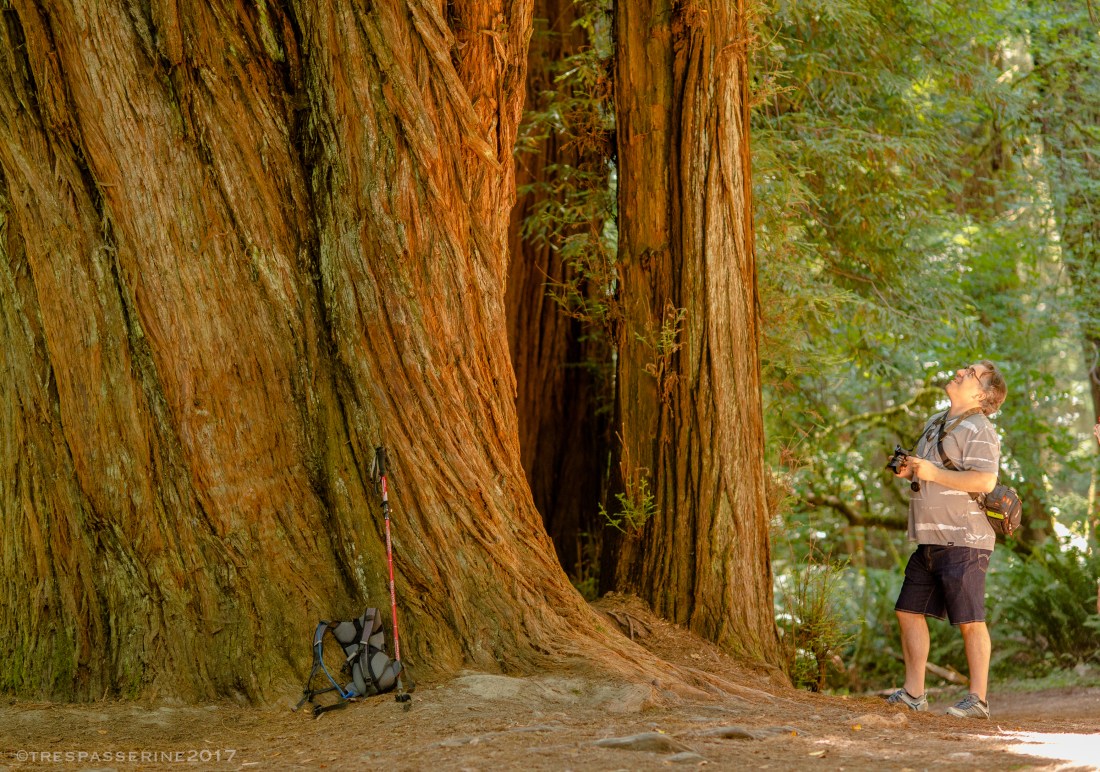
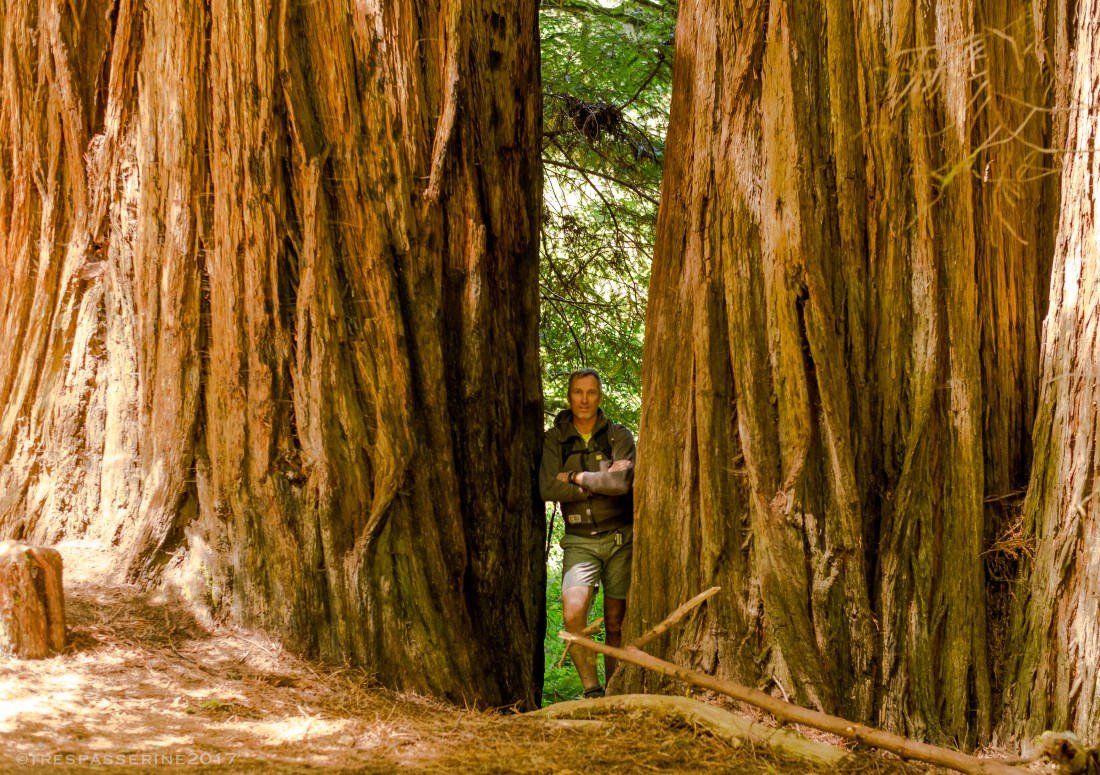
To preface: the coastal Redwoods, Sequoia Sempervirens, are some of the biggest and oldest living things on the Earth. Aside from their fatter cousins, the sequoias of California’s central Sierra Nevada mountains, they are. Before the American West was opened up to the gold-rushing ’49ers followed by wagon trains bringing the whites with their inveterate ways, there were millions upon millions of giant redwoods in what is now northern California. Liking the moisture from the perennial fog, the coastal redwoods grew pretty much from the north Pacific coastline to ridges many miles inland in a line unbroken for hundred of miles north to south. Scattered tribes such as the Yurok and Sinkyone, lacking either hard tools or malevolent willpower to chop chop chop, had lived ‘in timeless harmony’ (a phrase that guilt-ridden white revisionists like myself like to trot out) amid the giants. The first white settlers to San Francisco, most of whom came from the east where trees were smaller, must have gazed disbelievingly at groves of these conifers that could grow so high and so wide. By the mid-19th century California had been wrested from Hispanic rule by Americans of north European descent who sensed there was gold in them hills. With that entrepreneurial mindset, compounded by the belief in God’s providence – that natural resources were both divinely given and limitless – it wasn’t long before the lumber barons followed. Where they prospered the forests grew poorer in number day by day. The biggest and the best were the first to fall. The axe then the crosscut saw picked off the giants of the giants. Creaking as they fell one after the next, by the tail end of the 19th century an epoch in natural history was coming to end with silent screams and tremendous thuds onto forest floor.

young girl backs into a giant, Stout Grove, Jedediah Smith State Park

These living sentinels, there to watch through the ages, stood no chance against the demands of capital and where time had stood still in the 250 million years since they evolved in the primordial forests of the mesozoic, a little thing called progress soon shunted along a real possibility of their extinction from forests.

By the dawn of the 20th century a crisis had ensued. Tough times call for great men, and one duly emerged all the way first from Dunbar, Scotland, via Missouri. His name was John Muir and thanks to his monumental efforts and those of the Sierra Club of conservationists the 5% of giant redwoods remaining today might well have been 0%.

I saw my first redwood off Highway 199 coming in from Gasquet, a settlement on the northern frontiers of California where it touches southern Oregon. Seeing a road that might lead to camp, I turned off Redwood Highway and into deep forest a few miles beyond the town. The South Fork Road led over a bridge and past the turning that led to some of the biggest remaining stands of redwood anywhere. The road wend its way ever further into thick forest, away from any trappings of civilisation. Following a tributary of the Smith River the road had to perform switchback after switchback to keep with the sinews of the river. The hills were high and cloaked with firs. The sky was bruised, of a intense blue you only really see in northern California. Sundown was coming.

There it was, roadside. I slowed to a stop. The tree was of a stout base that flattened the earth like a giant elephant’s foot. It was unlike any growing nearby. The trunk was rust red and the furrows deep and shadowed into bark that I later felt to be soft and none too reluctant to offer up a slither of its thick epidermis to the exotic bark trophy hunter. The bark itself was of a rare quality as trees go, cracking as the inner tree fought to expand. In places the trunk oozed deep russet tannins. If I didn’t know any better, I could have sworn blood was trickling down a woolly mammoth’s gargantuan leg.
Relative Sizes, Jedediah Smith State Park

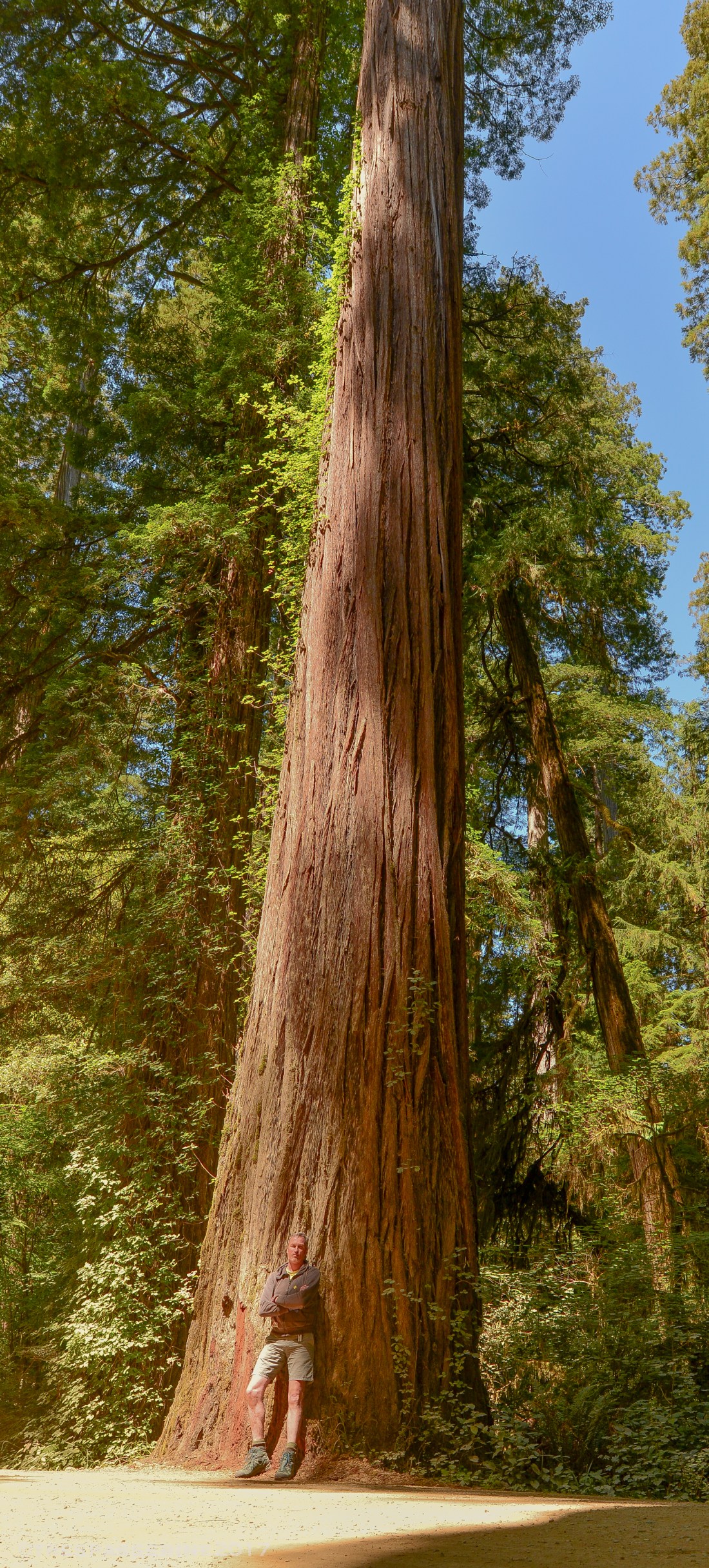
At a beautiful place called the Big Flat, a campground so remote as to be fifteen miles from the highway on neglected backroads that went from smooth blacktop to grainy hardcourt and eventually to dirt, I made camp. Unable to shake the image of that one solitary redwood on the road down I doubled back, judging there still to be time in the day. Back close to the Redwood Highway, I took the rear entrance into Jedediah Smith State Park, where some of the most impressive redwoods still call a grove a home (often and elsewhere they cut lonely figures surrounded by little conifer companions). There I parked. Everyone had gone home. Along what was probably once a timber truck road, I walked, craning my neck ever up. Being human had never felt less remarkable. Now the close of day, twilight filled the spaces between redwood after redwood after redwood, each varying in size, from gigantic to galactic. To my surprise, being two-hundred feet and shallow rooted didn’t prevent them thriving on steep hillsides. It was intuitive to think that the loftier a thing rises the deeper it send its roots. Yet, everything about these ancient evergreens ran counter-intuitive. Nothing ought to be that tall nor nothing that old. Nothing that tall should grow on a gradient. As for their roots The reason redwoods reached for the sky was, I read, because the morning fog is where they tapped the moisture needed to grow the flaky bark that insulates them so well against the ravages of fire (fire which they periodically need to reproduce). They knew not to find the millions of tonnes of water needed for their capillaries in the soil, soil which was often parched and nutrient-depleted. So the root system grew shallow and outward, coiling above and below ground around whatever happened to be there.
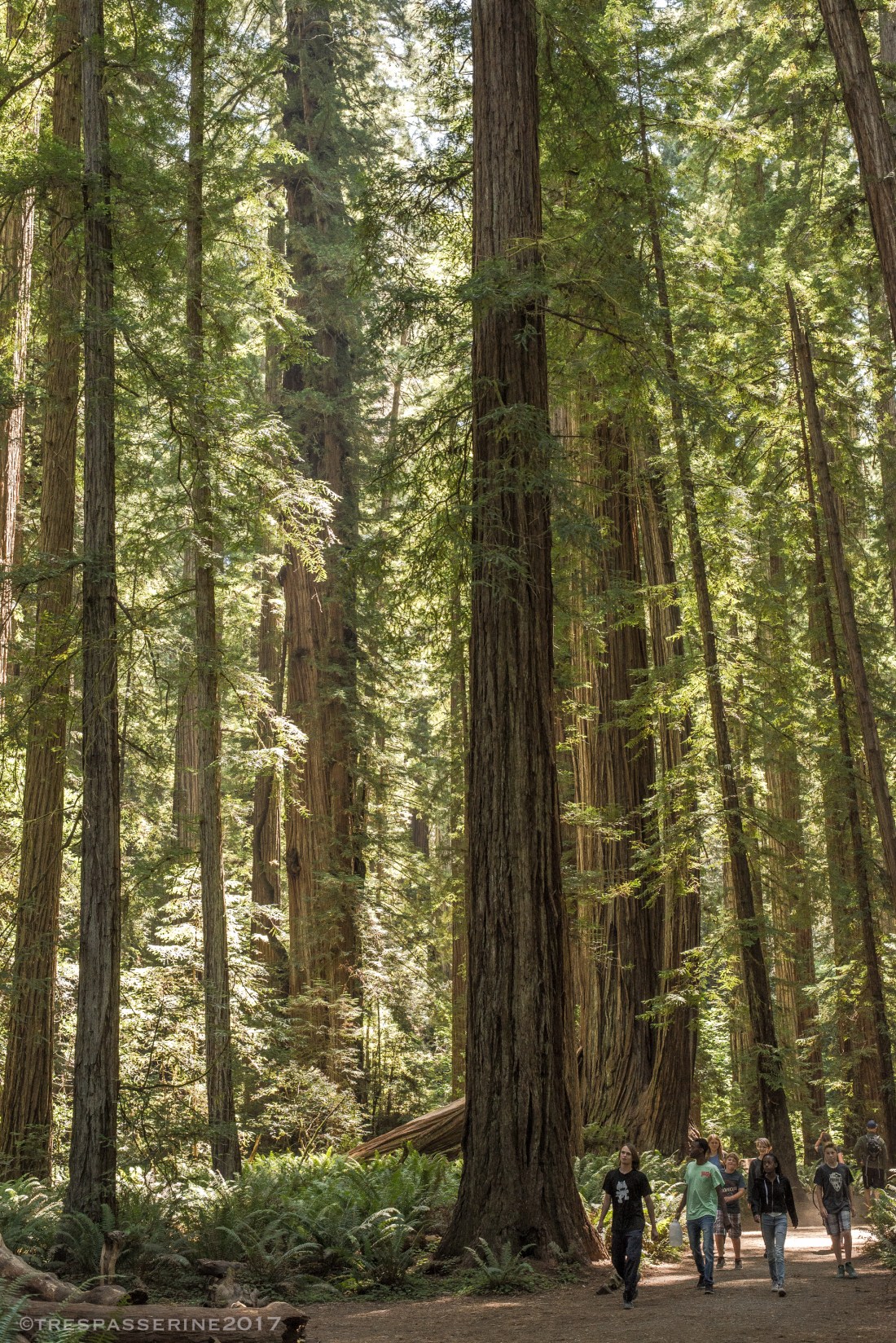
kids strolling amid the tall trees, JS State Park

Instantly, it became clear that what I was seeing was wondrous. A man regresses to boyhood when his eyes behold a thing of wonder. He asks how something can be, just as he did ad nauseam to himself and his puzzled parents when he was five-years old. With full moons for eyeballs he asks the tree how it came to be like nothing else he’s ever seen. He knows his kind built towers larger than nature constructed trees. Still, on this road to Stout Grove, with nothing but silent giants for company, he dismisses the mile-high towers because engineering can explain them. Much as they strive to fire human imagination, not the sky-piercing needle of Dubai’s Burj Khalifa nor the art deco finesse of Manhattan”s Chrysler Building can qualify as an eighth wonder of the world in the manner these mysterious objects can.

Any adult lucky to be a small boy when the Star Wars Trilogy hit the screens in the late 1970s and early 80s will remember Endor. Dizzying pursuits on hover-bikes through the forest of Endor left an indelible mark on mine and many a schoolboy’s imagination. Of course, all of it was conceived in the mind of George Lucas. It was his brainchild. Or so we presumed. For years I harboured that belief. Lucas could visualise worlds few others were privy to. Little did I know then that George Lucas was a native of California and likely familiar with the tall trees of Northern California. The realisation that Endor was nature’s brainchild and not his, that his inspiration was mine to share, was a consolation.

Kids measuring tree girth, Stout Grove, Jedediah Smith State Park

I knew there and then that evening as I glided along that timber road in a dream-like state some things were worth the effort of living for, if only to see repeatedly for the first time. Why the coastal redwoods can stake a claim – not that they care to – to being a bona fide wonder of the natural world was borne witness the following morn when in the hallowed light of a California day I looked upon those trunks again for the first time. When I thought that was merely coincidence, i stayed again at Jedediah Smith state park and this time paid a king’s ransom to pitch up inches from the base of a young redwood. On the third morning since first laying eyes on the world’s gentle giants, crawling out of that tent I gazed again in the same resplendent light and once again craned my neck to breaking point, jaw slacked both in incredulity and paralyzed joy, only to see the mighty redwood again for the first time.