It’s (at) the End of the World as We Know it & I Feel Fine

adventure, chile, South America, Travel, Travel Photography, travelogue, Valparaiso
img_3728

Exaggeration. It’s nowhere near the end of the world; it’s not even near the world of the end. Nor is it at the end of Chile. Far from it. For that you’ve got to motor another 2000km south to Punta Arenas. But you get the idea, and if you remember a certain REM classic from the 80s, you’ll get the cultural reference, too. One fact in the title is incontrovertible: I did feel fine. Chile left me feeling as fine as I’ve felt for a while. Moreover, when the actual end of the world is unravelling half a world away in the Near East, Chile’s Pacific coast might well be the other end of the world spared the end. That enhances its attractiveness all the more.

Way down south lies a land of immense variety. A land that the relatively few who visit will not readily forget. Rigid like a backbone that runs down the southern cone of South America, Chile is tierra blessed by nature and by virtue of the 40 lines of latitude it straddles on the great southern highway reaching from the subtropics to the subantarctic. 40 degrees of latitude! As far as parallels go, that’s unparalleled, anywhere.
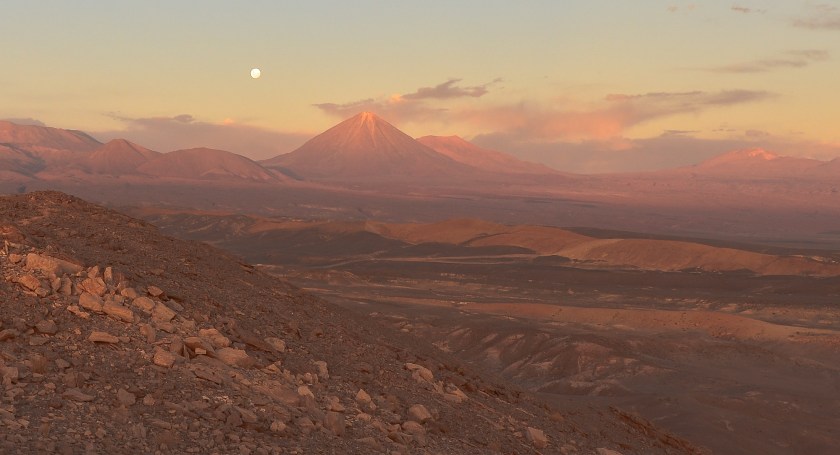
If i may stoop to condescend for a moment, with that irritating air of a geography teacher who always fancied himself as a geophysical mystic, the only true frontiers are natural: rivers, ocean, mountains, deserts, and so on. All else is political and therefore abstract. Chile is pinched between Earth’s longest mountain range above sea level and its deepest blue wilderness below. The altitude range within the space of 150km is about 40,000ft. With the exception of islands, Chile is the embodiment of a sovereign nation as nature intended. To its north is the Atacama, the world’s highest desert, recording some of the driest non-polar conditions on Earth; to its south a subpolar peninsula recording some of the strongest winds on Earth. So unusually-shaped within its borders, Chile is rather unlike anything else out there. Only its Andean neighbour, Argentina, comes close. Chile is a beautiful ecological layer cake. As mentioned, northern Chile, on the altiplano, is a high altitude, volcanic desert of spectacular beauty and otherworldly mystique. NASA use it as a Martian lab. Beneath that is a Mediterranean belt, where vines are grown, climate is optimal, and where most Chileans choose to live. Beneath that lies the cool temperate zone. This region is verdant like Scotland or the Pacific Northwest. This pristine region is studded with inlets and ring-fenced by national parks. Its coastline is so jagged it’s positively fractal.
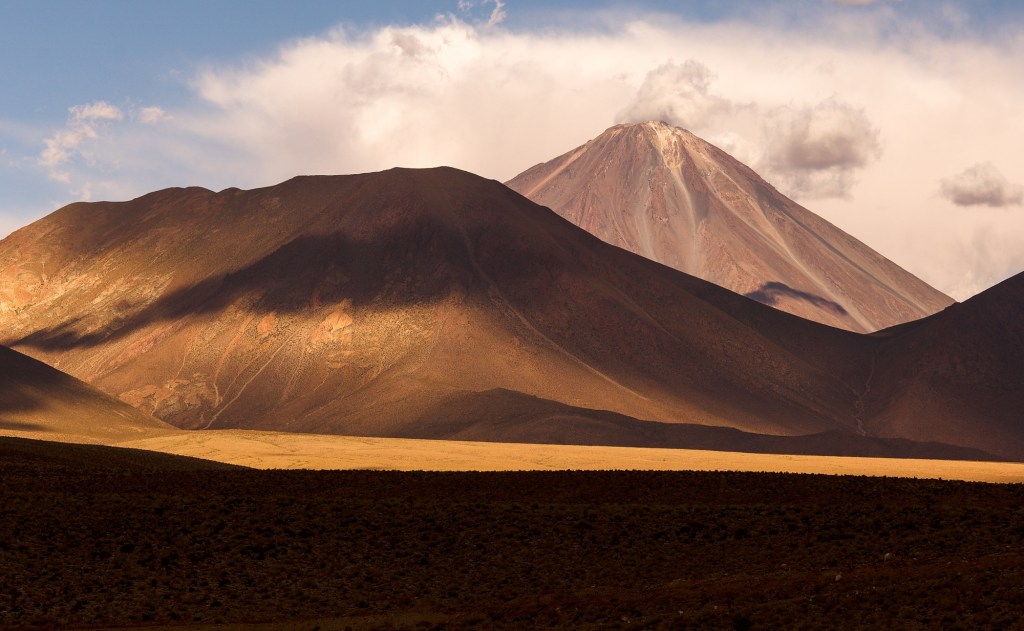
licancabur16-1

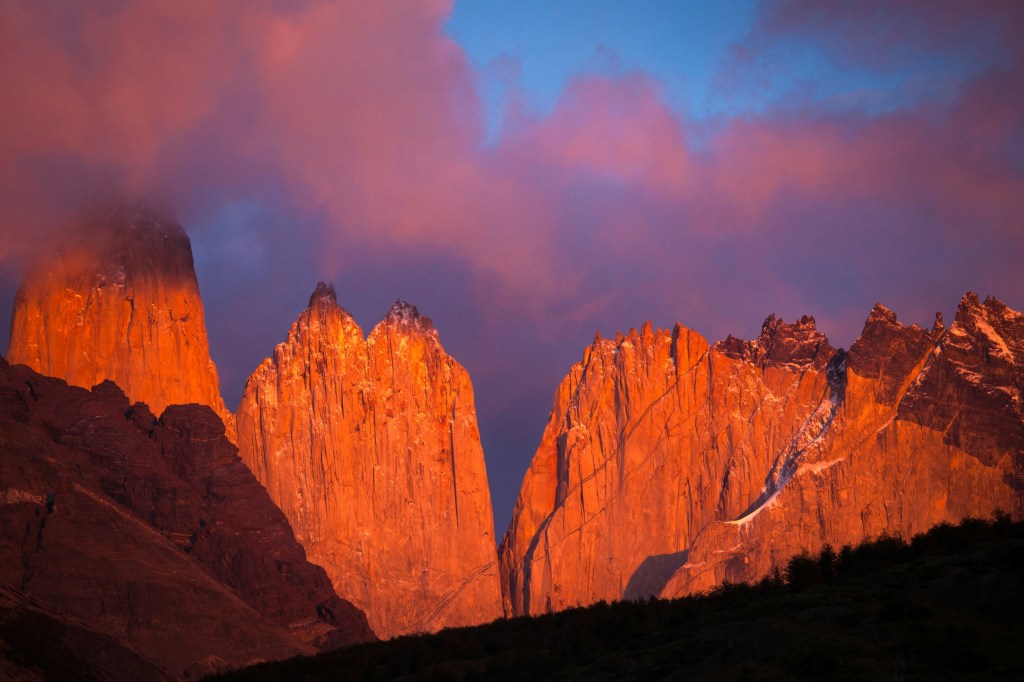
Beneath that you’re entering true Patagonia: a subpolar zone dotted with glaciers, guanaco, and granite fingers pointing up to their creator. Torres Del Paine is the most celebrated of these granite peaks. Beyond this storybook wilderness we come to the nub of the habitable world: the Chilean Antarctic and the Straits of Magellan. Beyond this point, history attests to where fools have rushed in where angels have feared to tread. Not mountains and ocean. Rather mountains of ocean.
Geography class over. Psychotherapy Class Underway.

Valparaiso – San Francisco of the South

How do you cross a country three times the size of Great Britain in a single day? Well, you go to Chile is what you do. From Santiago’s Pajaritos (‘little birds’ – what a name for a bus station where pickpocketing is rife) it was an hour and an half to Valparaiso, the erstwhile ‘Jewel of the Pacific’. These days this coastal city of a quarter of a mill is not so much of a jewel, but more like a frayed patchwork quilt. But nonetheless, Valparaiso was immortalised by Sting in an eponymously-titled song from his 1996 album, Mercury Falling. Since I heard that song the year it was released when, coincidentally, I was on the other flank of the Andes in Argentina, I think I had harboured a longing to see this nineteenth century pride of the Pacific for myself. I knew of its dashing, federation-style, clapboard houses. I had seen images of it as an artist’s messy palette, all splashed in mixed hues of gouache across a Kraken’s bite mark in the coast where deep ocean becomes a narrow continental shelf, then suddenly and dramatically breaking the surface as South America in the form of a magnificent natural harbour.
img_3732

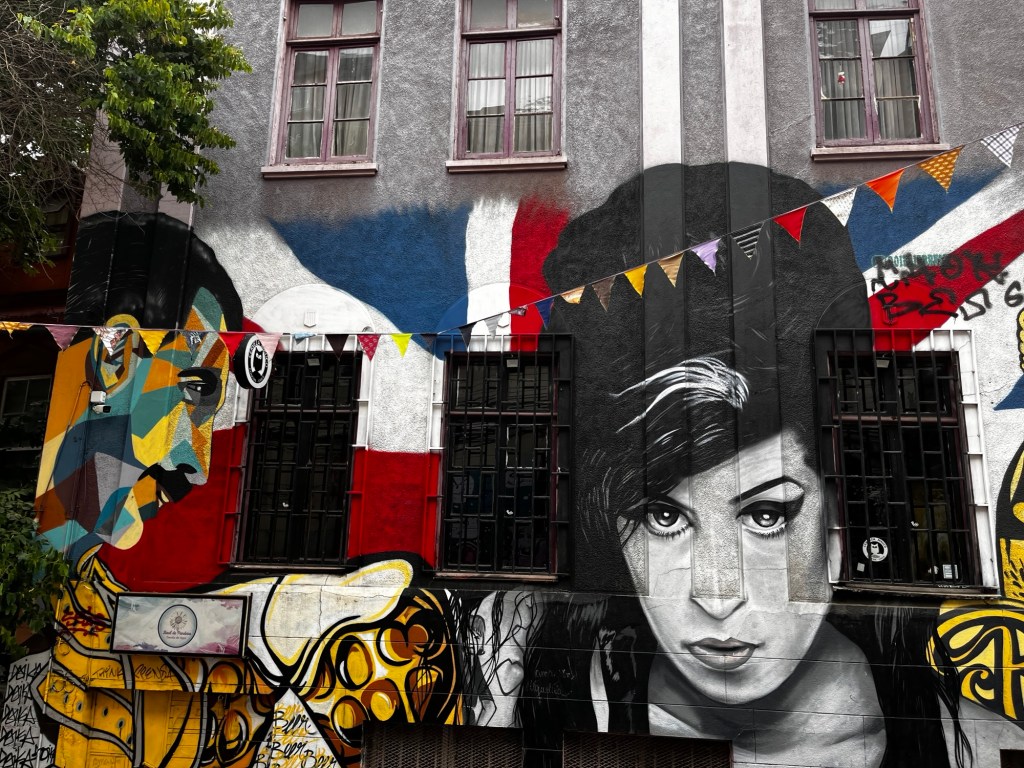
I knew of its reputation as an outpost of bohemian art. I knew a little of its rich history, its links to Victorian Britain. Though it was what i didn’t know that outshone what I knew. This in itself is the essence of discovery. For instance, I had not a clue how shabby Valparaiso was, how far she had fallen into disrepair. My legs were shocked at how steep her hills were; how every chipped and tattered surface now doubled as a work of art writ large; and, finally, how shady it was to walk her threaded streets after dark. This town struck me immediately as San Francisco’s doppelganger. The bay minus the tech giants. Full of dreamers, freaks, addicts, and creative types. A city falling off its elegant hinges, overwritten by the hand of youthful self-expression, I quickly realised there’s probably little else like it, never mind in Chile, or even Latin America, but across the entire world. Except for San Francisco, that is. And maybe Seattle. And Vancouver. Why don’t we throw in Vladivostok into the Pacific coastal family, not that i’ve been to the Russian Far east.
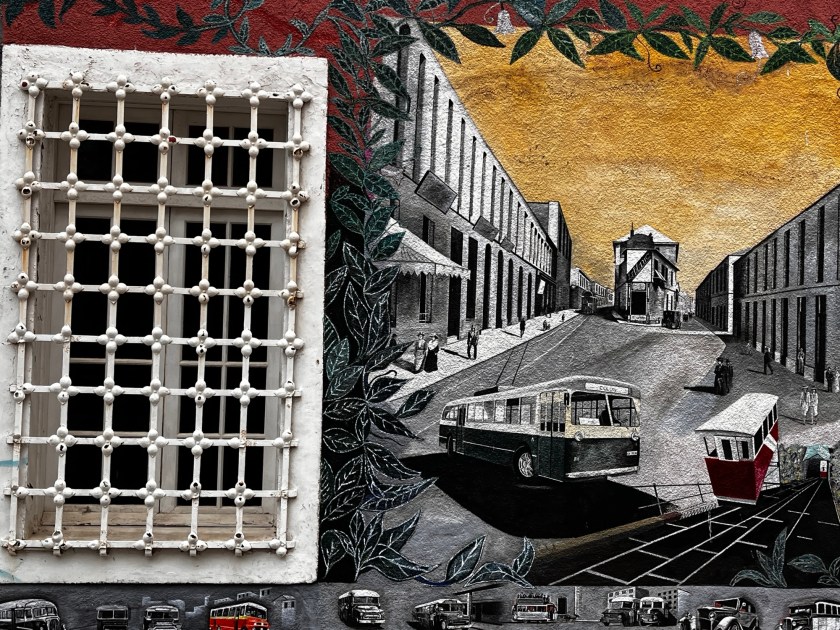
With vigour i set off out into the night. Pacific sunset falling down walls that told a story of decay and rebirth. This civic decrepitude you see across much of Latin America – from old British railway stations and Baroque colonial style in Sâo Paulo and Rio, to the flaky shutters and crumbling facades of San Telmo in Buenos Aires. But this decay does not mean death in Latin America. The blood of Latin creativity transfuses into the old, ailing body, rather like Count Dracula on his nightly prowls.
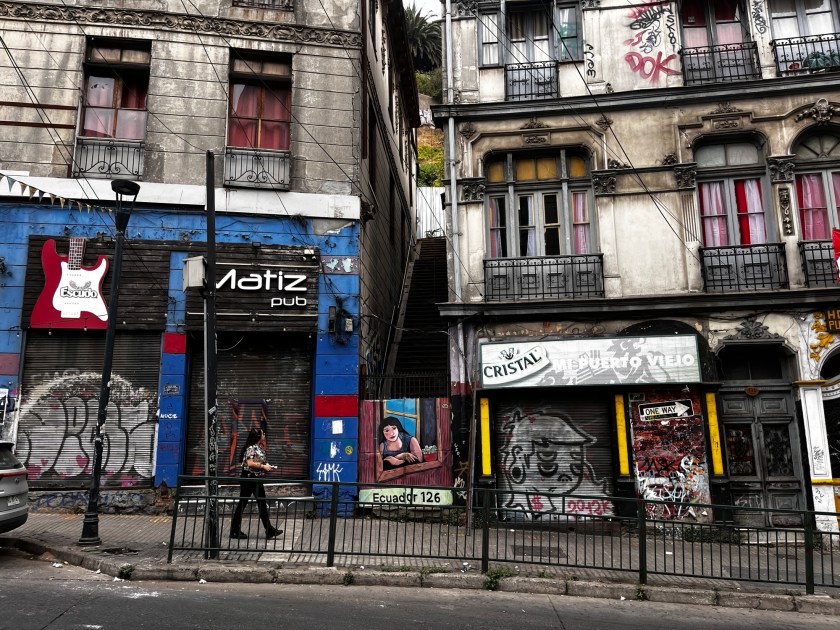
The day was handing over to the night shift when i got there. Scrawled metal shutters were coming down while the warm glow of micro pub lanterns were coming online. People sat on street tables quaffing the nation’s favourite tipple, which, by the way, is not wine. Chile has artisanal beers aplenty, many of which hail from the far south. It does red beers, ales, porters, lagers and pilsners, and all to a standard that even the Brits, Belgians and Germans might approve of. Yes, it’s official: Chileans fucking love beer, about as much as they love marijuana. In fact, they often combine them for a night to remember that gradually descends into a night forgotten. I sat outside at one such bar. The waiters were impeccable in their service in a way that puts my people to shame. They even spoke English, not that I wanted them to. But seeing that Chilean Spanish is a dialect unto itself, hearing English turned out to be a welcome tap on the eardrum.
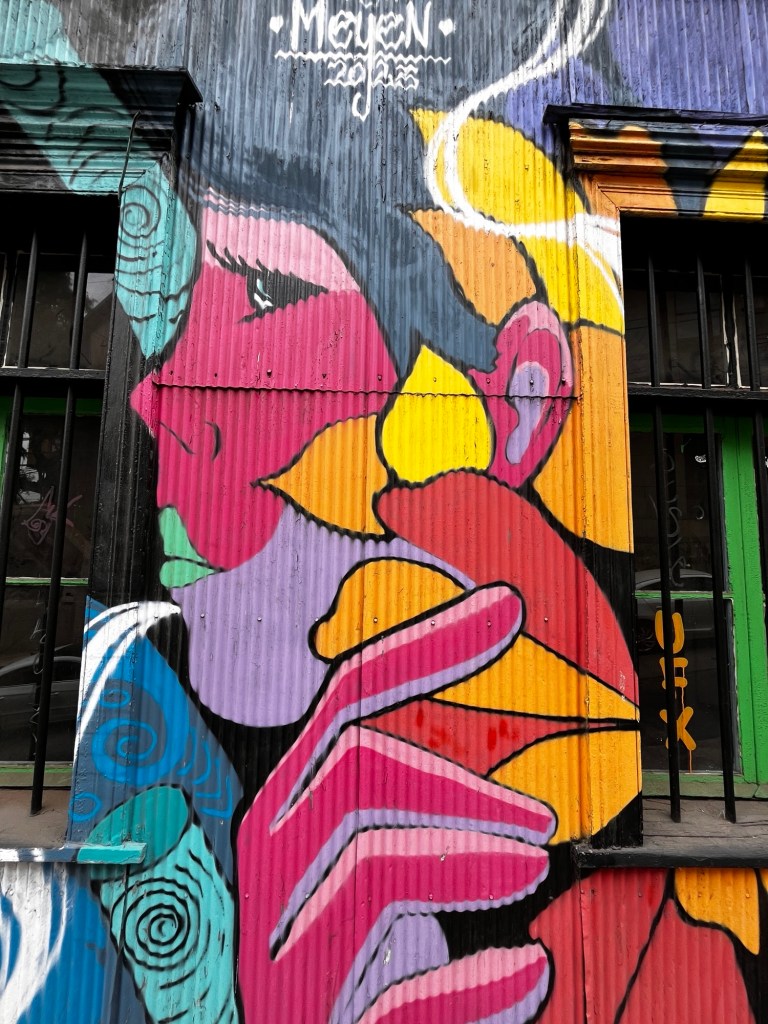
On returning from el baño, the waiter warned me about leaving anything unsupervised, even four raw eggs, two bread rolls and a lump of cheese. Why, i asked. Because they’ll steal the clothes off your back in this town. It quickly became apparent that Valparaiso was the long-lost twin of San Francisco – a place where dreams come to die, a town where for every up and coming sort there down and out to match. When you think of South American cities you think of Old Portugal and Spain surrounded by cement. But not here. Here it’s Amityville meets neo-Baroque meets German half-timbering meets art nouveau meets grimy post-industrial meets the deep, blue yonder.
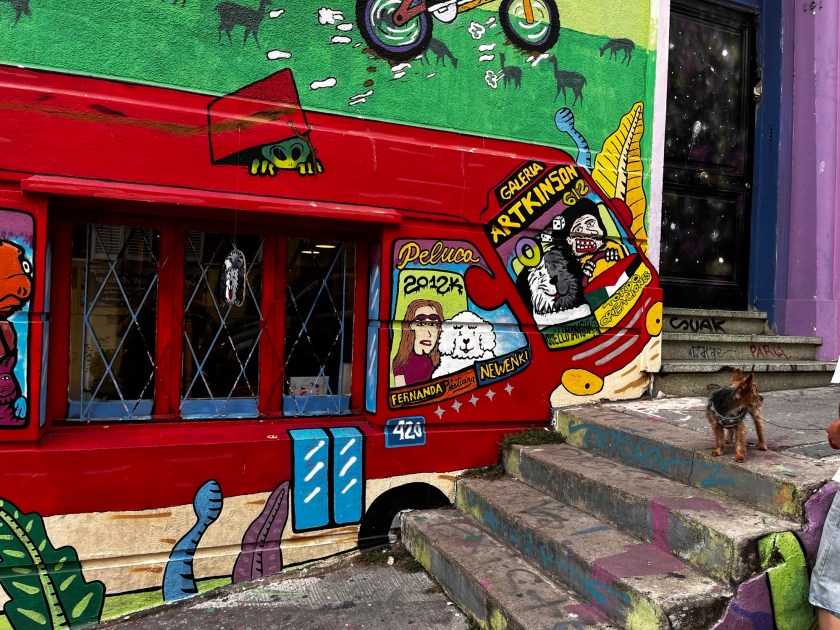
It’s sad really – seeing this once vital port of the South Pacific, for so long not just a refuelling station for naval and merchant shipping, but also an endpoint for Europeans seeking a new start – going downhill like a decrepit old dame rattling her jewels, wearing her tattered cha cha frock she kept from her heyday in the roaring Twenties. Yet, for all those flaked louvre shutters and all that graffiti scrawled across neo-baroque stonework, Valparaiso has reinvented itself in ways most other cities would have neither the chutzpah nor the imagination to do.
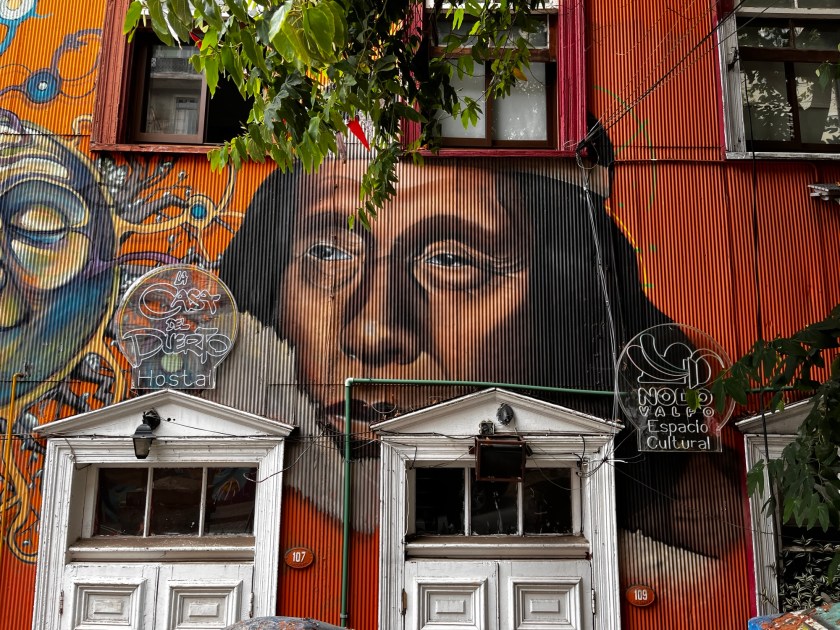
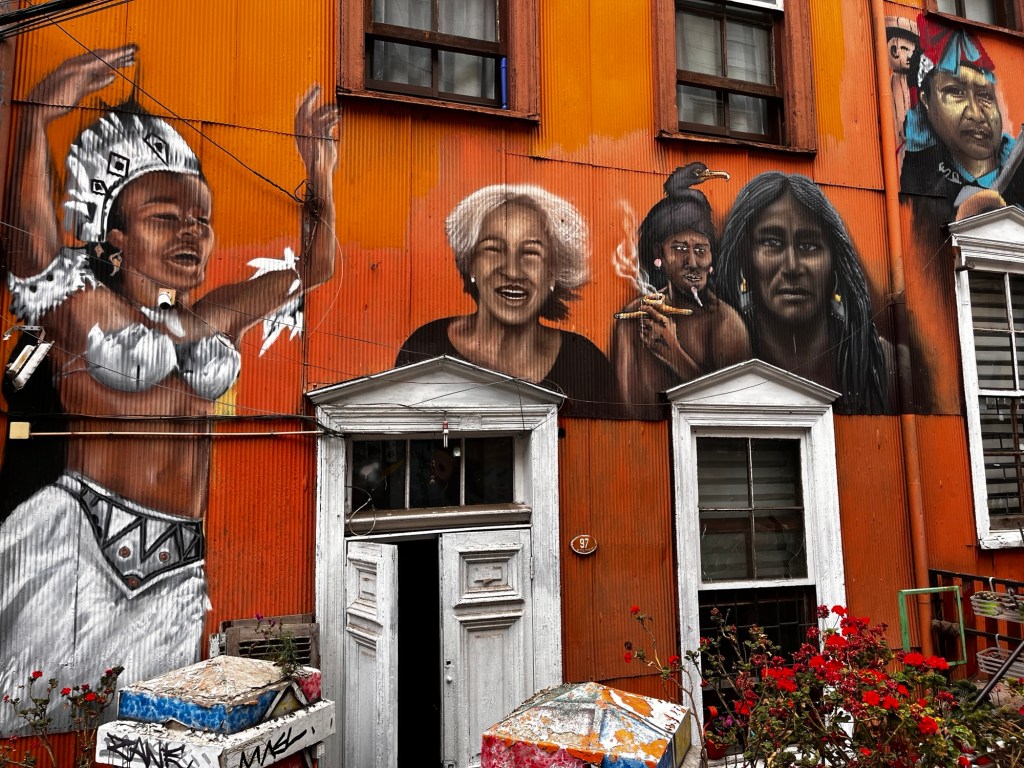
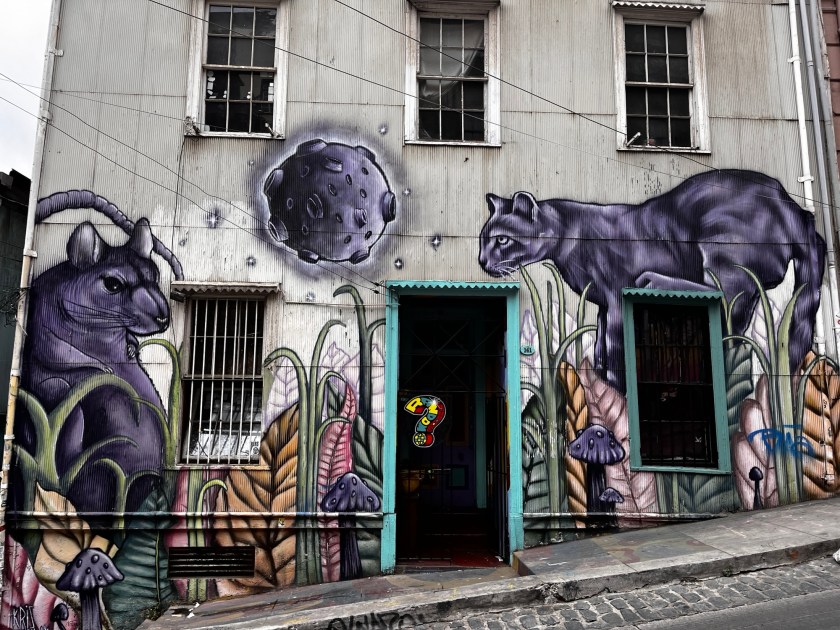
Why bother scrubbing the walls when you can bedaub them with a riot of colour which is the world itself if you can only move beyond the grey of the everyday? Valparaiso is colour writ large. It’s subversion in the way Paris’ Pompidou Centre is subversive. Murals extend out root and branch as if their host building existed purely for the moment the artist eyed their surface relief; just like the exoskeleton that wraps France’s greatest museum to modern art.
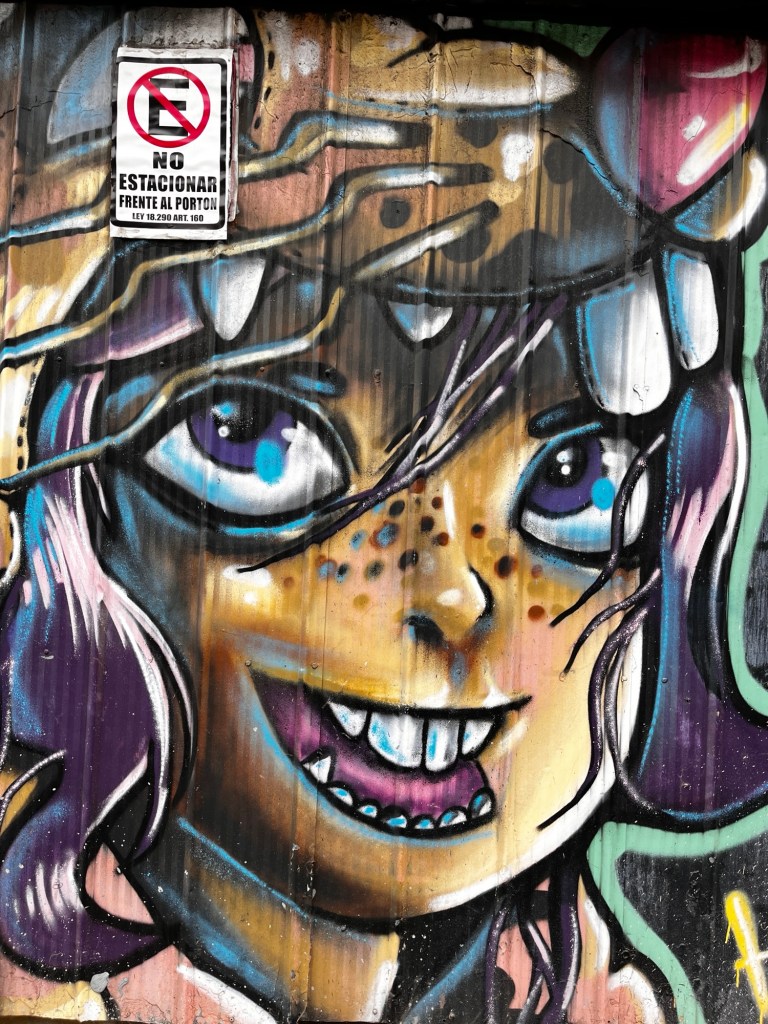
Valparaiso might well be the end of the world’s greatest open-air art gallery, but I’m running out of platitudes for a city falling so far apart it’s falling back together as a mass mania of magic murals that lend themselves to what survives of a human race that is failing in so many other ways. I’m all out of words. Speechless, even. Let each picture speak a thousand of them.
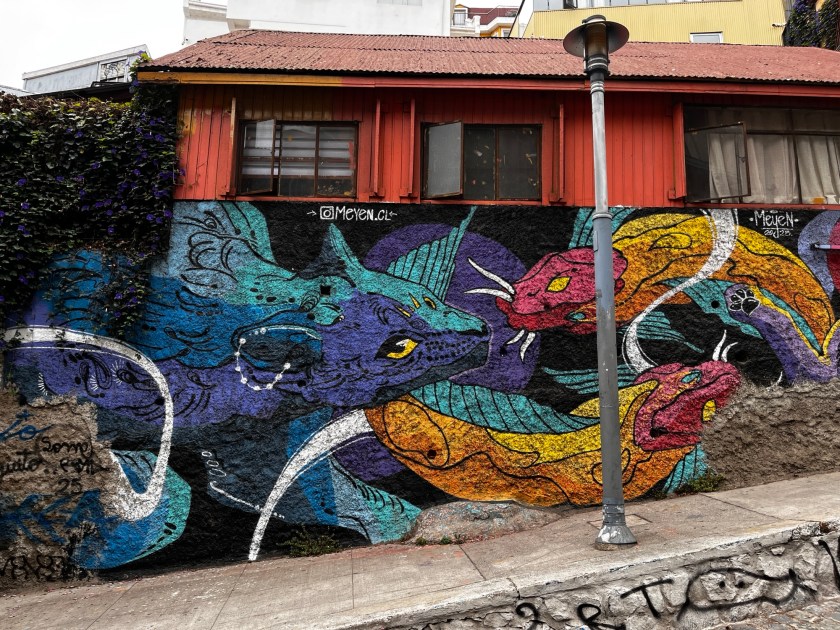
Until Valparaiso I never knew how decay could be subverted in such spectacular ways.
What Goes Down Must Come Up: Why You Should See the Colca Canyon

#adventure, adventure, Andes, backpacking, Landscapes, Latin America, Perú, Perú, Travel, Uncategorized

Olympian Among Canyons

Allow me to set the scene, if you will. The Colca Canyon is situated in Southern Peru, about a 3-hour drive northwest of the White City, Arequipa. By all measures, the Colca is the world’s third deepest canyon (some say fourth) after the Yarlung Tsangpo Grand Canyon in Tibet, followed by the jaw-dropping Kali Gandaki Gorge in the Annapurna region of Nepal.

The Colca Canyon cuts such a swathe through the Andean plateau that it bottoms out at about 11,000ft (3,400m). To offer up some idea of scale that clicks with most of us, that’s about twice the depth of the world’s most celebrated geological knife wound, Arizona’s Grand Canyon. So, one Grand Canyon nested on top of another, and the Colca will just about accommodate them both.

Where Humans Dare To Tread and Till

Farmed by Inca peoples since time immemorial, its steep slopes show abundant signs of continuous human occupation. At about 50 miles in length that’s one deep cut for Man; one deeper cut for the magisterial condor that has made a miraculous comeback there after decades of persecution from local livestock farmers. Its confidence soaring, the condor is one of the main attractions of the hordes of tour buses that stop at the various lookouts along the canyon rim.

For the adventurous few though, what awaits them is a gruelling descent to the canyon floor, where if lucky, they’ll see the condor soar not below them, but at eye level. It’s all downhill from here. And surprise, surprise, the prospects never looked so good.

I got teamed up with a nice bunch of continental Europeans half my age and double my knee flexibility. Among them a smattering of French and German. The Franco-Prussian alliance had sunk to new heights. Our guide was a native of Arequipa, a man who had led so many 3-day expeditions in and out of the canyon that, as can be expected, he was rather unfazed by the whole affair.

El Condor Pasa

One moment we were setting off along the canyon rim and the next a slow motion plunge down a zigzagging hoof trail that swallowed us whole. The view was stupendous, the scale was suddenly gargantuan, and the sky a blue bonanza between weeks of monsoon rain that would render it all but impassable before and after. With the heat rising and the sunlight penetrating the deepest, darkest rincones of this abyss, we fell into a hypnotic rhythm. Our guide pointed out geological features, and delved into a history of human geography. But in keeping with great journeys, what you rank as the best bits keep getting superseded by better bits. Half way down royalty dropped in. Condors swooping over us so near and so balletic on the hot air updrafts that by the time i reached for my oversized SLR camera, they had glided away into the shaded recesses under the canyon walls.

It’s All Downhill From Here

Serendipity had accompanied us that day. Our guide marvelled at how rare it was to come so close to the feathered emblem of the Andes. Then again, perhaps he said that to all his small tour groups. Down and down we traipsed until, looking up, the canyon walls closed in on us like great doors in some medieval banquet hall.

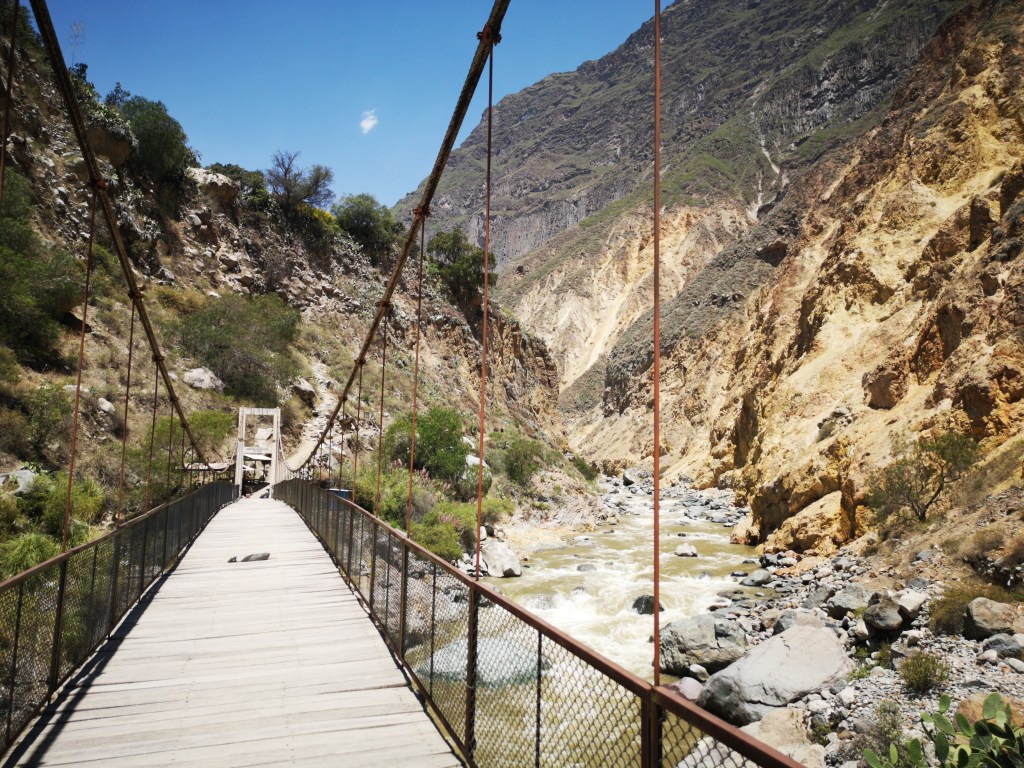
Having spent the better part of the day tiptoeing down about 3,000ft we found ourselves at the nadir. By no means the lowest point in our experience, crossing the iron suspension bridge over the Colca’s mazy river did signal the lowest point geographically-speaking. The sun was beyond its zenith, casting its brilliance on the east face of the canyon, making shadow creep gracefully up the west face.

Scraping the Barrel to Find an Oasis

We had been descending all this time. Now we were walking along the canyon floor adjacent to the watercourse. Festooning the margins of the clear crystal water were orchards of figs and other succulent fruits. Vegetation was abundant. Light and warmth caressing in a very special place where the wind and the winds of change were banished.

We walked and talked for the next couple of days along that canyon floor. We passed churches and villages, kids coming home from school, and guinea pigs flayed and hung out to dry. We stopped in a guesthouse with the most amazing swimming pool, fed to pure by an oasis. A classic desert oasis in the truest sense it was, fringed by date palms whose seedlings had come from half a world away.

It’s All Uphill From Here

On the third morning since taking the plunge into the world’s third deepest canyon, we gathered around our guide at 4am to face the trek back up and out. We obviously knew all along that what goes down must come up. But comfortable in our deep oasis on the previous evening, tipsy on rum and oxygen, I was contemplating a helicopter medevac out of there. The climb looked daunting, and was. 3,000ft straight up in the grip of incipient subtropical heat. Hence the reason we left before daybreak. As if to foreshadow what would be a gruelling hike out, my guide took one look at the packs I was carrying back and front, and shook his head in pity. “I told you to travel lightly, didn’t I?”

Half-light kissed the rim tops around an hour or two into the climb. Then, quick as ink blotting on paper, the dawn light seeped down until we rose to meet it a quarter of the way up. By then the pain of being a human packhorse had slowed my stride to a lumbering, teetering mess. My t-shirt was soaked with the sweat of my own labours. My bandana had to be wrung out every 100 metres or so. My eyes were weeping salty tears of pure perspiration. The line between myself and the other group members was attenuating fast, as they strode ahead. Overcome with guilt, eventually my guide offered, with a degree of reluctance visible in his grimace, to take one of my packs. But not before hailing a passing muleteer who refused.

Ghosts From the Past

Onward we clambered, inch by inch until at about 10am – a full 6 hours after setting off from the now microscopic guesthouse on the canyon floor – he and I emerged on the lip. Shattered, reddened to bursting, and vowing never to descend that far again with any baggage whatsoever, I collapsed in a heap. Beside me, by the grace of an ironic God, were a couple of Estonians I had climbed with a couple of weeks earlier. On that occasion, the altitude was so dizzying that it was they who struggled with hypoxia to the point of almost fainting, and me who offered a helping hand. Now there they were all smiles, relaxing after practically jogging up the Colca carrying nothing but a 7-litre daypack. And me, a sorry sight, temples pounding, eyes throbbing and near spent. Valió la pena? Was it worth the pain? Absolutamente!

Socorro Answers a Cry for Help.

#Brazil, Brazil, Säo Paulo, Socorro, South America, Travel, travelogue

Made ancient by granitic bedrock jutting through in megalithic outcrops, while at the same time made new by the accelerated growth rate of vegetation rampaging over every sod of this Capricorn earth, the topography takes a sideways glance at normality. It’s a split personality of rural France and equatorial South America: piebald cows grazing upland pastures that border dense strips of Atlantic rainforest. Nobbled hilltops, a punk mohican of Atlantic rainforest on one flank, scalped green on the other. If ever Gondwana had an affair with Occitanie, the hills around Socorro is where the child was raised.

There’s nothing quite like a great view to soothe frayed nerves. We left the madhouse of Säo Paulo later than expected on Friday. Wanting to escape the quantum chaos of Friday rush hour traffic, instead the invisible threads that bind millions to the city’s ailing physiology – with its high cholesterol and hypertension – took us into its sickly hold. A passing thunderstorm brought rain not in drops but in globules. Five minutes of deluge had the streets funnelling a torrent of water. As the afternoon wore on, I feared being held hostage to fortune in what would be a million-man race out of the city before dark. And so it went. Swerving hither and thither, we dodged four-wheel bullet after four-wheel bullet in our haste to pull off a spectacular jailbreak. And we almost made it the 25-odd miles to the city limits without incident. That is, until some inconsiderate arsehole (cuzaö in Portuguese – my new favourite, adopted insult) decided to cut us up by swerving violently off the middle lane to reach the exit (saída) and clipping the flank of our car which was motoring along on the inside lane.

Bang! Time stopped momentarily while fate decided whether to flip the car onto its roof and under the 18 wheels of a trundling road train, or to spare us with a mere metallic slap. Fate chose the latter. Stopped in the central reservation of a 6-lane highway from hell, cars flew past us as we remonstrated with the intransigent old fool, who blamed us for being in the slow lane, and therefore causing considerable inconvenience to his plans to make a sudden and spectacularly boneheaded exit off the expressway. ‘Sua culpa’ I said, which maddened him all the more. Meanwhile, I could see the red mist come down on my girlfriend. The offending driver refused to exchange insurance details, stating he didn’t bother buying any for his €15,000 car. Having given up trying to make him see reason, he fled. Karine snapped at the injustice, and an emotional catharsis ensued. Despairing, she insisted on going home. I said no way, so took the wheel and tried to make a dignified escape into the thickly-forested mountains at the natural delimitation of this red giant of a town.

Catharses often end in a profound sense of inner peace. And so it was with Karine. I placed a reassuring hand on hers, and reminded her that we were uninjured and the car, while pranged, was driving well enough. And best of all, we had escaped Säo Paulo’s potent clutches and were now under a tranquil blanket of night in rural Brazil.

We made Socorro by 9pm. The surrounding hills were just about discernible as an inky staircase climbing into the unsullied night. The town, now just a cluster of lamplight in the saddle of a distant valley, looked inviting in a way that only a boy from the provinces could understand. Our little love shack was waiting for us along the Rio de Peixe (Fish River) tourist valley, off the asphalt and down a red oxide dirt track. Old derelict outhouses that once served the Fazenda Fartura loomed in the shadow. Other than weak porch light from the few farm dwellings dotted around the meadows and beside lone arboreal survivors from a disappearing world of giants, we arrived to nought but bliss, and the sound of Earth spinning soundlessly through the void.