Broken Wings Make Broken Hearts

animals, Birds, canada goose, death, mortality, natural history, Natural Law, natural world, nature

For the past few seasons I’ve received a couple of unusual panhandlers. On the face of it, they were Canadian, though I heard them speak neither French nor English. They just kind of sat silently, patiently on cold water, fixing me stares through expectant eyes.

What began as a flying visit soon became a daily occurrence. Those expectant eyes soon started forming words of their own, like : ‘We’re peckish, so feed the beak’. And so i would dutifully open the swan hatch and break little bits of the baker’s dozen, hand-nourishing them with all the love and affection that only a mother could muster. The male – i knew he was a male because of the longer neck and the tendency to forsake his own hunger for the increased dietary needs of his pregnant missus – he was something to admire. He was selfless yet would keep her in line with a peck to the nape when her avarice got the better of her. With balletic charm she would round him and then leap up and snatch, warily, at the tasty morsels pinched between my fingers. His was no desperate lunge. He would take from my hand with a kind of gentle insouciance. Soon they grew bold and I, in turn, grew so fond of them that as he would take from my hand, with the other I would pat the feathers on his perfectly little anserine head. This interaction with wildlife I thought would never end, so much so that when they had their brood of goslings I imagined they would make me honorary godfather.

But nothing living lasts. Tragedy comes to remind us of that.

Last Friday I came upon a scene so distressing I’m still mulling over it days later. I saw a Canada goose flailing in the water right where my pair used to line up at the window to Scott’s wildlife soup kitchen. She was waterlogged and struggling to stay afloat. Sensing her end, the white swans soon encircled her. Initially I perceived them as a merciless mob who gained in strength from the weakness of others. Later i was to be informed that they do this because they are angels of death, white in their feathery shroud to deliver the condemned from protracted pain and suffering. Nature appears cruel but only in the pursuit of kindness.

She was in a terrible state, this Canada goose. Immediately recognising her as the feminine short-neck of my long-standing pair, her terrible suffering behoved me to act. I ran down the river bank as the current was carrying her away. But when I got too near she would flail with her one good side and, listing like a holed ship, paddle with all her might away from me and back into the waiting swans that loitered ready to euthanise her. Her movements made no sense. Waterlogged, limbs broken, her dignity was a thing of yesterday. Heavy now her plumage was a scrambled mess, she went under. I thought she was gone until, through one final death defiance, she surfaced and paddled away. Her mangled wing could have been an outrigger. She had no idea the extent of her wounds. This fact saddened me more.

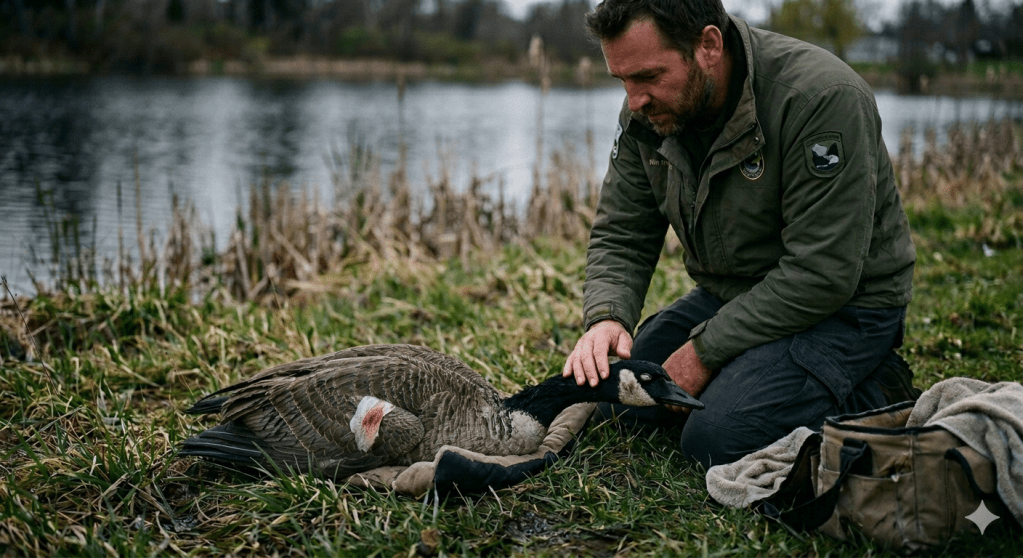
I called the swan rescue society. England has its faults, but lack of compassion for animals is not one of them. A woman wasted no time in coming out to assist. With her she carried a hook and a net. After what seemed an eternity of trying to capture the bird, i scooped up the poor thing. She was cold, drenched and her wing horribly broken at the clavicle. We agreed that this goose had probable flown into a lorry in the fading light of evening. I spoke of my long acquaintance with these pair of Canada geese. To the rescuer I relayed my fears that this poor animal’s devoted partner had also flown into the trailer of the lorry and was right now lying dead in a ditch. She agreed.

Carrying the injured goose to the woman’s car to be taken away to a vet and put to sleep, the goose did not struggle or protest. Instead a great calm came over her, almost as if she has resigned herself to her impending death. Swaddling her in warm covers, I placed her in the boot of the car. Her neck was limp and outstretched. With the bottomless love I have for all God’s creatures, I stroked the wet feathers on her head as those black eyes gazed up at me. In a way she was saying thanks. Tears began to fill me eyes. I did not know why I shed tears for this wild animal. I could not gauge the reason why i felt immeasurable pity and loss that what was only the day before one half of a beautiful pair who went everywhere together in all seasons, even winter with hoary frost on their backs. In that very moment I felt such love for a wild animal. I felt loss. I mourned her life partner. And I believe she too, in her own way, felt not only the pain of terrible injury but also the pain of loss. Canada geese don’t betray emotions on their faces, so I’ll never truly know if in those eyes lay the look of disorientation that engulfs us when we know our time has come, or whether these were the eyes of acceptance and quiet relief.

We leave this world not as we found it. Question is: do we find it again to leave it on different terms, this time knowing not to collide with that lorry? That in the life of an animal the tragedy of history is never repeated as farce?

To Live With a Loss That Has No Purpose.

animals, Buddhism, death, dogs, ethics, fate, free will, human mind, kindness, Life, Meaning, meditations, Menaing, Musings, Natural Law, natural philosophy, Reflections, Religion, stoicism, thoughts

So, it couldn’t have happened to a nicer bloke.

We often use the verb ‘to stumble’ when employing metaphor in describing mishaps on the road to personal progress. For instance, ‘I was doing so well to make this dream happen until i stumbled into trouble.’ Thing is, we don’t often apply the term literally when describing the very moment that things took a definitive turn for the worse. Take this example: ‘He stumbled on the escarpment and fell to his death‘. Exceptions prevail, of course. Sometimes people stumble literally and the ensuing fall is even more consequential (and somewhat more inexplicable) than if the stumble had been figurative in a metaphorical sense. What happened the other night was not exactly a stumbling block on the road to Middle East Peace; being real and not abstract it was arguably more compelling than that.

Soon enough we’ll come back to this nice bloke for whom it happened to. It must be foretold that I’ve got this far in life without throwing the towel in by consoling myself that we inhabit an orderly, law-abiding universe. A chaotic, lawless universe is too hard to countenance. In this universe of mine watchful, seemingly benign forces act upon our individual conduct to pave our way with either help or hindrance. You might call this ‘the blind watchmaker’ syndrome. A classic call to monotheism’s central tenet that God is everywhere and judging. He maketh even that which He cannot possibly maketh. My take is more Tao of Physics, more Oriental holistic, more interconnected subatomic networks with inbuilt natural laws of justice than your run-of-the-mill divine, omnipotent Father-figure there to restore the cosmic balance of justice in favour of the kind and compassionate over the cruel and selfish among us. Intelligent design? Only in so far as subatomic matter is mystically connected to each other despite time and vast distance. Protons telekinetically agreeing that so-and-so is worthy, through honourable conduct, of synchronicity with benevolent time. On time’s elevator, the good don’t even need to punch in their desired floor. The lift knows where to take them. Whereas, the black of heart, for all their frantic prodding of buttons on the console, the elevator nevertheless spits them out precisely on a floor where only woe can find them. These we call the natural laws. You get what you give, no more, no less. Except my story betrays this as fanciful thinking dreamed up by those who need to know that behind every senseless action lurks a just reason. My story tells of how our foundations can be shaken by events that have no purpose other than to reaffirm the popular, secular belief that shit just happens. If everything happens for no other reason than to provide no other reason, then please stop the whirring cosmos for i want to get off.

My neighbour, for want of a better word, was coming home two nights ago. Now his home is rather unconventional. To get there he has to park his car by a canal bridge in a hushed little village full of fairytale thatched cottages, then walk a considerable distance through the quarter-lit gloaming along the black waters of the canal towpath. The towpath is narrow and the banks steep. On one side foliage arches over like a line of tall, bowing hunchbacks. On the other is the water, sullied and still like a river of weak tea with a dash of milk. This garden path of his is neither for the frail nor the faint of heart. Seeing that he answers to neither of these calls, he was walking home with his six month-old pup, Patsy, off the lead with shopping bags in each hand. The Irish terrier, still in that delicate stage of training, would ordinarily have been on the lead but for the fact that the shopping won’t carry itself. Learning to walk independently and by his side, she was beginning to make great strides toward obedience.

Emerging from under a small brick bridge, he put one foot in front of the other, feeling his way through the rapid darkening. As if from nowhere his toe stumbled hard against an exposed tree branch and the forward momentum of his body coupled with the weight of the bags sent him headlong into the canal. Head first he fell, scattering his shopping everywhere, disappearing under the stagnant water. When he emerged from the shallow water he panned his vision around but she was gone. The dog had hightailed it in fear. Now this ‘flight-mode’ is not unheard of in young dogs once spooked by something. Their calm demeanour snaps, leaving their primitive instinct in the driving seat.

All night he paraded up and down the towpath, calling her name, coaxing her to come back. The following morning I got wind of her disappearance and so, without hesitation, joined the hunt. We combed the coppiced fringes of the canal, straying into neighbouring fields, all the while calling her name gently. By now a proper search party had been raised. People being people, dog people being even more divided by canine opinion than non-dog people, theories starting flying thick and fast. She’s gone to ground, some said. The fear has triggered her amygdala into making her cower timorously in the undergrowth until such time as hunger snaps her out of this fugue state. Other theories centred on her terrier nature. She must have found a drain pipe. Others still wondered if she had run and run and run until, young and utterly bewildered, she could no longer find her way home to her master and their boat. I asked the owner what his instincts were telling him. She’s gone to ground, he averred. Agreed, we vowed to resume the search the following morning, though I knew his search would go on undaunted throughout the night.

The following day came and, well, nothing. So again we theorised as to where a panicked puppy might go. We covered a radius of maybe five kilometres in all directions. Meanwhile, other kindly souls had mounted a search and rescue effort. Word was out. Even a local drone pilot wanted in on the action. By the end of the second day I could see his facade of bravery start to crumble. It’s all in the downward sloping of the eyebrows, exposing these two vertical furrows leading up from the bridge of the nose. Again I asked him, what do your instincts tell you? She’s in warm room somewhere beside an old lady who’s picked her up. There and then, a crack appeared in his sixty-eight years of tough stolidness: English passion, I call it. I don’t want to entertain that thought, he said. I have to stay positive. Granted, in such a rural area, where could she have got to? No main road for miles. Only a mainline from Bristol to London, but she wouldn’t, she couldn’t, clamber through the thorny brambles, scramble up the track ballast and onto the lines. Too gnarly, too steep, too pointless for even a pup with no sense of anything other than love for every living soul.

He kept a vigil, returning precisely to the spot where the stumbling had taken place two nights previous. The owner even left a scent trail of his socks, his t-shirts, her basket, blanket, every last little clue he could muster to coax her back from her ‘safe’ place in the undergrowth to their safe place on the boat. I watched as his initial optimism turned in on itself. Two days cowering in a damp bush without food? This theory was beginning by now to sound wishful. By the end of the second day, my thoughts turned to the likelihood that a six month-old Irish terrier, a rare and desirable pedigree, had been snaffled by a lucky passerby. She had to have been sequestered by someone, being such a ditsy and trustful little thing. Question was: what manner of character would this passerby possess? Would they be honest and self-effacing enough to know that this was someone’s prized possession? Or would they be a finders-keepers-losers-weepers type who justifies their deceit on the grounds that property is nine-tenths of the law, whatever that means?

This morning i awoke late. Powering up my phone i received a ping. It was him. He wrote to thank me for my help, but that it wouldn’t be any longer needed. She was found late last night dead by the rail tracks right next to his boat on the other side of a thicket of oak trees. She must have found her way back to the boat but took a wrong turn and ended up trotting along the tracks alone in the dark, afraid. She could hear him calling her but was stricken and helpless to go to him. So light and frail, she was struck by either the London train or a freight train. Her – and his – only solace was that her death would have been instant.

I told my mum, who has loved and lost dogs. She answered, life can be cruel sometimes, son.

Why do terrible things happen to good people? Why must the most vulnerable have to live in fear? Why is love taken away from us only when we’ve found it? Where is the natural justice in all this? I refuse to believe we exist in a dimension where senselessness and meaninglessness is a defining feature. That said, today my eyes are welling up wondering if my grip on an orderly reality is slipping and that, in the end, it’s shit that happens and no one knows the f&ck why.

The Buddha implored us not to get too attached as it would only cause suffering when weaning occurred. He must have known, however, that as humans our attachment to objects – both animate and inanimate – can be both profound and wholly natural. Within this paradox we must make our last stand. This is our eternal condition.

Hey Bulldog!

Beatles, Buddhism, death, fate, free will, future, Life, meditations, Musings, natural world, nature, Oddities, philosophy, predator, Reflections, Solipsism, thoughts

These are the days of our lives. Whether we like it or not, the clock is ticking. The long hour upon the stage will, of a fashion, one day be heard no more. So, let the tale told, ideally, not be by an idiot espousing sound and fury. Let it be told well, full of twists and turns, laughs and loves, random acts of kindness, adventures and heart-fluttering moments that lend themselves to the proud declaration: I was there.

I was recently watching colour footage of the Beatles in the studio, circa 1968, recording Hey Bulldog!. A song destined for obscurity, for me it was a much underrated number. According to Lennon, Hey Bulldog! was a nice tune that meant nothing. However, it wasn’t the melodies that stood out, nor McCartney’s catchy bass line. Rather, it was how the four lads from Liverpool – how the Beatles as a living organism – had undergone a profound physical and mental transformation in such a short space of time since they burst onto the scene in ’63. In the annals of rock music, who else aged and evolved so rapidly in relatively few years? To watch the Beatles do their seven years together was to observe a lifespan in time-lapse photography. Not only did the hair grow and the faces harden, the voices deepened and the subject matter took on ever more gravity. Theirs was an accelerated existence full of very little wasted time, a sort of Haiku poetry in motion.

Some creatures, like giant tortoises, slow down their metabolism to reach the age of Methuselah. He crawls, unchanged, through the centuries. Others, like dormice, speed up their heartbeats to live a James Dean life: short and intense. Mayflies explode onto the scene only to drop dead in the Danube before their first Earth day is out. In the human realm, things are similar. Picasso painted for over seventy years, ten times longer than the Beatles jammed. No slouch, over decades he painted thousands of canvases, admittedly. Some brush work he performed with a swish of urgency, but overall Picasso’s life mirrored the tortoise. He went for longevity, enjoying his life’s true calling all along the way. Physically, Picasso didn’t really alter appearance over time. He started small, tanned, dark-haired and Spanish-eyed, and he ended small, even more tanned, no-haired and Spanish-eyed. The Beatles, contrastingly, seemed to physically and creatively morph so fast, you could almost watch them grow up and apart. Lennon was the epitome of this. From young scallywag to long-haired gnostic, Lennon’s ageing was catalysed by a public domain obsessed with him. Like Mr Benn (for those of you old enough to remember the children’s TV show of the early 1970s) he changed his appearance in no time. As Lennon set about to change the world, the world changed him. And everyone could see him carrying carrying the weight of the world, plain as day (citation: boy, you’re gonna carry that weight, from Abbey Road.)

I employed the Beatles as an analogy to underscore the importance of using the time each of us have to reinvent ourselves: to morph; to never sit on our laurels. Your average human life is more four score and seven years than the squeeze of seven years the Beatles had to shake the world. That said, because we have no idea how long we have to live, these numbers melt away. The Beatles had seven years, but what they did in that time was the musical equivalent of the seventy years afforded Picasso. From I Want to Hold Your Hand to Eleanor Rigby in a mere three years? The difference in maturity might as well amount to forty.

I speak to so many people convinced that because life is long they can afford to sit out the game for long spells. In absentia, years vanish and little substantive gets done. A fearfulness sets in, front doors slam shut, possessions mount up, families fuse together before they sometimes shatter, leaving our clever model of market economics to dig its hooks in until ‘financial commitments’ make it all but impossible to break the chains that bind you to an immovable object that remains out of sight. Folks get stuck in a rut they can’t physically see, and their only consolation is that, ‘oh well, at least I’ve got years ahead of me to change things’.

If only we knew that the game was up much earlier than we originally thought might we take affirmative action to be the change we saw in ourselves. Maybe the Beatles knew deep down they didn’t have long (compared with their musical contemporaries) and that was the catalyst for them to live like no tomorrow (for Tomorrow Never Knows) : to pupate, to reinvent, to transmogrify, to create then recreate, and then some more. You don’t have to have penned Strawberry Fields Forever to view life as a series of peaks and troughs: of pinnacles that only the ingenious few can reach and rifts that the rest of us wallow in. If I had the power to tell another they had one more year instead of forty to thrive, what then? If others had the divine prophecy to forewarn me that my innings was a lot shorter than I otherwise thought, what then would I do to affect change? How would i fill the empty pages in this blank book of life?

(Footnote: I was moved to write this as I pondered the meaning of why the female mallard I’ve been feeding from the boat for the past three months was inexplicably taken from us (and from her drake boyfriend, in a meaningful sense) by an ambush predator, a giant pike probably. She was seen being dragged under not three weeks before she would have presented hatchlings to the Spring. What is this that the life of an animal can end so abruptly, her genetic destiny to reproduce be so cruelly thwarted, by a big nasty bottom-feeding fish, off all things? How arbitrary! How absurd! How sad! Her boyfriend was quacking like a mad thing in distress. And five days on, I still give her a thought.)