(Nothing but) Flowers

apocalypse, botany, conservation, Coronavirus, Covid-19, crisis, development, earth, environment, ethics, forest, future, futurology, giant trees, Hippies, history, human development, Imagination, joni mitchell, Life, Lifestyle, lyrics, meditations, Music, Musings, natural philosophy, natural world, nature, pandemic, paradise found, paradise lost, People, Planet Earth, Political Culture, pop music, redwoods, Reflections, Society, talking heads, teleology, thoughts, trees, verse, Virus

Does art imitate life, or life art?

In days of Covid-19, when the sight of Piccadilly Circus derelict at 3pm could easily be mistaken for 3am midsummer in Murmansk with the sun already up (or more’s the point, having never actually gone down, situated as it is above the Arctic Circle), you know the face of the planet is a strange and beautiful – if deeply troubled – place in need of accounting for. To do that, what better way than to trove through the annals of music to find lyrics that somehow chime with our topsy-turvy vision of Twenty-Twenty.  

How pop music anticipated the short upside of the long lockdown.

Two classic numbers spring to mind as expressions of a world both blighted by the giant bovver boot of human success, and lifted from the dark shadow of its crushing conquest. To know them, we first need to know their context (both allude strongly to making/unmaking the world in our own human image) plus the order in which they arrived on the scene. 

The first song imagines paradise lost to human development and is really an ironic take on how when somewhere magical is discovered by the few it is soon descended upon by the many until that magic melts away before the axe, the pick, the shovel and the steamroller. Let’s face up, before the current pandemic, paradise was being lost at a rate of knots. Virgin lands were being deflowered faster than their chastity could stand. But this trend had a precedent. This was all laid out with depressing familiarity in the imagery conjured up in Joni Mitchell’s 1970 masterpiece, Big Yellow Taxi. She saw the tide changing even back then. Joni must’ve read Rachel Carson’s 1962 groundbreaker, Silent Spring. She, among the enlightened few, flocked to Laurel Canyon, in the hills outside L.A., when it was relatively untouched. By 1970 her lyrics were prescient enough to foreshadow an era when the faraway magic tree was starting to get laden with nest builders. In short, when the visionary few woke up to us killing the goose that laid the golden egg. 

She sings,

Don’t it always seem to go
That you don’t know what you’ve got
‘Til it’s gone
They paved paradise
Put up a parking lot.

This was 1970. By then California’s redwoods had taken about as much pummelling as they could without going extinct in their native habitat. Federal protection would soon ensue to safeguard the remaining 5% of coastal redwoods left in the wild. Things were by no means great, ecologically-speaking. But the world contained far fewer people than today, and far more biodiversity in still unchecked corners of the globe. Joni saw the writing on the wall. For her, it was going to be ugly, but not without the delicious tang of irony.

They took all the trees
Put them in a tree museum
And they charged all the people
A dollar and a half to see ’em.

The rapid human (& by extension commercial) development of Southern California, and in particular Laurel Canyon, was cause for concern, even then. It was in every sense yet another paradise in the process of being lost. You didn’t have to go back to Milton in the 1600’s to realise this. Nor even to the loss of Eden in the Old Testament. In fact, it was happening all around her and her hippie acolytes. So much so that she saw fit to pen the words to one of the great songs of popular music.

Hey, farmer, farmer
Put away the DDT now
Give me spots on my apples
But leave me the birds and the bees.

The birds needed their trees, but the trees were being shipped to the museum. And the bees needed the flowers to pollinate, but the flowers were sprayed with deadly insecticide. And so, the modern narrative was written. The context was nature’s loss for human gain, albeit temporary. The story of us was bittersweet. Our rampaging success came at a cost to everything that was hitherto worth living for. The garden of Eden was once again imperilled, and didn’t Joni express it every bit as well as a biblical prophet.

The second classic number from 1988, Talking Heads’ (Nothing but) Flowers, also laments loss – yes, those buckled blades of grass under the giant bovver boot of human progress that Joni decries – but this time in a different way. Human development for Joni amounted to stealing the pristine from under her nose as Laurel Canyon fills up with infrastructure that follows in the wake of other dream-seekers like herself. Where she accuses her fellow pioneers of stripping away at the fabric of pure nature in their onrush to exist in a state untouched by civilisation (in other words, by radical actions involving having to degrade nature so they could live it, which defeats the whole point of conservation), (Nothing But) Flowers laments the loss of what we brought to the world by changing it from natural to synthetic. The lyrics deliver a shot from the bows that, contrary to the selfish act of taking from nature to become more natural, mother nature (triggered by events untold in the Talking Heads song) has now reclaimed all things natural from her wayward child. His message is clear: we didn’t gain anything in losing our hold on the world. Roads without cars might well feel like a pleasant dream when cars on roads are all that is. But when all the cars are gone and the road is uprooted? Is that not just as lamentable as a world sans les animaux? Beware what you wish for is a sentiment that rattles through each verse.  

From the age of the dinosaurs
Cars have run on gasoline
Where, where have they gone?
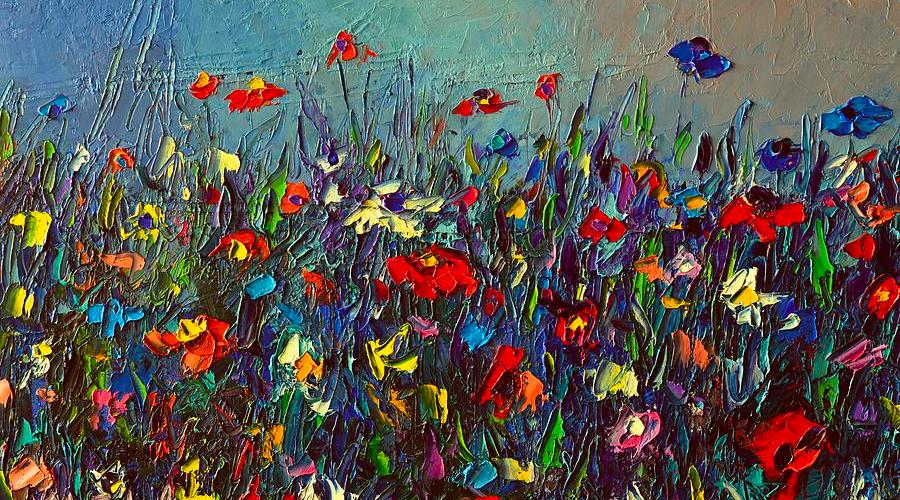
Now, it’s nothing but flowers.

Whereas Joni’s brand new parking lot paved paradise, Talking Heads’ frontman David Byrne sings,

Once there were parking lots
Now it’s a peaceful oasis.

His parking lot has become overgrown in the absence of cars by the creeping dominion of natural regrowth. We have, in essence, gone full circle. However, this oasis is not all it is cracked up to be. Byrne soon tires of this state of nature, dreaming instead of,

 …cherry pies,
Candy bars, and chocolate chip cookies.  

One would be forgiven for thinking that where

…There was a factory
Now there are mountains and rivers…

can only be good. But no. Byrne proves to be no such primitivist. He wants his Dairy Queen, Honky Tonk and 7-Eleven back. Joni saw real estate supplanting the wild fields and trees, a town sprung up where once there were flowers. Byrne envisions the opposite.

This used to be real estate
Now it’s only fields and trees
Where, where is the town?
Now, it’s nothing but flowers.

Disabusing us of this idyllic state of post-civilisation, catching rattlesnakes for dinner is not a tempting prospect once civilisation has collapsed. In a nod to the 17th century English philosopher, Thomas Hobbes, David Byrne sees savagery as the state of nature. Thus, sovereignty has to be restored lest we descend into the the very thing we’ve tried to get way from throughout our painful history. For Joni Mitchell, the romanticism is straight out of a Gaugin painting of Tahitian women. Noble savagery, all swished with colour. For David Byrne, this post-apocalyptic bloom might as well be algal. For Joni, the optimal state of existence is what you might term prelapsarian, that is to say, straight from the Garden of Eden before the flood. Humans are the harbingers of apocalypse for her. Everything they do to commodify their world ends up being worse than the purity of what it replaced.

As Byrne sings toward the end verses:

We used to microwave
Now we just eat nuts and berries.

Don’t leave me stranded here
I can’t get used to this lifestyle

Both these splendid tunes are musical museum pieces for good reason. You or I couldn’t sit down and write them in an afternoon. But in spite of their substantive differences, both numbers are really just two sides of the same coin. Both deal with before and after. Both lament loss. Both pivot around this idea of the aftermath of a profound transition felt by everyone. In this regard, one can thread them to the current state of lockdown being experienced around the world. As has become all too apparent that everyone is feeling a different vibe to the recent halting of practically all human activity in the face of a deadly virus, we may well ask: is it time for a prequel to these songs? This time, in lieu of loss, the unnamed songwriter can wax lyrical about how we unpaved paradise, took down a parking lot. Of how we took all the museums, put them in a massive tree. Or, this was going to be real estate, but it was decided the best buildings are trees. Or, please leave me stranded here, I could get used to this lockdown. 

Leave something for the birds and the bees. Leave something for us and those of us to come.


The Resurrection Will Not Be Televised

Britain, British Isles, Coronavirus, Covid-19, earth, free will, future, kindness, Landscape Photography, Life, Lifestyle, natural history, natural philosophy, natural world, nature, pandemic, People, philosophy, Planet Earth, Politics, Reflections, Socioeconomics, thoughts, urban decay, Virus, Wildlife

If I’ve said it once i’ll say it again: nature is back with a stealthy, healthy whimper. While Rome burns, Gaia fiddles a melodic tune. For literary effect, to assert that nature is back with a bang! as opposed to a mere whimper might hit harder, but it would defeat the point, for it is humanity that creates big noise. Nature is as nature does, and what it does while a quarter of the planet is housebound, while international trade experiences historic levels of supply chain disruption and slumped productivity, is to go about restoring a dynamic balance with quiet purpose. As house elves set about sprucing up the house during the dead of night when all slumber, watching spring assert itself while trade, commerce, and human bustle sleeps is a spectacle worthy of praise. Question remains: when we all wake up, how soon before the house is reduced to another ransacking?

Of course, I’m not the first to notice this wondrous upturn in our fortunes. People stop by the boat and remark how they’re beginning to notice things they hadn’t before on their daily stroll through the countryside. That obsolete word wildlife is even making a comeback. They notice the sky turning from wispy blue-white on a good day a deeper shade of aqua in the absence of belching fumes. They notice the stars return to cityscapes after a lengthy absence. They stop and notice birds do their courtship thing where before they just zoomed past. In short, more and more people are diverting their attentions away from servicing the machine of unenlightened human progress and toward natural events so revered by their forebears. What’s more, they like what they see.

The turning of the seasons becomes all the more apparent when the hatches are battened down. Human sensory organs realign themselves, from toning down the din of normal working life to tuning in to the rhythms of the living planet. Now i know that stuck in a megalopolis of high rises as far as the eye can see poses a challenge to the notion that pandemic lockdown has an unexpected upside that might even outrank the pandemic itself in vitality and importance. Half the world, nevertheless, still lives within range of what could be nominally called ‘the countryside’. Those multitudes are getting out (well they certainly ain’t wasting the opportunity where i am, which I take to be fairly typical) and some are pleasantly stunned into silence by the very act of silence. Have you heard the countryside now the internal combustion engine has been locked in the garage? Nature dislikes a vacuum, as ecologists like to emphasise, so in place of the universal background drone of cars from roads never further away that a mile (in the U.K., anyway), nature has come up with this novel scheme. It’s called keep producing the sounds of spring that never completely vanished, but rather were drowned out for generations by the vandalism of urban noise. So long, Range Rover Discovery, hello skylark or coal tit.

Few are disingenuous enough to really think that all supply chain distribution has stopped, that the tens of thousands of articulated lorries that deliver the length and breadth of the land have simply given up the game in the face of Covid-19. Most are painfully aware that the lorries are still doing the business so that fools like me can continue to enjoy Sicilian wine and Chilean avocados. Having said that, those delivery runs are sure as hell quiet at the moment. Never in all my years, have I heard the sound of total silence as i have blanketing the hills of West Wiltshire these recent weeks. It’s a thing to marvel at. To know that the world would go on without us. That the world doesn’t really need us, if only to process its complex interconnected workings in our complex interconnected human minds. I’m not even convinced that if we disappeared completely, or at the very least had our numbers severely curtailed, something else wouldn’t evolve soon enough with the ability to record and document phenomena in this world.

Lockdown will come to a close. Names of thousands of mainly elderly folks, ages with my beloved parents, by then will have filled death certificates. But in spite of the appearance of a population impatient to return to exactly how things were pre-pandemic, I think you’ll find that when the doors open again many (well, those in more favourable social and geographical positions) will privately bemoan the end of a peculiar phase in history when, instead of forging ahead on this unsustainable resource-greedy path we’re doomed on, we stopped a while and listened in to the heartbeat of the Earth. It was a very agreeable heartbeat and not one plagued with our hypertensions. More than anything, the resurrection of nature didn’t feel the need to announce its homecoming with much pomp or fanfare. It thrived all serene and dignified. While all this flourishing of life was happening behind the media wall of panic, some of us were alerted by a little voice in our primitive mind that said, ‘i feel good because the world seems to be repairing itself much quicker than anyone ever imagined.’

Of course, industry will once again crank up then overheat. Humans will continue to work against natural ecology – and ultimately their own long-term survival, proving even more of an aberration than any other species. Population in the cruelly-titled Developing World will explode like the algal blooms that human industrial pollution creates. Oceanic dead zones will reappear like necrosis on human skin. But all that planetary destruction will be okay because at least scientists cracked Coronavirus. Next year at this time, dissenting voices might whisper to other dissenting voices, ‘why can’t we have a pandemic every year?’

Declaring a pandemic month each year (without the concomitant death involved) could present hitherto unthought of opportunities. This could be our very own month of Ramadan, when so much comes to a halt during the day so that one may reflect on God (or nature, given that they are one in the same).

The resurrection will not be televised.

Springtime Of Our Lockdown

Britain, climate, conservation, Coronavirus, counter-culture, Covid-19, crisis, death, earth, environment, fate, free will, future, Hinduism, human mind, Liberalism, Life, Lifestyle, meditations, natural world, nature, neglect, pandemic, People, philosophy, Planet Earth, Political Culture, Politics, Reflections, thoughts

While we wither indoors, out there something profound is happening. Nature is back with a bloom. Can anyone remember it being so resplendent? So full of seasonal promise?

I’m asking myself how an annual event can seem to take on another dimension. Yet spring is springing with a wicked spring in its tail. Animals have returned to wander down paths long blocked to them. Goats window shopping in abandoned Welsh seaside towns; boars doing the passeggiata down silent streets in Bergamo; dolphins nosing around now crystal-clear canals in Venice in the absence of gondoliers sticking their bloody oars in everywhere. Hell! Even the tender shoots of first budding look that bit more sharp-suited, greener than usual. The sky, not so anaemic. The signs, far from being ominous to any life form other than us, are encouraging. If this is what the world’s end looks like, I’m signing up to it. The whole thing is beginning to feel like a massive teleological event: a reckoning that pits us against each other, and ourselves. What did Churchill once say? “Now this is not the end. It is not even the beginning of the end. But it is, perhaps, the end of the beginning.”

Can it be that Humanity pulls off a civilisational coup, foreclosing on the disastrous Age of Kali (see William Dalrymple’s 1998 travelogue for explanation, or else anyone of eight hundred million Hindus) for a gentler, more enlightened epoch? Could the pandemic be the hidden catalyst for it? Probably not, but the thought is a fitting one given the wonder show that nature puts on while we succumb to fear of personal extinction in our homes under the curfew of self-isolation. While a wholesale regeneration of purity in nature at the expense of human resource rape-&-pillage might be a bit much to hope for, certainly the lockdown can generate a paradigm shift in how people work, and in how we spend our few precious days on this Earth.

Yesterday I stopped by a glade of glistening wild garlic by the roadside. Ordinarily, cars would be humming past with such regularity that no one in their right mind would have pulled over on their bicycles to pick a bunch of nature’s own – a little crop of green goodness that went into the making of wild garlic pesto. In the absence of pandemic, would i have so much as done this? No. Am I better for having done so? Categorically, yes.

This reckoning, by which one refers to a near cessation of frenzied (and highly destructive) activity, which has come to characterise the Human Project over the past forty years, enables a beleaguered and frankly overwhelmed world a chance to hit reset. That great ferris wheel of civilisation that turns ever faster, drawing in and spitting out hapless human victims all the time, has ground to a halt for (shall we say) a spot of maintenance. While it lays motionless, finally we get the chance to stop being mesmerised by its whirring circulation, and start taking in the 360 degree view that was perilously neglected all the while.

Now is the springtime of our being (unless you live in the southern hemisphere in which case you’re on for a revolutionary autumn). Those who are in the gutter looking up at stars over cities that are not only shining but coruscating for the first time in the modern age, will they necessarily want a straight return to an orange-sodium sky above their heads, planes roaring overhead? Those realising that the job they are doing from home unexpectedly through lockdown can be done from home post-lockdown, will they desire an immediate return to crammed commuter lines full of sleepy, barely-approachable worker drones? All of us who may take our one hour of daily exercise (which in reality morphs into about four as the conditions are so favourable, and as time has taken on a more elastic property), we who can stroll down lanes untrammelled by the impatient thud of footsteps, do we want necessarily to cash in the quietude for a ride on the capitalist wheel of fortune again?

The spectre of death clears the field. If there were ever a moment to stop and smell the roses, it is now. If there were ever a moment to ask ourselves: what do each of us want from this fleeting life, and what are we prepared to leave behind when the fire goes out? Now is the time. A gift has been offered to us in the form of mass global quarantining. From this renewal nature may stand a fighting chance while for our part we may gain absolution from mass collective sin. Now I don’t quite know what kind of force is behind these weird developments, but whatever orchestrated them is giving Humanity an open window for opportunity to refashion ourselves into a life force that goes with the seasons, instead of one that signifies such damage and ecological destruction that the seasons themselves cease to be what they were. That window will all but certainly blow shut with the first shunt of summer wind against the pane. While we’re all locked down, let’s make room for the other tenants that call Earth their home, too. When the time comes to fling open our doors again, let goodness flow out and everywhere.