To Machu Picchu, With Love

#adventure, #romance, adventure, Andes, backpacking, Eighth Wonder of the World, environment, Lifestyle, mountains, natural world, nature, peru, Planet Earth, Salkantay, South America, Travel, Travel Photography, travelogue, Trekking, Wilderness

It was always central to the plan. Fly transcontinental to Peru. Once in the capital, randomly follow compass points leading out of Lima in all directions but west, which would be suicidal as it would leave me adrift somewhere in the deep Pacific Ocean. But whatever I do, the golden rule stands: don’t fly home without first having taken the long trail to Machu Picchu.

Many roads lead to Rome. So too are there a fair few routes to Machu Picchu. The Inca, like the Romans, were master road builders after all. You can opt for what most do and that is to fly to Cusco, board a mini bus from that old Inca seat of power to the sublime surroundings of Ollantaytambo in the even more sublime Sacred Valley of the Inca, board the train from the terminus there 90 minutes to Aguas Calientes at the foot of Macchu Picchu, and from there board another bus that winds up and up until it reaches, at 2,430mt a.s.l., the ticket booths standing like sentinels at the entrance to the eighth wonder of the world.

Or you can pay Atahualpa’s ransom and trek the three nights, four days to Aguas Calientes on the famous Inca Trail. Equally, you can step out of the ordinary and hike the Lares Route running along the valley to the north of the Sacred Valley. But that plonks you down at Ollantaytambo and from there you’ll still need to ride the packed train to Machu Picchu. For the even more intrepid there’s the Vilcabamba Traverse route, which basically follows in the now well-trodden footsteps of Hiram Bingham, the American who discovered Machu Picchu with a little help from an unheralded fellow who happened to farm land in Aguas Calientes and knew all about the strange ruins in the thick undergrowth at the top of the mountain. At ninety kms long, descending into canyons, crossing raging rivers and back up mountains so steep you tip your head backwards just to see them in their entirety, the Vilcabamba can take well over a week to traverse. And then there’s the Salkantay. Free but definitely not easy. That’s the route I took. It turns out, with unintended consequences.

They always say, don’t they, that certain actions have unintended consequences. The more extreme the action, the more consequential. By the standards of some, walking a full five days and sixty kms to the foot of Machu Picchu over a 4,600m (15,090ft) pass is pretty extreme. Especially so when you happen to be fifty years old on your next birthday. Anyway, i digress. For five days I walked the walk and talked the talk and in between saw deep time cut deep into rock and cappuccino brown waters froth and fury on the valley floor because the mighty, near-mythical Urubamba river could not run down to the Amazon fast enough, pushed on as it was into incandescent rage by mountains pressed hard up against it, bullying it and blocking its light.

It was raining as the ten of us flooded out of the mini bus on the trailhead. In reality, the official start to the 75km Salkantay Nevada was 20km back down a very inundated road-cum-track. Ordinarily, day one of the Salkantay would involve a trek up and up that rutted track, waterlogged by weeks of summer rain and spun into mud by the endless turning of Mercedes minibuses wheels ferrying sightseers up to Humantay Lake. We were cutting to the chase on our five day dash to Machu Picchu by skipping the boring bits.

Our guide, Jorge, told us to get suited and booted. Raincoats and plastic ponchos would be the order of the day. My Texan friend and I clambered onto the muddy ground. Walking poles were doled out in exchange for rent money. Essential item. $10 for the duration. Our walking group – at that point still a bunch of strangers, mainly from Germany and Holland – formed under the rain, almost by accretion. Bedecked in plastic ponchos of the most garish colours, they readied themselves for a 2-hour detour to Humantay Lake, before bracing for a 3-hour climb up to camp 1 at Soraypampa. As usual, I was first off the bus and last onto the trail. The Texan and I rolled a smoke, buckled up and in our own time started this great overland journey with a single step. The young bucks and hinds in the group were already visibly ahead within minutes. But the Texan and I were not lone stragglers. Beside us we noticed a girl.

I had seen her when i first boarded the bus back in Cusco at 4am that morning. There she was all alone with only a covid mask covering her eyes, depriving me of the totality of her pretty face. She sat alone, not feeling the urge to befriend others, as so many solitary types do when they’re on the road. She slept, and when she woke she kept herself very much to herself. Much as I tried not to, i found myself constantly stealing a glimpse of her while trying to act all natural. Physically, she was nothing like us. I guessed Brazilian due to these fulsome lips and coffee complexion. She certainly wasn’t Peruvian, with their proud Quechuan noses. Nor Chilean. Nor Argentinian. Definitely not Bolivian. Ecuadorian? Hmmm. Nah. They too were ruled by the Inca, as their faces testify to. She could have been Colombian, or Venezuelan. I deduced that much. Anywhere in the Caribbean, the genetic blend of European, African and Indigene created this unmistakeable exoticism, verging on the absolutely beautiful. But, no. I settled upon Brazilian, as there are 150 million of them, and only 50 million Colombians and 25 million Venezuelans (there used to be 30 million, but 5 million are now refugees).

As we ambled, tortoises off the blocks, she drew abreast of us. Slightly discomfited by the presence of two jackasses who – as i was to later find out, she found irksome when they boarded the minibus at 4am singing, joking and generally ignoring the protocols of getting on a night bus – it took me to break the ice.

‘See my friend here, he doesn’t think you’re Brazilian. But i do. Am i right?”

She was. And I was. And that was the first time we were right together.

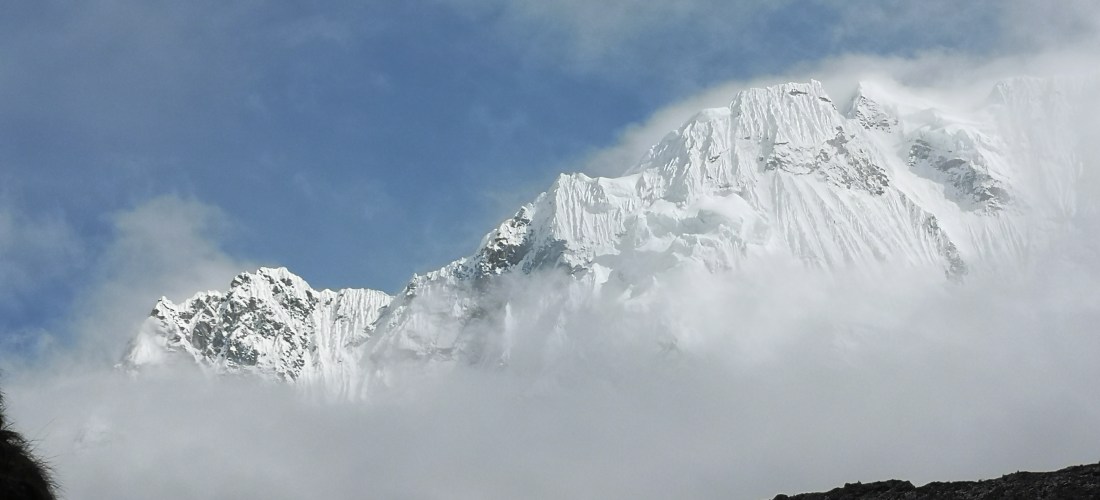
At Humantay lake, the surface water was a bioluminescent paint pot. The color was electric blue-green. Around it the land rose sharply, a browned earth soft as shale where the land had collapsed in. And on top of that sat a crumpled mountainous mass of black rock and ice. The Andean giant flitted in and out of sight, behind a veil of cloud and Scotch mist. It was summer, but the Andes being the Andes and defying definition, this was the rainy season. And for anyone who knows the high mountains, everything is exaggerated, even the intensity of the rain.

I could see the glass domes – our beds for the night – on the ridge up ahead far in advance of arriving. The others were all there, but she and I had fallen far behind. Our footsteps slow, deliberative, rhythmic. We were tired beyond belief, for here at nearly 4,000 metres (or 13,000ft) the air was reed thin and the angle of ascent deceptively steep and seemingly without end. For every gulp of air, disappointment ensued. And as the occluded sunlight dipped on a fading afternoon she and I became more and more talkative. Gassing while climbing at these altitudes is not always the right strategy. So for every sentence a pause for breath that doesn’t readily come the way it does as sea level. Our legs could not catch up with our tongues but I knew that something had clicked between us, language barrier or no language barrier.

Up on the ridge with the Salkantay mountain looming in the twilight behind a wall of white cloud, she and I slumped down. We were exhausted, the right kind of exhaustion that combines the very tired with the very happy. Eagles flew sorties in the valley beneath and every now and then a huge wall of granite would flash into view through the gathering night. Magic all around. This, I thought, is why I damned near killed myself to get here. And in the process i made a friend, a beautiful friend.

Day one not even drawn to a close, and this adventure was already shaping up to be a classic. It’s in the nature of duality that with pain comes a degree of pleasure that makes the pain bearable. Altitude and steep gradients might be the root cause of the pain, but the pleasure was all mine with her by my side. I have a fridge magnet back home that reads, ‘no road is too long in good company‘. Never was this Turkish proverb more true than the moment we collapsed into camp 1.
Oh, The Places You’ll Go.

#adventure, Life, Lifestyle, love, lyrics, mountains, nature, poetry, rhyme, Travel, verse

Picture a Place beyond your front door,

Where the world awaits you, when you are locked down no more.

Where Coronavirus is a Mexican beer-drinking game,

And social isolation a choice not a chore. Things will never be the same.

I’ve heard that one before. The plain fact is, lifetimes well lived never were,

But that little reminder is neither here nor there.


Is it high tide, or glen, or Thai bride, or fen

You seek? Petersburg or Pelion? Russian or Greek?

Then, is it painting a mural on a West Bank wall?

Or lying in wet sand doing not much at all?

Do you see yourself gladly on a deck chair in Spain?

Or puffing away on the Darjeeling train?

A bit of imagination and the possibilities seem endless. And they are.

I can testify to that. Because I’ve kept near and I’ve ventured far.

There’s really nowhere you’ll feel friendless. Whether you’re watching red cardinals from a bench in Central Park.

Or itching your head in the flea markets of Muscat.

There’s nowhere you won’t make your mark.


I myself have had visions on high,

Of following mountains way up to the sky.

And then looking down on all I survey,

A thought. A plot. I’ll come back here one day.

Or not go away,

at all.


I know. I’ll stay rooted to the spot, and dream not of what I’m missing,

but of what I’ve got.

Which is really the whole world when what’s all around

Are mountains beyond mountains. What is this I have found?

Head in the jet stream, heart on my sleeve,

Life’s best in the thrill of the chase, i believe.

Or better still, I found contentment. That’s what i meant.


There is so much to see, so far to go,

So many ways: fly, cycle, row. Hitch a ride, crawl on all fours,

It doesn’t matter how. Providing you do it outdoors.

Depart at a snail’s pace. Arrive in an instant.

Whoever said dreams had to be distant?

By saying ‘I can’t’, you never will. A mountain?

You’ll be lucky to get up a hill.

So don’t forget to recall, it’s all in the mind. If you fall,

Only you can leave yourself behind.


If you like, walk on your hands to Timbuktu,

And when you get there you’ll know what to do.

Keep on keeping on, this time on your feet,

and smile aloud at the people you meet. Everywhere along the way.

Your presence there will make someone’s day, no doubt. Maybe everyone’s.

Depends where you are, where it’s about. Greeks are not Egyptians.

Cambodians not Colombians. Angolans not Australians. Same but different,

Different but the same, a million broken pictures within a single frame.

A mosaic, you might say. A tapestry, a dot painting, a thing on a wall,

Hungarian, Haitian, Hurdy Gurdy Man, or Han. People are people. Wherever you find them. That’s all.


Wherever you roam, roam with a smile.

And if strangers invite you in for a while,

Don’t turn them down.

Turn them up, let them speak, of what they did today and what they did last week.

Who cares if you can’t follow, if it’s all mumbo-jumbo.

You’ve given them yourself, not some hollow

Man! They can see your spirit is willing, your eyes are smiling, your voice is trilling

Out birdsong, some foreign tongue, delighted to have you here among

Strangers.

No one is a stranger, not when you travel.

Except yourself maybe. Let that twist of fate unravel.


So, next time you find yourself in some forgotten land.

Soon, I trust. On an island in a warm sea scratching the sand,

Or if needs must, holidaying local. Even if that means dressing up as a yokel.

Original thinking is the key. Another experience in the bag. The making of me.

Give yourself a big pat on the back for re-learning the art of life. Such a drag, after a year stuck at home

On the edge of a blunt knife.

All things exist, but only life is for living. Tell me something I don’t know.

But have you thought of the future, of the places you’ll go?


(Inspired by Dr Suess, Oh, The Places You’ll Go)


<p value="<amp-fit-text layout="fixed-height" min-font-size="6" max-font-size="72" height="80">

The Year is 2020, So Where is the Vision?

Britain, conservation, crisis, desert, developing world, development, earth, environment, ethics, EU, Fishing, forest, future, global polity, globalisation, history, human development, Libertarianism, Life, natural philosophy, natural world, nature, neglect, Ocean, People, Planet Earth, Political Culture, Politics, Poverty, revolution, Society, Socioeconomics, third world, thoughts, trees, Uncategorized

Humanity bumbling along, governing bodies staring longingly into their former selves à la Dorian Grey and his cloaked mirror, and so-called policies as ham-fisted as a fist full of, erm, ham. Yes, the list just rolls on and on in this the only year in history dedicated to a field of vision deemed as clear and perspicacious as you can get. Oh, the irony of it all! We might be languishing in the year of our landlord, 2020, but we as a race do not enjoy the accompanying 20/20 vision that makes a bleary-eyed rookie into a hawk-eyed fighter pilot.

Let’s start with the only thing that really matters, and no it’s not us. Dorian Grey’s older self would be disappointed to hear that admission. That thing I speak of is the world around us. Let’s face it, it’s the only world we’ll ever have and the only living one within about, let’s say for argument’s sake, ten light years, or 58 trillion 590 billion kilometres, if you’re claiming on mileage. Wilderness, as most of us are aware, is being co-opted for agronomy and industry to serve a human population that is beginning to resemble an infestation or worst still a bacterial culture gone rogue in a planet-sized petri dish. This is happening at a rate for which there is no excuse. We are eating ourselves out of house and home and the only ones not seeing that are those with their craw stuffed full of nature’s bounty, as well as unschooled ignoramuses, for which there are many even if the the doyens of political correctness admonish us for calling out all the provincial thinkers in our swelled ranks. We have known for much of my own lifetime about the concomitant risks in taming the wild places: what is lost cannot be recovered in a timeframe that humans understand. Every Tom, Dick and Harry, however hard of hearing, must know that extinction is forever. We’ve known the phrase slash and burn for decades and, encoded in it, all its barbaric implications. Even though the debate has taken on new and violent terms of reference, eco-vandalism is going on in spite of our knowledge of it and complicity in it. All the while it seems the more dire the prognostications, the more wanton our behaviour and the more debased our greed for the things that have kept the world hitherto in balance. I have lost track of the number of times I hear the term ‘sixth extinction’. Now if that were insufficient to jolt us into redefining the boundaries by which the human race exploits the natural world, i do not know therefore what is sufficient. The more the mainstream media reports on how we’re approaching a tipping point, a point of no return, the more the average family’s material needs appear to multiply. While global population ploughs upward to an 11-digit figure, our celebrity culture boasts of its procreative prowess by inviting the media to snapshot their opulent lives in rural Sussex with six children in tow. Why make the implicit link between many offspring and material success in the knowledge that this is a false correlation? I mean, throughout most of history large families have more often than not been synonymous with extreme poverty, and not opulence. A Prime Minister of Great Britain with six offspring (that we know of), chaired with the task of finding a common voice to bring down the human impact? Gimme a break. What kind of vision is that coming from the stuttering mouth of yet another high-flying free-market mercantilist libertarian who believes in the greatest markets for the greatest numbers?

While the correlation between modern industry and atmospheric-changing carbon emissions has been better made, we continue to miss the point. If you want to trace the problem back to its genesis, jump not onto the bandwagon of climate change. Look again, use that 20-20 vision and you’ll see that Attenborough has been whispering truth: it all comes back to global human population. It’s out of control and from it everything flows. Rampant human overpopulation is the taproot down which a pestilent tree of Man grows. Wild habitat is stolen to tend the needs of a burgeoning population (in Africa and Asia) who all aspire to live as postwar Americans have. Forest goes tree after tree, species after species. We know all this. We know that nothing hosts biodiversity better than a forest found 20 degrees either side of the equator. We know the secrets to finding cures for human ailments lies within their mind-blowing array of biota. We know that to have space to grow row after endless row of oil palm trees to produce better soap and all manner of packet food to feed ever-growing numbers of hungry mouths and to wash evermore grubby little faces, we first have to collapse an ecosystem perfectly evolved to provided a pyramidical shelter for every manner of creature, plant and fungus from here to kingdom come. We know that without canopy cover the thin, reedy soils of the tropics turn infertile, into dust under the blazing sun. So why do we, as a race, persist in laying the groundwork to seed our own miserable demise? Why clear-fell whole countries only to fatten cattle for their mass slaughter to give some Lazy Joe a nutrition-depleted, ready-made burger? Not content with turning the complex machinery of nature into a monocultural wasteland where even the public are forbidden to go, we’re even ramping up operations on livestock farms to expand the export market for meat into a China that’s seen the largest middle-class in history emerge within the past thirty years. Even their tastes are changing to embrace a completely cruel and unsustainable world. Bye bye Taoism. The only consolation we can draw is that 800 million Hindus refuse point blank to jump on the cattle train, not that Mother India is a shining beacon of environmental custodianship.

Living in 2020 without the corresponding vision is not totally unlike the proverbial overflowing bucket of liquified manure that spills out to all quarters. It’s not just the disappearance of tropical and sub-tropical forest, nor the disappearance of broadleaf temperate forest that we in Europe have mourned for a thousand years. It’s everything, everywhere. The human cancer has gone metastatic. Desert is growing everywhere between latitude 20 and 30 north and south, yet we turn a blind eye for most of us do not live in a desert, nor have so much as stepped in one. Grasslands have already been co-opted, but that’s old news now since Buffalo Bill Hickok shot six million bison on the Great Plains as a way of spitefully starving the Sioux. Ice is going, yet while we mourn its melting we overlook that if it were advancing – as it has dozens of times in the past two million years – we wouldn’t find it so brilliant white or cute. As for the oceans, well, not only have we gone from trawler to factory ship as if to underscore the intensification of the end for all who partake in the feast of misery, we continue to sully the waters around our coasts and then some more. We’ve created a floating mat of congealed plastics that swirl around in the North Pacific and is reckoned to be the size of big ol’ Texas. A remarkable feat of human ingenuity if you ask me. Only outdone by the crass stupidity of knowing that fish stocks (even the term ‘stocks’ implies monetary value and property for humans) are near exhausted, so how about we build trawlers the size of small passenger liners with hooked lines trailing off the stern, some long enough to reach the moon and back, which was in all fairness the last decent thing we ever did to get one over on nature. Scrape the seabed for a catch that justifies the distances the fleets (mainly Chinese) will go in order to bring home the ocean’s bacon. They know the damage wrought by this crude method, but do they care? They must know that hardwired into their rapacious business model is the reality that what they’re doing is finite and temporary and smacks of the kind of short-term strategic planning that is no planning at all. Rather, the dragnet of modern fishing fleets represents another instance of short-sightedness that can never equate to the far, crystal clear vision that 20-20 provides.

A discussion about the absence of vision in the year where the two words best eclipse, cannot be foreclosed without mention of political will and leadership. It does not require radical insight to see that leadership around the world is characterized by a near collapse in the manner of vision needed to see the living Earth through the 21st century without any more bodily desecration than is strictly needed to lead a low-impact life. Leaders are followers. Whom they follow is up for argument, but you can bet that the pursuit of profit and unenlightened self-interest lies right behind them. Britain and the U.S. are grotesque examples of nations who have known visionary leadership in their illustrious pasts and who have now descended into a near-existential breakdown because the current crop of leaders are singularly lacking in the kind of millennial vision that sees a hundred years ahead, and not the next hundred days, fearing the imminence of their own destruction, which is the lot of the modern politician. Where are the leaders that the world in crisis demands? Where are the new wave of articulate young voices? Where is the unity of purpose in it all? Of course, worshipping the making of capital and looking to those early 21st century capitalists as pedigree for the type of leadership our damaged world needs is going to end badly. The credo of unlimited economic growth built upon the conquest of nature (as espoused by Adam Smith back in 1776) is a dangerous one, setting a course for yet more planetary destruction by a species whose boots have gotten too big for their feet, whose eyes have grown too large and covetous for their sockets, but whose vision has dimmed. Contrary to the saucer-sized eyes they think is needed for a bigger, bolder vision, they’re missing the whole point: its smaller, less covetous eyes we need, but eyes that penetrate the darkness we currently find ourselves lost in.