TITICACA: Afterlife Vacation Spot #1

#adventure, Lakes, Perú, Reincarnation, South America, Titicaca, Titicaca, Travel

Did You Find Me, or Did I Find You?

For now that blue eye in the sky between Peru and Bolivia still exudes magic. Where others struggled to point, as a kid obsessed with the physical world I faced down that map of the world and prodded right at the X. Titicaca, there’s no hiding from my beady eye. In hindsight, it was my way of saying,


‘Don’t you go evaporating because one of these days I’m coming for you.’

It only took nearing thirty years of travelling to other Titicacas before the real thing found me wandering life’s lost highway. And now Titicaca is gone from sight, tucked away behind that annular world of rock and sky, she hasn’t really gone anywhere other than shrink inch by inch. As the lake was with me from the start, so she shall be to the end. And beyond. Maybe so far beyond that my ashes will linger longer than her vapours.

Early Onset Titicaca Syndrome

I might have mentioned, There’s not a time i can recall not knowing of the lake. Maybe it was the name itself banded around like M-i-s-s-i-s-s-i-p-p-i in the corridors of primary school. The hee-hee and ka-ka onomatopoeia of a laughing jackass, the repetition of the phonemes -ti and -ca, so alien to my English mother tongue. And the familiarity just deepened, breeding not contempt but a certain fascination. Ferocious battles of Trivial Pursuit at the tender age of ten taught me that Titicaca was Earth’s highest navigable body of water. That cool factoid stayed lodged in my hippocampus, planting some seed in the drifting dunes of the mind that would one day bring ephemeral rain enough to germinate that seed into an apparition of the lake itself. I could have sworn it was the real thing, though these days you never can tell.

The Old Ones Are The Best

Hands down, Lake Titicaca is stocked with knockout trivia the way Lake Malawi is stocked with cichlids. Off the bat, it’s where the supreme god Viracocha created the first man (and presumably woman, given that we’re all still here). But more importantly for their selfless service to all life on Earth compared with selfish man and woman, he sent up the sun and the moon from the dark waters. The sun, who went by the name of Inti, then ordered forth his two little suns, Manco Copac and Mama Ocllo (presumably more daughter than sun) to put Man, who was not only selfish but wayward, on the righteous path to Inca-dom. So they set forth over the primordial Altiplano to found Cusco, on a now well worn – if sublime – route covered by both the tourist bus and train between Puno and the aforesaid capital of the Inca’s Pan-Andean empire.

But Titicaca doesn’t even start with the same waist measurements, nor with those time-lost legends of Gods and monsters. Too many of us start skinny and move ever outward around the girth; the lake did the opposite. I read that about 12,000 years ago, when Göbekle Tepe was wowing forager crowds and ice was on the retreat from gigantic Andean glaciers, what now covers 8,370km2 between the modern political constructs we call Peru and Bolivia drowned a much larger area, was at least a hundred feet deeper, creating a liquid landscape bigger than my imagination. Think of it as a rooftop pool not just for Viracocha, but an infinity rooftop (of the world) pool for all the Incan pantheon. Now that’s a big pool of meltwater, all consecrated, it goes without saying.

But alas! Things ain’t what they used to be. In today’s balmy Holocene, all that’s left is a slow-disappearing puddle a few hundred feet deep about the size of Puerto Rico. Still, not to be sniffed at.


Ticking off the Ash Bucket List

Ever asked yourself where you’d like those ashes scattered when you are no more? I’ve roamed around looking for ideal ‘eternity’ spots rather like first-time buyers viewing properties in the housing market. In fact, I’ve been crying, ‘this must be the place!’, since the first time I crossed the Oakland Bridge as a greenhorn globetrotter of tender twenty-two and saw San Francisco shimmering like Oz before my very eyes. I was in love with it then and I’m in love with it now. There’s eternity spot #1. But who’s to say one’s vial of earthly remains have to be tipped out in the same place?

Why not entrust a dear friend, or maybe a kindly stranger, to sprinkle a little bit of yourself in more than one hotspot you visited and fell head over heels for? Call it a breadcrumbs trail of your brief appearance on this beautiful blue planet, there for your reincarnate self to rediscover on the great wheel of time.


Leave A Little Piece of You Wherever You’ve Gone

In Puno, Peru’s port town on the shore’s of Titicaca, I got the idea for this grand post-mortal plan. On the bus from Cusco i met two of the very few Englishman I found in three months of travelling this land north to south. Affable Liverpudlians, they too were heading to Titicaca for a special reason. One of them, the one not married to the Peruvian girl, was carrying valuable cargo. So priceless it could fit in his pocket; so symbolic it brought him all the way to the Southern Hemisphere.

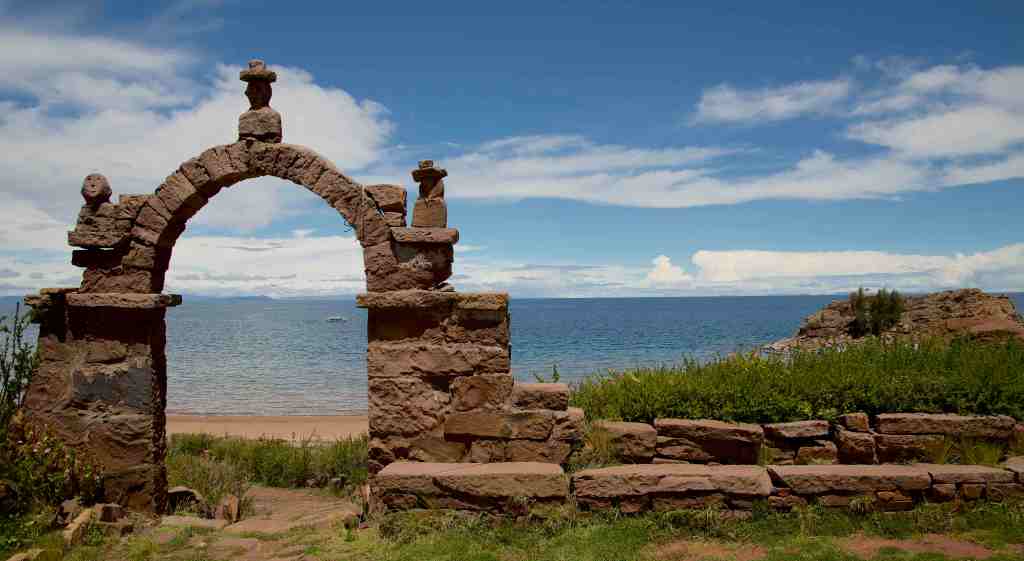
His dad had died a couple of years prior. The man’s dying wish was that his son would ration his ashes, setting aside enough to be able to scatter in a number of his favourite locations around the world. One such spot was Titicaca, though strangely i don’t think he had ever been there himself. Rather, he died with this long-harboured dream unfulfilled. So his son grasped the initiative. He and his friend took a boat from Puno to Isla Taquille – Avalon in the middle of the lake – and on the way there tipped the vial into inky waters of Titicaca. It was there he could say a final farewell to his father. It was there his father’s 21-gramme soul could say an initial hello to this lake so big and so mystical it could be a freshwater sea sailed by the sky people. There was something truly Arthurian about this tale. A power that never left me.


Beaches Where Clouds Ought To Be

Picture yourself on a beach, but no ordinary beach. Picture yourself instead on a soft, sandy beach on an isle ringed with clouds in the middle of Lake Titicaca, at 12,507ft above the bigger cousin of this sea way down there where the world’s intractable problems are deepening by the day. Imagine mountaintops in plain sight, yet so distant I’m not even going to guess how. Visualise a dirty storm front gathering over starboard waters on your Titicaca vessel when on the port side hills are bathed in pure sunlight. Stop and consider for a moment sleeping on a double bed in a floating lodge atop a huge, anchored raft of totora reeds 15ft thick. Being essentially grass this mythical totora, with which the proto-Inca built their distinctive canoes with their curlicue prow, is continuously waterlogged. If the Uro people, who have presumably lived this way since time immemorial, are to avoid a sailor’s death by sinking into 50ft of water, these totora reed mats need re-thatching every fortnight. Can you imagine having to re-thatch a Cotswolds cottage roof every two weeks? I’ve seen the sea peoples of the Andaman. I’ve seen the Junk-dwellers of Canton. Hell, I live on a boat myself. But I’ve seen nothing like this. No, the lake doesn’t add up. And that’s precisely why it does. And that’s why I want my ashes scattered there. Or at least a pinch of them. 

Picture Yourself on a Boat or in Rio

#adventure, #Brazil, Latin America, South America, Travel, Travel Photography, travelogue

I suppose all travellers feel the homecoming differently. Some crash to earth while others drift down all light and feathery. It all depends on a number of factors: how intense the trip has been, and how far you ventured to make that trip happen in the first place. For a reliable measure of to what degree you feel the fallout of coming home, look no further than this equation: divide the value of where have i just been with the value of where the hell I think I am going now. Unless the sum comes out as a negative number, you might just have experienced a homecoming crash.

With the world numbering about 200 sovereign nations, there are tens of thousands of combinations in theory you can make on any end-to-end journey. You can go from Java to Japan, Venezuela to Vanuatu, or the Faroes Isles to France. You can make these point to point destinations alliterate with a classic short back vowel sound, like the UK to the US. Or go large with a nice voiced consonant, like Gabon to Ghana. If you’re willing to speak the lingo of long-haul, how about the rarely confused but uncannily similar-sounding Austria to Australia? Or for practicality’s sake you can dump literary pretensions, and just stretch the alphabet by going Azerbaijan to Zanzibar and back to Abyssinia – except, Ah! Sugar! Abyssinia is now known as Ethiopia, so ditch that. Be judicious when combining vowel sounds on your long end-to-end destination list, as they can culminate in an act of war, as the Ethiopians and Eritreans discovered to their detriment. Russia and Ukraine are neighbours in the alphabet, but far apart in other ways. Nor are either viable travel destinations right now.

In my case, I stuck to the early stages of the alphabet: I went from England to Brazil, albeit via France’s exquisite Charles de Gaulle airport. As E can never be B, so it follows, England can never be Brazil. Not that E would ever truly want to be…uh…B. The world has quite enough to contend with having one Brazil in it far less two. Another Brazil on the fringes of Northwest Europe, and the planet would spin out of orbit (all that rain and vegetation on all that landmass is a weighty proposition). On second thoughts, forget it! An E=B duplicate Brazil this far north just wouldn’t be Brazil. It would be a bloody big England, and more of a headache for Europe.

Before I go in sinuous, unplanned narrative directions, I think it behooves me to say, Brazil is a truly amazing country. Okay. Wind that back. Correction: Brazil is a continent within a continent. So, therefore, Brazil is an amazing country-continent. By definition, it doesn’t rely on any place else. If all others withered, it would keep sprouting new shoots. It grows its own food, drink and living materials in abundance, making it self-sufficient in all but the imported luxuries, which frankly no one needs for happiness because they are by definition luxuries and exist only to make dreary winter days in Europe feel meaningful to dissolute rich people. But Brazil is far from myopically narcissistic. She’ll take you in alright. And she’ll make you feel bloody good about being accepted. Particularly, I must add, if you’re white, European and male. Speaking the global lingua-franca helps, too. But white British privilege aside, even undervalued black Brazilians and pardo/as (name given to mixed race Brazilians of uncertain origin) hardly gripe about their country, for all its historical betrayal of them. Being a continent within a continent, and the sole Portuguese-speaking one, at that, it’s all they’ve seen. And by and large, what they see more often than not pleases the eye, whether that eye be blue, green or brown.

I want to talk about the immediate aftermath of what it feels like living a whole season in Brazil. I want to drift in an out of feeling into thinking and back into feeling. I want to talk stats, sights, sounds and smells, but after three months of sensory overload, i am clueless of where to begin. Being a journey with a beating heart, maybe the writing style should mirror the pulsations of the human corazão. Like a healthy heart, the retelling should contract into a tight ball of fleeting moments – observational vignettes set on location in some of the meanest, greenest backcountry I have seen (i shit you not) in 30 years of darting all over this planet. Then, filled with blood that still boils with the heat of the Brazilian summer, the heart of the travelogue should expand to draw in the immensity of facts and physical features that fill the eyes with sights incomprehensible to those whose gaze has yet to be blessed to fall upon such places.

This is the challenge of the ‘travelong travelogger’. This might smack of bombast, but such is the burden we carry, all too often alone.

The experts say ‘write what you know’. I prefer to invert the maxim to ‘know what I write’. And right now, I’m in that 72hr critical period when where I’ve landed still feels like a diorama, capturing all that’s still-life about these dying days of England’s winter. Small-town English life with all its bauble hats and padded overcoats is going on outside my boat on the other bank of the river, but – Brazil fresh in my mind and radiating in a tropical afterglow out from my skin – there’s a yellow and blue filter between these eyes that cast an outward stare on that monochrome movie out there. I’m trying to see both sides of the world for what they are, but every time I try take each on their own merit, i end up trying to colour match the two. This contrast is stretching me a bit.

The subjectivity aspect of how your perceptions both change and adapt to seeing a familiar place as if for the first time, having been somewhere so qualitatively different for so long, kind of hastens you to want to reach for the encyclopaedia. Having travelled long days by road from São Paulo, only to make the slightest of incisions into the neighbouring states of Rio and Minas Gerais – such is the scale of a land half the size of the South American continent it occupies – there’s little doubt Brazil is rich in details, mostly, but by no means exclusively, natural.

Scenes set context. Even though my impression is that I saw a lot on my expeditionary outings in Brazil, I saw but a fraction. And here’s why. Let’s go holistic before getting to the nub.

Broadly-speaking, there are a handful of ecosystems that constitute the eight million square km landmass of South America’s dancing, oversized child. Imagine for a moment a litter of mongrel pups, Brazil’s natural habitats are varied as they are conjoined. You’ve got flat pampa in the Gaucho grassland country of the far south; you’ve got Pantanal – floodplain swamp country in the Mato Grosso, rich in plant and animal life; inland you’ve got cerrado (pronounced say-hado) in Minas Gerais and Goianas – yellow savannah and rocky extrusions, not unlike parts of Australia; between the cerrado and the sea you’ve got caatinga (pronouned kah-chinga) in Minas Gerais and Bahia – hot, dry, hilly scrubland of tight, gnarly vegetation, deep canyons and red oxide earth; you’ve got Amazonia – lowland river basin of pure, tropical rainforest with its prodigious feet in the world’s largest drainage system. Between the hot highlands of the vast interior and 4,000km of sometimes sultry, botanical coastline, there’s lush, semi-deciduous forest featuring immigrants like towering eucalypts and golden oldies like Permian pines in the form of Araucaria. Then there’s the other, less celebrated but far more felled brethren – the Mata Atlantica. There might only be 7% of the original Atlantic rainforest left, but it don’t let that fool you. It continues to cloak innumerable hillsides, and brings rain in multitudes between Brazil’s two most recognisable urban centres: São Paulo and Rio de Janeiro. Moreover, it brings organic reproduction in ways hard to fathom when you live the four seasons.

It is this habitat, the Mata Atlantica, reaching all the way from the mountains near Minas Gerais to the magnificent beaches along the litoral norte of São Paulo and the Rio coast, that I was witness to. It’s formidable as it is stupendous. Though it wants to bite you at every opportunity. When the sun blazes, it burns. And when it rains, boy does it rain.

Now seems like a good moment to end this instalment. Let anticipation hum for a while before following up with an op-ed piece on why magical encounters – from Minas to São Paulo, and best of all Rio State – are best shared with posterity, as well as maybe a few accidental readers. Why stash these experiences selfishly away in a memory capsule? The 72hr window will only pass, and the new reality will shove and jostle the previous one until it’s all but banished to a darkening past.

Oh, The Places You’ll Go.

#adventure, Life, Lifestyle, love, lyrics, mountains, nature, poetry, rhyme, Travel, verse

Picture a Place beyond your front door,

Where the world awaits you, when you are locked down no more.

Where Coronavirus is a Mexican beer-drinking game,

And social isolation a choice not a chore. Things will never be the same.

I’ve heard that one before. The plain fact is, lifetimes well lived never were,

But that little reminder is neither here nor there.


Is it high tide, or glen, or Thai bride, or fen

You seek? Petersburg or Pelion? Russian or Greek?

Then, is it painting a mural on a West Bank wall?

Or lying in wet sand doing not much at all?

Do you see yourself gladly on a deck chair in Spain?

Or puffing away on the Darjeeling train?

A bit of imagination and the possibilities seem endless. And they are.

I can testify to that. Because I’ve kept near and I’ve ventured far.

There’s really nowhere you’ll feel friendless. Whether you’re watching red cardinals from a bench in Central Park.

Or itching your head in the flea markets of Muscat.

There’s nowhere you won’t make your mark.


I myself have had visions on high,

Of following mountains way up to the sky.

And then looking down on all I survey,

A thought. A plot. I’ll come back here one day.

Or not go away,

at all.


I know. I’ll stay rooted to the spot, and dream not of what I’m missing,

but of what I’ve got.

Which is really the whole world when what’s all around

Are mountains beyond mountains. What is this I have found?

Head in the jet stream, heart on my sleeve,

Life’s best in the thrill of the chase, i believe.

Or better still, I found contentment. That’s what i meant.


There is so much to see, so far to go,

So many ways: fly, cycle, row. Hitch a ride, crawl on all fours,

It doesn’t matter how. Providing you do it outdoors.

Depart at a snail’s pace. Arrive in an instant.

Whoever said dreams had to be distant?

By saying ‘I can’t’, you never will. A mountain?

You’ll be lucky to get up a hill.

So don’t forget to recall, it’s all in the mind. If you fall,

Only you can leave yourself behind.


If you like, walk on your hands to Timbuktu,

And when you get there you’ll know what to do.

Keep on keeping on, this time on your feet,

and smile aloud at the people you meet. Everywhere along the way.

Your presence there will make someone’s day, no doubt. Maybe everyone’s.

Depends where you are, where it’s about. Greeks are not Egyptians.

Cambodians not Colombians. Angolans not Australians. Same but different,

Different but the same, a million broken pictures within a single frame.

A mosaic, you might say. A tapestry, a dot painting, a thing on a wall,

Hungarian, Haitian, Hurdy Gurdy Man, or Han. People are people. Wherever you find them. That’s all.


Wherever you roam, roam with a smile.

And if strangers invite you in for a while,

Don’t turn them down.

Turn them up, let them speak, of what they did today and what they did last week.

Who cares if you can’t follow, if it’s all mumbo-jumbo.

You’ve given them yourself, not some hollow

Man! They can see your spirit is willing, your eyes are smiling, your voice is trilling

Out birdsong, some foreign tongue, delighted to have you here among

Strangers.

No one is a stranger, not when you travel.

Except yourself maybe. Let that twist of fate unravel.


So, next time you find yourself in some forgotten land.

Soon, I trust. On an island in a warm sea scratching the sand,

Or if needs must, holidaying local. Even if that means dressing up as a yokel.

Original thinking is the key. Another experience in the bag. The making of me.

Give yourself a big pat on the back for re-learning the art of life. Such a drag, after a year stuck at home

On the edge of a blunt knife.

All things exist, but only life is for living. Tell me something I don’t know.

But have you thought of the future, of the places you’ll go?


(Inspired by Dr Suess, Oh, The Places You’ll Go)


<p value="<amp-fit-text layout="fixed-height" min-font-size="6" max-font-size="72" height="80">