
It’s (at) the End of the World as We Know it & I Feel Fine

adventure, chile, South America, Travel, Travel Photography, travelogue, Valparaiso
img_3728

Exaggeration. It’s nowhere near the end of the world; it’s not even near the world of the end. Nor is it at the end of Chile. Far from it. For that you’ve got to motor another 2000km south to Punta Arenas. But you get the idea, and if you remember a certain REM classic from the 80s, you’ll get the cultural reference, too. One fact in the title is incontrovertible: I did feel fine. Chile left me feeling as fine as I’ve felt for a while. Moreover, when the actual end of the world is unravelling half a world away in the Near East, Chile’s Pacific coast might well be the other end of the world spared the end. That enhances its attractiveness all the more.

Way down south lies a land of immense variety. A land that the relatively few who visit will not readily forget. Rigid like a backbone that runs down the southern cone of South America, Chile is tierra blessed by nature and by virtue of the 40 lines of latitude it straddles on the great southern highway reaching from the subtropics to the subantarctic. 40 degrees of latitude! As far as parallels go, that’s unparalleled, anywhere.
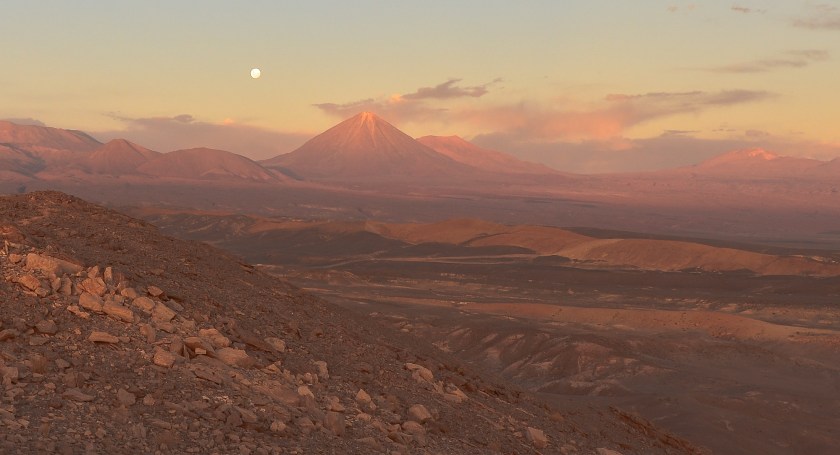
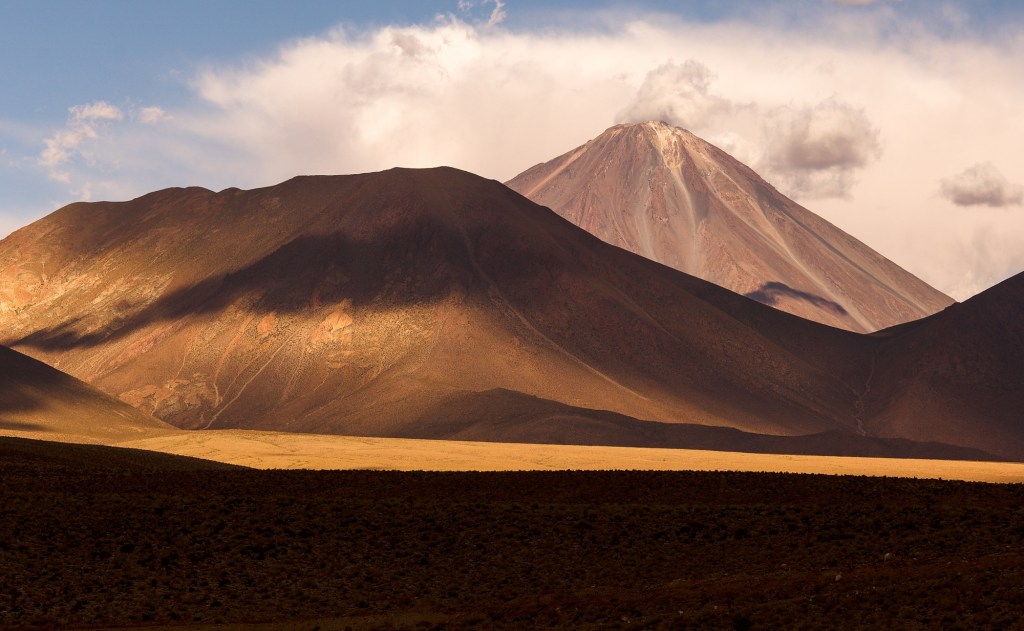
If i may stoop to condescend for a moment, with that irritating air of a geography teacher who always fancied himself as a geophysical mystic, the only true frontiers are natural: rivers, ocean, mountains, deserts, and so on. All else is political and therefore abstract. Chile is pinched between Earth’s longest mountain range above sea level and its deepest blue wilderness below. The altitude range within the space of 150km is about 40,000ft. With the exception of islands, Chile is the embodiment of a sovereign nation as nature intended. To its north is the Atacama, the world’s highest desert, recording some of the driest non-polar conditions on Earth; to its south a subpolar peninsula recording some of the strongest winds on Earth. So unusually-shaped within its borders, Chile is rather unlike anything else out there. Only its Andean neighbour, Argentina, comes close. Chile is a beautiful ecological layer cake. As mentioned, northern Chile, on the altiplano, is a high altitude, volcanic desert of spectacular beauty and otherworldly mystique. NASA use it as a Martian lab. Beneath that is a Mediterranean belt, where vines are grown, climate is optimal, and where most Chileans choose to live. Beneath that lies the cool temperate zone. This region is verdant like Scotland or the Pacific Northwest. This pristine region is studded with inlets and ring-fenced by national parks. Its coastline is so jagged it’s positively fractal.
licancabur16-1

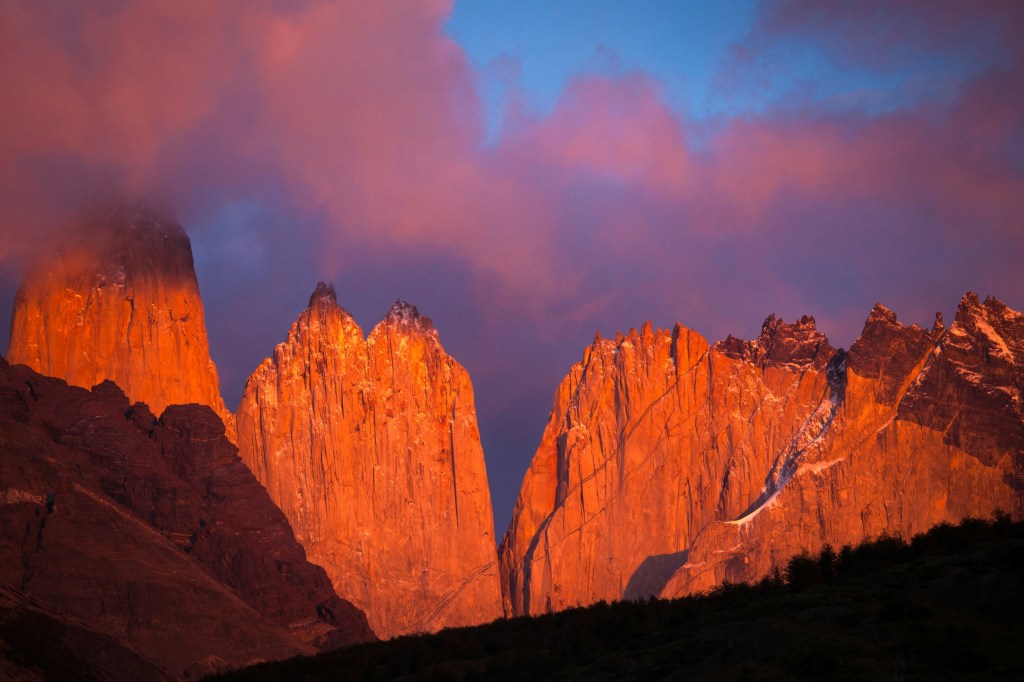
Beneath that you’re entering true Patagonia: a subpolar zone dotted with glaciers, guanaco, and granite fingers pointing up to their creator. Torres Del Paine is the most celebrated of these granite peaks. Beyond this storybook wilderness we come to the nub of the habitable world: the Chilean Antarctic and the Straits of Magellan. Beyond this point, history attests to where fools have rushed in where angels have feared to tread. Not mountains and ocean. Rather mountains of ocean.
Geography class over. Psychotherapy Class Underway.

Valparaiso – San Francisco of the South

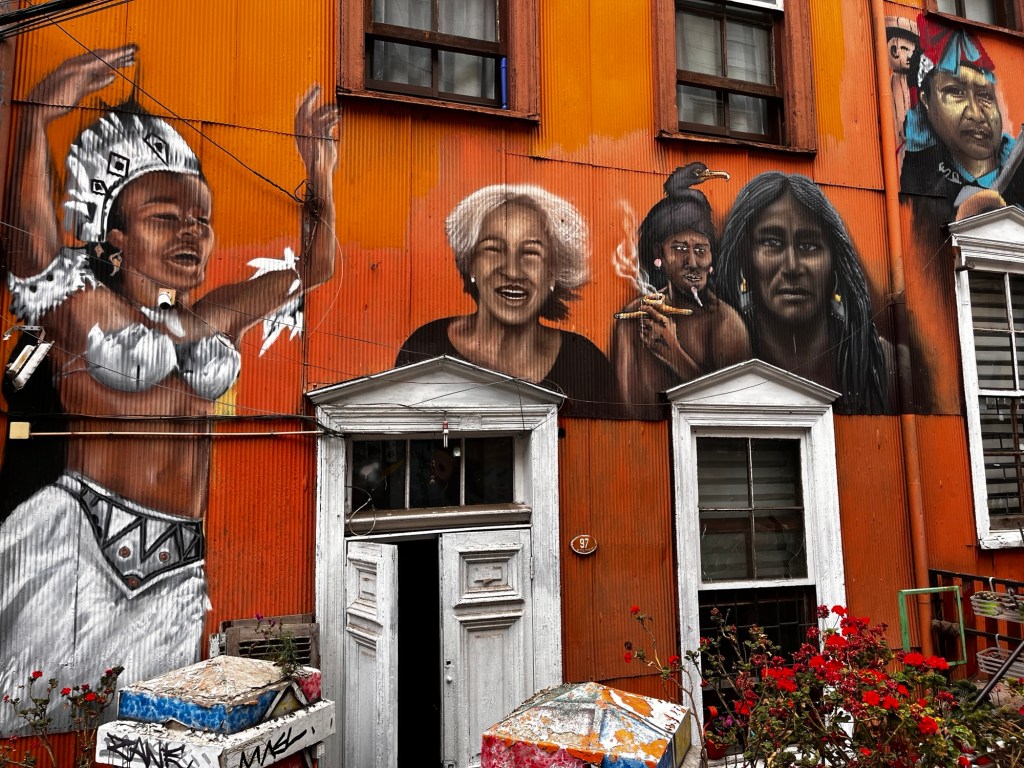
How do you cross a country three times the size of Great Britain in a single day? Well, you go to Chile is what you do. From Santiago’s Pajaritos (‘little birds’ – what a name for a bus station where pickpocketing is rife) it was an hour and an half to Valparaiso, the erstwhile ‘Jewel of the Pacific’. These days this coastal city of a quarter of a mill is not so much of a jewel, but more like a frayed patchwork quilt. But nonetheless, Valparaiso was immortalised by Sting in an eponymously-titled song from his 1996 album, Mercury Falling. Since I heard that song the year it was released when, coincidentally, I was on the other flank of the Andes in Argentina, I think I had harboured a longing to see this nineteenth century pride of the Pacific for myself. I knew of its dashing, federation-style, clapboard houses. I had seen images of it as an artist’s messy palette, all splashed in mixed hues of gouache across a Kraken’s bite mark in the coast where deep ocean becomes a narrow continental shelf, then suddenly and dramatically breaking the surface as South America in the form of a magnificent natural harbour.

img_3732

I knew of its reputation as an outpost of bohemian art. I knew a little of its rich history, its links to Victorian Britain. Though it was what i didn’t know that outshone what I knew. This in itself is the essence of discovery. For instance, I had not a clue how shabby Valparaiso was, how far she had fallen into disrepair. My legs were shocked at how steep her hills were; how every chipped and tattered surface now doubled as a work of art writ large; and, finally, how shady it was to walk her threaded streets after dark. This town struck me immediately as San Francisco’s doppelganger. The bay minus the tech giants. Full of dreamers, freaks, addicts, and creative types. A city falling off its elegant hinges, overwritten by the hand of youthful self-expression, I quickly realised there’s probably little else like it, never mind in Chile, or even Latin America, but across the entire world. Except for San Francisco, that is. And maybe Seattle. And Vancouver. Why don’t we throw in Vladivostok into the Pacific coastal family, not that i’ve been to the Russian Far east.
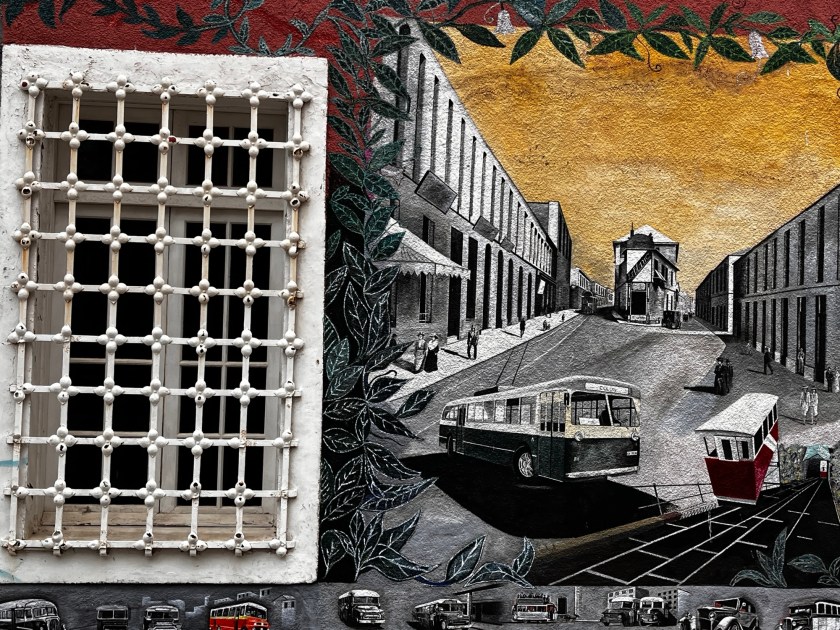
With vigour i set off out into the night. Pacific sunset falling down walls that told a story of decay and rebirth. This civic decrepitude you see across much of Latin America – from old British railway stations and Baroque colonial style in Sâo Paulo and Rio, to the flaky shutters and crumbling facades of San Telmo in Buenos Aires. But this decay does not mean death in Latin America. The blood of Latin creativity transfuses into the old, ailing body, rather like Count Dracula on his nightly prowls.
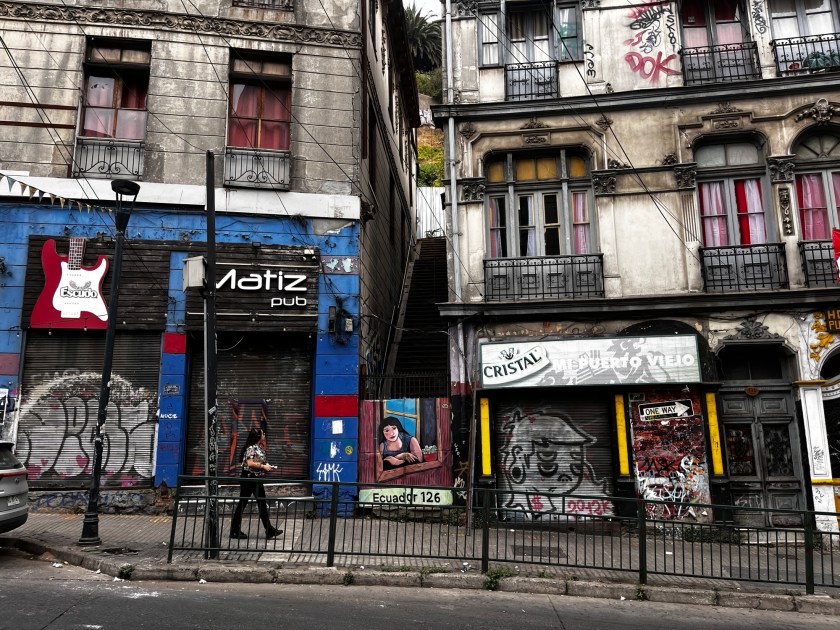
The day was handing over to the night shift when i got there. Scrawled metal shutters were coming down while the warm glow of micro pub lanterns were coming online. People sat on street tables quaffing the nation’s favourite tipple, which, by the way, is not wine. Chile has artisanal beers aplenty, many of which hail from the far south. It does red beers, ales, porters, lagers and pilsners, and all to a standard that even the Brits, Belgians and Germans might approve of. Yes, it’s official: Chileans fucking love beer, about as much as they love marijuana. In fact, they often combine them for a night to remember that gradually descends into a night forgotten. I sat outside at one such bar. The waiters were impeccable in their service in a way that puts my people to shame. They even spoke English, not that I wanted them to. But seeing that Chilean Spanish is a dialect unto itself, hearing English turned out to be a welcome tap on the eardrum.
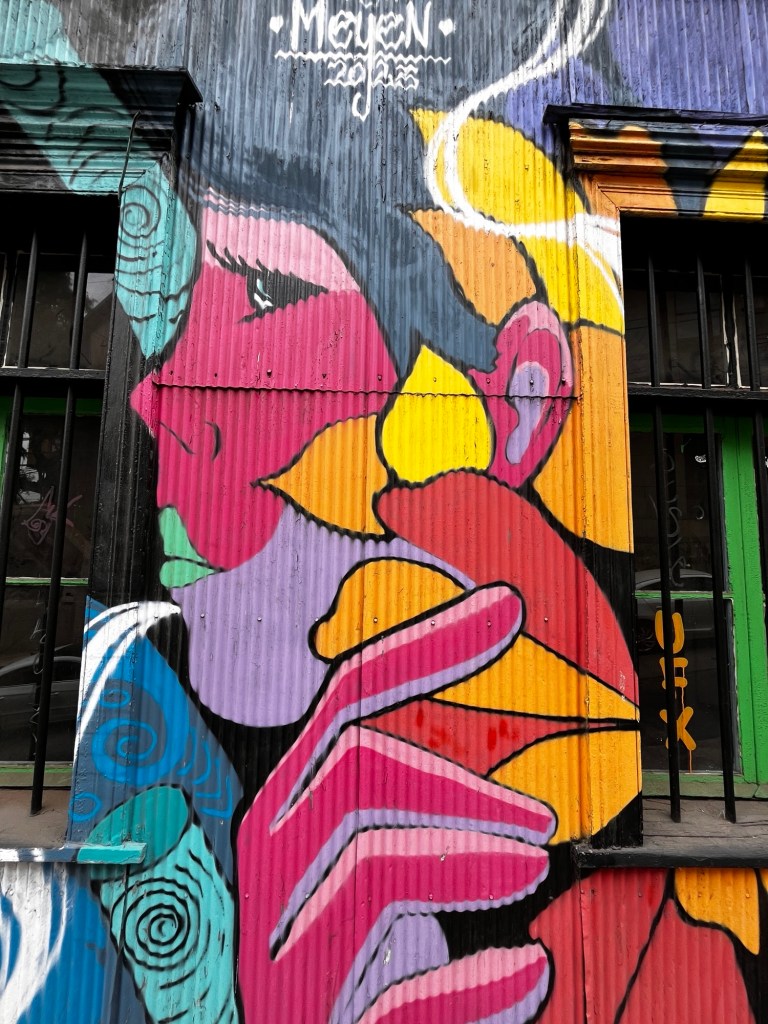
On returning from el baño, the waiter warned me about leaving anything unsupervised, even four raw eggs, two bread rolls and a lump of cheese. Why, i asked. Because they’ll steal the clothes off your back in this town. It quickly became apparent that Valparaiso was the long-lost twin of San Francisco – a place where dreams come to die, a town where for every up and coming sort there down and out to match. When you think of South American cities you think of Old Portugal and Spain surrounded by cement. But not here. Here it’s Amityville meets neo-Baroque meets German half-timbering meets art nouveau meets grimy post-industrial meets the deep, blue yonder.
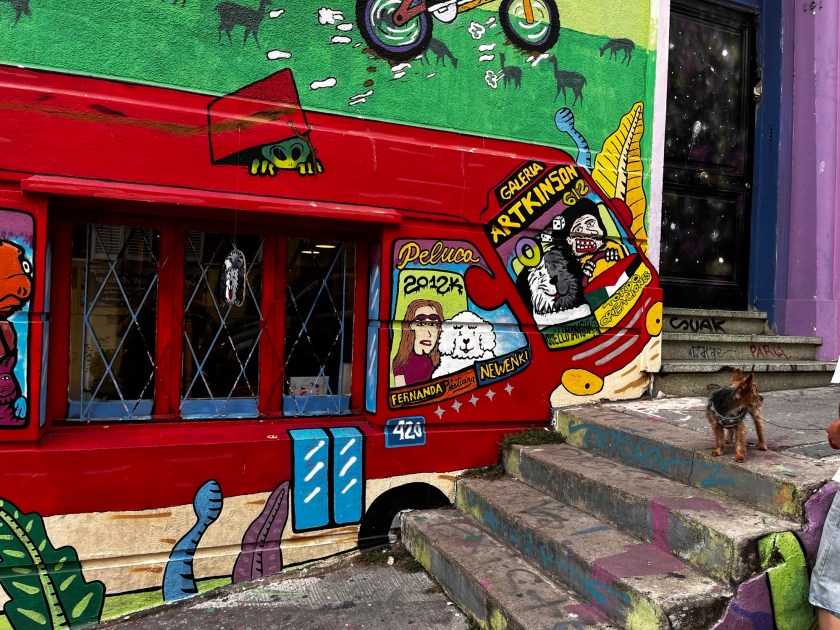
It’s sad really – seeing this once vital port of the South Pacific, for so long not just a refuelling station for naval and merchant shipping, but also an endpoint for Europeans seeking a new start – going downhill like a decrepit old dame rattling her jewels, wearing her tattered cha cha frock she kept from her heyday in the roaring Twenties. Yet, for all those flaked louvre shutters and all that graffiti scrawled across neo-baroque stonework, Valparaiso has reinvented itself in ways most other cities would have neither the chutzpah nor the imagination to do.
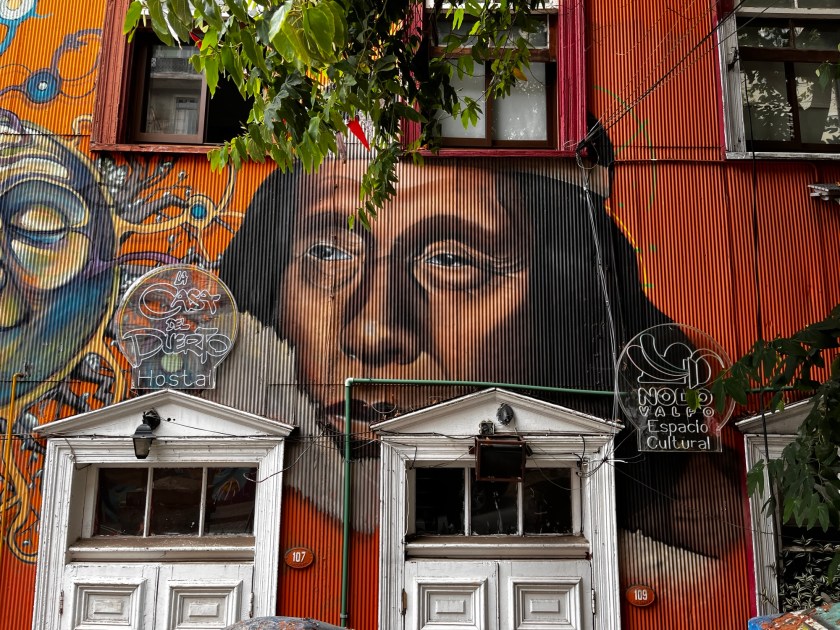
Why bother scrubbing the walls when you can bedaub them with a riot of colour which is the world itself if you can only move beyond the grey of the everyday? Valparaiso is colour writ large. It’s subversion in the way Paris’ Pompidou Centre is subversive. Murals extend out root and branch as if their host building existed purely for the moment the artist eyed their surface relief; just like the exoskeleton that wraps France’s greatest museum to modern art.

Valparaiso might well be the end of the world’s greatest open-air art gallery, but I’m running out of platitudes for a city falling so far apart it’s falling back together as a mass mania of magic murals that lend themselves to what survives of a human race that is failing in so many other ways. I’m all out of words. Speechless, even. Let each picture speak a thousand of them.
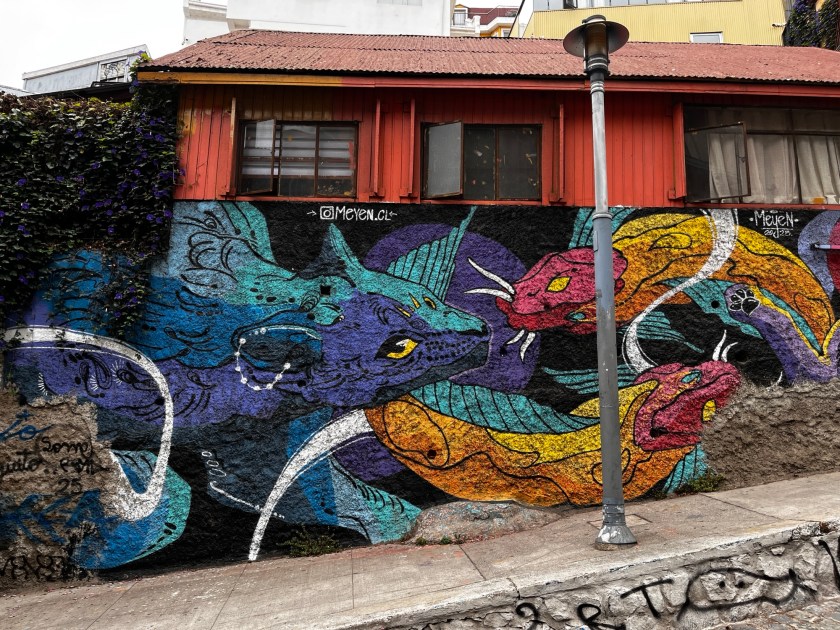
Until Valparaiso I never knew how decay could be subverted in such spectacular ways.
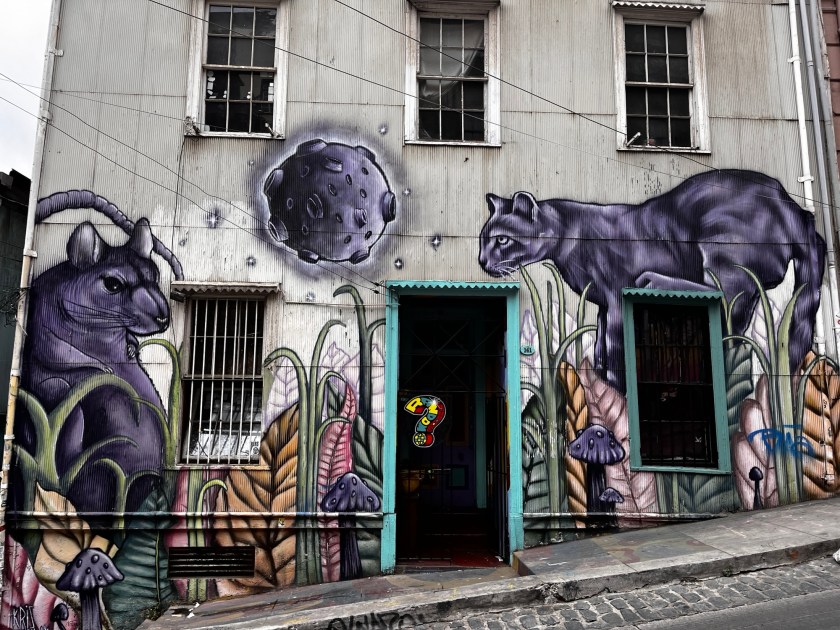
Socorro Answers a Cry for Help.

#Brazil, Brazil, Säo Paulo, Socorro, South America, Travel, travelogue

Made ancient by granitic bedrock jutting through in megalithic outcrops, while at the same time made new by the accelerated growth rate of vegetation rampaging over every sod of this Capricorn earth, the topography takes a sideways glance at normality. It’s a split personality of rural France and equatorial South America: piebald cows grazing upland pastures that border dense strips of Atlantic rainforest. Nobbled hilltops, a punk mohican of Atlantic rainforest on one flank, scalped green on the other. If ever Gondwana had an affair with Occitanie, the hills around Socorro is where the child was raised.

There’s nothing quite like a great view to soothe frayed nerves. We left the madhouse of Säo Paulo later than expected on Friday. Wanting to escape the quantum chaos of Friday rush hour traffic, instead the invisible threads that bind millions to the city’s ailing physiology – with its high cholesterol and hypertension – took us into its sickly hold. A passing thunderstorm brought rain not in drops but in globules. Five minutes of deluge had the streets funnelling a torrent of water. As the afternoon wore on, I feared being held hostage to fortune in what would be a million-man race out of the city before dark. And so it went. Swerving hither and thither, we dodged four-wheel bullet after four-wheel bullet in our haste to pull off a spectacular jailbreak. And we almost made it the 25-odd miles to the city limits without incident. That is, until some inconsiderate arsehole (cuzaö in Portuguese – my new favourite, adopted insult) decided to cut us up by swerving violently off the middle lane to reach the exit (saída) and clipping the flank of our car which was motoring along on the inside lane.

Bang! Time stopped momentarily while fate decided whether to flip the car onto its roof and under the 18 wheels of a trundling road train, or to spare us with a mere metallic slap. Fate chose the latter. Stopped in the central reservation of a 6-lane highway from hell, cars flew past us as we remonstrated with the intransigent old fool, who blamed us for being in the slow lane, and therefore causing considerable inconvenience to his plans to make a sudden and spectacularly boneheaded exit off the expressway. ‘Sua culpa’ I said, which maddened him all the more. Meanwhile, I could see the red mist come down on my girlfriend. The offending driver refused to exchange insurance details, stating he didn’t bother buying any for his €15,000 car. Having given up trying to make him see reason, he fled. Karine snapped at the injustice, and an emotional catharsis ensued. Despairing, she insisted on going home. I said no way, so took the wheel and tried to make a dignified escape into the thickly-forested mountains at the natural delimitation of this red giant of a town.

Catharses often end in a profound sense of inner peace. And so it was with Karine. I placed a reassuring hand on hers, and reminded her that we were uninjured and the car, while pranged, was driving well enough. And best of all, we had escaped Säo Paulo’s potent clutches and were now under a tranquil blanket of night in rural Brazil.

We made Socorro by 9pm. The surrounding hills were just about discernible as an inky staircase climbing into the unsullied night. The town, now just a cluster of lamplight in the saddle of a distant valley, looked inviting in a way that only a boy from the provinces could understand. Our little love shack was waiting for us along the Rio de Peixe (Fish River) tourist valley, off the asphalt and down a red oxide dirt track. Old derelict outhouses that once served the Fazenda Fartura loomed in the shadow. Other than weak porch light from the few farm dwellings dotted around the meadows and beside lone arboreal survivors from a disappearing world of giants, we arrived to nought but bliss, and the sound of Earth spinning soundlessly through the void.

Into the Heartland: Interstate 70

#adventure, America, California, Landscapes, mountains, philosophy, Reflections, roadtrip, San Francisco, Travel, Uncategorized, United States

Part II

Into the Heartland: Interstate 70

At Baltimore you are good to go. You are in fact as good as gone, for lying at the edge of Maryland’s biggest town is the east end of the I-70, one of America’s five 2,000 mile-plus interstate arteries. Hit the road, Jack. And don’t you come back no more. Whether Ray Charles ever found himself in Fort Cove, Utah, at the west terminus of this mind-boggling belt of bitumen, I cannot say. What I can assert with the certainty of shared memories is that it took us sweeping past its exit signs, diners, and moving landscapes all of a quarter century ago, though for all the imprinting my optical nerve did, it might as well have been last week. It’s true, we each remember events in different ways: some episodic like your 8th birthday gift of a puppy but not your 9th; others by associating that pilgrimage to Varanasi with pungent odours of incense and burning flesh on charcoal; and me, it’s majorly in Kodachrome and sometimes Ilford B&W that I sense a past with me in it. My memories can be 35mm or medium format. Sometimes the ISO is low and the pictures of bygone years well defined, while other times the light was low, the ISO high and the memory grainy.

I’m not deluded enough to think that this was the definitive road trip. Yeah, it certainly followed in the tyre tracks of beatniks and explorers who did it the long, slow spiritual way. Still, there are more logistically challenging transcontinental road trips out there. Mine was by no means the first – for the Romans were doing road trips 2,000 years ago on surfaces they had laid expressly for that purpose – nor the best – for London to Kathmandu or the Alaska to Tierra del Fuego overlander on the Pan-American Highway takes a lot of beating. That said, by whichever means (and there are many highways connecting the Atlantic with the Pacific) the Trans-America is travel’s answer to a pair of Levi 501s – original and stone-washed.

The road undulates at first, cutting a swathe past tasteless roadside attractions (like tufts of commercial hoarding growing high for the sunlight of your attention) and past tasteful wooded landscape lying peacefully beyond those pesky pit-stops and hoardings that much of the world now sees fit to emulate. The knolls of this eastern route are made of spruce and oak, hemlock and hickory. What I was saying about that photographic memory doesn’t apply to eastern America’s partially cloaked surfaces. When you cannot see the wood for the trees, identifying a hickory from a hemlock takes on a vertical challenge. But I know that, unlike the island of my birth, the American continent knows its fair share of trees extending away into yesterday. That much I do remember from my first great road trip all of nearly a quarter century ago.

The houses you see abutting the highway are not predominantly brick like ours. The residential architecture comes in different shapes and sizes, but I do think there’s more than a bit of Dutch and German influence in those lateral clapboards. Old world, but not English in influence as the structures of New England attest to.

The I-25 runs west out of Pennsylvania and that swirling nexus of a turnpike is the point of origin. West she blows, crumbling ever more through Maryland near to where the old Mason-Dixie line forms a Caesarian scar under all that concrete and vegetation.

That modern America had a traumatic birth is no exaggeration. The embryo grew subdivided in the womb of the New World. The two fetuses, one Union and the other Confederate, grew too large to either share the same womb or to be born by natural birth. Battles (such as Gettysburg, Pennsylvania) were staged around these parts for the soul of a young nation chosen by the Almighty to dwell in a land where Native American spirits were everywhere and old. This nation of epic roads might think it has matured beyond the attrition of civil war, that it has healed its deep rifts, but the divided states of America is kidding itself if it really believes it has.

Maryland is a slip of a state. We leave her as we found her: ambling past at 55 mph. On the road to somewhere, some places are merely waypoints while others are curiosities worthy of scrutiny. The industrial east, dotted with its established settlements of Europeans who made the Atlantic crossing, for the most part in the late nineteenth and early twentieth centuries, is all well and fine and handsomely endowed in many a place, but when San Francisco is the endgame of a short game, this is one quarter you don’t want to go into overtime.

Did we even stop in Indiana? As I remember it, I blinked in the passenger seat and there it was in a scene from Never the Mark Twain Shall Meet: the bridge on the River Mississippi. Jesse James and his band of brigands roamed the heartlands, earning sympathy as they robbed and plundered their way to ignominy, and him a bullet in the back of the head by the coward Robert Ford.

The state in July is hot and swampy and full of biting insects. The man at the trailer park, the owner most likely, warmed to us in that ‘hands across the water’ fashion. It was said by the man himself beaming with pride that he visited England in the age of B&W while serving as a G.I. in Germany (but probably not sharing a bunk with Elvis, who was there too). Though it was many years ago, he remembered old Albion fondly. The guy, by now he must have been sixty at a pinch, flew back across the pond (as anglophile Americans and Amerophile Englanders like affectionately to call that gargantuan body of thrashing, grey water that’s anything but pond-like) in a rickety old DC-8, which in all fairness was probably fresh off the production line in 1960-sum when he flew in it. We’re talking about the early days of transatlantic air travel as an alternative to second-class on ocean liners for the common folk. This commercial aircraft, so ballerina-light compared with the later Boeing 747, was kicked around like an old tin can somewhere high over Greenland he said. How did he know he was over Greenland? Well, That plane was shunted around so much by that old devil turbulence that it almost ended up on its side. It was then, face pressed against the porthole he was able to get a good view of the white world beneath.

Paralysed by fear, he reckoned none of those two hundred-odd passengers aboard thought they’d make it home at all far less in time for dinner. They’d come to land alright, he was sure, but not in the manner that airline passengers have become accustomed to, and nor in the manner that any self-respecting mortal would ever hope for. That’s the thing about the trauma of near-death experience. Like your faithful hound it’ll never leave your side no matter what. Keep feeding that long, long time ago event with tidbits of vivid recollection and Rex the long-haired ‘I almost died’ will keep lying forever at the feet of the survivor.

The Mississippi cuts the nation in half vertically as the Mason-Dixie line cuts her longways across her abdomen and then sideways politically-speaking. Although the river meanders under way more than one, perhaps the most visible bridge in St Louis is not one at all. Rather, it’s an arch, high as it is symbolic of westward expansion in the nineteenth century. Put there to bridge two nations – one almost an eagle and the other a puny fledgling – the Gateway Arch in St Louis is a fitting reminder that for bridges to be built and formidable barriers to be spanned, first the far side has to be conquered. And to do that, the first peoples, such as the Dakota tribe, had to be pushed back until they could be pushed no more for there was no corner to push them into other than a lousy reservation. By crossing that river whose tongue-tying spelling was recited, never to be forgotten, by generations of Scottish schoolchildren, the St Louis bridge over the mighty M-i-s-s-i-s-s-i-p-p-i spans two rather distinct hemispheres: one, the long-settled East; the other, the endless plains, mountains, deserts, canyons, badlands, and forests of the West.

Tom Sawyer and Huck Finn would turn in their fictional graves to know that these whirlpool waters of the Mississippi no longer add up to a whole lot of natural barrier. Gone is the obligatory river boat crossing with its tillerman, a nineteenth century Charon who’d take you across the Styx to the underworld that was the little-known Frontier, and for only nickels and dimes that dead men wore to cover their eyes to the dazzling light of western settlement. But the world is lost to the mystique that once shrouded it. Modern transport has made a mockery of distance, shrinking everything but itself.

On the great plains the sky weighs down the land and lays down the land. A gap-fill of blue ether over green corn, restless air over restful earth. The cornfields of Kansas open up before us. Black clouds gather overhead, chasing us west across the interstate highway that crosses the plains. Cumulo-thunderheads the size of English counties send bolts of lightning down to strike indiscriminately at hapless heads of wheat, barley and corn that sway hypnotically, and when it gusts, frenziedly, in that sea of ripening ears. At time like these, the sky hates the earth, wanting only to show who is boss.

We skirt the peripheries of Kansas City where man-size droplets of rain finally catch up with the traffic. Day turns to night. The downpour is torrential. I’ve seen this kind of rain in the tropics and where el Niño was to blame, not expecting it here. When the whole world awaits you for the first time, who’s to say what to expect?

The land is a sea of wheat and soya, barley and rape seed. To call these agricultural lands a patchwork of ‘fields’ can be misleading. When does a field become to large in area to remain a field? The highways, in another sense, are shipping lanes. You can tell from the way they all run through the unbroken expanse, unlike old England and France where roads and lanes enclose fields, forming boundaries at the limit of where some farmer Joe’s smallholding meets some other farmer’s.

Many folks are mistaken to think that the state of Colorado, lying due west of Kansas, is all ski resorts and Aspen trees bedecked with virgin snow. Much of the east of the state, and we are talking a fair dollop of land, is essentially a flat extension of the great plains of Kansas whence we came. Some way short of alpine, farmed to fuck and featureless, one could be forgiven for thinking that the cloud bank you see on the far side of the flatlands at the limit of a distant horizon is actually a bank of clouds and not the outline of the Rocky Mountains, which it turns out in fact to be.

You want natural barriers of the kind no longer afforded you by the mighty Mississippi and the plains of Kansas? Then look no further than the fake mirage at the end of the visible horizon. Like the Himalaya when you’re gazing north from the Indian Terai, the Rockies loom higher and harder as the traveller approaches along Interstate 70.

Never bowled over by annual membership of the mile-high club, I always fancied myself taking a day pass for the mile-high city, Denver. What they don’t see is that the height and elegance of youth all too often succumbs to the flabby girth of age. Viz. Denver was a mile high from the moment it was born, but these days, being that bit older, with a metropolitan population of about three million, it has to be more than a mile wide, too. Keep the day pass, around the waistline we go. That’s the trouble with road tripping: stopping for anytime can be a drag. What lies beyond has got to be better than what lies near. Isn’t that the whole point of monotheism?

We head up into the mountains near Arapaho, where the carpet reeks of pine needles dying to be let out by water that hasn’t seeped through since winter’s end, where the sloping roof peaks punch little holes in a sky of ice blue, where Native Americans are sadly gone leaving the victorious cowboys to ride on steeds whose clop-clopping rings throughout the cloaked valleys. The air is thinner up here. Sound travels faster and further than its maker could ever hope for. It’s pretty up here, a first gulp of the great West as I imagined the West to be from old Hollywood films I used to watch with my Scottish grandfather.

In a cabin in the woods (how much more quintessentially North American can you get?) we meet a father and son from Houston, Texas. The old guy sports the tapered beard ripped off Custer’s chin as a spoil of war after Crazy Horse got him at Little Bighorn in 1876. He wears boots fit for a regal cowboy. He slings those long blue denim legs over the balustrade of the cabin’s verandah as leisurely as a saddle on a hitching post. Cuban heels perched on the beam, toes pointing at the Dog star on a Rocky Mountain night spangling with American stars. He speaks of things you don’t normally associate with boot-heeled Texans, like his love for yachting and the storm in the Gulf of Mexico that near as damn buried him, boots n all, in Davy Jones’ Locker. The rest of the conversation is gone to seed, not surprisingly, as our encounter happened twenty-five years ago, and the old guy himself, unlike his impressive outline in my mind, is likely dead and gone, too.

The I-70 keeps on West from Denver through a series of national forests, then Grand Junction that might not be so grand but indubitably is a junction. Thenceforth the road runs onward to Utah where it runs out of itself around Fishlake National Forest. From Baltimore at its inception to its death (or maybe its rebirth) in Western Utah, the I-70 blazes a trail about that of the distance between Edinburgh and Istanbul. Woe betide the crew charged with the maintenance upkeep on that stretch of tarmac! It is in Denver, however, we bid it fare-thee-well. It’s time to hitch a ride on another highway north then west to California.