
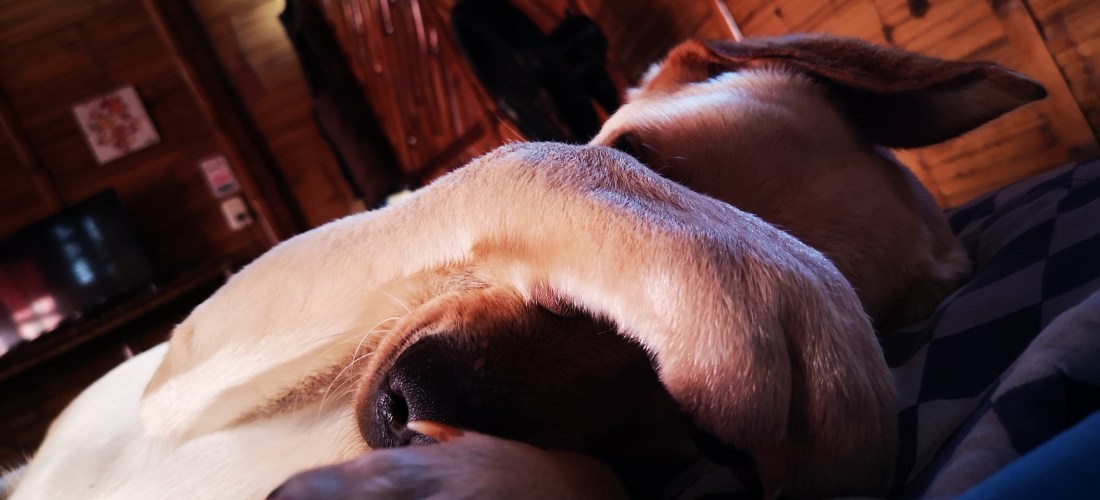
Three Days with Totoro

adventure, Birds, dogs, Happiness, Life, Meaning, natural world, nature, Perú, peru, Photography, Seaside, thoughts, Travel, Uncategorized

Am I right in thinking love spans not only generations but species, too? The most obvious case in point is man’s enduring love for canis lupus familiaris. When did it all begin, this love affair between Man and dog? Round a neolithic campfire on long winter nights with that wolf cub with the soft, ticklish underbelly? I know it can happen in the unlikeliest of places, as interspecies love did with me on a beach in a little balneario near where Peru meets Ecuador.

I fell head over heels for Totoro. King of all he surveys. Totoro, a regent in a republic of waifs and strays.
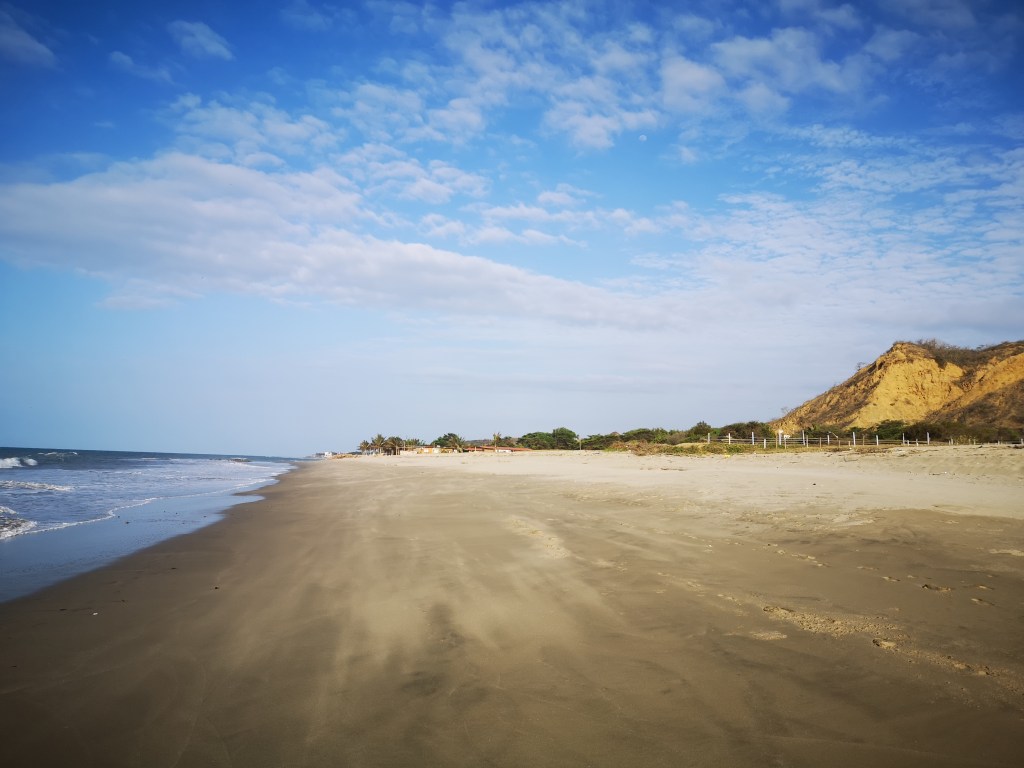
Totoro lives in Perú’s far north region of Tumbes. He is, quite simply, a regional celebrity. As every dog needs a home, even free spirits like Totoro become attached to somewhere. His somewhere is a beach hostel: a ramshackle beast of a place, oozing character, built metres from the warm Pacific surf.

Totoro is no ordinary dog. In fact, he is such a heartthrob that – and i kid you not – his name is cited in multiple booking.com reviews of La Casa de Diego. At his beachfront hostel home oftentimes he can be found disappearing into a hole in the sand, nuzzling into a smitten guest, or else chasing down pelicans full pelt along the beach. One review, as I recall, lauded this canine character so much the couple in question decided to stay another week, mainly because they were the ones with separation anxiety, and not the dog. 
Like many great acquaintances in life, I made Totoro’s quite by chance. I was staying in a dive further up the beach in the balneário town of Zorritos (little foxes in English), on the scale of Peru a stone’s throw from a Covid-closed Ecuador. How did I even end up there? Being on the road makes no sense at times, because one minute you’re planning a jaunt into the hinterland of the jungle and the next minute you find yourself on a 12-hour coach journey up Peru’s long and parched coastline. Frankly, i was expecting more from this little hideaway. I don’t know what I was searching for. I was the only Northern European face on a coastal highway littered with refugees fleeing the human catastrophe which is Venezuela. Zorritos was, and is, a side of Perú that foreign tourists don’t often care much to see. It wasn’t until i checked into La Casa de Diego a little ways out of town that the other side of that other side revealed itself.

In no small measure because of Totoro.

Monday morning, beginning of December. The height of summer 3 degrees south of the equator where – as you know – summer is a permanent fixture. There’s not a sole around. I’m sitting under a coconut palm, and who should sally into view but this regal-looking Nordic beauty of a dog – half pure-bred golden retriever, half Brad Pitt.

Like a stage actor he makes his grand entrance from the wings. Assuming he’s just another of Peru’s legion of wandering dogs, I note with surprise the lustre of his coat. Lingering on him, i watch him cosying up to a guest who’s readying to leave. He looks completely at home with humans, which is by no means a given in a land where dogs manage to coexist with the population while still maintaining a certain wariness of humans, who to be fair do not fetter them with cuddles and coo-ing affection quite as we do in rich countries. This confidence he airs strikes me as uncommon.

The lady disappears forever from view, leaving Totoro alone on the beach facing the hostel. As if she never existed, he immediately seeks new thrills. Sensing treasure deep below, like a pooch possessed he starts digging. He scoops with such fury that the damp sand sprays six feet behind him. Soon, he has excavated a large mound of sand while simultaneously being swallowed up by the beach. Only his little tush and tail remain aloft.

At length his head shoots up from the sand pit of his own making. He swivels it. Finally he notices me. Trotting over, for that’s what confident dogs do, he introduces himself. It’s love at first sight, for my part anyway. He’s in love with everyone. Moreover, he’s in love with life. ‘Come on,’ he intimates, ‘let ME take YOU for a long walk.’

Plastic rubbish litters the beach. The type of litter that doesn’t biodegrade is a real problem in Peru. But for dogs like Tororo, plastic bottles present an opportunity to play fetch. I pick up a 500ml Coke bottle half filled with seawater and feign a throw. This excites him. I feign again. This piques his annoyance. He barks, but not as a mindless utterance, rather a form of modified speech. His bellow cries, ‘stop fannying around, and throw that thing as far as you can.’ I do and he hurtles off after it like a pro.
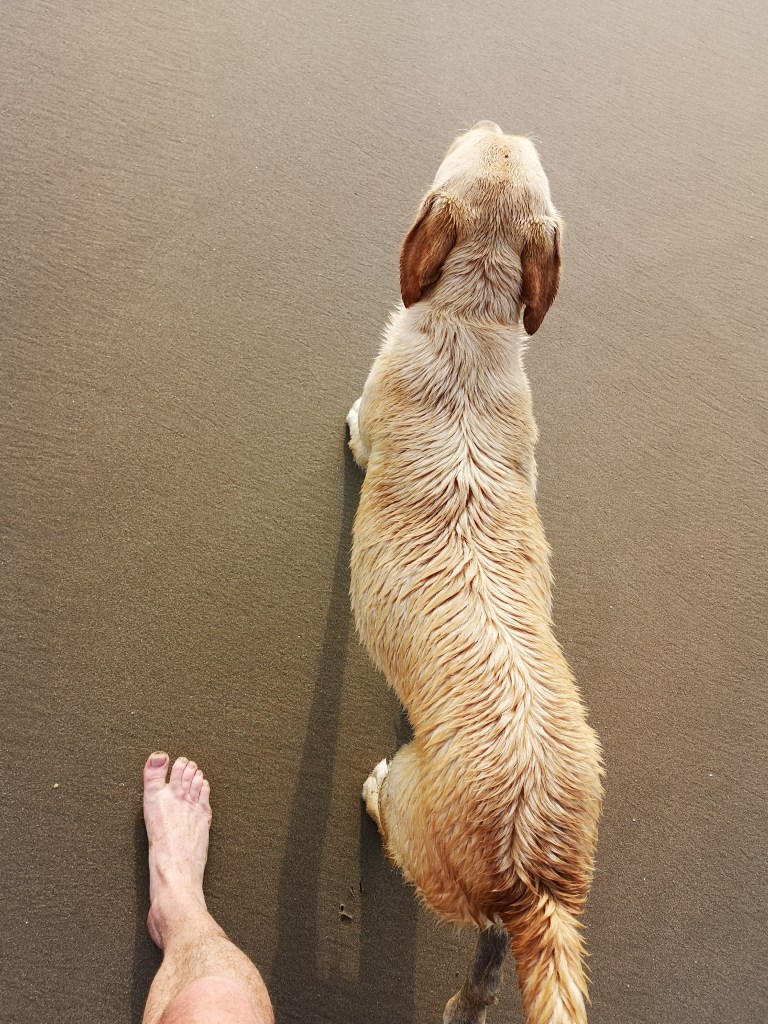
We walk for miles together, Totoro and I. Together in the loosest sense of the term, for Totoro is way too individualistic to be walking with anyone. He is a pioneer, this dog. A pathfinder. He goes at a canter, leaving me miles behind, only to find me again, the pinball that he is. When the bottle winds up churning in the surf, he barks at me to find a suitable replacement. Finding one, once that goes the way of the coke bottle he tires of the game and goes off in high pursuit of seabirds skimming the waves in the intertidal zone. Crashing through the surf, he launches himself, almost snagging one in his mouth.

People approach. As they pass, they look on in bemusement at Totoro who is rounding me, corralling me as if I’m a sheep, which I am compared to this lion. He’s calling out to me in a voice so powerful to give him a reason to run. The strangers can’t tell if the dog is showing aggression or is being playful. Totoro trots past a dead and bloated sea lion, showing little interest. An American in a stockman’s hat walks toward us. He asks if the dog is mine. That dog is no one’s, i tell him. He’s a fine dog, the man adds. A dog you might see in America, i say. Yeah, he goes on. He’s not your usual kind of dog here. I reply, i think he belongs to the hostel, but he comes and goes as he pleases.

We walk directly into the sunset until i can no longer visualise where i am. I call him and he responds right away. He knows the score. I am not the first guest at La Casa de Diego to have walked Totoro. Rather, he walks the guests as he sees fit. I happen to be the only one resident at this time, which pleases him while offering me exclusivity. We turn our backs to the tropical sun and head home. Totoro spots another sortie of seabirds skirting the rolling surf and goes hell for leather after them, stomping on the water’s edge like his life depended on it.

On the verandah outside my room, the day is ending. I rock rhythmically on the hammock while under me he settles down to rest. Finally, I think, this elegant brute is settling into the Sphinx position. Every part of him is washed by the Pacific surf. I watch his chest gently rise, gently fall. Every part of him is perfection. His paws are large as a mountain lion. He is in the prime of his life, and that saddens me because at that moment I feel my prime has gone. Well, at least i am as free as Totoro. The difference is, though, Totoro exists only and always in the moment, and I do not. So who now is the freer of us both?

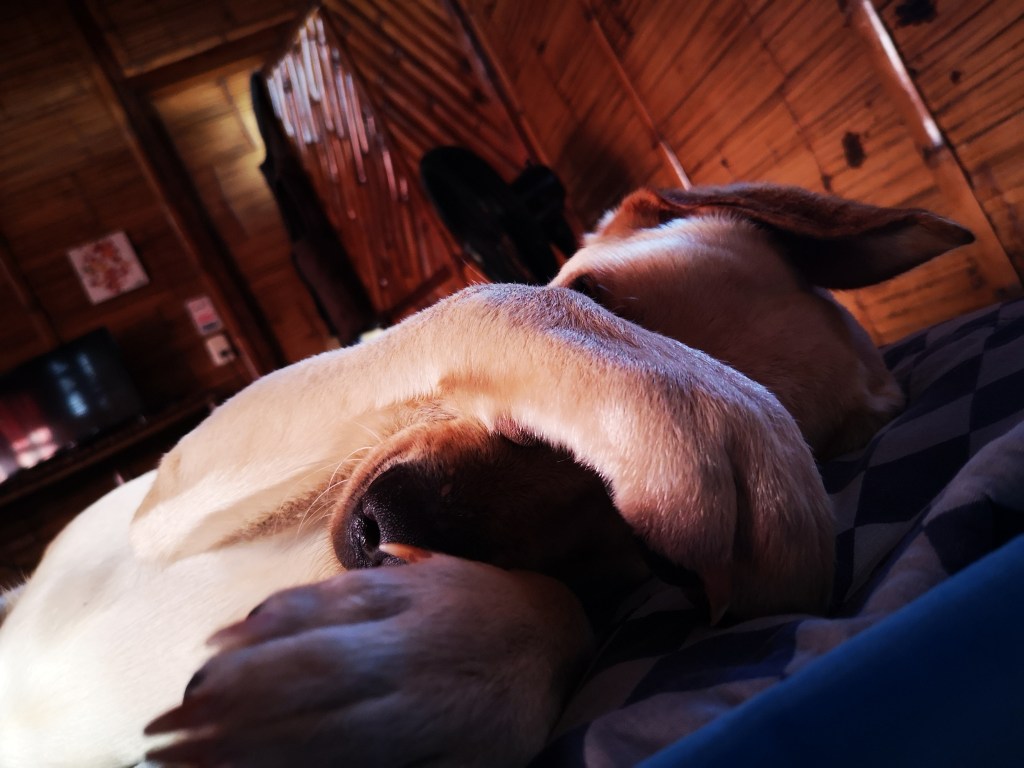
In the morning when I awake, he is there sprawled out over three-quarters of the double bed while I’m shunted to the edge. As if he has learned from other guests the art of manipulation, he hides his eyes coyly with his enormous paws. ‘Sorry for commandeering your bed,’ he says without words. ‘But, on second thoughts, I’m not actually sorry at all. This is what I do when people like you come to stay.’

The day is bright, the heat incipient. Opening the rattan door Totoro bounds down the rickety staircase to the sand below. Like yesterday and all the days preceding, this is the first day of his life. The excitement of new adventures in familiar places is suitably matched by his enthusiasm for the chase.

He waits patiently for me to eat breakfast. Once done, with that stentorian voice of his, he orders me to get up so he can take me for a walk; a long walk on the wet sand of the Gulf of Guayaquil, its lukewarm Pacific waters bobbing gently under twine-bound fishing rafts already poised for the day’s catch.

We walk for hours, leaving fleeting imprints in the sand near the water’s edge. He hurtles off, chasing down whatever has the temerity to try and outrun him. The seabirds that fly in single file inches above the waves are always one step ahead. This frustrates him, and even from a quarter mile away, I hear his voice boom with rage and his long legs pummel the shore. He is in his element in ways I could only dream of.

On the evening of the fourth day of my stay at La Casa de Diego, the curtain comes down on our love affair. I stack my bags up against the fence in readiness for the moto-taxi driver to collect me. Totoro stays by my side but knows what to expect. I am not the first to fall for him, nor will I be the last. I so want to leash him and take him with me on the overnight bus south. But I know that an organism needs its habitat; that to deprive him of this world over which he rules would be to strip a king of his crown.

I can still see him now, digging up the beach, beguiling locals with his brazen beauty and confidence, bounding, like a straw-coloured stallion, after those shore birds that artfully skim the waves single file in a game he’ll never stop playing until he is old and dignified enough to know that against the pelicans he can never win. But winning is a strategy and strategy is not the point. It is capturing every moment that counts, and few embody this true meaning of happiness more than him.
Debunking the Myths of Travel, Fifteen Times Over

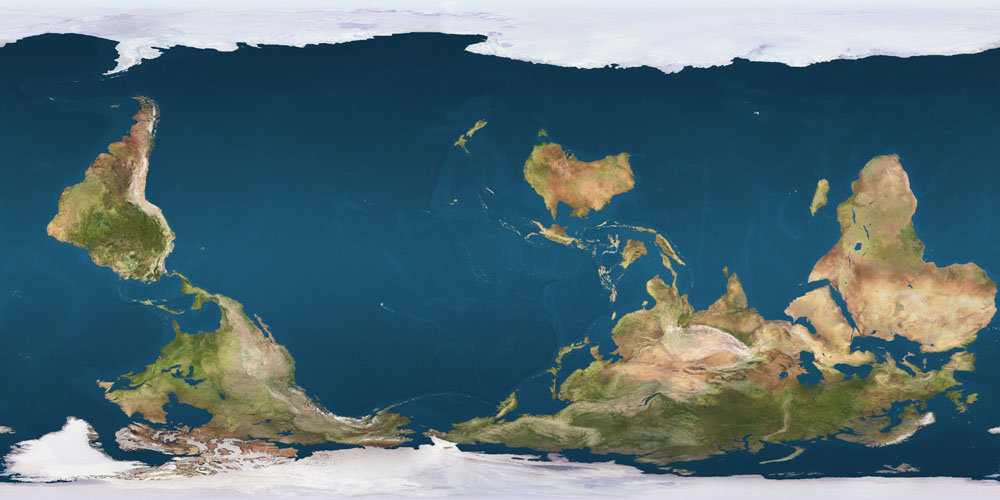
#adventure, adventure, ageing, debunking, global, myths, Travel, upside_down, world
  1. Seeing the world opens the mind (Not always – travel can have unintended consequences of reinforcing pre-existing cultural stereotypes. Travel obliges you with the power of empirical observation, but for what end? To see for yourself where narrow-minded cultural tropes originate? – Yes, Italians do gesticulate wildly; Aussies can be laconic; Chinese chatty; Germans analytic; Arabs welcoming; Russians deadpan; you get the idea. It’s when these tropes are broken, that’s when travel becomes interesting).
  2. Seeing the world gives you a new found appreciation for home – (Does it? For me, it comprehensively dismantled the whole notion of what home was, never mind where. Rootless, I’m living with the consequences to this day).
  3. Seeing the world enlarges career prospects – (Well, that’s a moot point. Providing you travel often enough, travelling to new lands will become your career at the expense of a ‘real’ one).
  4. Seeing the world fulfils a long-term longing to see the world. (If only. Whoever coined the the idiom ‘travel bug’ wasn’t being glib. Globetrotting is as psychologically addictive as pot. That big first RTW journey won’t quench any thirst you might have had. Rather, it’ll give you an unquenchable taste for more).
  5. Seeing the world is something you do in your 20’s. (Okay. This one’s a marginal call. Admittedly, one does see one’s fair share of the youth out there on the planet’s intersecting backpacker trails. It seems much of the population of Germany between the ages of 23-30 is, at any one time, somewhere out there occupying every square terrestrial metre of planet Earth, lugging a Deuter backpack around and looking confident. But let’s give a warm hand to the intrepid oldies – those who have either been honing their globetrotting skills for decades, or those who are new to the game and humbled into personal excellence by starting their adventures of a life time AFTER spending their lifetime adventures toiling year after year for da man. Deferred gratification exists, but not for everyone).
  6. Seeing the world ensures you’ll never be the same again (Don’t bet on it. That’s why, more often than not it’s so damn disappointing coming home. Personally, this scenario has happened to often to even mention).
  7. Seeing the world is so character-building that for every country visited the next will obviously be easier. (Funny you should mention that. I once knew man who had been to 173 countries. And he swore the hundredth was no easier than the first)
  8. Seeing the world is too much for old timers. (This is a deviation on point no.5 – Ye olde narrative goes rather like this: do your maddest adventures when you’re young and reckless, then when you hit risk-aversion in middle age slow down into sedate sightseeing. No, old is the new young and counter intuition is the new intuition. When one starts one’s travel career as a snowflake puss-in-boots, one can be freaked out at the slightest thing. Arriving in Hong Kong aged 22 in desperate need of work – i can testify to the fear. By the age of 50 life has grown so passé you could watch a beheading on a Friday afternoon in Chop Square, Riyadh, only to consider this spectacle a form of – albeit not to everyone’s taste – entertainment.)
  9. Seeing the world is an elaborate exercise in self-discovery. (Give me a break! Seeing the world is pure discovery. Sometimes you’re so overwhelmed with what you see, outwardly, that you kind of overlook what’s going on inside. Taking in Machu Picchu’s magnificent panorama is a case in point. It’s just a pity those pioneers got there before you. But oh well, no shame in standing on the shoulders of giants).
  10. Seeing the world exposes you to unnecessary danger (Invert that logic if you can. Staying home has a nasty habit of exposing you to a different, more pernicious, form: debt, deadening and disappointment. We can throw another dreaded D into the broth: drudgery. Anyway, the closer one is to death, the closer one is to the true meaning of life: that is, feeling alive).
  11. Seeing the world ain’t what it used to be. (that’s because the world turns on its axis through the uncharted void of spacetime, so it’s bound never to be what it used to be. Besides, it doesn’t help that the human race has an insatiable appetite for eating everything contained therein. See that boring field of soya? That used to be a flourishing rainforest containing a mind-boggling array of flora and fauna – sad emoji)
  12. Seeing the world unaccompanied must be lonesome. (No. It can be lonelier among familiars, let’s face it. Lonesome is not as lonesome does.)
  13. Seeing the world in an act of overexposure to much of what treasure it contains will tear up the conventional path through life to absolution. (Uh? Do you mean if we say hello to too many big trips, we say goodbye to that Holy Trinity of social status we call home, family and career? Well, isn’t that a good thing? Isn’t the world already dotted enough with houses and kids playing computer games? Fine, I’m being trite. You can still spearhead that domestic dream by taking mama bear and the cubs with you on your peregrinations. If you want evidence of digital nomadism of the successful kind, go to the Sacred Valley of the Inca in Perú to see a neo-colonialism 21st century-style).
  14. Seeing the world makes you wiser (That’s an insult to all those luminaries who stayed at home to acquire wisdom. Emanuel Kant never left Königsberg; Nietzsche was content with the Alps; Blake’s world was London; and Socrates was no Odysseus. Having said that, it’s hard not to derive some lasting benefits from wandering in foreign lands).
  15. Seeing the world turns you into a global citizen (What a term of nobility! Pity that the best i can do is claim citizenship of nowhere. King without a kingdom. D’oh!).
  16. Can you think of another myth to debunk? Or do you need another RTW trip to experience a Eureka moment!?

To Machu Picchu, With Love

#adventure, #romance, adventure, Andes, backpacking, Eighth Wonder of the World, environment, Lifestyle, mountains, natural world, nature, peru, Planet Earth, Salkantay, South America, Travel, Travel Photography, travelogue, Trekking, Wilderness

It was always central to the plan. Fly transcontinental to Peru. Once in the capital, randomly follow compass points leading out of Lima in all directions but west, which would be suicidal as it would leave me adrift somewhere in the deep Pacific Ocean. But whatever I do, the golden rule stands: don’t fly home without first having taken the long trail to Machu Picchu.

Many roads lead to Rome. So too are there a fair few routes to Machu Picchu. The Inca, like the Romans, were master road builders after all. You can opt for what most do and that is to fly to Cusco, board a mini bus from that old Inca seat of power to the sublime surroundings of Ollantaytambo in the even more sublime Sacred Valley of the Inca, board the train from the terminus there 90 minutes to Aguas Calientes at the foot of Macchu Picchu, and from there board another bus that winds up and up until it reaches, at 2,430mt a.s.l., the ticket booths standing like sentinels at the entrance to the eighth wonder of the world.

Or you can pay Atahualpa’s ransom and trek the three nights, four days to Aguas Calientes on the famous Inca Trail. Equally, you can step out of the ordinary and hike the Lares Route running along the valley to the north of the Sacred Valley. But that plonks you down at Ollantaytambo and from there you’ll still need to ride the packed train to Machu Picchu. For the even more intrepid there’s the Vilcabamba Traverse route, which basically follows in the now well-trodden footsteps of Hiram Bingham, the American who discovered Machu Picchu with a little help from an unheralded fellow who happened to farm land in Aguas Calientes and knew all about the strange ruins in the thick undergrowth at the top of the mountain. At ninety kms long, descending into canyons, crossing raging rivers and back up mountains so steep you tip your head backwards just to see them in their entirety, the Vilcabamba can take well over a week to traverse. And then there’s the Salkantay. Free but definitely not easy. That’s the route I took. It turns out, with unintended consequences.

They always say, don’t they, that certain actions have unintended consequences. The more extreme the action, the more consequential. By the standards of some, walking a full five days and sixty kms to the foot of Machu Picchu over a 4,600m (15,090ft) pass is pretty extreme. Especially so when you happen to be fifty years old on your next birthday. Anyway, i digress. For five days I walked the walk and talked the talk and in between saw deep time cut deep into rock and cappuccino brown waters froth and fury on the valley floor because the mighty, near-mythical Urubamba river could not run down to the Amazon fast enough, pushed on as it was into incandescent rage by mountains pressed hard up against it, bullying it and blocking its light.

It was raining as the ten of us flooded out of the mini bus on the trailhead. In reality, the official start to the 75km Salkantay Nevada was 20km back down a very inundated road-cum-track. Ordinarily, day one of the Salkantay would involve a trek up and up that rutted track, waterlogged by weeks of summer rain and spun into mud by the endless turning of Mercedes minibuses wheels ferrying sightseers up to Humantay Lake. We were cutting to the chase on our five day dash to Machu Picchu by skipping the boring bits.

Our guide, Jorge, told us to get suited and booted. Raincoats and plastic ponchos would be the order of the day. My Texan friend and I clambered onto the muddy ground. Walking poles were doled out in exchange for rent money. Essential item. $10 for the duration. Our walking group – at that point still a bunch of strangers, mainly from Germany and Holland – formed under the rain, almost by accretion. Bedecked in plastic ponchos of the most garish colours, they readied themselves for a 2-hour detour to Humantay Lake, before bracing for a 3-hour climb up to camp 1 at Soraypampa. As usual, I was first off the bus and last onto the trail. The Texan and I rolled a smoke, buckled up and in our own time started this great overland journey with a single step. The young bucks and hinds in the group were already visibly ahead within minutes. But the Texan and I were not lone stragglers. Beside us we noticed a girl.

I had seen her when i first boarded the bus back in Cusco at 4am that morning. There she was all alone with only a covid mask covering her eyes, depriving me of the totality of her pretty face. She sat alone, not feeling the urge to befriend others, as so many solitary types do when they’re on the road. She slept, and when she woke she kept herself very much to herself. Much as I tried not to, i found myself constantly stealing a glimpse of her while trying to act all natural. Physically, she was nothing like us. I guessed Brazilian due to these fulsome lips and coffee complexion. She certainly wasn’t Peruvian, with their proud Quechuan noses. Nor Chilean. Nor Argentinian. Definitely not Bolivian. Ecuadorian? Hmmm. Nah. They too were ruled by the Inca, as their faces testify to. She could have been Colombian, or Venezuelan. I deduced that much. Anywhere in the Caribbean, the genetic blend of European, African and Indigene created this unmistakeable exoticism, verging on the absolutely beautiful. But, no. I settled upon Brazilian, as there are 150 million of them, and only 50 million Colombians and 25 million Venezuelans (there used to be 30 million, but 5 million are now refugees).

As we ambled, tortoises off the blocks, she drew abreast of us. Slightly discomfited by the presence of two jackasses who – as i was to later find out, she found irksome when they boarded the minibus at 4am singing, joking and generally ignoring the protocols of getting on a night bus – it took me to break the ice.

‘See my friend here, he doesn’t think you’re Brazilian. But i do. Am i right?”

She was. And I was. And that was the first time we were right together.

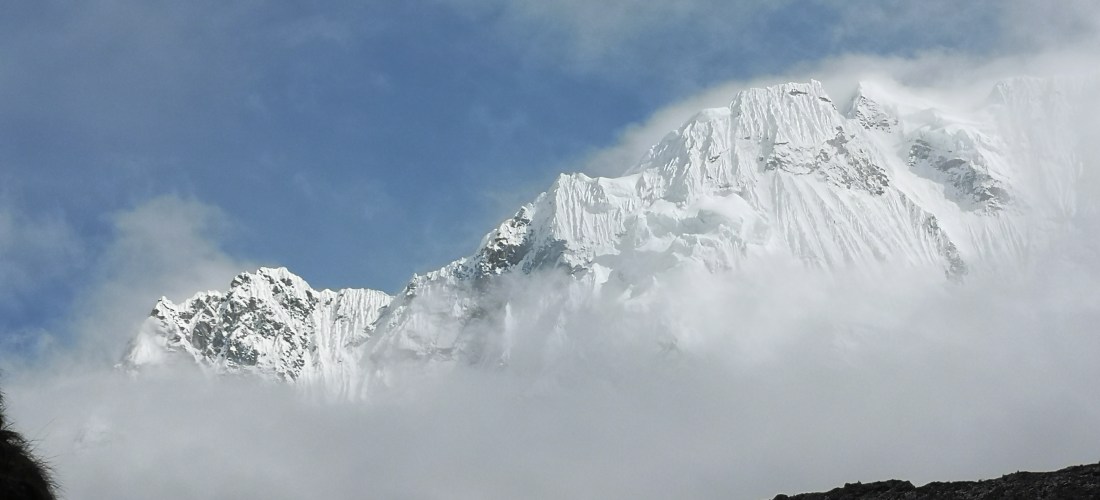
At Humantay lake, the surface water was a bioluminescent paint pot. The color was electric blue-green. Around it the land rose sharply, a browned earth soft as shale where the land had collapsed in. And on top of that sat a crumpled mountainous mass of black rock and ice. The Andean giant flitted in and out of sight, behind a veil of cloud and Scotch mist. It was summer, but the Andes being the Andes and defying definition, this was the rainy season. And for anyone who knows the high mountains, everything is exaggerated, even the intensity of the rain.

I could see the glass domes – our beds for the night – on the ridge up ahead far in advance of arriving. The others were all there, but she and I had fallen far behind. Our footsteps slow, deliberative, rhythmic. We were tired beyond belief, for here at nearly 4,000 metres (or 13,000ft) the air was reed thin and the angle of ascent deceptively steep and seemingly without end. For every gulp of air, disappointment ensued. And as the occluded sunlight dipped on a fading afternoon she and I became more and more talkative. Gassing while climbing at these altitudes is not always the right strategy. So for every sentence a pause for breath that doesn’t readily come the way it does as sea level. Our legs could not catch up with our tongues but I knew that something had clicked between us, language barrier or no language barrier.

Up on the ridge with the Salkantay mountain looming in the twilight behind a wall of white cloud, she and I slumped down. We were exhausted, the right kind of exhaustion that combines the very tired with the very happy. Eagles flew sorties in the valley beneath and every now and then a huge wall of granite would flash into view through the gathering night. Magic all around. This, I thought, is why I damned near killed myself to get here. And in the process i made a friend, a beautiful friend.

Day one not even drawn to a close, and this adventure was already shaping up to be a classic. It’s in the nature of duality that with pain comes a degree of pleasure that makes the pain bearable. Altitude and steep gradients might be the root cause of the pain, but the pleasure was all mine with her by my side. I have a fridge magnet back home that reads, ‘no road is too long in good company‘. Never was this Turkish proverb more true than the moment we collapsed into camp 1.