São Thomé das letras: Brazil’s Glastonbury

#adventure, #alternative lifestyle, #Brazil, Brazil, duendes, Latin America, Lifestyle, Minas Gerais, Sâo Thomé das letras, South America, Spiritualism, Spirituality, Três Corações

For every action there is an equal and opposite reaction. For every human a doppelgänger. Every town a twin, but not always officially twinned in the sense of Bristol and Bordeaux or Birmingham and Chicago – towns that to all intents and purposes have little in common. Some towns are kindred spirits. Soul brothers. Sister cities. Take Edinburgh and Florence, two cities well matched both in grace and favour.


Not that many New Age & Main Stage-lovin’ aquarians, who show up perennially at the gates of Michael Eavis’ Somerset farm each and every summer, will ever go there (the UK festival circuit is pricier than budget adventure travel through South America), but no word of a lie, on a recent trip to São Thomé das letras I swear i met Glastonbury’s long lost twin. Though it would be fair to say they remain lost to one another, and there’s no telling when these long-lost brethren will be given the This is Your Life treatment. This is their historical destiny, given that Britain’s empire was kept in check in Latin America, and British interest there today is at best marginal.  

Everyone who is no one knows England’s Glastonbury. There’s the annual arts and music festival, of course. The inevitable cat and mouse game between stewards and fence-jumpers, which results in ever higher fencing and standing charges for tickets that sell out within a hour. The periodical return of Van Morrison and Coldplay to the Pyramid Stage, just when everyone thought they might take a permanent rest. There’s the Tor, the grassy hump that everybody climbs to flee the rising floodwaters that beset the Somerset Levels with increasing regularity and ferocity. There’s the legend of Camelot, if you buy into that sugar-spun fairytale. (Until diets improved in the area, the locals were happy with Spamalot). Then there’s Jesus’ uncle, Joseph of Arimathea, who devotees believe house-swapped a life of danger in the Levant for bucolic Britannia, bringing only a cup with him in his 1st AD century removals caravan. There’s bombed-out deadheads that haunt the town, barefooted and extremely confused, months after the festival has ended, wandering into corner shops asking if this is where Hawkwind are playing this weekend.

Glastonbury is all that and some. Who can forget the quaint little cottages for sale at not such a quaint little price? And the annual orgy of money made in holiday rentals from well-heeled festival goers for whom a row of dripping, wet tents is just not appealing? And last but by no means least, what of those ley lines running under this most pagan of towns? This mystical grid force of supernatural, electromagnetic power is responsible for getting the crystals all excited. Spiritualists and necromancers follow this flow of uninterrupted energy like the children of Hamlin to the penny whistle tones of the pied piper.

That’s Glastonbury seen from a slightly flippant angle. But what about its southern counterpart?
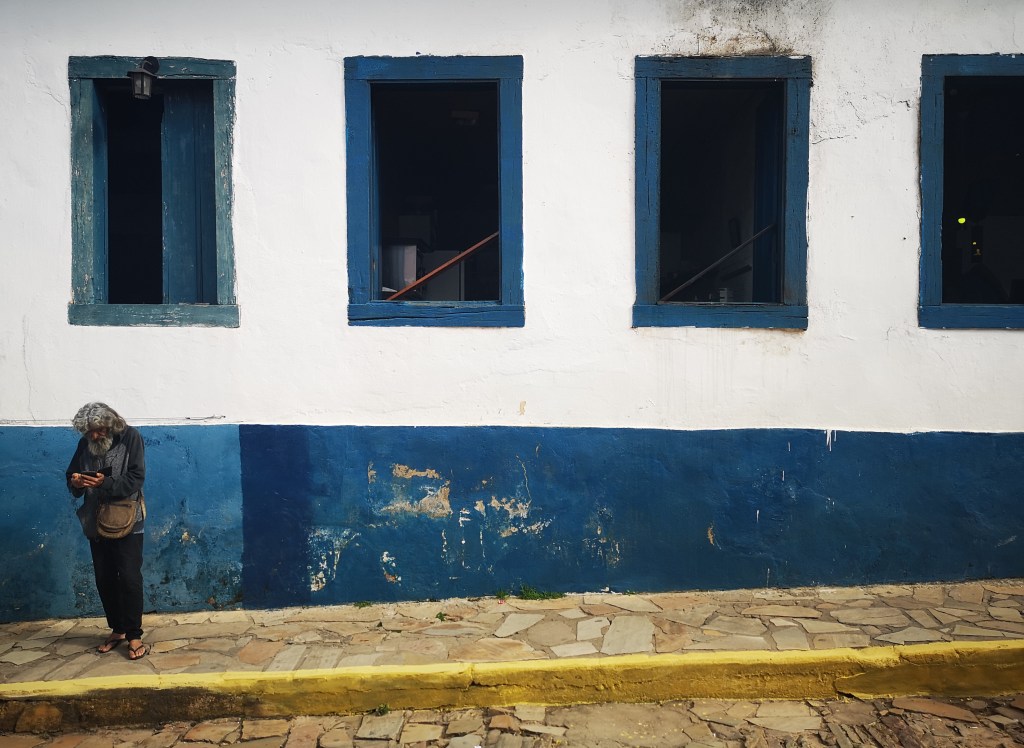
 

On the subject of Joseph and the Grail, São Thomé das letras was named in honour of another hero of the Jewish uprising against both Judaism and Roman Rule in 1st century Judaea: the doubting Thomas, apostle and man of my own heart. Quite what the letters (letras) part is about is the subject of much conjecture. But i would say it might have something to do with the Gospel of Thomas, and the fact that gospels were written into letters. One would assume that early Portuguese settlers, with God on their side and Christ in their hearts, in what was the colonially important and unromantically-named province of Minas Gerais (or General Mines), founded this little settlement long before the hippies started flocking. It is highly unlikely that whomever called the province General Mines and the town St Thomas of the Letters was much of a crystal-gazing spiritualist with animistic tendencies. In all likelihood they were a pragmatic, Catholic bunch who mined valuable stones all week for money while worshipping all weekend for salvation. Stranger things have happened at sea, where, luck would have it, the Portuguese spent much of their time conquering the then unknown world.


Brazil’s Glastonbury is a tenuous link at best, you shrug. A non-identical twin in a world obsessed with identical ones. I mean, São Thomé doesn’t attract the likes of Beyoncé, Dolly Parton, and The Foo Fighters over from the U.S. to join the rock and pop pantheon in a 5-day annual music blitz. Joesph of Aramathea never crossed the Atlantic. And Camelot’s influence couldn’t possibly have predated Pedro Álvares Cabral’s new world discovery of Rio de Janeiro in 1500. But look beyond the obvious – transcend the tawdry – and you’ll see that both towns coruscate with pixie dust.

Legends abound here and there. There’s a tunnel that runs from two undisclosed entrances: one at Machu Picchu and the other in Sáo Thomé 3,000km away. The ground beneath Sáo Thomé is so highly-charged with potions of motion that there’s a spot there where your car will drive itself. So many varieties of magic mushroom can be bought sealed and ready to nibble on that you’ll be hallucinating all the way under that tunnel to Machu Picchu, if only that entrance can be found. So potent are these so-called cogumelos that doubtless you’ll still be high when you emerge at the Peru end of the tunnel.


At the summit of all things heady in Sao Thomé is its very own Tor, but nothing like the old phallic one atop a hill in Glastonbury. Nevertheless, the same purpose is served: pilgrimage. The Brazilian construct is somewhat unorthodox, and a whole lot newer. Built sometime in the 20th century, of a quartzite now afforded Kryptonite powers, the Pyramid couldn’t be better named, given the invented similitude with Glastonbury. And, like Glastonbury’s sound-splitting, prismatic Pyramid this too is a stage, of sorts. Namely, a stage for all Brazil’s seekers of the transcendent realm that come here in search of whatever it is the rocks are emitting. It can’t be enlightenment they are after, as if it’s the light of truth they want bathed in, the sun here packs enough punch to drown them all. It must be the panorama that wows the crowd, because from there the rolling country of emerald Minas Gerais never looked so good.


Ascending and descending the Pyramid for yet another spectacular sunset is not unlike the Sermon of the Mount scene from Monty Python’s Life of Brian. There’s a sense of destiny about being in attendance for nature’s greatest revelation. And descending at dusk with all the others, there’s still the vendors at their makeshift stalls to pass, flogging everything from moonstones to magic potions, in this nation of ingenious artisans.

São Thomé das letras is more than worth the six-hour drive from Sáo Paulo (equidistant from Rio). Yes, seeing the promise of fadas and duendes – fairies and elves – is reason enough in itself to go, as every great traveller will tell you, it’s not about the destination. For lovers of o jogo bonito, en route you can stop off in Três Coraçōes to pay homage to the great Pelé in his place of birth. If Brazil beguiles you with its beautiful game, let it beguile you further with its beautiful countryside and magical realism, even if the analogies to Glastonbury are a tad far-fetched.

end

Life Signs Vital

#adventure, Australia, Britain, British Isles, Buddhism, fate, free will, Hinduism, human mind, Life, Lifestyle, meditations, Musings, nature, Oddities, philosophy, predestination, Queensland, Reflections, roadtrip, serendipity, Solipsism, Spirituality, thoughts, Travel

From the wandering star followed to Bethlehem by the Magi, to Constantine and his Latin cross in the night skies over Rome’s Milvian Bridge, for as long as any historic text can remember, humans have acted not (as they might like to imagine) independently in matters of life choice, but as a response to phenomena out there in the world. Whether these phenomena involve snapped branches pointing in a particular direction out of the tangled forest, serendipitous meetings with mysterious strangers, or even constellations that speak directly to the individual in us by spelling out our mission in dot writing, natural events have proved unshakeably reliable as SIGNS ripe for following. Other animals follow their hunger and their paternal instinct toward the rains, or the seasons, or the ocean currents. But not us. Oh no, not humanity. We follow abstract signage in the most unlikely of quarters because something in the form and motion of a sign tells us that nature exists to furnish us with little messages put there FYI only.

But in an age of scientific materialism, should we listen to superstitious signs, or let mediums self-appointed with the power to interpret that symbolic value for us. The Gypsy lady? She who lets the tea leaves/coffee granules to settle into a discernible form spelling out (in her own inexplicable way) what’s in store for each of us? She with the singular ability to divine the past, present and future, and thus able to cut a path through our impenetrable present? Hooped earrings and colourful headscarves aside, should we even listen to ourselves when something out of the blue tells us which corner to turn in life? What is it in the nature of choice, the one true act of free will we convince ourselves is ours and ours to fuck up? Are we slaves to signs, subconsciously letting them lead us on into what we think will end either in good life choices or, horror of horrors, outcomes less than desirable? Do other members of our rapidly-proliferating species see signs with quite the obsessive sensing that I seem to? Questions, questions, questions, and only vague signs there to answer them.

I wrote a woefully-neglected book back in 2007 called Signs of Capricorn. Essentially, it was a free-thinking, free-spirited, faintly philosophical travelogue based on a long-awaited return to Australia. I had left the land Down Under in 2003, instantly regretting a choice which i deemed purely my own, without any other agency. At the time, I must have figured if i return to Britain things will be different. I’ll finally, after thirty years of trying and failing, fall in love with the island of my birth, and especially those two peculiarly British contributions to the world: a stubborn class system and a maritime climate that makes the headlines most days for all the wrong reasons. Yes, my family were instrumental in my going back. Unlike the weather, they weren’t changeable and horrid. But, like the English class system, they could be stubborn.

So, in the wake on my grand homecoming in 2003, I realised I had made a major life error, and instantly vowed to overturn this disastrous decision by going back to Sydney the following year. However, as the venerable Lennon said, life’s what happens when you’re busy making other plans. Suffice it to say, it wasn’t until 2006 that my pledge was finally realised. I departed a rainy Manchester, arriving after a brief stopover in Dubai, in to a hot Sydney. The city had changed in the intervening three years. That much i could detect within moments. It didn’t feel the same. Well, of course. Why would it? And here is where the book comes into play. I threw my hat up into the air and let the winds of fate carry it aloft. And so it was that I chose to spend a month driving as far and wide as I could in search of signs.

A critical factor in all this unfolding story is that I was misinformed that my Australian Permanent Residency visa would be duly reauthorised merely by going back there on holiday. Cruelly, this was not how how the immigration system worked. Nor was this how things were meant to be. On hearing that I had not amassed sufficient residential time in Australia within a 5-year period (i was a month short), I was faced with a binary choice: by all means, stay indefinitely (thus leaving my rental home, family and beloved dog back in Yorkshire where my family call home) in the Commonwealth of Australia; or fly out of Kingsford-Smith Airport and back to Heathrow, but do so knowing the consequences. That being an annulment of my right to remain in Australia. Visa cancelled. The term Burn Bridges springs to mind (another historical instance of how signs influences the course of a lifespan, in this case of Caesar’s Roman Empire). Mainly because of my dog, I knew I was going back, like it or not. With a month’s adventure ahead, I drove north through Queensland’s Sandstone Belt and out to the Barrier Reef. Along the way, I followed roadsigns down highways where life signs clung on like the spinifex grasses that give the Outback its patchy head of hair.

On returning to Britain, I nursed a quiet devastation. My first encounter – the first of many troubling signs, you might conclude – was with my neighbour, an awful human specimen who spent his disempowered life fulminating in one garden-wall dispute after another. In Old England, where most people are packed like sardines in a tin can because the entitled few own and jealously guard huge swathes of the land, such disputes and tensions are not uncommon. Knowing that I had made not one but two cardinal misjudgements in leaving Australia (an island-continent I had reimagined as being above such petty squabbles between neighbours) not once but twice. I knew the recurrence of this poor choice must signify something. It must be life’s ineluctable way of telling me I had, in fact, made the right choice leaving Sydney. Struggling to understand why, I wrote the book as a therapy, as a means of retracing my steps in order to discover the origins of these signs, and what they could possibly mean for my life, one that seemed to be in disarray.

You can generate the data to fit the theory, but that is not true science. Or you can map the data (as it appeared along the road to the Barrier Reef on that epic trip of self-discovery), building a picture through which a workable theory emerges. First data, then theory, then test of theory. Burning rubber on blacktop, I probed the island-continent to probe the answer to why life had turned out this way. For such a dry landmass, the results were improbably fertile. Hadn’t one of the great Greeks said something to the tune of….’life is played out on an ocean of timespace, whose currents carry us of their choosing unless we find it within ourselves to take the tiller and steer a course, even though the current will still take us, ultimately, where it chooses. In short, we can infer signs in life and so effect small but significant changes in our lives, even if the grander designs, such as fate, love, accident and death are not within our remit to shape as we would see fit to?

(n.b. of course, most of us would choose to be rich, healthy and loved, and never to die).

At journey’s end, I flew back. The immigration officer at Sydney’s airport peered at the visa page of my passport and asked me if I was sure I wanted to do this. You realise that if you leave you cannot come back? Helpless, unsure if I had even found a green light on those outback roads, I timidly acknowledged the gravity of what she was saying. Somewhat bemused, she stamped the exit visa and that was that. Another chapter closed. Except it wasn’t. Once back in England, I threw myself into the writing. Stapling together every little back-dated detail on what had been a diverse but disconnected life of travelling, of living in disparate regions of the world following love over career, the unpredictable over the predictable, I tried but could not discern signs that would lead me out of this mess of my own making.

I looked around. I looked inside. I could not make sense of life’s highway code. At the end of the book, life appeared to recover. Things were looking up. England didn’t seem quite so dismal, nor quite so synonymous with personal failure and utter alienation. And then the possibility dawned on me that therapising the experience of making life-changing choices had had the inadvertent upshot of detoxifying – for want of a better word – Australia from my bloodstream of consciousness. The book flopped but thanks to reclusive and intensely introspective nature of remaking memories in narrative form (a year locked away in a room), I steered a course through cold turkey. What emerged was acceptance that i had taken a wrong turn. Moreover, that ages hence I might actually find that leaving Australia when i did was not a misreading of signs at all. Rather, it was a correct reading of the sign to leave when I did and to return three years later to make peace with the war that was raging inside for all that time. It was not unlike the signs of Outback roads themselves – the ones that appear only once, at the beginning of the backroad, and where no signposts will appear again for many, many kilometres. Following a sign laid down years before gave to no signs whatsoever until the next one appeared. The next one would appear near the end of that stretch of bitumen. It stood as proof positive that the next junction led somewhere good, somewhere new.

Signs are everywhere to be followed, and yet nowhere to be seen. We convince ourselves we take decisions independent of influence, particularly from abstractions such as physical objects (stars), chance encounters (accidents that change our lives irrevocably), epiphanies birthed from freak occurrences (a spiritual awakening on the road to Kathmandu), and the likes. But our rational minds are steeped in the mythology of the inexplicable. Knowing that every weighty little decision rests solely on our steepled shoulders, or that each one is not interrelated, represents an unbearable burden on our lives. Decisions are ours to make? Oh yeah? That I followed invisible signs to where I am now (which is no bad place) suggests some things are meant to be. That all things might, just maybe, be more bound together than our Western social constructs would have us believe.