Flying Over Planet Lockdown on a Magic Carpet Ride

adventure, agriculture, Cities, climate, conservation, Coronavirus, counter-culture, developing world, environment, ethics, EU, future, futurology, Imagination, Life, Lifestyle, natural philosophy, natural world, philosophy, Reflections, revolution, Society, Socioeconomics, thoughts, Travel

It’s 2030. Imagine you could select anything from home to power your low-level flight around the planet. It wouldn’t be the stressed planet we have come to know. It would still be a human planet, but one rather unashamedly changed from the one you knew and despaired of back in 2020.

The overhyped pandemic of 2020, the one that had the world all in a panic to the point where it effectively closed human activity down, produced unexpected outcomes. No one quite knew it at the time, but the quarantining of humanity inadvertently gave breathing space to all terrestrial life that had been trampled in the poisoned dirt since the mid-20th century. Gone were the crisscross scars of vapour trails from planes all across the sky. Gone too were the ‘conjunctivitis domes’ that enclosed all but a few cities and towns in hazy, acrid pollution. More than anything, gone was the constant background noise of society consuming itself into an early grave. At first, even the most misanthropic kept tight-lipped about how the lockdown was having anything but a deleterious effect on them. They wanted to tell everyone about how delirious with happiness they were, that they were reconnecting with the world around, how the spring had never seemed so polarised with deep colours, and how the silence of everywhere had led to a great sonic peace across the entire sky. While patients with Coronavirus were gasping for their last breath, the guilty enjoyment of the majority who bore no symptoms seemed unutterable. But as the lockdown went on, more and more started to admit there was an upside to the downside of putting industrial society on ice for a while. While they cited different reasons for secretly enjoying the mass meditation retreat that the world had become, a common theme began to emerge. The average Joe and Joanne hadn’t been happy for a long time, but it was only through the Covid lockdown that it struck them exactly why.

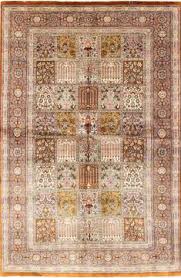
I would select my cherished silk-on-silk rug from Kashmir as my means of transport, the one I bought for a princely sum from Kashmiris in a bazaar in old Kathmandu. The colour is light green with pink woven into the borders. When you brush your hand across it, the sweep turns it darker or lighter, not unlike suede. The pattern is distinctive: 32 geometric panels depicting the Islamic Garden of Paradise, including pomegranate trees, arbours, plant pots and rambling rose. Tradition tells that this is a design from the revered Iranian town of Qom, from where the finest silk rugs and carpets on Earth are spun by weavers with magic fingers. Hence, magic carpets. If not that precious (and surprisingly tough) silk rug, I have another I’d consider riding on over a changed world in 2021. This one is an Islamic prayer rug (although I do not profess to be a man of any faith, other than faith in myself). I bought it from a reliable dealer in the Emirates, but the thing itself was woven in Northern Afghanistan and is exceptionally beautiful. Not of silk, this short-pile rug is of the finest wool dyed with the madder root into a colour resembling the dark dried blood of many an Afghan who has spilled their veins throughout the long war. Yes, my choice of long-haul air transport would be either the Kashmir silk rug or the Afghan prayer rug. Then again, for spaciousness there’s also that large tribal kilim from Tabriz in my collection. I could spread out on that during my transcontinental flyover. I’ll need a flying jacket and goggles, as it might get chilly, breezy and bumpy riding up there on the thermals. Oh, and my Leica monocular, too, so I can peer into the lives of others, and to see how the wildlife is coming along.

The roots of popular unhappiness, more and more started to realise, were becoming evident in the pleasant results the lockdown had produced on the wider world. Where the pace of life had been pulling us at 5Gs in a centrifuge, instead of being forced outwards the lockdown had now turned the force inward, to where we were all falling forward together into an attractive centre, which I call a natural equilibrium. Where previously few had any time for anyone else, they now found themselves devoting newfound time to the human relations they once held at the fulcrum of their world. Where many were being sucked into deadly debt traps, they now saw another possibility for an economic model that extolled the simple, organic life. Where many couldn’t sleep for the din of a society that had turned into a screaming lunatic asylum, quiet lockdown nights brought quiescence to tortured minds. It also revealed what had always been there but droned out: birdsong, and other naturally-occurring sounds. Where tens of thousand of species teetered on the brink of extinction due to human unwillingness to share, humanity finally agreed that the wild places were too few and the tamed ones too many. Monoculture changed in the agri business. Farmers were now harvesting goodies from the broad-leafed forests they had let grow in the vacuum of brown fields whose soil was depleted to the point of exhaustion. Animals that had resisted extirpation by laying low during the worst of our planetary abuses, and generally driven to the edge by our selfish species, followed suit. Population policy aimed at natural reduction, allowing crops to be grown vertically in great agri-towers that ran on sunlight. Where our industrial-age fear of the dark had produced so much halogen light to power society through night after night, so the lights went off and the stars returned to twinkle over what were sulphurous megacities. Something else unexpected returned: the sun. The industrial age had whipped up a dynasty of stormy weather by seeding every cloud with effluents and contaminants into raining. Gone was the chromatic aberration caused by poor air quality. Now the portrait of the planet looked pin sharp and didn’t we know it.

A revolution in the mind happened soon after the lifting of the 2020 lockdown. People wanted it back. They may not have professed to wanting thousands dead of a pathogen, but what they did want was to mitigate the disastrous effects of the human project by blocking off one month in every year where systems ground practically to a halt; where only essential distribution services, such as food and medicine and so forth remained a mainstay priority. Of course, they were compensated financially, but this would decrease over time as we moved away from heavy borrowing and high expenditure market economics to an ecological model of sustainable productivity. So, there you are on the magic carpet, skirting over the planet.

Ten years have past since the lockdown revolution/revelation of 2020. The annual month of fallow is now enshrined in UN law. Every nation is a signatory. Even the U.S., that resisted for so long because it was a concept engineered through the myth of the American Dream to exist only by maximising capital gains in every overworked American, even they got on board. China remains the dark horse: tense on the issue because the Chinese are caught between their philosophical tradition of Taoism and their love of making money by ramping up industry to ridiculous levels. Europe, being the old man, was at the forefront of the new paradigm for living. The Continentals approved wholeheartedly of this nouvelle approach to tempering things down.

Mechanisms were put in place to ensure that the other eleven months are not abused by the rush to over-productivity, as this habit came to be scoffed at for its backward greed motive. As a burned-out race we started mellowing. Our eyes were evermore open to the great clockwork of nature and how we – contrary to the proud fools that modernity and progress had made us – had broadly accepted our fixed role as a cog in that natural machinery, and not – contrary to the arrogance of our predecessors – as its clockmaker. Delegates even took to doling out liberal sprinklings of Gandhi’s wisdom that we live simply so that we may simply live.

What do you see, future me, when you look down from way up high on that Afghan rug in the new blue sky?

The Resurrection Will Not Be Televised

Britain, British Isles, Coronavirus, Covid-19, earth, free will, future, kindness, Landscape Photography, Life, Lifestyle, natural history, natural philosophy, natural world, nature, pandemic, People, philosophy, Planet Earth, Politics, Reflections, Socioeconomics, thoughts, urban decay, Virus, Wildlife

If I’ve said it once i’ll say it again: nature is back with a stealthy, healthy whimper. While Rome burns, Gaia fiddles a melodic tune. For literary effect, to assert that nature is back with a bang! as opposed to a mere whimper might hit harder, but it would defeat the point, for it is humanity that creates big noise. Nature is as nature does, and what it does while a quarter of the planet is housebound, while international trade experiences historic levels of supply chain disruption and slumped productivity, is to go about restoring a dynamic balance with quiet purpose. As house elves set about sprucing up the house during the dead of night when all slumber, watching spring assert itself while trade, commerce, and human bustle sleeps is a spectacle worthy of praise. Question remains: when we all wake up, how soon before the house is reduced to another ransacking?

Of course, I’m not the first to notice this wondrous upturn in our fortunes. People stop by the boat and remark how they’re beginning to notice things they hadn’t before on their daily stroll through the countryside. That obsolete word wildlife is even making a comeback. They notice the sky turning from wispy blue-white on a good day a deeper shade of aqua in the absence of belching fumes. They notice the stars return to cityscapes after a lengthy absence. They stop and notice birds do their courtship thing where before they just zoomed past. In short, more and more people are diverting their attentions away from servicing the machine of unenlightened human progress and toward natural events so revered by their forebears. What’s more, they like what they see.

The turning of the seasons becomes all the more apparent when the hatches are battened down. Human sensory organs realign themselves, from toning down the din of normal working life to tuning in to the rhythms of the living planet. Now i know that stuck in a megalopolis of high rises as far as the eye can see poses a challenge to the notion that pandemic lockdown has an unexpected upside that might even outrank the pandemic itself in vitality and importance. Half the world, nevertheless, still lives within range of what could be nominally called ‘the countryside’. Those multitudes are getting out (well they certainly ain’t wasting the opportunity where i am, which I take to be fairly typical) and some are pleasantly stunned into silence by the very act of silence. Have you heard the countryside now the internal combustion engine has been locked in the garage? Nature dislikes a vacuum, as ecologists like to emphasise, so in place of the universal background drone of cars from roads never further away that a mile (in the U.K., anyway), nature has come up with this novel scheme. It’s called keep producing the sounds of spring that never completely vanished, but rather were drowned out for generations by the vandalism of urban noise. So long, Range Rover Discovery, hello skylark or coal tit.

Few are disingenuous enough to really think that all supply chain distribution has stopped, that the tens of thousands of articulated lorries that deliver the length and breadth of the land have simply given up the game in the face of Covid-19. Most are painfully aware that the lorries are still doing the business so that fools like me can continue to enjoy Sicilian wine and Chilean avocados. Having said that, those delivery runs are sure as hell quiet at the moment. Never in all my years, have I heard the sound of total silence as i have blanketing the hills of West Wiltshire these recent weeks. It’s a thing to marvel at. To know that the world would go on without us. That the world doesn’t really need us, if only to process its complex interconnected workings in our complex interconnected human minds. I’m not even convinced that if we disappeared completely, or at the very least had our numbers severely curtailed, something else wouldn’t evolve soon enough with the ability to record and document phenomena in this world.

Lockdown will come to a close. Names of thousands of mainly elderly folks, ages with my beloved parents, by then will have filled death certificates. But in spite of the appearance of a population impatient to return to exactly how things were pre-pandemic, I think you’ll find that when the doors open again many (well, those in more favourable social and geographical positions) will privately bemoan the end of a peculiar phase in history when, instead of forging ahead on this unsustainable resource-greedy path we’re doomed on, we stopped a while and listened in to the heartbeat of the Earth. It was a very agreeable heartbeat and not one plagued with our hypertensions. More than anything, the resurrection of nature didn’t feel the need to announce its homecoming with much pomp or fanfare. It thrived all serene and dignified. While all this flourishing of life was happening behind the media wall of panic, some of us were alerted by a little voice in our primitive mind that said, ‘i feel good because the world seems to be repairing itself much quicker than anyone ever imagined.’

Of course, industry will once again crank up then overheat. Humans will continue to work against natural ecology – and ultimately their own long-term survival, proving even more of an aberration than any other species. Population in the cruelly-titled Developing World will explode like the algal blooms that human industrial pollution creates. Oceanic dead zones will reappear like necrosis on human skin. But all that planetary destruction will be okay because at least scientists cracked Coronavirus. Next year at this time, dissenting voices might whisper to other dissenting voices, ‘why can’t we have a pandemic every year?’

Declaring a pandemic month each year (without the concomitant death involved) could present hitherto unthought of opportunities. This could be our very own month of Ramadan, when so much comes to a halt during the day so that one may reflect on God (or nature, given that they are one in the same).

The resurrection will not be televised.

Springtime Of Our Lockdown

Britain, climate, conservation, Coronavirus, counter-culture, Covid-19, crisis, death, earth, environment, fate, free will, future, Hinduism, human mind, Liberalism, Life, Lifestyle, meditations, natural world, nature, neglect, pandemic, People, philosophy, Planet Earth, Political Culture, Politics, Reflections, thoughts

While we wither indoors, out there something profound is happening. Nature is back with a bloom. Can anyone remember it being so resplendent? So full of seasonal promise?

I’m asking myself how an annual event can seem to take on another dimension. Yet spring is springing with a wicked spring in its tail. Animals have returned to wander down paths long blocked to them. Goats window shopping in abandoned Welsh seaside towns; boars doing the passeggiata down silent streets in Bergamo; dolphins nosing around now crystal-clear canals in Venice in the absence of gondoliers sticking their bloody oars in everywhere. Hell! Even the tender shoots of first budding look that bit more sharp-suited, greener than usual. The sky, not so anaemic. The signs, far from being ominous to any life form other than us, are encouraging. If this is what the world’s end looks like, I’m signing up to it. The whole thing is beginning to feel like a massive teleological event: a reckoning that pits us against each other, and ourselves. What did Churchill once say? “Now this is not the end. It is not even the beginning of the end. But it is, perhaps, the end of the beginning.”

Can it be that Humanity pulls off a civilisational coup, foreclosing on the disastrous Age of Kali (see William Dalrymple’s 1998 travelogue for explanation, or else anyone of eight hundred million Hindus) for a gentler, more enlightened epoch? Could the pandemic be the hidden catalyst for it? Probably not, but the thought is a fitting one given the wonder show that nature puts on while we succumb to fear of personal extinction in our homes under the curfew of self-isolation. While a wholesale regeneration of purity in nature at the expense of human resource rape-&-pillage might be a bit much to hope for, certainly the lockdown can generate a paradigm shift in how people work, and in how we spend our few precious days on this Earth.

Yesterday I stopped by a glade of glistening wild garlic by the roadside. Ordinarily, cars would be humming past with such regularity that no one in their right mind would have pulled over on their bicycles to pick a bunch of nature’s own – a little crop of green goodness that went into the making of wild garlic pesto. In the absence of pandemic, would i have so much as done this? No. Am I better for having done so? Categorically, yes.

This reckoning, by which one refers to a near cessation of frenzied (and highly destructive) activity, which has come to characterise the Human Project over the past forty years, enables a beleaguered and frankly overwhelmed world a chance to hit reset. That great ferris wheel of civilisation that turns ever faster, drawing in and spitting out hapless human victims all the time, has ground to a halt for (shall we say) a spot of maintenance. While it lays motionless, finally we get the chance to stop being mesmerised by its whirring circulation, and start taking in the 360 degree view that was perilously neglected all the while.

Now is the springtime of our being (unless you live in the southern hemisphere in which case you’re on for a revolutionary autumn). Those who are in the gutter looking up at stars over cities that are not only shining but coruscating for the first time in the modern age, will they necessarily want a straight return to an orange-sodium sky above their heads, planes roaring overhead? Those realising that the job they are doing from home unexpectedly through lockdown can be done from home post-lockdown, will they desire an immediate return to crammed commuter lines full of sleepy, barely-approachable worker drones? All of us who may take our one hour of daily exercise (which in reality morphs into about four as the conditions are so favourable, and as time has taken on a more elastic property), we who can stroll down lanes untrammelled by the impatient thud of footsteps, do we want necessarily to cash in the quietude for a ride on the capitalist wheel of fortune again?

The spectre of death clears the field. If there were ever a moment to stop and smell the roses, it is now. If there were ever a moment to ask ourselves: what do each of us want from this fleeting life, and what are we prepared to leave behind when the fire goes out? Now is the time. A gift has been offered to us in the form of mass global quarantining. From this renewal nature may stand a fighting chance while for our part we may gain absolution from mass collective sin. Now I don’t quite know what kind of force is behind these weird developments, but whatever orchestrated them is giving Humanity an open window for opportunity to refashion ourselves into a life force that goes with the seasons, instead of one that signifies such damage and ecological destruction that the seasons themselves cease to be what they were. That window will all but certainly blow shut with the first shunt of summer wind against the pane. While we’re all locked down, let’s make room for the other tenants that call Earth their home, too. When the time comes to fling open our doors again, let goodness flow out and everywhere.