What Goes Down Must Come Up: Why You Should See the Colca Canyon

#adventure, adventure, Andes, backpacking, Landscapes, Latin America, Perú, Perú, Travel, Uncategorized

Olympian Among Canyons

Allow me to set the scene, if you will. The Colca Canyon is situated in Southern Peru, about a 3-hour drive northwest of the White City, Arequipa. By all measures, the Colca is the world’s third deepest canyon (some say fourth) after the Yarlung Tsangpo Grand Canyon in Tibet, followed by the jaw-dropping Kali Gandaki Gorge in the Annapurna region of Nepal.

The Colca Canyon cuts such a swathe through the Andean plateau that it bottoms out at about 11,000ft (3,400m). To offer up some idea of scale that clicks with most of us, that’s about twice the depth of the world’s most celebrated geological knife wound, Arizona’s Grand Canyon. So, one Grand Canyon nested on top of another, and the Colca will just about accommodate them both.

Where Humans Dare To Tread and Till

Farmed by Inca peoples since time immemorial, its steep slopes show abundant signs of continuous human occupation. At about 50 miles in length that’s one deep cut for Man; one deeper cut for the magisterial condor that has made a miraculous comeback there after decades of persecution from local livestock farmers. Its confidence soaring, the condor is one of the main attractions of the hordes of tour buses that stop at the various lookouts along the canyon rim.

For the adventurous few though, what awaits them is a gruelling descent to the canyon floor, where if lucky, they’ll see the condor soar not below them, but at eye level. It’s all downhill from here. And surprise, surprise, the prospects never looked so good.

I got teamed up with a nice bunch of continental Europeans half my age and double my knee flexibility. Among them a smattering of French and German. The Franco-Prussian alliance had sunk to new heights. Our guide was a native of Arequipa, a man who had led so many 3-day expeditions in and out of the canyon that, as can be expected, he was rather unfazed by the whole affair.

El Condor Pasa

One moment we were setting off along the canyon rim and the next a slow motion plunge down a zigzagging hoof trail that swallowed us whole. The view was stupendous, the scale was suddenly gargantuan, and the sky a blue bonanza between weeks of monsoon rain that would render it all but impassable before and after. With the heat rising and the sunlight penetrating the deepest, darkest rincones of this abyss, we fell into a hypnotic rhythm. Our guide pointed out geological features, and delved into a history of human geography. But in keeping with great journeys, what you rank as the best bits keep getting superseded by better bits. Half way down royalty dropped in. Condors swooping over us so near and so balletic on the hot air updrafts that by the time i reached for my oversized SLR camera, they had glided away into the shaded recesses under the canyon walls.

It’s All Downhill From Here

Serendipity had accompanied us that day. Our guide marvelled at how rare it was to come so close to the feathered emblem of the Andes. Then again, perhaps he said that to all his small tour groups. Down and down we traipsed until, looking up, the canyon walls closed in on us like great doors in some medieval banquet hall.
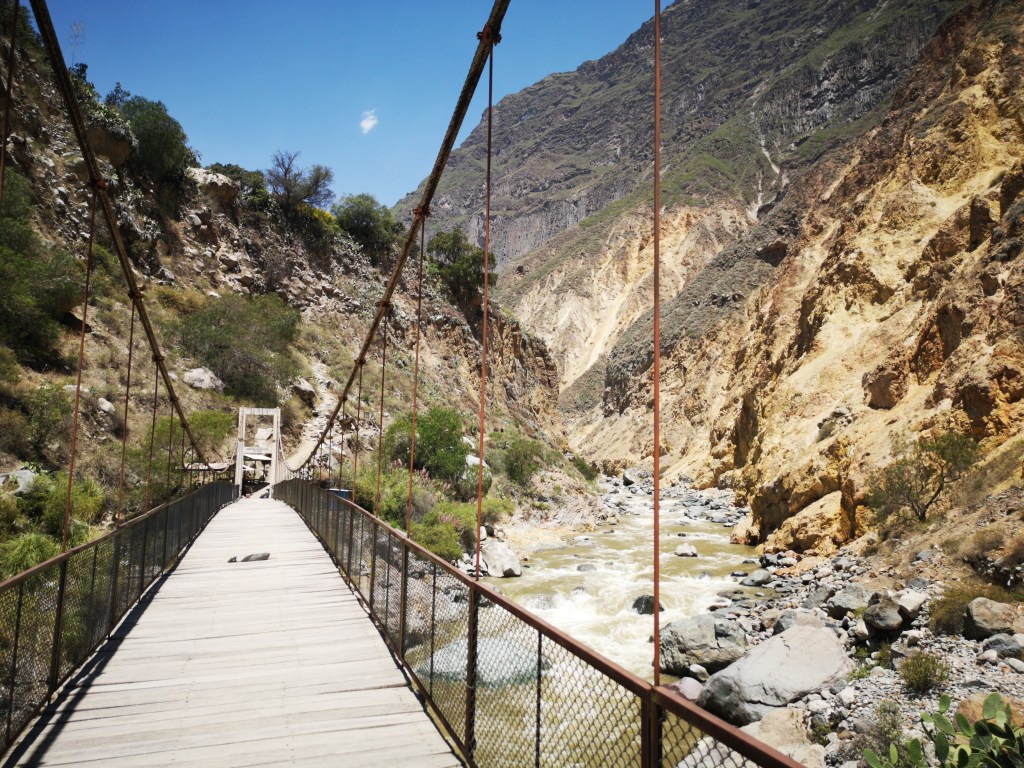
Having spent the better part of the day tiptoeing down about 3,000ft we found ourselves at the nadir. By no means the lowest point in our experience, crossing the iron suspension bridge over the Colca’s mazy river did signal the lowest point geographically-speaking. The sun was beyond its zenith, casting its brilliance on the east face of the canyon, making shadow creep gracefully up the west face.

Scraping the Barrel to Find an Oasis

We had been descending all this time. Now we were walking along the canyon floor adjacent to the watercourse. Festooning the margins of the clear crystal water were orchards of figs and other succulent fruits. Vegetation was abundant. Light and warmth caressing in a very special place where the wind and the winds of change were banished.

We walked and talked for the next couple of days along that canyon floor. We passed churches and villages, kids coming home from school, and guinea pigs flayed and hung out to dry. We stopped in a guesthouse with the most amazing swimming pool, fed to pure by an oasis. A classic desert oasis in the truest sense it was, fringed by date palms whose seedlings had come from half a world away.

It’s All Uphill From Here

On the third morning since taking the plunge into the world’s third deepest canyon, we gathered around our guide at 4am to face the trek back up and out. We obviously knew all along that what goes down must come up. But comfortable in our deep oasis on the previous evening, tipsy on rum and oxygen, I was contemplating a helicopter medevac out of there. The climb looked daunting, and was. 3,000ft straight up in the grip of incipient subtropical heat. Hence the reason we left before daybreak. As if to foreshadow what would be a gruelling hike out, my guide took one look at the packs I was carrying back and front, and shook his head in pity. “I told you to travel lightly, didn’t I?”

Half-light kissed the rim tops around an hour or two into the climb. Then, quick as ink blotting on paper, the dawn light seeped down until we rose to meet it a quarter of the way up. By then the pain of being a human packhorse had slowed my stride to a lumbering, teetering mess. My t-shirt was soaked with the sweat of my own labours. My bandana had to be wrung out every 100 metres or so. My eyes were weeping salty tears of pure perspiration. The line between myself and the other group members was attenuating fast, as they strode ahead. Overcome with guilt, eventually my guide offered, with a degree of reluctance visible in his grimace, to take one of my packs. But not before hailing a passing muleteer who refused.

Ghosts From the Past

Onward we clambered, inch by inch until at about 10am – a full 6 hours after setting off from the now microscopic guesthouse on the canyon floor – he and I emerged on the lip. Shattered, reddened to bursting, and vowing never to descend that far again with any baggage whatsoever, I collapsed in a heap. Beside me, by the grace of an ironic God, were a couple of Estonians I had climbed with a couple of weeks earlier. On that occasion, the altitude was so dizzying that it was they who struggled with hypoxia to the point of almost fainting, and me who offered a helping hand. Now there they were all smiles, relaxing after practically jogging up the Colca carrying nothing but a 7-litre daypack. And me, a sorry sight, temples pounding, eyes throbbing and near spent. Valió la pena? Was it worth the pain? Absolutamente!

Cha-cha-chani: Volcanoes Don’t Get Much Bigger Than This.

#adventure, altitude, Andes, mountains, peru, South America

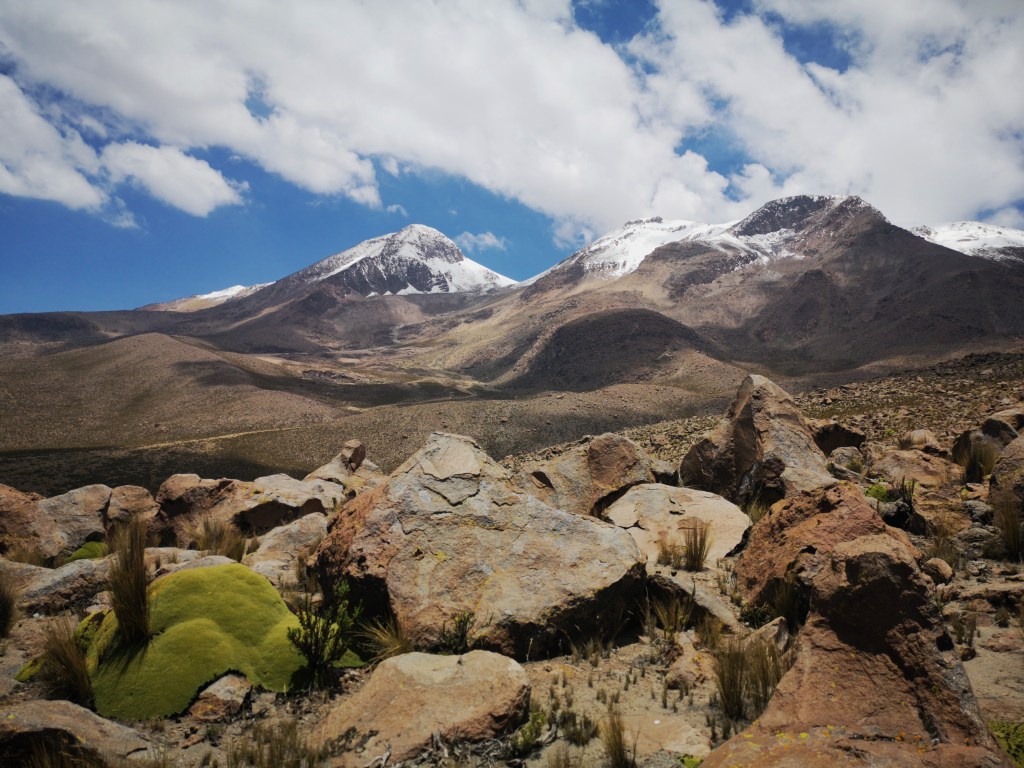
Though Chachani may sound like a dance step, ascending this Peruvian volcano – one of only eighteen on Earth to exceed 6,000 metres – is no waltz.

No Walk in the Park

As I sit here tapping away, turning milestone into narrative, an ironic smile upturns the corners of my mouth when I think of trying ballroom dancing on its icy apex. So, if you’re thinking of celebrating the feat of summiting your first 6,057 metre peak (19,872 feet) with a little jig, forget the waltz. You can forget the cha-cha, too. In fact, about the best I could hope for was a stiff and ponderous trudge: the dance of the malfunctioning robot.  

Those who purport to know say Chachani is the easiest 6,000 metre climb anywhere in the world, but I can testify that if climbing Chachani is a stroll compared to the others then the others must require something extraordinary. That, plus a lungful of bottled oxygen. Nevertheless, it was an opportunity way too good to miss.

Chachani coming in from the North

To See or Not to See

Let’s go on the proviso that it’s not everyday one decides to tackle a behemoth of geology that stands proud above all else – even over the formidable presence of El Misti, a 5,822 metre (19,101 feet) stratovolcano that, alongside Chachani, forms a silent guardianship over a white city named Arequipa that itself sits 2,335 metres (7,660 feet) up on the arid Andean plateau in Peru’s deep south. So, let’s go on that proviso: one chance in life to ascend to places that few ever venture. Or would ever want to. Do you take it? You’d be a fool to, but an even bigger fool not to.

Don’t Go it Alone

Adventurous types pour into Arequipa, or at least they did before Peru declared a national state of emergency due to Covid. As of early 2022, the city and country were still struggling to recover sufficient tourist numbers. Bars and diners lay empty. By government decree, not one but two face masks were the order of the day. Troubling times for the adventure tour industry, sure. Having said that, keep a good thing down and it always rebounds.

The bigger they are, the higher they rise. Arequipa’s two famous volcanic landmarks are, by any measure, epic. Hardly surprising then that a number of tour providers on Calle Jerusalén, as well as in and around the Plaza de Armas remained open for business. Covid might have detrimentally impacted the local adventure travel industry, but it seems it couldn’t make a dint in interest for Chachani. The rates too, were as low as the volcanoes were high: about $80 all in.

When it comes to mini expeditions of this stature, it’s a professional guide you need. These guys go to university to learn to lead expeditions in these mountains. I went with Waiky Adventours, but a whole host of others made similar arrangements.

The Long Road to Basecamp

A good many operators in Arequipa’s burgeoning adventure tour business will take you most of the way to base camp by jeep. Up and up the route snakes, north and away from the city’s sprawling limits, past the sublime figure of El Misti toward the indomitable sight of Chachani spread even over a massif of towering, flattened peaks.

With Arequipa due south and out of sight, you come in behind it to face Chachani’s arid, northern flanks. Grazing vicuña dot the altiplano, gentle in their ways. As you are already at nearly 5,000 metres at the foot of the range, it doesn’t look especially imposing. We were subsequently to discover that just because a thing doesn’t appear imposing, it doesn’t mean to say it’s not. Up here in the liminal space between worlds habitable and inhabitable a peaceful silence pervades the air, as if the mountains are holding their breath ready for you to hold yours.

Up Where the Air is Thin

Away to the right as we started our two-day round-trek to the summit, I saw there a painted mountain. Made of iron and sulphur and all those minerals that Man so desires, under the shifting sky of cotton wool stuck on a background of cerulean blue the mountain’s rusted hues throbbed and dimmed with the coming and going of the light.

I knew such wondrous sights could only be had up here in the Gods. The natural reaction to seeing this psychedelic landscape at high altitude is to gasp, but that – as became immediately clear – was easier said than done. Oxygen levels at roughly 5,000 metres (16,500 feet) are about 60% of those at sea level, meaning those lungs have to work nearly twice as hard just to make up the same ground.

The Long Wait

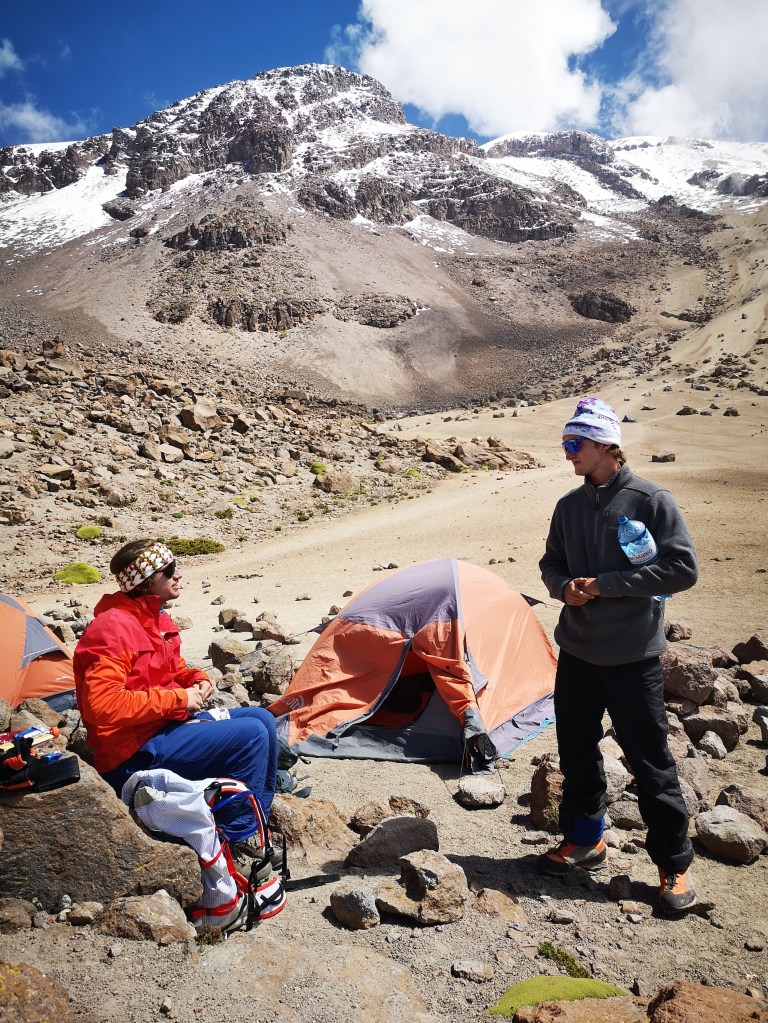
Arriving exhausted at our base camp, we were encouraged to rest up and sleep for the day. The reason given was that at night the air pressure drops in the high mountains. Above about 5,000 metres sleep becomes a real problem after dark, as I found out the hard way. Other than a brave, solitary fox that came calling for dinner at our basecamp not a lot ekes out a meagre living above this height. Multicellular life wasn’t really designed for it. Even the unexpected sight of a fox tamed into revealing itself by the temptations of a handout – life must be unremittingly tough at the top.

This being the season the Andean weather gods show their unpleasant side, vistas to die for can be fleeting. By mid-afternoon the fog crept in and all about. The altiplano and all the peaks rising from it, like ships scattered on an ocean, disappeared. All at once, we were wreathed in a freezing world of the spirits. Visibility decreased until not a thing except our date with the mountaintop could be seen.

Nightfall at 5,000 Metres

I must have fallen into demented dreams for a few minutes before awakening in the pitch black with a pounding headache. Our basecamp comprised half a dozen tents, though only one showed signs of life and that amounted to no more than a rasping cough. The others lay dormant. I thought for a moment my group had gone home, and I was left alone with High Altitude sickness, until the thought consoled me that others too probably lay in their tents peering into the void, thinking about how difficult sleep was, and how cold it was becoming.  

As the evening ground on, my headache worsened. In the absence of sunlight, the chill gripped me with an intensity hitherto I had never experienced. I cocooned my legs inside my down jacket, but even that was glistening with frost.

I tried to lie horizontal, until sleep apnea grabbed me by the throat and made me sit up and lunge at the vestibule zip. I couldn’t breathe. I was alone. And then to cap it all, the nausea, which I had suffered at altitude elsewhere in Peru, came back with a vengeance. I couldn’t wait for midnight to come. That’s when the push for the summit would begin. Or would it? At this rate of physiological decay, I would need to be escorted down and off the mountain.

Should I Stay or Should I Go?

Sometime before midnight, the camp stirred back into life. Everyone gathered around cups of hot coca tea. Headlamp beams made feeble work of the immense darkness of our surrounds. I reported my symptoms to my guide, who seemed irked that his hopes of a hassle-free night ahead might be inconvenienced by having one of his clients die on him.

‘Stay here and we’ll come for you in about 8 hours from now on our way back.’

‘Are you not supposed to descend with high altitude sickness?’

Then I addressed him in Spanish, hoping for more sympathy.

‘No creo que deba quedarme aqui. Hay que bajar.’

By now my lungs were froth-corrupted, resulting in a lot of sputum being gobbed onto the ground. Bad sign. I ran to a rock where I vomited. Worse sign.

When he saw me throw up, his demeanour changed. Suddenly he was concerned.

‘The other guide will accompany you down.’

But some deeper power had stirred in me. My pride burned such that the air no longer felt so icy. I instructed him as to how we were going to tackle this.

‘I want to do this thing. If my headache gets worse higher up, I’ll take the other guide and turn back.’

He agreed, albeit dubiously.

The Only Way is Up

The climb, in the early stages, was brutal. I trailed the others, who had galloped off ahead, whose headtorches I could see as little beacons high above. For each scheduled stop I died a thousand times. Chewing with all the might of a retired mule, gobbets of mashed coca leaf occupied the space between teeth and gums. Hope against hope, I was sucking on that coca for dear life.

Although my eyes were fixed on the pool of light into where our frozen feet stepped, above me I caught glimpses of stars coruscating bright as a glitterball, and so bountiful they scorched the black out of the firmament. Jupiter rose over the shoulder of Chachani, not as the fake star it is with the naked eye at sea level but as the planet it truly is from Hubble.

As the hours passed, the gap between the early pacemakers and me started to close. I found I was gaining in strength while others were flagging. The headache dissipated; the nausea diminished. The coca was doing what mother nature intended. Not for nothing is this plant considered so valuable.

Kids half my age were showing signs of mental confusion in the absence of o2 brainfood. Grabbing one, he looked to be falling off the mountain. Another became quite delirious, muttering something under his breath. A girl in the group, who I later witnessed practically running up the Colca Canyon, looked lobotomised. Could brain damage be permanent, I thought.

So Near and Yet…

They say the darkest hour is just before the dawn. What they don’t tell you is that the coldest hour is also before the dawn. I should have known better.

We had climbed through the night. Our expedition team had gone from tight knot to attenuated line of trudgers. The first rays of morning had settled on distant peaks. The air was frigid and by now my toes had stopped receiving warm blood flow. But there was light even in the absence of day. Our guide was now excitable. Geeing us up, he promised us our reward was within reach. One in our group was suffering badly. He looked catatonic and I was worried for his welfare. Our guide plied him with coca and candy while his head swayed, and his attention faltered.

But me, I felt a new lease of life. Yes, my toes were frostbitten but my heart had never felt this heat of the moment. Yes, each step felt like my last, but I had found a new spring in my step. The night had yielded to a new day. The world was as if viewed for the first time. Seeing the rounded summit of Chachani and the cairn sitting atop I was overcome with emotion. So much so, that I threw up again.

What Goes Up…

Our travails were not quite over yet. An arête had to be crossed to reach the crater and beyond the summit whence we could see all of Arequipa before us. Picking through the jagged rock and ice we came upon a flattened brow and like that, the climb was over.

I sucked in the air at over 6,000 metres and held it there while I tried to absorb the magnitude of what I had achieved. Tears welled in my eyes. The others wore smiles as wide as the climb was long. Was it joy or relief?

Peering over the edge Arequipa, a city of two million people, was coming to life. And like that, she was gone, wreathed in the impenetrable fog. Our guide hastened us to descend before the weather worsened.

‘Back down the same route?’ We asked with a foreboding.

Then with an impish smile, he shook his head.

‘We’re taking the quick way down,’ he replied.

Then he turned, marched over to the world’s longest gully, slumped onto his backside, and proceeded to slide down the snowy mountain. Incredulous, we gawped at his receding orange figure as it diminished away to a pinprick. What had taken six hours to ascend was taking ninety minutes in the opposite direction.

We all looked at one another with childish delight then, slumping onto our backsides, followed him all the way back down to where we left the oxygen behind.

End.

To Machu Picchu, With Love

#adventure, #romance, adventure, Andes, backpacking, Eighth Wonder of the World, environment, Lifestyle, mountains, natural world, nature, peru, Planet Earth, Salkantay, South America, Travel, Travel Photography, travelogue, Trekking, Wilderness

It was always central to the plan. Fly transcontinental to Peru. Once in the capital, randomly follow compass points leading out of Lima in all directions but west, which would be suicidal as it would leave me adrift somewhere in the deep Pacific Ocean. But whatever I do, the golden rule stands: don’t fly home without first having taken the long trail to Machu Picchu.

Many roads lead to Rome. So too are there a fair few routes to Machu Picchu. The Inca, like the Romans, were master road builders after all. You can opt for what most do and that is to fly to Cusco, board a mini bus from that old Inca seat of power to the sublime surroundings of Ollantaytambo in the even more sublime Sacred Valley of the Inca, board the train from the terminus there 90 minutes to Aguas Calientes at the foot of Macchu Picchu, and from there board another bus that winds up and up until it reaches, at 2,430mt a.s.l., the ticket booths standing like sentinels at the entrance to the eighth wonder of the world.

Or you can pay Atahualpa’s ransom and trek the three nights, four days to Aguas Calientes on the famous Inca Trail. Equally, you can step out of the ordinary and hike the Lares Route running along the valley to the north of the Sacred Valley. But that plonks you down at Ollantaytambo and from there you’ll still need to ride the packed train to Machu Picchu. For the even more intrepid there’s the Vilcabamba Traverse route, which basically follows in the now well-trodden footsteps of Hiram Bingham, the American who discovered Machu Picchu with a little help from an unheralded fellow who happened to farm land in Aguas Calientes and knew all about the strange ruins in the thick undergrowth at the top of the mountain. At ninety kms long, descending into canyons, crossing raging rivers and back up mountains so steep you tip your head backwards just to see them in their entirety, the Vilcabamba can take well over a week to traverse. And then there’s the Salkantay. Free but definitely not easy. That’s the route I took. It turns out, with unintended consequences.

They always say, don’t they, that certain actions have unintended consequences. The more extreme the action, the more consequential. By the standards of some, walking a full five days and sixty kms to the foot of Machu Picchu over a 4,600m (15,090ft) pass is pretty extreme. Especially so when you happen to be fifty years old on your next birthday. Anyway, i digress. For five days I walked the walk and talked the talk and in between saw deep time cut deep into rock and cappuccino brown waters froth and fury on the valley floor because the mighty, near-mythical Urubamba river could not run down to the Amazon fast enough, pushed on as it was into incandescent rage by mountains pressed hard up against it, bullying it and blocking its light.

It was raining as the ten of us flooded out of the mini bus on the trailhead. In reality, the official start to the 75km Salkantay Nevada was 20km back down a very inundated road-cum-track. Ordinarily, day one of the Salkantay would involve a trek up and up that rutted track, waterlogged by weeks of summer rain and spun into mud by the endless turning of Mercedes minibuses wheels ferrying sightseers up to Humantay Lake. We were cutting to the chase on our five day dash to Machu Picchu by skipping the boring bits.

Our guide, Jorge, told us to get suited and booted. Raincoats and plastic ponchos would be the order of the day. My Texan friend and I clambered onto the muddy ground. Walking poles were doled out in exchange for rent money. Essential item. $10 for the duration. Our walking group – at that point still a bunch of strangers, mainly from Germany and Holland – formed under the rain, almost by accretion. Bedecked in plastic ponchos of the most garish colours, they readied themselves for a 2-hour detour to Humantay Lake, before bracing for a 3-hour climb up to camp 1 at Soraypampa. As usual, I was first off the bus and last onto the trail. The Texan and I rolled a smoke, buckled up and in our own time started this great overland journey with a single step. The young bucks and hinds in the group were already visibly ahead within minutes. But the Texan and I were not lone stragglers. Beside us we noticed a girl.

I had seen her when i first boarded the bus back in Cusco at 4am that morning. There she was all alone with only a covid mask covering her eyes, depriving me of the totality of her pretty face. She sat alone, not feeling the urge to befriend others, as so many solitary types do when they’re on the road. She slept, and when she woke she kept herself very much to herself. Much as I tried not to, i found myself constantly stealing a glimpse of her while trying to act all natural. Physically, she was nothing like us. I guessed Brazilian due to these fulsome lips and coffee complexion. She certainly wasn’t Peruvian, with their proud Quechuan noses. Nor Chilean. Nor Argentinian. Definitely not Bolivian. Ecuadorian? Hmmm. Nah. They too were ruled by the Inca, as their faces testify to. She could have been Colombian, or Venezuelan. I deduced that much. Anywhere in the Caribbean, the genetic blend of European, African and Indigene created this unmistakeable exoticism, verging on the absolutely beautiful. But, no. I settled upon Brazilian, as there are 150 million of them, and only 50 million Colombians and 25 million Venezuelans (there used to be 30 million, but 5 million are now refugees).

As we ambled, tortoises off the blocks, she drew abreast of us. Slightly discomfited by the presence of two jackasses who – as i was to later find out, she found irksome when they boarded the minibus at 4am singing, joking and generally ignoring the protocols of getting on a night bus – it took me to break the ice.

‘See my friend here, he doesn’t think you’re Brazilian. But i do. Am i right?”

She was. And I was. And that was the first time we were right together.

At Humantay lake, the surface water was a bioluminescent paint pot. The color was electric blue-green. Around it the land rose sharply, a browned earth soft as shale where the land had collapsed in. And on top of that sat a crumpled mountainous mass of black rock and ice. The Andean giant flitted in and out of sight, behind a veil of cloud and Scotch mist. It was summer, but the Andes being the Andes and defying definition, this was the rainy season. And for anyone who knows the high mountains, everything is exaggerated, even the intensity of the rain.

I could see the glass domes – our beds for the night – on the ridge up ahead far in advance of arriving. The others were all there, but she and I had fallen far behind. Our footsteps slow, deliberative, rhythmic. We were tired beyond belief, for here at nearly 4,000 metres (or 13,000ft) the air was reed thin and the angle of ascent deceptively steep and seemingly without end. For every gulp of air, disappointment ensued. And as the occluded sunlight dipped on a fading afternoon she and I became more and more talkative. Gassing while climbing at these altitudes is not always the right strategy. So for every sentence a pause for breath that doesn’t readily come the way it does as sea level. Our legs could not catch up with our tongues but I knew that something had clicked between us, language barrier or no language barrier.

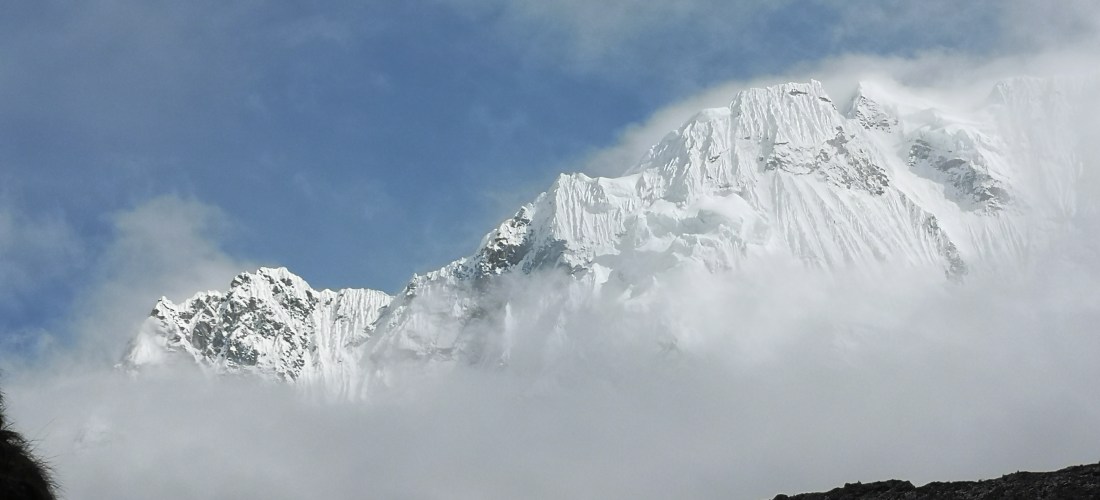
Up on the ridge with the Salkantay mountain looming in the twilight behind a wall of white cloud, she and I slumped down. We were exhausted, the right kind of exhaustion that combines the very tired with the very happy. Eagles flew sorties in the valley beneath and every now and then a huge wall of granite would flash into view through the gathering night. Magic all around. This, I thought, is why I damned near killed myself to get here. And in the process i made a friend, a beautiful friend.

Day one not even drawn to a close, and this adventure was already shaping up to be a classic. It’s in the nature of duality that with pain comes a degree of pleasure that makes the pain bearable. Altitude and steep gradients might be the root cause of the pain, but the pleasure was all mine with her by my side. I have a fridge magnet back home that reads, ‘no road is too long in good company‘. Never was this Turkish proverb more true than the moment we collapsed into camp 1.