To Machu Picchu, With Love

#adventure, #romance, adventure, Andes, backpacking, Eighth Wonder of the World, environment, Lifestyle, mountains, natural world, nature, peru, Planet Earth, Salkantay, South America, Travel, Travel Photography, travelogue, Trekking, Wilderness

It was always central to the plan. Fly transcontinental to Peru. Once in the capital, randomly follow compass points leading out of Lima in all directions but west, which would be suicidal as it would leave me adrift somewhere in the deep Pacific Ocean. But whatever I do, the golden rule stands: don’t fly home without first having taken the long trail to Machu Picchu.

Many roads lead to Rome. So too are there a fair few routes to Machu Picchu. The Inca, like the Romans, were master road builders after all. You can opt for what most do and that is to fly to Cusco, board a mini bus from that old Inca seat of power to the sublime surroundings of Ollantaytambo in the even more sublime Sacred Valley of the Inca, board the train from the terminus there 90 minutes to Aguas Calientes at the foot of Macchu Picchu, and from there board another bus that winds up and up until it reaches, at 2,430mt a.s.l., the ticket booths standing like sentinels at the entrance to the eighth wonder of the world.

Or you can pay Atahualpa’s ransom and trek the three nights, four days to Aguas Calientes on the famous Inca Trail. Equally, you can step out of the ordinary and hike the Lares Route running along the valley to the north of the Sacred Valley. But that plonks you down at Ollantaytambo and from there you’ll still need to ride the packed train to Machu Picchu. For the even more intrepid there’s the Vilcabamba Traverse route, which basically follows in the now well-trodden footsteps of Hiram Bingham, the American who discovered Machu Picchu with a little help from an unheralded fellow who happened to farm land in Aguas Calientes and knew all about the strange ruins in the thick undergrowth at the top of the mountain. At ninety kms long, descending into canyons, crossing raging rivers and back up mountains so steep you tip your head backwards just to see them in their entirety, the Vilcabamba can take well over a week to traverse. And then there’s the Salkantay. Free but definitely not easy. That’s the route I took. It turns out, with unintended consequences.

They always say, don’t they, that certain actions have unintended consequences. The more extreme the action, the more consequential. By the standards of some, walking a full five days and sixty kms to the foot of Machu Picchu over a 4,600m (15,090ft) pass is pretty extreme. Especially so when you happen to be fifty years old on your next birthday. Anyway, i digress. For five days I walked the walk and talked the talk and in between saw deep time cut deep into rock and cappuccino brown waters froth and fury on the valley floor because the mighty, near-mythical Urubamba river could not run down to the Amazon fast enough, pushed on as it was into incandescent rage by mountains pressed hard up against it, bullying it and blocking its light.

It was raining as the ten of us flooded out of the mini bus on the trailhead. In reality, the official start to the 75km Salkantay Nevada was 20km back down a very inundated road-cum-track. Ordinarily, day one of the Salkantay would involve a trek up and up that rutted track, waterlogged by weeks of summer rain and spun into mud by the endless turning of Mercedes minibuses wheels ferrying sightseers up to Humantay Lake. We were cutting to the chase on our five day dash to Machu Picchu by skipping the boring bits.

Our guide, Jorge, told us to get suited and booted. Raincoats and plastic ponchos would be the order of the day. My Texan friend and I clambered onto the muddy ground. Walking poles were doled out in exchange for rent money. Essential item. $10 for the duration. Our walking group – at that point still a bunch of strangers, mainly from Germany and Holland – formed under the rain, almost by accretion. Bedecked in plastic ponchos of the most garish colours, they readied themselves for a 2-hour detour to Humantay Lake, before bracing for a 3-hour climb up to camp 1 at Soraypampa. As usual, I was first off the bus and last onto the trail. The Texan and I rolled a smoke, buckled up and in our own time started this great overland journey with a single step. The young bucks and hinds in the group were already visibly ahead within minutes. But the Texan and I were not lone stragglers. Beside us we noticed a girl.

I had seen her when i first boarded the bus back in Cusco at 4am that morning. There she was all alone with only a covid mask covering her eyes, depriving me of the totality of her pretty face. She sat alone, not feeling the urge to befriend others, as so many solitary types do when they’re on the road. She slept, and when she woke she kept herself very much to herself. Much as I tried not to, i found myself constantly stealing a glimpse of her while trying to act all natural. Physically, she was nothing like us. I guessed Brazilian due to these fulsome lips and coffee complexion. She certainly wasn’t Peruvian, with their proud Quechuan noses. Nor Chilean. Nor Argentinian. Definitely not Bolivian. Ecuadorian? Hmmm. Nah. They too were ruled by the Inca, as their faces testify to. She could have been Colombian, or Venezuelan. I deduced that much. Anywhere in the Caribbean, the genetic blend of European, African and Indigene created this unmistakeable exoticism, verging on the absolutely beautiful. But, no. I settled upon Brazilian, as there are 150 million of them, and only 50 million Colombians and 25 million Venezuelans (there used to be 30 million, but 5 million are now refugees).

As we ambled, tortoises off the blocks, she drew abreast of us. Slightly discomfited by the presence of two jackasses who – as i was to later find out, she found irksome when they boarded the minibus at 4am singing, joking and generally ignoring the protocols of getting on a night bus – it took me to break the ice.

‘See my friend here, he doesn’t think you’re Brazilian. But i do. Am i right?”

She was. And I was. And that was the first time we were right together.

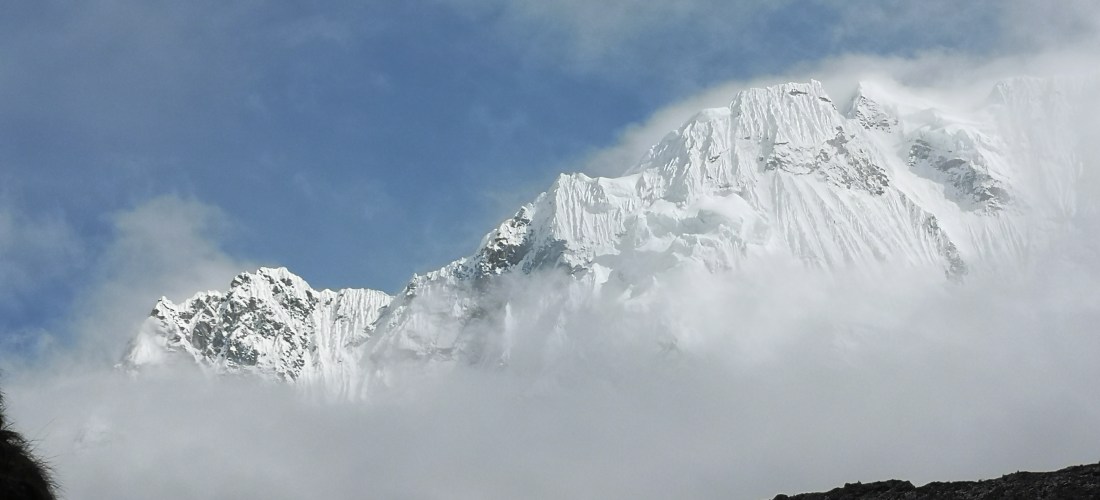
At Humantay lake, the surface water was a bioluminescent paint pot. The color was electric blue-green. Around it the land rose sharply, a browned earth soft as shale where the land had collapsed in. And on top of that sat a crumpled mountainous mass of black rock and ice. The Andean giant flitted in and out of sight, behind a veil of cloud and Scotch mist. It was summer, but the Andes being the Andes and defying definition, this was the rainy season. And for anyone who knows the high mountains, everything is exaggerated, even the intensity of the rain.

I could see the glass domes – our beds for the night – on the ridge up ahead far in advance of arriving. The others were all there, but she and I had fallen far behind. Our footsteps slow, deliberative, rhythmic. We were tired beyond belief, for here at nearly 4,000 metres (or 13,000ft) the air was reed thin and the angle of ascent deceptively steep and seemingly without end. For every gulp of air, disappointment ensued. And as the occluded sunlight dipped on a fading afternoon she and I became more and more talkative. Gassing while climbing at these altitudes is not always the right strategy. So for every sentence a pause for breath that doesn’t readily come the way it does as sea level. Our legs could not catch up with our tongues but I knew that something had clicked between us, language barrier or no language barrier.

Up on the ridge with the Salkantay mountain looming in the twilight behind a wall of white cloud, she and I slumped down. We were exhausted, the right kind of exhaustion that combines the very tired with the very happy. Eagles flew sorties in the valley beneath and every now and then a huge wall of granite would flash into view through the gathering night. Magic all around. This, I thought, is why I damned near killed myself to get here. And in the process i made a friend, a beautiful friend.

Day one not even drawn to a close, and this adventure was already shaping up to be a classic. It’s in the nature of duality that with pain comes a degree of pleasure that makes the pain bearable. Altitude and steep gradients might be the root cause of the pain, but the pleasure was all mine with her by my side. I have a fridge magnet back home that reads, ‘no road is too long in good company‘. Never was this Turkish proverb more true than the moment we collapsed into camp 1.

On the Mountain of God (PartIII)

#adventure, adventure, Africa, mountain of god, Ol Doinyo Lengai, Tanzania, travelogue, Trekking

If this was any Mountain of God, the God in question suffered at the hands of a greater one: the weather. Rain lashed the steep slopes. The gradient, the worsening conditions, the midnight black, the rising panic: this was becoming a Jesus lashed by the Romans moment.

I couldn’t stop but turn on my hips to train the head torch on what was immediately behind me. The pitched floor of the volcano, the void behind and beneath. Raindrops rushing me out of the inky nowhere. I began to slip down, unable to keep my footing. Grabbing what purchase i could from the ground, chunks of the weirdest paste came out in clumps. I feared the worst. Not even the Himalaya had put the fear in me like this mythical giant. And like a mythic giant, once stirred from slumber they arch and wriggle, until rising mightily there’s nowhere to hang on but hurtle down.

Moses, my guide, was close ahead. He kept turning to reassure me. I saw in his dark features great courage. Yet, even he, the Masai warrior with a taste for suicidal volcanoes, looked at the very least surprised by these Scottish-like conditions.

It must have been after 3am by now. Lengai sat practically on the equator, but the temperatures struggled above latitude 50. We had been ascending – what felt like near-vertically – for upwards of 4 hours. How much longer until the summit? Moses cast a look of disappointment. “We’ll be there for sunrise. Two more hours.”

“There will be no sunrise at this rate,” I shot back.

Beseeching me to go on, Moses sensed the mood had shifted in me. For the first time in a long time an indifference overcame me about reaching the goal. I had travelled so far overland, paid so much for the privilege of my own cook, driver, armed guard, not to mention donkey handlers. I had spent so many months orchestrating this plan. And yet, here we were, 120 minutes from the crater of the world’s quirkiest volcano and I wanted nothing more of it.

“All right,” I said to him. “Let’s keep going. I suppose the rain might stop.” Of course, the Scot in me knew that when a man wants rainclouds banished, the weather gods don’t take kindly.

Another half hour onward and upward and the rain was truly routing the mountain’s immense flanks. Continuing to slide a foot for every two planted, I suspected foul play, that God – or whoever dwelt in this abominable realm – had no intentions of receiving worshippers that day. I slumped onto the liquid ground, my shoulders hunched in defeat. Moses noticed straight away, and turned back to see what was the matter.

“It ain’t gonna stop, Man. I just know it.”

“Look,” he replied. “You’ve come a long way. You can do this. You’re a Masai, like me.”

“But even if we reach the top, what then? We can’t see anything.”

I had, obviously, researched this expedition, leaving no visual stone unturned. You don’t take on something of this magnitude without first watching a few YouTube documentaries containing aerial panoramas shot from helicopters that leave you gasping for breath. Knowing that on a clear morning from Lengai’s summit Mt Kilimanjaro was there in all its abundant glory ninety miles away, that candy floss flocks of pink flamingos could be seen massing over nearby Lake Natron, and that practically the whole floor of the neighbouring Rift Valley could be savoured with a single sweep of the eye, was beginning to bother me. Why? Because, at this rate there was going to be no clear morning. We were going to end up wreathed in filthy rain clouds, unable to see more than a few metres of visibility.

I tried telling Moses this. “It’s about the views, man.” This fine young man looked, for all intents and purposes, an ancient soul shouldering all blame for what the sky was throwing at us. But none of this was his doing.

“I’m really sorry, Scott.”

“That’s okay, Moses. Let’s wait here a while before we think about quitting.” In truth, the sun could have been shining and I still would have been too afraid to march on.

Far below us I could discern human life in the form of four beams of torch light. Through the swarm of rain drops I studied them for many minutes. They were ascending swiftly. Rainproof and determined, that was for sure. What started as four tiny specks of light moving up the mountain in a series of switchbacks, after a while – how long in this surreality I had no idea – the lights began to close in on us.

Out of the blackness we were confronted. By four white faces. Two were dressed to the hilt in waterproofs while the other two appeared suitably attired for the park on a summer’s day. Through her sculpted hood, one the figures stared right through me. Her headlight bore into my soul as I gazed back at her.

“Are you alright? Why are you sitting here?” she asked. “We saw you climb quickly and then suddenly stop. Why?”

I told them of my misgivings. Playing down my uneasiness about the mountain’s peculiar aura, as well as the impossible gradient of the slopes in these conditions, I chose to accentuate the missed photo-op side of it.

“If this rain doesn’t clear in the next half hour, there’s no point in summiting. We won’t see anything. Isn’t that the whole point of it?”

The girls, both Polish and air hostesses in Norway, as it turned out, eyed me sympathetically. They knew that what was gripping me was also gripping them. This trepidation was self-evidently not shared by all. Their male companions, Russian and by my reckoning not air hostesses, lobbied to go onward. We all remained in this eerie stand-off, perhaps 8,000ft up the world’s only carbonatite volcano. The two underdressed Russians were having none of it while the two overdressed Poles were showing signs of apprehension going any further.

On the face of it, the two Polish girls, Moses and I, were willing the rain to abate. We accepted not only the danger in clinging to such a rain-sodden slope but also the futility in walking vertically halfway to heaven only to get stopped at the pearly gates. The Russians had no such reservations. Men are men, particularly in a nation where Putin would not have forgiven their cowardice so readily.

‘We go on,” they stated. And that was that.

“This rain is here to stay,” I said somewhat defeatedly, and a whole lot defiantly. “I’m turning back.” Moses looked bereft. All he wanted was to be the best midwife he could be, delivering me into wondrous new world.

The girls turned their headlights toward the Russians, then me.

“We’re coming with you,” they said.

The split was on high up on the Mountain of God. One of the Polish girls admitted she had been afraid. I seconded that fear and we were the better for it. As we traipsed down with a beaten Moses ahead, I kept turning to see the progress of the Russians. In a true George Mallory moment, the last we saw of their head torches was them disappearing into a thick wreathe of raincloud about 9/10ths of the way up, according to Moses.

Now safely at the foot of Oldoinyo Lengai, a grey dawn broke. The mountain, its flanks rendered green by the rain and gouged by overflowing gullies, its crown all but invisible, seemed to me a refugee from Scotland’s Highlands before the ice smoothed all before it. Never had equatorial Africa looked so dreich. As we boarded the jeep, the rain finally ceased. But, trundling off across the Rift Valley I could see out of the rear window a perfect conical rising until decapitated by one stubborn son-of-a-bitch cloud that simply refused to budge.

The Russians might well have landed first, but as sure as sugar is sweet there’s no chance they were going to be met by that uninterrupted view all the way to Kilimanjaro. Though for them, that was never the purpose.

Below are hyperlinks to versions 1 and 2:

https://trespasserine.com/2016/09/06/on-the-mountain-of-god/

https://trespasserine.com/2016/09/20/on-the-mountain-of-god-2/

The Social Experiment: Going Off-Grid

#alternative lifestyle, #living off-grid, adventure, boats, Canal, climate, conservation, Ecology, England, environment, ethics

Part II: Life Off-Grid

There can be fewer acts of homegrown radicalism quite like going from mains power hook-up to living off grid. But what is it to live off-grid? Everyone is familiar with the term, though few are familiar with the kind of life that entails. Think of it thus: if mains power is similar to taking antibiotics through an I.V. drip, then living off-grid corresponds to foraging for your own medicine from nature’s own root & herb garden. The contrast couldn’t be greater, the results more startling. Sometimes wondrous, oftentimes disturbing. One thing’s for sure, there’s never a dull moment in the pursuit of the dream of living off-mains.

Before I embarked on what i call life unplugged I had seen glimpses of how it’s done. Having trekked the Himalaya a good few times, I had seen how the teahouses that operate as hostelries from the foothills to alpine altitudes managed to run their entire operations without the aid of AC power, or mains gas and cable telephony, for that matter. Naturally, these mountain people had no choice in the matter. Geography dictated Nepal’s infrastructure perhaps more than most places on Earth. Being poor didn’t help things either.

I marvelled at how these resourceful Nepalis ran an entire trekking operation with only two bottles of propane gas, a couple of 12V leisure batteries, a diesel generator, and a simple 12V wire loom coming off the batteries and leading to the only plug in the whole teahouse establishment. How they transport them up there is a whole other story. You see it, plain as day, a mess of plug adapters clustered onto a head adapter leading out from the wall sockets. From this higgledy-piggledy mess of cables, every mobile phone belonging to every paying guest is drawing electron juice from the auxiliary power source (in the absence of solar panels, usually the genny). There they are: a brood of mobile phones pulling like octuplets on their suffering mother’s teats, in the corner of the mess room where everyone spends their evening relaxing by the pot-bellied stove at 10,000ft.

That was the limits of my understanding back then. About the most i could discern from off-grid living was that when too many appliances try to draw current from a 12V/24V/48V system – one far lower than an AC voltage of 110v (USA) or 220v (UK) – there what’s called a voltage drop. You know when the bare lightbulb suddenly and inexplicably dims before shining brighter again. This, I later learned, is attributable to a fall in electrical pressure, which is essentially what voltage is. The phenomenon of this can be best imagined in cosmology documentaries where a distant star becomes a supernova, suddenly dimming before emitting a brilliant light in the night sky. Anyway, point is I had no inkling at all into the practicalities of surviving off-grid until I actually decided to try it. And try i did.

Initially, the feeling was euphoric. No more utility bills. Atonement for all those ecological crimes i partook of in the Gulf. Rapid diminution of carbon footprint, from gargantuan to nearly invisible. When the experiment in living commenced, it was the height of summer. Solar panels on the boat’s roof trickle-charged batteries, creating a false sense of power security. So convinced was I of the limitless benefits of going off-line that for that entire summer of 2019 I lived like there was no tomorrow: effectively consuming similar joules of energy than i had in a house. Unfortunately for me, gauging the true depth of discharge of those batteries, to whom i owed so much, did not become apparent until the gloomy autumn set in. By this time, so late in the year, long-term damage had been done to the 880Ah of lead-acid batteries. Plus, the solar panels were about as much use through a sunless English autumn/winter as a propeller in sand.

Sometimes the most enduring lessons to learn are also the hardest. It just so happened that the winter of 2019 was among the wettest on record. Noah would have been able to profit handsomely from starting an ark-building business had he been alive in that year. From the first ominous spatter in late September, that rain did not abate until the middle of March 2020. Living under the miserable deluge infinitely complicated the process of surviving off-grid life with relative comfort. Instead, as the batteries began their slow descent into decrepitude and death, the boat’s voltage meter reported a sorry tale of exhaustion with every reading. Just to get through the long evenings with a modicum of lamp light, heat and hot food in my belly, the trade-off was either to run a droning 2kw suitcase generator for hours on end each and every day under the rain, burning unleaded fuel and ruining my chances of salvation, or else run the boat’s powerful diesel engine. Restrictions applied by both methods. Running the genny meant, lest it end up stolen from a public towpath, i had to be in residence while it was going. The noise was incessant, not altogether dissimilar to the thrum of a billion hornets all descending on me. Try keeping your concentration when that din is going all day, and while people parade past your window gawping in to admire the designer kitchen. While the other method for supplying raw power to increase voltage in order to run every on-board system from plugs to pumps to central heating – the boat’s engine – never really deep-cycled the batteries for the simple reason that every 12v battery responds to an input charge voltage of a certain capacity, which the engine could never reach (it needed 14.7v but only put out 14.4v).

Talk about the best-laid plans o mice and men going awry. 250kg of lead-acid battery dumped after one year of chronic abuse. A replacement set costing a small fortune. A tonne and a half of coal burnt to keep the chronic dampness and cold out. Hundreds and hundreds of litres of diesel burnt to run on-board central heating, as well as to partially recharge the batteries. Hundreds of litres of unleaded fuel used to keep the suitcase genny sweet. A sizeable investment in solar panels, panels which for the half of the year you truly need them are conspicuous by their absence to deliver any volts whatsoever. It’s not even the off-grid burning of so many hydrocarbons that bothered me the most: it was the almost permanent state of hyper-alertness, apprehension and even anxiety, just waiting for the red low voltage warning light to blink on. Moreover, that one’s life is now going to be totally dictated to by the whims of auxiliary power. You cannot stop thinking about it. Constantly monitoring the situation; always on edge, twitching to pay back the battery bank for every little withdrawal of amps you make on a daily basis. I mean, how is anyone supposed to relax when providing domestic power becomes an almost obsessional challenge equal to servicing personal loans and debts.

The 99% who turn to mains power as a solution for modern power-intensive living: how could they ever know how taxing it is to manage the off-grid life? I didn’t until I unplugged the cable from shore power. Once the brief honeymoon period ended, the reality hit hard. Now, I believe if you are blessed enough to live in a perennially sunny spot below Latitude 45 degrees, living off grid by means of a large solar array is definitely do-able. Equally, tapping geo-thermal hotspots in your Icelandic backyard would work nicely, too. However, the indulgence of trying such a modus vivendi in a kingdom of rains and dirty grey clouds, like this one, by my reckoning is a challenge too great for most mortals. It was for me. I don’t want to face these uphill struggles through the dark of autumn and winter any more. Not here. Not now.

Human effort is not measured, thankfully, in amps. All experience is good experience, save for murder, incest and animal cruelty. At least i tried. And no one can take that away from me.