On The Mountain Of God

Africa, Travel, Uncategorized

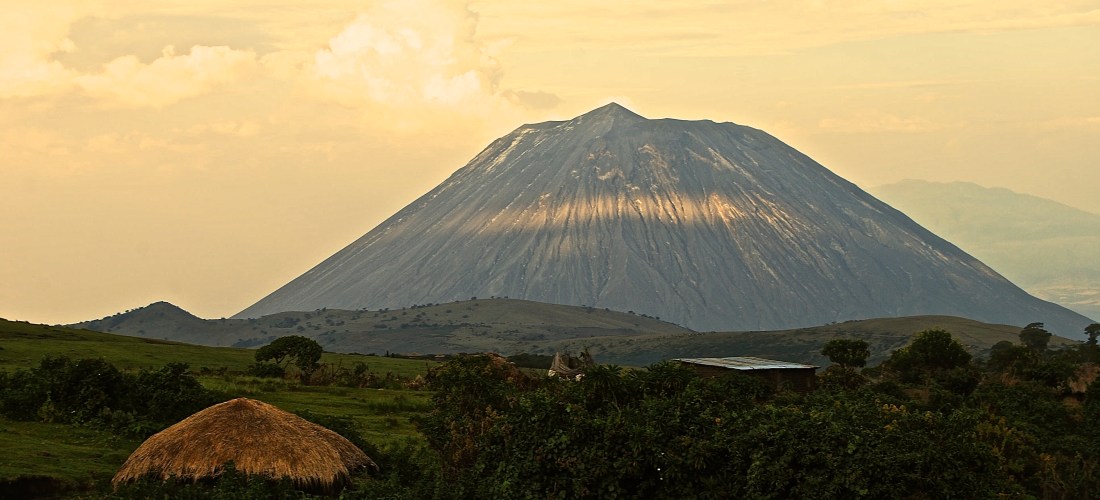
    Tanzania’s Ol Doinyo Lengai is the Mountain of God to the Masai people who live in its shadow. So central is this iconic mountain to their folklore that these East Africans venerate it as the maker of the world. Geophysicists would agree, but not for spiritual reasons. For the rock boffins, Lengai is the mother lode of raw materials that makes this mountain truly exceptional.

Still, this little tale seeks not to dwell on the stuff from which exceptional volcanoes are made. Rather, it’s about the stuff that we discover we are made from when gripped by the struggle to overcome fear, gravity, and the raw elements to reach a summit like Lengai’s.

The Mountain of God strikes a chord. God! It’s a mountain alright. For any rich man or woman who has taken on this 3,000 metre deity in East Africa’s Rift Valley, ascending through the eye of a needle to heaven disguised as a camel might be easier. From the watery labyrinth of cenotes in the limestone shelf of Mexico to the deep crevasses on Greenland’s icecap, the underworld is below us for good reason. Few, if any, of Earth’s natural wonders place that underworld over our heads. However, there’s one place where one looks up to look down: on the terrifyingly steep and slippery slopes of Ol Doinyo Lengai where the journey to Hades is straight up on the most dizzying of gradients.

Now you might wonder why a modestly-proportioned mountain on the warm, sunlit uplands of the planet could be damned. There are harder. True. There are higher. True. There are more frigid. There are more rarefied. There are more technical and more ragged, more vertiginous and more spiteful. All true. It’s just that Ol Doinyo Lengai is no mountain in the sense of ordinary. So banished is it from the range, so weird in its makeup, that it ought to be bagged and quarantined.

Tanzania’s second most iconic cone after Kilimanjaro, like Africa’s tallest point ninety-nine miles to the east, Lengai is not even a mountain in the classic sense. Rather, it is a volcano. Unlike Kilimanjaro, Lengai is neither dormant nor ordinary. In fact, there is literally nothing like it anywhere else on the known Earth.

Before the tale is told, a little descriptive background needs to be sold.

Tanzania’s only active hotspot, Ol Doinyo Lengai is geologically-speaking a stratovolcano, a perfect cone of natrocarbonatite material that shares a chemistry with none upon none of the world’s other roughly fifteen-hundred active volcanoes. Still growing year on year, it lies in the Great Rift Valley with the Serengeti away to the northwest, Lake Natron to the north, and the Crater Highlands featuring the famous Ngorongoro to the south. A serene majesty, it shares the throne with no other. All its crater siblings are long dead and collapsed, whose green calderas are filled with either water or wildlife. Alone it presides. Trusted by nothing and trusting nothing surrounding it, Lengai cuts a lonely, slightly sinister figure to whomever makes the descent on foot from the pastures in the relative cool of the crater highlands to the baking soda lake of Natron on the Kenyan border, a shallow alkaline icon of a lake where congregate some of the largest migrant flocks of pink flamingos anywhere on the planet.

On the approach the Mountain of God plays a game of deception, dominating like the hunched back of some primordial giant. From the thatched roofs of Masai huts dotted on their simple homesteads many miles away Lengai looms. How could it be anything but a God among men? When clouds mass over its rim – hanging around for a piece of the action as they often do given its amplitude and the brazen attitude with which it punches the air over the rift valley – a somberness seems to fall over its flanks, if sombre is something both mountain and God can feel. Lengai, you could say, is a widower in a world full of happy marriages: the marriage of the African sky and the African earth; of the million-strong wildebeest herds and their precious migration; of the Masai and their beloved Brahman cattle; and, perhaps greatest of all, how the colour of the lion’s pelt and the parched grasslands marry into a perfect camouflage arrangement.

As mentioned, Ol Doinyo Lengai is made of sterner stuff. Out bubbling from the open wound on its head is lava tapped from some wellspring of hot matter in the Earth’s mantle. When the crater floor is spattered with its lava, that lava is cold blood geologically-speaking. It is born at five hundred degrees Celsius, less than half the temperature of your average volcano. So cool is it, in fact, that apparently it can be gathered up with a dessert spoon (but only a fool would eat it). Because, or in spite, of the cold reptilian blood in its vein, the stuff that makes Ol Doinyo Lengai a God among tall and slender tribesmen in red shuka robes emerges without the signature glow of hot orange magma. Black and muddy brown are the colours of the bile it spews, glowing a dull red only when night falls. When the rain touches Lengai’s lava, within minutes it turns a paste-like white with a hardness of cement. Another unique feature is that Lengai’s ejecta shatters as glass when it comes into contact with high-altitude air.

Bizarrely, its volcanic outpouring hardly carries with it any of the silicates that predominate in the earth’s crust. Instead what channels up consists of 90% whitish carbonates of potassium and sodium, leaving the crater floor a strange feat of nature. Black strings of pahoehoe basalt on Hawaii’s Mona Kea this is definitely not. Quite how the segregation of the dominant silica and lesser carbonates happens baffles even the greatest minds in geology. Be that as it may, how does it do it? How does Ol Doinyo Lengai offer up its burning treasures on a spoon? How does it make liquid turn to shattered glass?

Their answer: Ol Doinyo Lengai is of another planet. That in itself makes it worth a multi-modal Phileus Fogg journey to climb and, with the Gods appeased, conquer, too.


…In the next part of my real-life adventure, I go in search of Ol Doinyo Lengai’s summit on a week-long trek through the Crater Highlands to my ultimate destination on the shores of Lake Natron. A veritable expedition, with my trusty, sword-wielding Masai guide by my side, we travel with armed guards, porters, cooks, drivers and even two sad-looking mules to the mountain.

Truly underestimating its ferocity, on Ol Doinyo Lengai will come a Mountain God that wants only to punish the trespasser(ine). The starless night, the unremitting rain, the desperate scramble to stay on the edge of that terrible mountain falling away onto the valley floor thousands of feet beneath….


(Image, © Trespasserine, 2014)


The Accidental Pilgrim

animals, Buddhism, Burma, dogs, Life, Myanmar, People, Reflections, Shan People, South East Asia, Spiritualism, Spirituality, Travel, Travel Photography, Trekking, Tribes

Bidding farewell to that little mongrel was not easy for any of we pilgrims. Those boy monks, hair all shorn, scalp dappled under the Burmese sun, cradled him like they would a baby, in the folds of those tatty robes of saffron red. Watching the eight of us trundle off, backpacks adjusted, into the cool of a highland morning, the boy monks looked more than equipped for the important job that lay before them. That in itself brought hope rising with another dawn.

For the Buddhist, love for even the smallest of things matters as much as carrying the entire weight of the world on a single fingertip. That much we saw there in their dark eyes, in their serene expression, in the oath of kindness they had taken from such a tender age to do the lion’s share of the caring that the rest of the world had given up on long ago in the pursuit of personal happiness.

A youngling may sleep easy when secure in the love that permeates the air. Now an accident-prone bundle of pup might not be the most astute of characters, but when an accident-prone bundle of adult human who has learned astuteness the hard way sees those four paws splashed across the chest of the apprentice ascetic, you just know that that dog has landed well and truly on his feet.

Yet, the creature’s journey through life did not start out with such providence. Nowhere near. When he crashed into us but a few short hours before, his destiny had appeared no different from so many other benighted souls in fur coats: born in a litter to parents who fucked but not out of enduring love, alive for no other purpose than to survive on slim pickings for a few years and then die alone on the packed earth of a litter-strewn back alley.

The solitary, poor, nasty, brutish and short life envisioned in Hobbes’ state of nature looked very much on the cards for this three month-old puppy. His only salvation seemed to be his obliviousness. But life has a funny way of confounding even the most pessimistic among us. For that happy and pitiful creature the winds of fate had turned full sail in the space of one day. We all saw with moistened eyes a feat that should offer a sense of calm to all our weary souls.

We started the morning early in a traditional Shan village deep in farming country. The Shan people of Myanmar, the long-isolated nation that British rulers called Burma, are a proud and self-sufficient lot. They occupy the central-east of this vast country where it abuts northwest Thailand and southwest Laos. Farmers, tribal confederates and a people proud as the chillies growing red on blanketed hillsides, they had been our hosts for the night.

Compared to other fraught margins of the republic, their land is considered safe enough to qualify as classic trekking country. From the former British hill station of Kalaw the walk takes the walker on three days of mostly gently terrain to Inle Lake, Myanmar’s second biggest. Through open countryside, on soil tilled and loamy for maximum crop yield, from that village the trek crossed a road and settlement before ending the second day in a secluded monastery on a wooded hillside.

We pulled in at a house-cum-diner for lunch. There where the plates came thick and fast, a steady parade of fellow trekkers filled up before pressing on. The undoubted star of an otherwise nondescript event was a puppy. Plump, carpeted beige and with a short black snout he could have been half-ursine. Unlike other strays, bony, coats dull from vitamin-deficiency, their natural beauty bred out of them, this one glowed. His cuteness and his daftness captivated all who entered, all except the local family who ran the show. Ignoring the sharp rebukes he received every time he bundled through the doorway and into us, this yogi was not your average bear. All the tourists could see that. We wrestled him on the floor and generally delighted in his brazenness and total lack of the kind of wariness that sets your average stray apart from your average family dog.

Upon leaving, our group assumed that this dog came with the furniture. Any fool could see that an addition like that would bring tourists from doggie-mad countries of the west flocking. But no, one man’s meat is another’s poison. We saw the local kids kick and threaten to maim him. Sadism is as sadism does. If indeed cruelty does come on the coattails of childhood, there was no adult on hand enlightened enough to show them the virtue in compassion.

Perturbed by this turn of events (myself and a lieutenant in Dutch Armed Forces, in particular), we first politely told them no, then beseeched them to treat him well. When that policy failed and still the puppy yelped, then coming back for more because he did not know as yet of man’s dark nature, our voices took on a more menacing and authoritative tone. Here we go again, I thought, another bullshit, untutored corner of the world that misguided Westerners take to be all spiritual and the panacea to all our industrial materialism if only we could be there and breathe it in. Here we go again, I intoned, supercilious arsehole backpackers from Western countries standing on judgement with dark-skinned lesser mortals exactly as the old colonials had.

And then, after no more than a smattering of words exchanged between our wonderful local guide and the family of villagers who would steal the innocence from that bundle of joy, we had ourselves a passenger. No more than five-foot-nothing in her stocking souls, she took that little dog in her arms and walked it right out of that village. Taking turns to carry the bundle, some miles out of town, on the margins of a field where things looked safe enough, that dog was gently lowered onto the banks of a gentle, swirling river where the girls got undressed and the wappy delirium of his reaction was enough to restore the faith of the most doubting of all doubters. In that moment, I could see that the Dutchman was falling hopelessly in love, and it wasn’t with any girl in our entourage. As was I.

Other than a heart-stopping minute or two whereby the pup went AWOL in the bushes, we kept a trained eye on him throughout. Through cultivated land, over grasses concealing a whole weaponry of reptilian delights, we pressed on, him trotting along demented with excitement then in our arms overwhelmed into sleep by it. By nightfall our destination had come upon us: the monastery. Rarer sights there were few, fewer still in the rich realms of my experience.

Checking in with our newfound trek mate, our group settled in for an evening of food, drink and merriment in the longhouse where pilgrims come to exchange life stories. There the bungling little fellow did it again, crashing parties, receiving honorary VIP status quicker than an A-list Bollywood star. In the dimness over drinks the Dutchman and I conspired to wrest the little guy away from the tight grip of a German sitting at the next table.

‘Typical,’ he lamented, ‘first they invade my country, now they have the cheek to take my dog.’

‘It’s not your dog,’ I protested. ‘It’s ours. It belongs to us.’

‘Okay. Seeing that Britain did its bit in the war, you deserve a piece of him, too.’

Emboldened by our joint declaration, we invaded the neighbouring table. The kindly kidnapper in question was none other than the German who had offered me brandy in our guesthouse two nights previous. We Europeans, I mused, we should stick together. The dog might be our common interest, but I demand, like a good contrarian from Albion, nevertheless to take back control from those dastardly Europeans. All the while, the puppy curled up, stretched out, did what puppies do in other parts of the world where they are loved. Ignorance can be bliss when you stand twelve inches above the ground, where the world is for big licks and sniffing, snaffling and capers.

When finally the time came on the following morning to pack up and go, we were left with more than a minor detail. What now? Today is New Year’s Eve, the culmination of a three-day stroll in the back country of Burma, the end of a long year of trails and trials and tribulations that tried the patience of not one but a pantheon of saints. We had snatched the dog from the grip of misery. That very deed cannot, must not be sullied. Anything less than a happy ending would be a sad and treacherous affair. Not to undermine the quiet heroism of our guide – who was a gifted young woman, in every sense the inheritor of a new Myanmar reacquainted with the world at large after decades of self-imposed exile from the world at large (the new Aung San Suu Kyi in the making?) – came up trumps again.

Acceding to her request for its sanctuary, the monks agreed to take our dog and to raise him and raise him well, in a loving and trusting community where he would grow to be wise and great among dogs. Given enough time, given enough chanting of mantras, our puppy may even be born again human.

That day, as we headed out on the trail to watch the monastery become the forest, the forest become the lake and the lake become the closing of something special, we knew among us, without needing to iterate, that the experience with that little dog had made us all in the process a little more human.

A Life That Laughs Last Laughs Loudest

fate, free will, future, Life, Oddities, philosophy, Reflections, Travel, Uncategorized

What does a man do with his life while he’s waiting for the real thing to get underway? He can start by picturing all the different scenarios of how it’s going to be, this life he envisages. He might take stock of where he is, what he’s got, where he’s going. He can even look around asking himself was I really meant for this? Did fate get the wrong man?

I never thought for one solitary moment it would cut this way. Never did I imagine I’d end up here by accident, far less on the permanent basis that it actually is. I remember seeing this land ten years back now. I was en route at the time to somewhere else, some place so unimaginably different, in every conceivable way, that I did not know that such a place as this one i was merely transiting through could exist on such a hot, barren and dusty land. When I set foot on that baking tarmac at that fast-expanding international airport it must have been for no more than a hour of getting off one big bird and onto the back of another. It seemed fitting that this place be the staging post and not the destination, for who would choose a destiny as this?

I can still see it now in the backroom of my mind. I visualize taxiing down that apron. The size and scale, not just of the surface area of the airport itself but of the ambitions that had gripped the powers-that-be in that young nation, were such that the bus from the jet to the terminal felt about as long as the flight from England to the airport had been. Even though there buzzed a certain energy to the place, I was not faintly interested in sharing their vision. To think of human history in an accelerated phase, the town was gripped in a frenzy of development, development of the kind that reminds you of a new pharaonic Egypt, built with hot haste and grandiosity by a vast army of freemen slaves under the discreet and watchful gaze of those city fathers plump with fabulous wealth and riches beyond the comprehension of the average Joe. Still, they could keep their gilded city at the edge of the empty quarter as far as i was concerned.

Distinctly unimpressed, I vowed not to miss that connecting flight. This transit town, although abuzz with the bold ambition of a late arrival eager to impress, would never be revisited by me as I saw it then. I and it were just too incompatible for a lengthier reunion. This place left its calling card alright. That card most closely resembled the king of diamonds, glittering the crassness that unlimited amounts of money can buy. That stench of ephemera. Even then I could see that it wouldn’t end well. Ozymandias writ large. What was now about to shine on the world stage would in the nearness of time (while London and Paris held on into a graceful senescence) be reduced to Shelley’s ‘colossal wreck, boundless and bare.

Nothing besides remains, not in a desert at any rate. When sand is ground down there is only dust.

The high entropy of all that sand would eventually rearrange the cosmetic face of this transit town, erasing all trace that we were once here. Nature’s infinite crystals would bring down man’s vanity, his attempts at immortality. At least, in my fertile, jet-lagged mind, that’s how I saw it. Fast forward ten years and those grand human designs were for the most part realised. That army of hired labour has been busy in the decade that intervened. The skyline is now a bric-a-brac effort of borrowed personality and epic proportions. My prophesy of never returning to a place so at odds with what I valued and how I saw the course of my own life rang hollow. But blown on the wind of globalization I did come back to that transit town to work and live. Oh the irony of it. Maybe if I vow never to set foot in the Redwoods of Northern California, I will end up there, too.

Well maybe it is just the time of year, Or maybe it’s the time of man, I don’t know who l am, But ya know life is for learning. Praise be, Joni, for sparing me the effort of summing it all up. Never knowing where the wind will blow us, we float. From place to place, time to time. And life is for learning. Look at me now sitting in this fancy apartment, not sixty miles from that transit town. Those cranes like derricks engorged with oil, I see them now as I was climbing the steps to board that plane. It could have been all my yesterdays ago. Like giant mantises praying on the far edges of the desert under a shimmering, jaundiced sky, I witnessed with fleetingness the birth of a nation. I am its age which, given the immortal life of the rock and sand on which it stands, sounds somewhat absurd.

So, the staging post became the destination. And the destination continues to elude. Life is funny that way. Not making its intentions clear until often it is too late to disagree.