Flying Over Planet Lockdown on a Magic Carpet Ride

adventure, agriculture, Cities, climate, conservation, Coronavirus, counter-culture, developing world, environment, ethics, EU, future, futurology, Imagination, Life, Lifestyle, natural philosophy, natural world, philosophy, Reflections, revolution, Society, Socioeconomics, thoughts, Travel

It’s 2030. Imagine you could select anything from home to power your low-level flight around the planet. It wouldn’t be the stressed planet we have come to know. It would still be a human planet, but one rather unashamedly changed from the one you knew and despaired of back in 2020.

The overhyped pandemic of 2020, the one that had the world all in a panic to the point where it effectively closed human activity down, produced unexpected outcomes. No one quite knew it at the time, but the quarantining of humanity inadvertently gave breathing space to all terrestrial life that had been trampled in the poisoned dirt since the mid-20th century. Gone were the crisscross scars of vapour trails from planes all across the sky. Gone too were the ‘conjunctivitis domes’ that enclosed all but a few cities and towns in hazy, acrid pollution. More than anything, gone was the constant background noise of society consuming itself into an early grave. At first, even the most misanthropic kept tight-lipped about how the lockdown was having anything but a deleterious effect on them. They wanted to tell everyone about how delirious with happiness they were, that they were reconnecting with the world around, how the spring had never seemed so polarised with deep colours, and how the silence of everywhere had led to a great sonic peace across the entire sky. While patients with Coronavirus were gasping for their last breath, the guilty enjoyment of the majority who bore no symptoms seemed unutterable. But as the lockdown went on, more and more started to admit there was an upside to the downside of putting industrial society on ice for a while. While they cited different reasons for secretly enjoying the mass meditation retreat that the world had become, a common theme began to emerge. The average Joe and Joanne hadn’t been happy for a long time, but it was only through the Covid lockdown that it struck them exactly why.

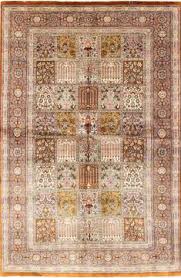
I would select my cherished silk-on-silk rug from Kashmir as my means of transport, the one I bought for a princely sum from Kashmiris in a bazaar in old Kathmandu. The colour is light green with pink woven into the borders. When you brush your hand across it, the sweep turns it darker or lighter, not unlike suede. The pattern is distinctive: 32 geometric panels depicting the Islamic Garden of Paradise, including pomegranate trees, arbours, plant pots and rambling rose. Tradition tells that this is a design from the revered Iranian town of Qom, from where the finest silk rugs and carpets on Earth are spun by weavers with magic fingers. Hence, magic carpets. If not that precious (and surprisingly tough) silk rug, I have another I’d consider riding on over a changed world in 2021. This one is an Islamic prayer rug (although I do not profess to be a man of any faith, other than faith in myself). I bought it from a reliable dealer in the Emirates, but the thing itself was woven in Northern Afghanistan and is exceptionally beautiful. Not of silk, this short-pile rug is of the finest wool dyed with the madder root into a colour resembling the dark dried blood of many an Afghan who has spilled their veins throughout the long war. Yes, my choice of long-haul air transport would be either the Kashmir silk rug or the Afghan prayer rug. Then again, for spaciousness there’s also that large tribal kilim from Tabriz in my collection. I could spread out on that during my transcontinental flyover. I’ll need a flying jacket and goggles, as it might get chilly, breezy and bumpy riding up there on the thermals. Oh, and my Leica monocular, too, so I can peer into the lives of others, and to see how the wildlife is coming along.

The roots of popular unhappiness, more and more started to realise, were becoming evident in the pleasant results the lockdown had produced on the wider world. Where the pace of life had been pulling us at 5Gs in a centrifuge, instead of being forced outwards the lockdown had now turned the force inward, to where we were all falling forward together into an attractive centre, which I call a natural equilibrium. Where previously few had any time for anyone else, they now found themselves devoting newfound time to the human relations they once held at the fulcrum of their world. Where many were being sucked into deadly debt traps, they now saw another possibility for an economic model that extolled the simple, organic life. Where many couldn’t sleep for the din of a society that had turned into a screaming lunatic asylum, quiet lockdown nights brought quiescence to tortured minds. It also revealed what had always been there but droned out: birdsong, and other naturally-occurring sounds. Where tens of thousand of species teetered on the brink of extinction due to human unwillingness to share, humanity finally agreed that the wild places were too few and the tamed ones too many. Monoculture changed in the agri business. Farmers were now harvesting goodies from the broad-leafed forests they had let grow in the vacuum of brown fields whose soil was depleted to the point of exhaustion. Animals that had resisted extirpation by laying low during the worst of our planetary abuses, and generally driven to the edge by our selfish species, followed suit. Population policy aimed at natural reduction, allowing crops to be grown vertically in great agri-towers that ran on sunlight. Where our industrial-age fear of the dark had produced so much halogen light to power society through night after night, so the lights went off and the stars returned to twinkle over what were sulphurous megacities. Something else unexpected returned: the sun. The industrial age had whipped up a dynasty of stormy weather by seeding every cloud with effluents and contaminants into raining. Gone was the chromatic aberration caused by poor air quality. Now the portrait of the planet looked pin sharp and didn’t we know it.

A revolution in the mind happened soon after the lifting of the 2020 lockdown. People wanted it back. They may not have professed to wanting thousands dead of a pathogen, but what they did want was to mitigate the disastrous effects of the human project by blocking off one month in every year where systems ground practically to a halt; where only essential distribution services, such as food and medicine and so forth remained a mainstay priority. Of course, they were compensated financially, but this would decrease over time as we moved away from heavy borrowing and high expenditure market economics to an ecological model of sustainable productivity. So, there you are on the magic carpet, skirting over the planet.

Ten years have past since the lockdown revolution/revelation of 2020. The annual month of fallow is now enshrined in UN law. Every nation is a signatory. Even the U.S., that resisted for so long because it was a concept engineered through the myth of the American Dream to exist only by maximising capital gains in every overworked American, even they got on board. China remains the dark horse: tense on the issue because the Chinese are caught between their philosophical tradition of Taoism and their love of making money by ramping up industry to ridiculous levels. Europe, being the old man, was at the forefront of the new paradigm for living. The Continentals approved wholeheartedly of this nouvelle approach to tempering things down.

Mechanisms were put in place to ensure that the other eleven months are not abused by the rush to over-productivity, as this habit came to be scoffed at for its backward greed motive. As a burned-out race we started mellowing. Our eyes were evermore open to the great clockwork of nature and how we – contrary to the proud fools that modernity and progress had made us – had broadly accepted our fixed role as a cog in that natural machinery, and not – contrary to the arrogance of our predecessors – as its clockmaker. Delegates even took to doling out liberal sprinklings of Gandhi’s wisdom that we live simply so that we may simply live.

What do you see, future me, when you look down from way up high on that Afghan rug in the new blue sky?

The Curious Case of the Dog on the Final Day

#adventure, abandonment, animals, cruelty, dogs, environment, europe, fate, forest, kindness, Life, nature, neglect, Oddities, Spain, Travel

Going somewhere exotic to rekindle lost love can be as worthwhile as flogging a dead horse. Until, that is, a minor crisis connects you both in ways you never knew possible. Even if it’s not enough to save a relationship, a double act of kindness can prove a fitting finale to a great affair.

As befitting a relationship that bloomed then faded over two dozen countries in a dozen years, my long-term partner and I met for a showdown in Almeria, Spain. A beleaguered ‘marriage’ was at stake. The intervening years had taken their toll on our inseparability. We fought one another on many fronts in many theatres of war, but always patching up as spectacularly as we had torn each up. Love was no more in the air, though I had hoped it might start suffocating us again blissfully as it had done a decade previous. From my vantage point, this was our last crack at compatibility. And we were going to give it our best shot under the blistering Spanish sun.

To cut to the chase, the endeavour didn’t start well. The bickering picked up nicely after a couple of days. Minor irritants swelled to the point where failure to turn the key to the hotel door resulted in fits of rage the likes of which no Hollywood diva could match. When personal insults fly in the face of what are little mechanical glitches, you know the noose is tightening and the game is up. There was only one antidote to the bitterness: find a place of serene calm off the beaten track. Let nature be our balm.

At the headwaters of the Guadalquivir, lying in the Parque Natural Sierras de Cazorla, we laid down a truce. And, lo, it held. Autumn had repainted the landscape into the most beautiful hues of mustard and rust red. The poplars, standing tall and alone in the saddle of the Sierra, rattled like a thousand tambourines in the breeze. Myrtle trees dropped tiny leaves around us. Confetti for our renewed marriage vows? The portents were good until we reached the source of the once-great river, now reduced to a trickle. So this is the source of our love? The waters of the famous Guadalquivir, running dry because there was never anything upstream of any substance. Is this to be the quality of even the deepest love between two people?

On the Almerian coast we stayed on Cabo de Gatas peninsula, Spain’s southeast cape. A tremendously evocative spot – its rock walls plunging into the Med – we marvelled at the palaeontology of the place: ancient coral reefs submerged off the coast; at four hundred million years old, some of the world’s oldest recorded. A half-finished hulk of a huge hotel, intruding into the delicate coastal ecology. Abandoned before it was ever inhabited, the developers threw up the superstructure without soliciting planning permission from the municipality, as if local government would ever consent to an eyesore of a hotel in the midst of a national park. That chimed with me too. I saw parallels with my faltering love affair. We lay foundations on precious living bodies we have no right building on. That’s love for you.

By the holiday’s end, the salvage operation was about to be called off on the relationship. No amount of romantic landscape was going to inject new blood into old veins. With a couple of day remaining until our final farewell, the two of us wound our way to Baza, a forest high up in Andalusia’s very own altiplano. Elevated to nearly 900 metres, the air was rarefied and the sky cerulean blue. Night would bite. There the trees bristled in anticipation of winter as pines do. Knowing we were calling time on our amazing life journey together, a sudden calm came over us.

Driving through the forest, an animal ran out in front of us. Stopping, we saw it was a dog with big, lolloping ears and a cropped, silver-grey coat, known as a Weimaraner. How odd, we remarked. A handsome young animal with a great pedigree out here in the middle of nowhere. It was agitated, you could tell by the way it paced up and down the road as if looking out for a car that never appeared. Curious, we parked up and observed the dog, who was so distressed our presence barely merited a sniff.

Upset by the sight of this dog darting around in bewilderment, we resolved to do something. Approaching, I saw she was both a bitch and young. With swollen teats she was also a mother minus the pups. Being a Weimaraner, she was friendly and intelligent. Clearly, she had grown up in a human home. I lifted her underside to place her on the back seat and she trembled. Our drive underway, we noticed her quivering in fear and bewilderment. This dog was at best lost; at worst, cruelly abandoned.

Stopping to ask foresters we met in a nearby clearing, they explained that hunters often drive their dogs up to this remote spot where they encourage the young females, already having produced a litter or two, to hop out only to drive off leaving them there. The ones that do survive the wild are found in state of shock. No different from the global trade in trafficking west African women to the Gulf to service male needs then. Use them and abuse them then throw them away.

This news angered the pair of us. After years, we could agree on something. Determined to right this wrong, I drove down the mountain. Finding ourselves now on the plains where Sergio Leone shot the classic Spaghetti Westerns of the late 1960s, our purpose together had finally been revealed: find the dog a home before tomorrow when we go our separate ways forever.

Being a Sunday in a Catholic nation, not much commerce was going on. The streets were abandoned, probably explaining why the location was chosen for tense gunfights in A Fistful of Dollars. A curtain of golden light was falling on the day’s end and we were feeling pressured. The poor dog cowering in the back didn’t help. We called the vet, but the vet must’ve been at vespers in the local church. We called a dog shelter. That too was closed. Taking the Weimaraner back to England was out of the question at such short notice. As the day shortened, our problems lengthened. It was then that we pulled in to a ranch-style trattoria. It was vast and its interior plush in that rustic manner. Whomever owned it was a wealthy man. Again, with no sign of life the two of us wandered round the back to the kitchen where the door was opened. Popping our heads around, we asked for the manager. They sent the owner. He was a tidy-looking man without pretension. Explaining our situation he fell silent.

’Show me this dog you speak of,’ he said.

Impressed by what he saw, he backed away. ‘I have one already. I cannot take another dog,’ he lamented. ‘Even if she is such a fine animal.’

Disappointed, but understanding, we took our leave. As we were exiting his palatial roadside restaurant, a tap on the window. It was him.

‘Tell you what. Here’s the deal. I go to my Land Rover. Now, I don’t know if I left my own dog’s chain on the passenger seat. But if I have, I will take care of this dog of yours. If it’s not there, you’re on your own.’

Walking with him to his car, he swung open the passenger door. The seat was strewn with papers, but there was no chain. He slammed the door.

‘Lo siento mucho,’ he said.

Our hopes fading fast with the daylight, again we took our leave. Seeing the dog’s face forlorn against the window, my soon-to-be ex and I looked at each other with renewed vigour and certainty, for the first time in I don’t know how long. ‘We cannot just dump her by the side of the road.’

‘But I have to return to England tomorrow,’ I answered.

‘Not before we find the dog a home you don’t.’

Turning, I caught the trattoria owner out the corner of my eye. He was moving toward our car, his hands behind his back.

‘Look what I found in the footwell,’ he smiled. ‘It was under all those papers.’

In his outstretched arms he dangled exhibit 1, the dog chain.

‘Fate decided.’ He said with a warm reassurance we knew would translate into responsible ownership.

‘You will care for her? You won’t leave her abandoned a second time?’ You promise?’

Casting his hand as if to magic into existence his beautiful roadside trattoria, he replied. ‘I look after things. And I don’t give up on a promise.’

Without flinching he clicked the hasp of the chain onto her collar ring and calmly trotted off with the Weimaraner, who by now had ceased quivering. With the dying rays of the day warming an old wooden shack that could have been a stage prop in The Good, The Bad, & The Ugly, we pondered the view and with it possibly the life we had shared for all those incredible years that brought us to this final day. It had all been thoroughly vale la pena. Worth the pain, as they say in Spain.

Life Signs Vital

#adventure, Australia, Britain, British Isles, Buddhism, fate, free will, Hinduism, human mind, Life, Lifestyle, meditations, Musings, nature, Oddities, philosophy, predestination, Queensland, Reflections, roadtrip, serendipity, Solipsism, Spirituality, thoughts, Travel

From the wandering star followed to Bethlehem by the Magi, to Constantine and his Latin cross in the night skies over Rome’s Milvian Bridge, for as long as any historic text can remember, humans have acted not (as they might like to imagine) independently in matters of life choice, but as a response to phenomena out there in the world. Whether these phenomena involve snapped branches pointing in a particular direction out of the tangled forest, serendipitous meetings with mysterious strangers, or even constellations that speak directly to the individual in us by spelling out our mission in dot writing, natural events have proved unshakeably reliable as SIGNS ripe for following. Other animals follow their hunger and their paternal instinct toward the rains, or the seasons, or the ocean currents. But not us. Oh no, not humanity. We follow abstract signage in the most unlikely of quarters because something in the form and motion of a sign tells us that nature exists to furnish us with little messages put there FYI only.

But in an age of scientific materialism, should we listen to superstitious signs, or let mediums self-appointed with the power to interpret that symbolic value for us. The Gypsy lady? She who lets the tea leaves/coffee granules to settle into a discernible form spelling out (in her own inexplicable way) what’s in store for each of us? She with the singular ability to divine the past, present and future, and thus able to cut a path through our impenetrable present? Hooped earrings and colourful headscarves aside, should we even listen to ourselves when something out of the blue tells us which corner to turn in life? What is it in the nature of choice, the one true act of free will we convince ourselves is ours and ours to fuck up? Are we slaves to signs, subconsciously letting them lead us on into what we think will end either in good life choices or, horror of horrors, outcomes less than desirable? Do other members of our rapidly-proliferating species see signs with quite the obsessive sensing that I seem to? Questions, questions, questions, and only vague signs there to answer them.

I wrote a woefully-neglected book back in 2007 called Signs of Capricorn. Essentially, it was a free-thinking, free-spirited, faintly philosophical travelogue based on a long-awaited return to Australia. I had left the land Down Under in 2003, instantly regretting a choice which i deemed purely my own, without any other agency. At the time, I must have figured if i return to Britain things will be different. I’ll finally, after thirty years of trying and failing, fall in love with the island of my birth, and especially those two peculiarly British contributions to the world: a stubborn class system and a maritime climate that makes the headlines most days for all the wrong reasons. Yes, my family were instrumental in my going back. Unlike the weather, they weren’t changeable and horrid. But, like the English class system, they could be stubborn.

So, in the wake on my grand homecoming in 2003, I realised I had made a major life error, and instantly vowed to overturn this disastrous decision by going back to Sydney the following year. However, as the venerable Lennon said, life’s what happens when you’re busy making other plans. Suffice it to say, it wasn’t until 2006 that my pledge was finally realised. I departed a rainy Manchester, arriving after a brief stopover in Dubai, in to a hot Sydney. The city had changed in the intervening three years. That much i could detect within moments. It didn’t feel the same. Well, of course. Why would it? And here is where the book comes into play. I threw my hat up into the air and let the winds of fate carry it aloft. And so it was that I chose to spend a month driving as far and wide as I could in search of signs.

A critical factor in all this unfolding story is that I was misinformed that my Australian Permanent Residency visa would be duly reauthorised merely by going back there on holiday. Cruelly, this was not how how the immigration system worked. Nor was this how things were meant to be. On hearing that I had not amassed sufficient residential time in Australia within a 5-year period (i was a month short), I was faced with a binary choice: by all means, stay indefinitely (thus leaving my rental home, family and beloved dog back in Yorkshire where my family call home) in the Commonwealth of Australia; or fly out of Kingsford-Smith Airport and back to Heathrow, but do so knowing the consequences. That being an annulment of my right to remain in Australia. Visa cancelled. The term Burn Bridges springs to mind (another historical instance of how signs influences the course of a lifespan, in this case of Caesar’s Roman Empire). Mainly because of my dog, I knew I was going back, like it or not. With a month’s adventure ahead, I drove north through Queensland’s Sandstone Belt and out to the Barrier Reef. Along the way, I followed roadsigns down highways where life signs clung on like the spinifex grasses that give the Outback its patchy head of hair.

On returning to Britain, I nursed a quiet devastation. My first encounter – the first of many troubling signs, you might conclude – was with my neighbour, an awful human specimen who spent his disempowered life fulminating in one garden-wall dispute after another. In Old England, where most people are packed like sardines in a tin can because the entitled few own and jealously guard huge swathes of the land, such disputes and tensions are not uncommon. Knowing that I had made not one but two cardinal misjudgements in leaving Australia (an island-continent I had reimagined as being above such petty squabbles between neighbours) not once but twice. I knew the recurrence of this poor choice must signify something. It must be life’s ineluctable way of telling me I had, in fact, made the right choice leaving Sydney. Struggling to understand why, I wrote the book as a therapy, as a means of retracing my steps in order to discover the origins of these signs, and what they could possibly mean for my life, one that seemed to be in disarray.

You can generate the data to fit the theory, but that is not true science. Or you can map the data (as it appeared along the road to the Barrier Reef on that epic trip of self-discovery), building a picture through which a workable theory emerges. First data, then theory, then test of theory. Burning rubber on blacktop, I probed the island-continent to probe the answer to why life had turned out this way. For such a dry landmass, the results were improbably fertile. Hadn’t one of the great Greeks said something to the tune of….’life is played out on an ocean of timespace, whose currents carry us of their choosing unless we find it within ourselves to take the tiller and steer a course, even though the current will still take us, ultimately, where it chooses. In short, we can infer signs in life and so effect small but significant changes in our lives, even if the grander designs, such as fate, love, accident and death are not within our remit to shape as we would see fit to?

(n.b. of course, most of us would choose to be rich, healthy and loved, and never to die).

At journey’s end, I flew back. The immigration officer at Sydney’s airport peered at the visa page of my passport and asked me if I was sure I wanted to do this. You realise that if you leave you cannot come back? Helpless, unsure if I had even found a green light on those outback roads, I timidly acknowledged the gravity of what she was saying. Somewhat bemused, she stamped the exit visa and that was that. Another chapter closed. Except it wasn’t. Once back in England, I threw myself into the writing. Stapling together every little back-dated detail on what had been a diverse but disconnected life of travelling, of living in disparate regions of the world following love over career, the unpredictable over the predictable, I tried but could not discern signs that would lead me out of this mess of my own making.

I looked around. I looked inside. I could not make sense of life’s highway code. At the end of the book, life appeared to recover. Things were looking up. England didn’t seem quite so dismal, nor quite so synonymous with personal failure and utter alienation. And then the possibility dawned on me that therapising the experience of making life-changing choices had had the inadvertent upshot of detoxifying – for want of a better word – Australia from my bloodstream of consciousness. The book flopped but thanks to reclusive and intensely introspective nature of remaking memories in narrative form (a year locked away in a room), I steered a course through cold turkey. What emerged was acceptance that i had taken a wrong turn. Moreover, that ages hence I might actually find that leaving Australia when i did was not a misreading of signs at all. Rather, it was a correct reading of the sign to leave when I did and to return three years later to make peace with the war that was raging inside for all that time. It was not unlike the signs of Outback roads themselves – the ones that appear only once, at the beginning of the backroad, and where no signposts will appear again for many, many kilometres. Following a sign laid down years before gave to no signs whatsoever until the next one appeared. The next one would appear near the end of that stretch of bitumen. It stood as proof positive that the next junction led somewhere good, somewhere new.

Signs are everywhere to be followed, and yet nowhere to be seen. We convince ourselves we take decisions independent of influence, particularly from abstractions such as physical objects (stars), chance encounters (accidents that change our lives irrevocably), epiphanies birthed from freak occurrences (a spiritual awakening on the road to Kathmandu), and the likes. But our rational minds are steeped in the mythology of the inexplicable. Knowing that every weighty little decision rests solely on our steepled shoulders, or that each one is not interrelated, represents an unbearable burden on our lives. Decisions are ours to make? Oh yeah? That I followed invisible signs to where I am now (which is no bad place) suggests some things are meant to be. That all things might, just maybe, be more bound together than our Western social constructs would have us believe.