
Life, so they say, can be stranger than fiction. This fact, or rather this fiction, can be evident in everything from the unexpected to the plainly weird. We see it when we view the world as a stage full of actors, props, scripts, and backdrops. You only have to cast an eye back to Macbeth (life…the poor player that struts and frets his hour upon the stage) to know that even the Bard agreed with me on this score. Life as theatre; landscape as backdrop; weather as atmosphere. It’s hard sometimes to frame even the most staid human life without the injection of a little dramatic licence. The actor’s role may be minor, his input stuttering at best, but life being theatre the director can always throw in a little squall of wind and rain from the rafters to enliven the backdrop, as well as to defy Shakespeare by making life signify something instead of nothing.
The unnamed stage director – the identity of who or what is behind all this is a question for the ages – has seen fit to sprinkle onto his now dreary play that pixie dust that might help pick up the pace. With the play in a lull, and with not a great deal to stir the protagonist into something approaching life, attention turns to props that fill the backdrop so as to crank up the drama. In a near-perfect mirror image of one man’s life and its fictional mise-en-scène, the backdrop outside my window more than compensates for a dearth in action on stage. Outside an ill wind throttles trees, horizons are blighted by the murk of an uncertain present time, and what falls as rain falls always. In the theatre of fiction, even there they’d struggle to keep up with the scene out there.
The same rain that hath come, goes not. Like a burrowed cancer it refuses to yield. I thought the apocalypse was the sole bringer of incessant rain. In the Blade Runner an ecocide caused by meddling Man has bruised the sky such it bleeds rain unceasingly. In Apocalypse Now, Marlow’s painted face is washed unclean by a tropical downpour as he creeps upon Colonel Kurtz to deliver the bloody coup-de-grace. In the Old Testament, God sends the almighty heavens to wash away the sins of Man, but not before Noah can construct an Ark of salvation for the innocents. How wrong can a man be? This is no apocalypse now. This is an island but not unto itself. Rather, it sits on the edge of a vast, churning ocean of grey. That ocean has a big old surface area and on that surface the water temperature is creeping up such that the water cycle is heating up. More prone to evaporation in the warmer winter months, more driven by a stronger Jet Stream, the quantities of rain are becoming prodigious. The frequency of this natural event has gone from what is sublime – a thing of beauty when rain comes only when rain needs to fall for plants to regenerate and for rivers to replenish themselves – to what is absolutely ridiculous.
Here in this region of England’s SouthWest, it has rained practically every day since the end of September. I thought these meteorological conditions were the preserve of film noir, graphic novels, and dark, sinister fictions. But no. Life, as we know it here, has emerged stranger than fiction. And like the strangers no longer welcome to Brexit Britain 2.0, the strangeness of seeing rain every day for months on end, well, let’s just say the wet has outstayed its welcome, too.
How has it come to this? Speaking personally, not eighteen months ago and I was positioned at the edge of a vast empty quarter where life was also stranger than fiction. There, the rain fell so infrequently we assumed it had been engineered to make its annual appearance on National Day. Some said the Air Force existed purely to seed constipated clouds that refused to precipitate. When it fell, it took more airborne dust than water with it. Touching earth, the drops fizzled before withered roots had the chance to prosper, though now and again flash flooding would send cascades down parched valleys, turning the deadened mountainsides green with a Lazarus resuscitation. Fast forward eighteen months, the inverse has become the new norm. Different place, same old shit. An Age of Extremes is where we are at. Over here, we’ll soon need the Red Arrows to disperse the clouds just to reassure a benighted people that there is a sun somewhere in the sky.
These are funny times indeed. How rare that you can travel the world in search of extremes only to come back ‘home’ and find conditions you’d struggle to find even in India during the monsoon. All of October, all of November, December, January, and now well into the third week of February. When will it end? Can the clouds deliver so much without respite that the land can take no more? Once rivers have burst their banks and storm drains froth and bubble like the blood-soaked mouth of an Ebola victim, where can all this water go? It seeps underground into vast subterranean chambers and hidden river systems until all the caverns are drowned and the soil beneath our feet starts spouting little springs in the oddest of places. And still the developers buy up the last remaining acres of cheap land on floodplains where they lay their flimsy foundations to sell onward those dream homes that would be better-suited built with a hull, a prow and a stern ready for the inevitable. And still we refuse to advocate the slow and humane replacement of burgeoning human populations with tree saplings that nature anoints into magnificent sponges whose roots drink their fill and much more. Life is indeed stranger than fiction.
There was a time before us when Gaia (the living, breathing skin of the Earth) posed the greatest challenges to life on Earth while providing the greatest answers to them all. It threw everything at itself and then brushed it off. Every action had a reaction, which was beautifully synergised. Mother Nature led a three billion-year dynasty of dynamic equilibrium. I don’t know if we are capable of such balancing acts. We stand on the high wire but only to teeter on the brink. This weird weather would indicate she is growing ever impatient. Sensing our human shortcomings, will natural forces wrest back control? Will she return to lavish the sunlight on these dark, soddened corners? When again will fiction take back its claim to be stranger than life? I’ll tell you when. Only when Man goes back to what he does best, writing strange fiction, will nature go back to what she does best, writing the beautiful story of life.
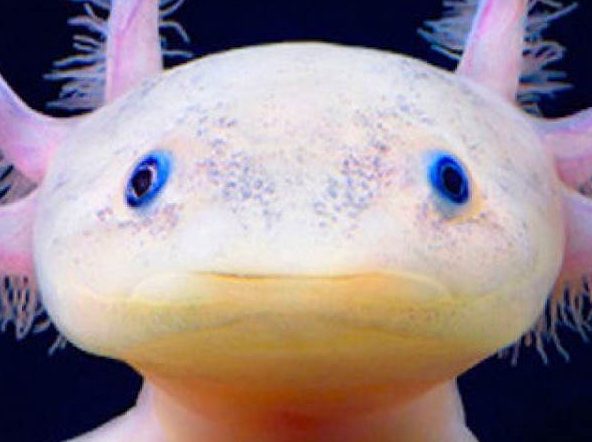
 The Blind Salamander