
The Five Corners of Love

#adventure, America, California, Travel, United States

Pt IV

California, I’m Coming Home.

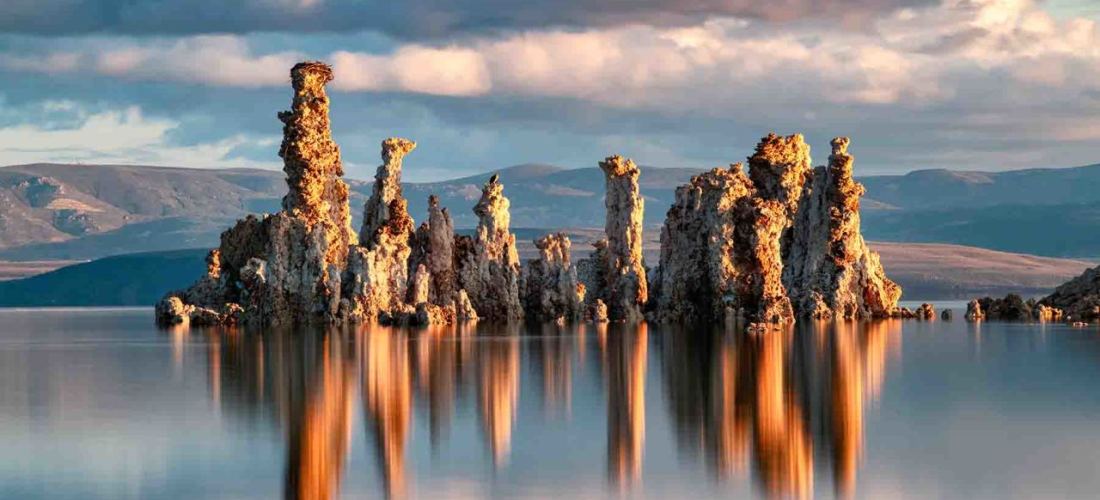
Mono Lake lies far from the major urban centres of America’s most powerful and populous state, California. Economists reckon that standing alone on the world stage California would be nudging Britain for the fifth spot in the league of wealthiest nations. But unlike Britain with its Lake District, Mono Lake is no Lake Windermere. It’s mono, and not stereo lake, for a reason. Unlike the collegiate system of lakes dotting England’s northern Lake District, this ancient body of water is geology’s orphan. Isolated in a parched landscape, with no outlet for water to either drain and replenish, the lake long ago turned to bicarbonate of soda. What would the Lake District’s very own poet-laureate, William Wordsworth, have made of Mono Lake had he been there during a lifetime that coincided with one of the greatest movements of humanity in search of treasure without the traditional mayhem, piracy, plunder and pillage: the California Gold Rush of 1849? I’ll tell you what he would’ve done. He would have wandered lonely as a cloud, imitating the desert sky above, until standing there on the lake’s edge he would have muttered to himself – and I mean himself for there would have been no one around for miles and miles – what in God’s name is this i see before me? For once, words fail me.

Once Wordsworth had beheld these alien surroundings he would have shifted his emphasis. From aghast to agog, he would have repeated the sentiment that living in England’s Lake District had instilled in him: that Nature never did betray the heart that loved her. But it’s hard to love nature’s jagged edges. Romantic love of nature here is forsaken. Here on Highway 395, Eastern California, nature is elemental. Here the planet is as troubled as a teenager. Lifted, folded, exposed, hidden, the geology of Mono Lake is akin to that little blister on the skin of the Earth that, to heal itself, seeps clear serum from deep in the interior. Up from the deep interior superheated water fills the lake, changing the water chemistry and that of the rocks on which the lake rests. Not unlike what you see in the Apennines of Italy, cracks in the mantle let groundwater settle down deep before being pressurised by geothermal heat and pushed up to the surface where it does something to the limestone, spewing out carbonates that form towers of tufa in the centre of the lake. You’d think you were on top of Ol Doinyo Lengai, the mud volcano in East Africa. To look at it, you’d think Mono Lake was a volcanic caldera with whiteish scabrous deposits revealing its true Hadean nature broiling away beneath waters that above it appear so innocuous.

It is here we decide to remain for a couple of days. Finding a hostel not too far away, we sense magic in the air. Dave, the guy who lives in an annexe beside the hostel, quickly establishes his credentials as the most sardonic Californian you’ve never met. I’m thinking he’s learned the ropes from spending too much time in Northern pubs until he tells us he’s never been to Britain. Why then the phlegmatic humour? What comes out your mouth is too dark, too barbed, to be Californian with all that floodlit optimism that doesn’t lend itself well to cynicism. The enigma, which is Dave, then decides to take us to the lake for a hot bath.

Once there in nature’s open-air spa we form a circle of cynics. Dave says bathers have been scalded to death by moving all of 6-feet into what they thought was a harmless wet and warm zone when in fact the lake had undetectable hotspots where the water gushes up at over 70 degrees celsius, very possibly higher. I stay rooted to the spot afraid of turning my already burned skin into a whole new level of heat damage. Never before have i bathed in geothermal springs. The experience is unforgettable as it is unforgivable. The sun comes on like a thousand-watt bulb in a cubby hole. The sky is deeply blue. Not a single cloud wanders by high over. Never before have I felt nature burning me from beneath as from above. I have found home away from a home that failed to feel like a home. As my life will one day end, I know for a fact I’m going to like California. Sitting there in an open-air jacuzzi ringed by mountains the thought hits me: I feel good here. After waiting a lifetime to visit, the reality exceeds the expectations. And that doesn’t happen with everywhere we dream of travelling to. This state might just be golden, after all.

With the soda rinsed off our radiant bodies it’s time to move ever west to the world’s best-situated city, San Francisco. But not before climbing up and over America’s last barrier of rock and permafrost: the Sierra Nevadas. ‘Frisco is a Mecca for the godless. It’s where Steve McQueen just about drove his 1968 Ford Mustang off the brow of a hill and into the stratosphere. It’s where Dirty Harry cleaned the mean streets of limping serial killers. It’s where the Age of Aquarius was first entered. In short, it’s where the West ends and new promises begin. And for that reason alone it was worth the pilgrimage.
The Five Corners of Love

#adventure, America, California, environment, Travel

Pt III

United Across the Great Divide.

All the way to Reno……

…….I was looking to segue from the last instalment into this one after a hefty hiatus of eighteen months. Once the mothballs had settled I should have known that life lays down markers everywhere only to let the individual decide to see them for what they are or else ignore them for what they’re not. This ‘gift’ came wrapped in an R.E.M. song title. How does one get from Denver to San Francisco in a story without travelling a thousand rugged miles in words? Answer: one cheats by picking a song title which says it all. Hey now, all the way to Reno. If you’re old enough or urbane enough to be listening to REM, you’ll know the number.

All that my memories will reveal to me about the long bitumen from Colorado to beautiful California was that the I25 in Denver led due north to Cheyenne, the state capital of Wyoming. We must have doubled back from our pioneer hut in the Rockies to Denver knowing that to reach central California expeditiously we would be better suited to heading north to Cheyenne before taking a sharp left onto the I80 through the prairie lands of southern Wyoming. The car delivery operator gave us only fourteen days to cross the continent. Adding that failure to present ourselves and their car at our destination in Sacramento might result in an FBI warrant being issued in our names, was enough to keep us from digressing too much en route. No sacrilege on the road to the Sacrament, that was the mantra.

Southern Wyoming, I remember chiefly as being the gateway to the world’s oldest designated National Park. We even spotted roadsigns denoting so. For Yellowstone turn north. But turn we did not, in spite of temptation that Jesus could have empathised with. The detour would have added days to the trip, and quite possibly – in our callow minds – brought us into the FBI’s ambit alongside Colombian cartel lords, the Unibomber, and a splendid array of serial killers.

West we drove through a sea of yellowing grass stuck to hills filed down by the Earth’s master carpenter, time. Through Rawlins, Rock Springs and Evanston, and onward we hardly stopped even after crossing state lines into Utah. At Salt Lake City on the southeast shores of the Great Salt Lake we kept on the I80. The city of the Latter-Day Saints sat there piously wedged between a mountain ridges running north-south. I thought it was befitting of a religious colony of New World Christian non-conformists that they found their new Nazareth in a place so far removed by distance from the Holy land yet so near in terms of the harsh semi-desert terrain upon which Christ built his broad church. They choose one helluva place to settle into unorthodoxy. The Wasatch to the east and north; the Oquirrh to the west, both ranges rising from the valley floor, pushed up until their ridges cut the arid air. In the midst of untrammelled wilderness emerged over time a city as different from any other in the Continental United States that anyone could imagine. So improbable it would end up cemented there but that was the pioneer spirit of the brutal nineteenth century. Those religious zealots with the pioneer spirit welling up in their eyes, they must’ve marched in unison over forest, river prairie and mountain until stopping there with the Rockies towering either side of them they said, this is far enough.

Outside of SLC a vast salt flat shimmers on the horizon. The I80 slices through it, a gesture of unflappable self-confidence by American civil engineers of the mid-20th century. Then again, what else could they have done? Reroute the highway around the imposing site of a salt desert? Nah. Signs offering fuel and food warn of shortages ahead. No fuel beyond here for 100 miles. You get the idea. The heat was phenomenal, yet you wouldn’t have known it, so dry was the atmosphere. The skin burned without telling so. A gasp of air was all it took to singe whatever lines the windpipe. This is mirage country. The flats, where water once abounded, were now desiccated. Salt crystals is all that withstood the heat until turning the world white this bed of minerals reflected the sunlight back but the sunlight wouldn’t bounce back in a straight line. It swayed and wobbled instead, hence the hazy reality of looking through and beyond a salt desert. The trucks ahead looked for all the world as if shimmering through a wormhole, all pulled and stretched out of their normal dimensions, somehow levitating over a roiling sea of salt. The gum i had been chewing on melted onto the windscreen after a failed attempt at flicking out the gobbet of gum going at 60mph. That’s what i recall most: the sight of chewing gum turning to liquid on the outside windscreen, dripping down until realising it would take an ice storm to remove that careless blemish from this car.

And so the road went on. Straight as an arrow it cut through the dazzling flats until leaving them the mountains once again took us into their fold. But by then we had left one state and entered yet another, this time Nevada. Meaning ‘snowy’ in Spanish, Nevada was too baked by this ferocious summer to offer up snowflakes. But it mattered not. By now we had crossed the Great Diving Range and now could say confidently of ourselves, we have made it to the West, to Pacific Time. I don’t remember crossing Nevada on the I80 to Reno, the state capital. It was up and down, though that’s for sure. And because of plate tectonics, the ridges formed N-S, therefore when travelling west you go over every last buckle in the Earth’s crust. On the outskirts of Reno I sensed California was close. Roadsigns affirming such were all the evidence I needed to back my claims. The town itself looked like so many others en route: a pitstop; a temporary settlement in the most unlikely of places that found permanent status on account of the fact that wave after wave after wave of new world hopefuls had kept passing through on their way to the promised land of California only to get waylaid for long enough to put down some odd manner of roots.

It was at Reno we turned off the I80. Knowing we had time before the FBI were called in, we decided to take the back roads into California. Unbeknownst to us, this deviation into the magnificent unknown would meanaling delightful acquaintance with one of America’s truly great roads: Highway 395. Forget Route 66 or even Highway 61, this was the road that would leave an indelible mark on me, so much so that twenty-three years later i would return alone to do the whole thing again. This road had fable written all over it. Had a young a precocious Bob Dylan driven it before making Highway 61 Revisited, we would never have had Highway 61 Revisited.

Highway 395, if you didn’t already know, runs from Carson City near Lake Tahoe all the way to San Bernardino, east of L.A. It runs parallel with the backside of the Sierra Nevadas where grows the Giant Sequoia tree and in between there and the White Mountains where grows the ancient Bristlecone Pine. Between them are vast geographical features that battle the heat and the cold and the light and the dark. The heavens make Wagnerian cloud operas over this gap between two mountain ranges, such is the drama nature cooks up. It’s no coincidence that Edwards Airforce Base lies amid all this scale and all this splendour. Neither is it a surprise that Edwards Airforce Base is where the space shuttle would come into land. To slow from 17,500 mph to 200 you need acres of space to land, you need light to sight the shuttle as it re-enters the Earth’s atmosphere, and you need high pressure, and lots of it, to mellow the bumps. Highway 395 and its back yard had it all. And smack bang in the midst of that lay Mono Lake, whose chemistry was most unusual, whose size was monumental, whose ambience was strange and beguiling.

The Curious Case of the Dog on the Final Day

#adventure, abandonment, animals, cruelty, dogs, environment, europe, fate, forest, kindness, Life, nature, neglect, Oddities, Spain, Travel

Going somewhere exotic to rekindle lost love can be as worthwhile as flogging a dead horse. Until, that is, a minor crisis connects you both in ways you never knew possible. Even if it’s not enough to save a relationship, a double act of kindness can prove a fitting finale to a great affair.

As befitting a relationship that bloomed then faded over two dozen countries in a dozen years, my long-term partner and I met for a showdown in Almeria, Spain. A beleaguered ‘marriage’ was at stake. The intervening years had taken their toll on our inseparability. We fought one another on many fronts in many theatres of war, but always patching up as spectacularly as we had torn each up. Love was no more in the air, though I had hoped it might start suffocating us again blissfully as it had done a decade previous. From my vantage point, this was our last crack at compatibility. And we were going to give it our best shot under the blistering Spanish sun.

To cut to the chase, the endeavour didn’t start well. The bickering picked up nicely after a couple of days. Minor irritants swelled to the point where failure to turn the key to the hotel door resulted in fits of rage the likes of which no Hollywood diva could match. When personal insults fly in the face of what are little mechanical glitches, you know the noose is tightening and the game is up. There was only one antidote to the bitterness: find a place of serene calm off the beaten track. Let nature be our balm.

At the headwaters of the Guadalquivir, lying in the Parque Natural Sierras de Cazorla, we laid down a truce. And, lo, it held. Autumn had repainted the landscape into the most beautiful hues of mustard and rust red. The poplars, standing tall and alone in the saddle of the Sierra, rattled like a thousand tambourines in the breeze. Myrtle trees dropped tiny leaves around us. Confetti for our renewed marriage vows? The portents were good until we reached the source of the once-great river, now reduced to a trickle. So this is the source of our love? The waters of the famous Guadalquivir, running dry because there was never anything upstream of any substance. Is this to be the quality of even the deepest love between two people?

On the Almerian coast we stayed on Cabo de Gatas peninsula, Spain’s southeast cape. A tremendously evocative spot – its rock walls plunging into the Med – we marvelled at the palaeontology of the place: ancient coral reefs submerged off the coast; at four hundred million years old, some of the world’s oldest recorded. A half-finished hulk of a huge hotel, intruding into the delicate coastal ecology. Abandoned before it was ever inhabited, the developers threw up the superstructure without soliciting planning permission from the municipality, as if local government would ever consent to an eyesore of a hotel in the midst of a national park. That chimed with me too. I saw parallels with my faltering love affair. We lay foundations on precious living bodies we have no right building on. That’s love for you.

By the holiday’s end, the salvage operation was about to be called off on the relationship. No amount of romantic landscape was going to inject new blood into old veins. With a couple of day remaining until our final farewell, the two of us wound our way to Baza, a forest high up in Andalusia’s very own altiplano. Elevated to nearly 900 metres, the air was rarefied and the sky cerulean blue. Night would bite. There the trees bristled in anticipation of winter as pines do. Knowing we were calling time on our amazing life journey together, a sudden calm came over us.

Driving through the forest, an animal ran out in front of us. Stopping, we saw it was a dog with big, lolloping ears and a cropped, silver-grey coat, known as a Weimaraner. How odd, we remarked. A handsome young animal with a great pedigree out here in the middle of nowhere. It was agitated, you could tell by the way it paced up and down the road as if looking out for a car that never appeared. Curious, we parked up and observed the dog, who was so distressed our presence barely merited a sniff.

Upset by the sight of this dog darting around in bewilderment, we resolved to do something. Approaching, I saw she was both a bitch and young. With swollen teats she was also a mother minus the pups. Being a Weimaraner, she was friendly and intelligent. Clearly, she had grown up in a human home. I lifted her underside to place her on the back seat and she trembled. Our drive underway, we noticed her quivering in fear and bewilderment. This dog was at best lost; at worst, cruelly abandoned.

Stopping to ask foresters we met in a nearby clearing, they explained that hunters often drive their dogs up to this remote spot where they encourage the young females, already having produced a litter or two, to hop out only to drive off leaving them there. The ones that do survive the wild are found in state of shock. No different from the global trade in trafficking west African women to the Gulf to service male needs then. Use them and abuse them then throw them away.

This news angered the pair of us. After years, we could agree on something. Determined to right this wrong, I drove down the mountain. Finding ourselves now on the plains where Sergio Leone shot the classic Spaghetti Westerns of the late 1960s, our purpose together had finally been revealed: find the dog a home before tomorrow when we go our separate ways forever.

Being a Sunday in a Catholic nation, not much commerce was going on. The streets were abandoned, probably explaining why the location was chosen for tense gunfights in A Fistful of Dollars. A curtain of golden light was falling on the day’s end and we were feeling pressured. The poor dog cowering in the back didn’t help. We called the vet, but the vet must’ve been at vespers in the local church. We called a dog shelter. That too was closed. Taking the Weimaraner back to England was out of the question at such short notice. As the day shortened, our problems lengthened. It was then that we pulled in to a ranch-style trattoria. It was vast and its interior plush in that rustic manner. Whomever owned it was a wealthy man. Again, with no sign of life the two of us wandered round the back to the kitchen where the door was opened. Popping our heads around, we asked for the manager. They sent the owner. He was a tidy-looking man without pretension. Explaining our situation he fell silent.

’Show me this dog you speak of,’ he said.

Impressed by what he saw, he backed away. ‘I have one already. I cannot take another dog,’ he lamented. ‘Even if she is such a fine animal.’

Disappointed, but understanding, we took our leave. As we were exiting his palatial roadside restaurant, a tap on the window. It was him.

‘Tell you what. Here’s the deal. I go to my Land Rover. Now, I don’t know if I left my own dog’s chain on the passenger seat. But if I have, I will take care of this dog of yours. If it’s not there, you’re on your own.’

Walking with him to his car, he swung open the passenger door. The seat was strewn with papers, but there was no chain. He slammed the door.

‘Lo siento mucho,’ he said.

Our hopes fading fast with the daylight, again we took our leave. Seeing the dog’s face forlorn against the window, my soon-to-be ex and I looked at each other with renewed vigour and certainty, for the first time in I don’t know how long. ‘We cannot just dump her by the side of the road.’

‘But I have to return to England tomorrow,’ I answered.

‘Not before we find the dog a home you don’t.’

Turning, I caught the trattoria owner out the corner of my eye. He was moving toward our car, his hands behind his back.

‘Look what I found in the footwell,’ he smiled. ‘It was under all those papers.’

In his outstretched arms he dangled exhibit 1, the dog chain.

‘Fate decided.’ He said with a warm reassurance we knew would translate into responsible ownership.

‘You will care for her? You won’t leave her abandoned a second time?’ You promise?’

Casting his hand as if to magic into existence his beautiful roadside trattoria, he replied. ‘I look after things. And I don’t give up on a promise.’

Without flinching he clicked the hasp of the chain onto her collar ring and calmly trotted off with the Weimaraner, who by now had ceased quivering. With the dying rays of the day warming an old wooden shack that could have been a stage prop in The Good, The Bad, & The Ugly, we pondered the view and with it possibly the life we had shared for all those incredible years that brought us to this final day. It had all been thoroughly vale la pena. Worth the pain, as they say in Spain.