Could Life’s True Calling Be Life Itself?

#adventure, #alternative lifestyle, #Brazil, adventure, Brazil, Latin America, Lifestyle, natural philosophy, South America

Fretting the whole weekend about this and that, I found myself facing down that age-old question: do each of us have a true life’s calling? If so, what is mine? And while I’m on the subject, is there an upper age bracket beyond which the only calling you’re ever going to get is from the archangel Gabriel to notify you the Big Man is tapping his sandalled feet impatiently at the pearly gates?

I’m 51. Does that place me in that liminal space between youthful optimism and senescent dread? And anyway, aren’t callings for the ocularly able, who tend to be young and sharp enough to hear their future purpose drop like a pin before their quivering feet? Not like we mid-lifers, lugs clogged with 50 years of bullshit curdled with earwax. Ask any self-respecting 60-something and they’ll tell you that by the seventh decade of life a man’s true calling is the bathroom, given that the old bladder is becoming compromised by the ever-expanding prostate tucked under it.

Callings schmallings! You’re never too old to grow bold. In Scotland, never too auld to grow bald. History is littered with stories of now-forgotten legends who reinvented themselves while their contemporaries were busy nursing their grandchildren while their sons were dying on a foreign field for some megalomaniacal noble, and their daughters had already bled out in a dead pool of childbirth.

I am unreliably informed that 50 is the new 40, 40 is the new 30, and anything under that age is not worth exalting because for that you’d need to qualify as either Gen-Zedder or New-Millennial, and we all know that their idea of a true calling will trend anytime soon on Instagram. Likes are callings in and of themselves. The sooner we tiresome analogues realise that callings happen online, the better.

My hippocampus doing backward spooling all the way to the source of my weekend existential nail-biting, i found myself back in 1990 lamenting my choice of first undergraduate degree. Back then, the 60’s still reverberated through our Liberal Arts and Social Sciences curriculum with a modicum of respectability long eclipsed by today’s neurotic climate of S.T.E.M.. Don’t knock a good acronym when it makes POTUS declare one SNAFU too many. If you ain’t on board with coding, computational mathematics and the suffocating empirics of big data, you’re not worth the paper you are written on (or not, as paper is so 20th century). Back then, you didn’t have to be a loser with a capital L emblazoned across your forehead. Aspiring to become rounded in one’s repository of knowledge – a generalist as opposed to a specialist – was seen as, if not quite a conduit to becoming an all-round more complete human being, and therefore of the highest utilitarian value, then more or less acceptable. The trouble was, for us generalists the whole notion of a singular calling in life was kind of postponed indefinitely. Some felt the epiphany of true calling a few years later, while the rest of us went into teaching.

But I digress. I entered the weekend gnawing fingernails and bemoaning the absence of a true calling. (Or perhaps bemoaning my lack of perseverance. Some years before, I did find my calling but couldn’t stick at it long enough to monetise it because I was so distracted with serial callings, usually taking off on a big adventure somewhere in the world.) But where there’s a foreground of sorrow and self-pity, there’s also a background of various hues. Some either 1) reassuringly familiar or 2) depressingly familiar; others either 3) shockingly unfamiliar or 4) spectacularly unfamiliar. Was this trip a 4 in the making? So, there we were, motoring out of Säo Paulo en route to the Costa Verde (Green Coast), on Säo Paulo’s Litoral Norte.

The voyage starts in the dense concrete undergrowth of inner-city Säo Paulo. Being the world’s 4th largest metropolis and spilling forth outward in a haphazard forest of 20-storey tower blocks, barred street frontages, impromptu favelas, and shacks for the destitute erected in the central reservations of multi-lane highways choked with cars, it’s impossible to know where the inner city ends and the outer suburbs begin. First the unwary foreigner must escape a road system designed by 1960s civil engineers who, judging by the asphalt layout, were tripping on wachuma and ayahuasca over their draughtsman boards.

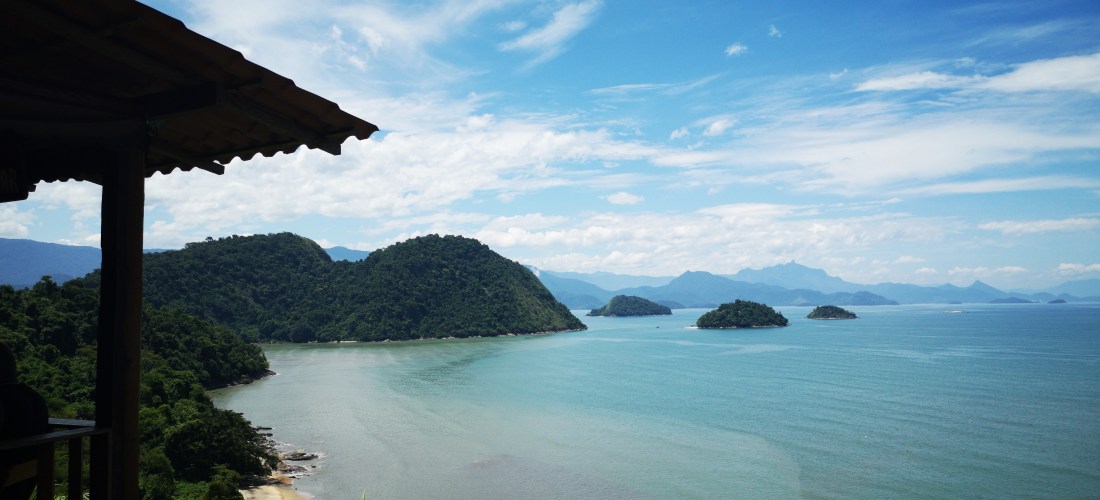
South America’s biggest urban sprawl is indeed a nightmare from which to escape but, once free of its insane hold, the surrounding countryside is a joy to behold. And on that ribbonous Rio highway that meets with the road that runs up and over the Serra of the Atlantic rainforest and down to the green and sumptuous coast of Säo Paulo state, my life’s calling started to take a weird and wonderful form. The rolling hills and fat, old Capricorn sun going down. The termite hills erupting on steep, grassy knolls like molehills from another dimension. The music. The light. The prospect of new horizons. Old memories to rekindle from the last visit to Brazil; new memories to forge.

And on that road through that cloud forest – roadsigns of capybaras, sloths and vipers reminding reckless drivers that the world is still hiding mystery and magic – that opened onto panoramas of steaming paradise it struck me like a lightning bolt from one of Brazil’s epic summer electrical storms: maybe my life’s true calling is life itself. Real living has nothing to do with science. It’s art all that way.

end.

TITICACA: Afterlife Vacation Spot #1

#adventure, Lakes, Perú, Reincarnation, South America, Titicaca, Titicaca, Travel

Did You Find Me, or Did I Find You?

For now that blue eye in the sky between Peru and Bolivia still exudes magic. Where others struggled to point, as a kid obsessed with the physical world I faced down that map of the world and prodded right at the X. Titicaca, there’s no hiding from my beady eye. In hindsight, it was my way of saying,


‘Don’t you go evaporating because one of these days I’m coming for you.’

It only took nearing thirty years of travelling to other Titicacas before the real thing found me wandering life’s lost highway. And now Titicaca is gone from sight, tucked away behind that annular world of rock and sky, she hasn’t really gone anywhere other than shrink inch by inch. As the lake was with me from the start, so she shall be to the end. And beyond. Maybe so far beyond that my ashes will linger longer than her vapours.

Early Onset Titicaca Syndrome

I might have mentioned, There’s not a time i can recall not knowing of the lake. Maybe it was the name itself banded around like M-i-s-s-i-s-s-i-p-p-i in the corridors of primary school. The hee-hee and ka-ka onomatopoeia of a laughing jackass, the repetition of the phonemes -ti and -ca, so alien to my English mother tongue. And the familiarity just deepened, breeding not contempt but a certain fascination. Ferocious battles of Trivial Pursuit at the tender age of ten taught me that Titicaca was Earth’s highest navigable body of water. That cool factoid stayed lodged in my hippocampus, planting some seed in the drifting dunes of the mind that would one day bring ephemeral rain enough to germinate that seed into an apparition of the lake itself. I could have sworn it was the real thing, though these days you never can tell.

The Old Ones Are The Best

Hands down, Lake Titicaca is stocked with knockout trivia the way Lake Malawi is stocked with cichlids. Off the bat, it’s where the supreme god Viracocha created the first man (and presumably woman, given that we’re all still here). But more importantly for their selfless service to all life on Earth compared with selfish man and woman, he sent up the sun and the moon from the dark waters. The sun, who went by the name of Inti, then ordered forth his two little suns, Manco Copac and Mama Ocllo (presumably more daughter than sun) to put Man, who was not only selfish but wayward, on the righteous path to Inca-dom. So they set forth over the primordial Altiplano to found Cusco, on a now well worn – if sublime – route covered by both the tourist bus and train between Puno and the aforesaid capital of the Inca’s Pan-Andean empire.

But Titicaca doesn’t even start with the same waist measurements, nor with those time-lost legends of Gods and monsters. Too many of us start skinny and move ever outward around the girth; the lake did the opposite. I read that about 12,000 years ago, when Göbekle Tepe was wowing forager crowds and ice was on the retreat from gigantic Andean glaciers, what now covers 8,370km2 between the modern political constructs we call Peru and Bolivia drowned a much larger area, was at least a hundred feet deeper, creating a liquid landscape bigger than my imagination. Think of it as a rooftop pool not just for Viracocha, but an infinity rooftop (of the world) pool for all the Incan pantheon. Now that’s a big pool of meltwater, all consecrated, it goes without saying.

But alas! Things ain’t what they used to be. In today’s balmy Holocene, all that’s left is a slow-disappearing puddle a few hundred feet deep about the size of Puerto Rico. Still, not to be sniffed at.


Ticking off the Ash Bucket List

Ever asked yourself where you’d like those ashes scattered when you are no more? I’ve roamed around looking for ideal ‘eternity’ spots rather like first-time buyers viewing properties in the housing market. In fact, I’ve been crying, ‘this must be the place!’, since the first time I crossed the Oakland Bridge as a greenhorn globetrotter of tender twenty-two and saw San Francisco shimmering like Oz before my very eyes. I was in love with it then and I’m in love with it now. There’s eternity spot #1. But who’s to say one’s vial of earthly remains have to be tipped out in the same place?

Why not entrust a dear friend, or maybe a kindly stranger, to sprinkle a little bit of yourself in more than one hotspot you visited and fell head over heels for? Call it a breadcrumbs trail of your brief appearance on this beautiful blue planet, there for your reincarnate self to rediscover on the great wheel of time.


Leave A Little Piece of You Wherever You’ve Gone

In Puno, Peru’s port town on the shore’s of Titicaca, I got the idea for this grand post-mortal plan. On the bus from Cusco i met two of the very few Englishman I found in three months of travelling this land north to south. Affable Liverpudlians, they too were heading to Titicaca for a special reason. One of them, the one not married to the Peruvian girl, was carrying valuable cargo. So priceless it could fit in his pocket; so symbolic it brought him all the way to the Southern Hemisphere.

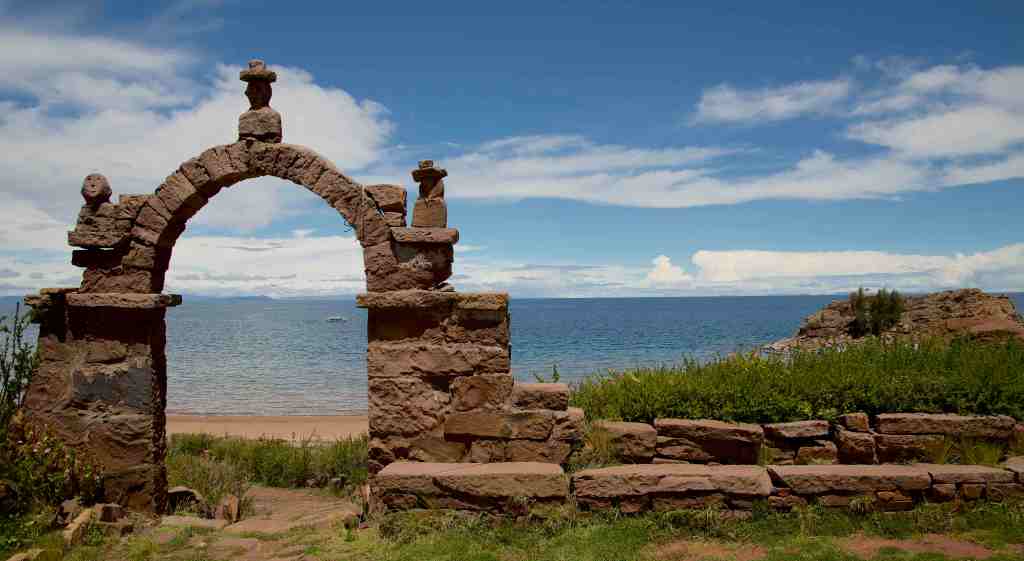
His dad had died a couple of years prior. The man’s dying wish was that his son would ration his ashes, setting aside enough to be able to scatter in a number of his favourite locations around the world. One such spot was Titicaca, though strangely i don’t think he had ever been there himself. Rather, he died with this long-harboured dream unfulfilled. So his son grasped the initiative. He and his friend took a boat from Puno to Isla Taquille – Avalon in the middle of the lake – and on the way there tipped the vial into inky waters of Titicaca. It was there he could say a final farewell to his father. It was there his father’s 21-gramme soul could say an initial hello to this lake so big and so mystical it could be a freshwater sea sailed by the sky people. There was something truly Arthurian about this tale. A power that never left me.


Beaches Where Clouds Ought To Be

Picture yourself on a beach, but no ordinary beach. Picture yourself instead on a soft, sandy beach on an isle ringed with clouds in the middle of Lake Titicaca, at 12,507ft above the bigger cousin of this sea way down there where the world’s intractable problems are deepening by the day. Imagine mountaintops in plain sight, yet so distant I’m not even going to guess how. Visualise a dirty storm front gathering over starboard waters on your Titicaca vessel when on the port side hills are bathed in pure sunlight. Stop and consider for a moment sleeping on a double bed in a floating lodge atop a huge, anchored raft of totora reeds 15ft thick. Being essentially grass this mythical totora, with which the proto-Inca built their distinctive canoes with their curlicue prow, is continuously waterlogged. If the Uro people, who have presumably lived this way since time immemorial, are to avoid a sailor’s death by sinking into 50ft of water, these totora reed mats need re-thatching every fortnight. Can you imagine having to re-thatch a Cotswolds cottage roof every two weeks? I’ve seen the sea peoples of the Andaman. I’ve seen the Junk-dwellers of Canton. Hell, I live on a boat myself. But I’ve seen nothing like this. No, the lake doesn’t add up. And that’s precisely why it does. And that’s why I want my ashes scattered there. Or at least a pinch of them. 

For You Beach Bums, Here’s the World’s Worst-Kept Secret

#adventure, #Brazil, #coast, A Costa Trindade, adventure, Brazil, Rio de Janeiro, South America, Travel, Travel Photography, travelogue

There are coastlines. Then there are coastlines. They vary vastly from pole to equator. Some are drowned mountain chains, others hilly escarpments ending in sea stacks, but most I can think of are fairly flat and innocuous. To quote American comic great, Bill Hicks, the place where dirt meets water. These level coastlines are where continental plains slope gracefully, but unspectacularly, into seas and oceans before falling off the edge of the continental shelf and into the inky abyss.

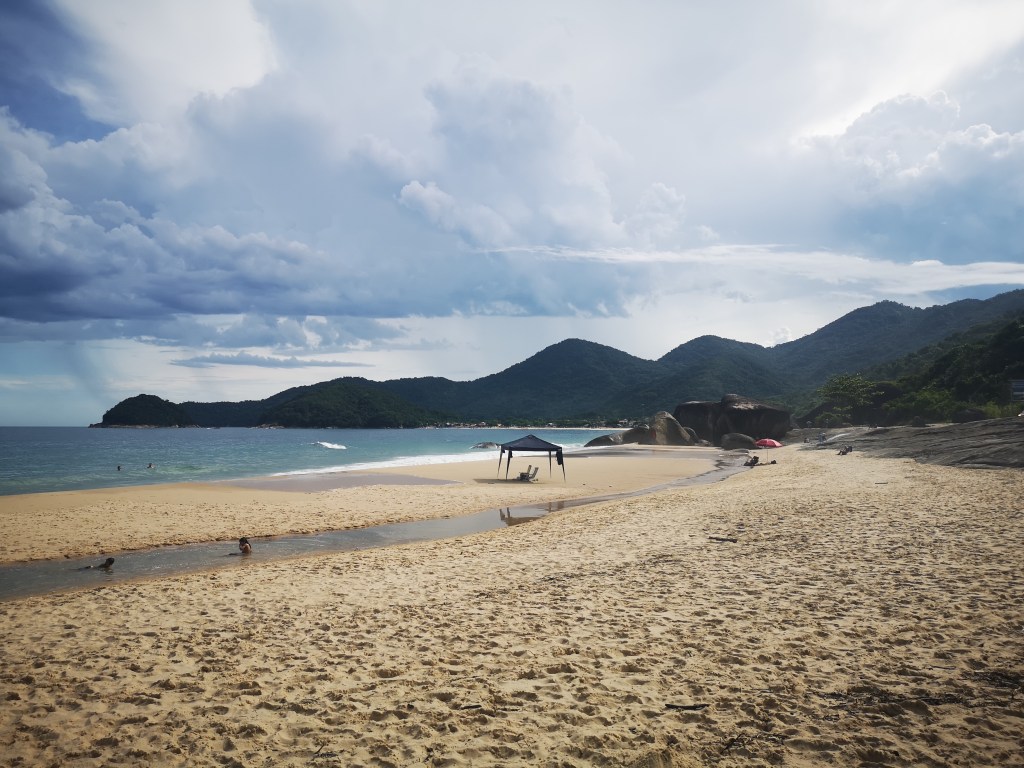
Just once in a while, though, you come upon a coastline which, for all intents and purposes, looks like it was designed by nature to strike undying awe into all humans. Occasionally, that awe extends to – now here i’m thinking bubbly bottlenose dolphins, leisurely leatherback turtles, and even that daft dog you always see barking at the crashing waves – creatures hitherto considered incapable of feeling awed by something abstract like beauty. Its every contour is divinely formed. Its lush, green, & pinnacled backdrop exists to try and upstage the coastline itself, although all it tends to end up doing is to add gloss to the whole picture. Both its outcrops of tide-smoothed megaliths and its oddly-placed vegetation could have been put there by a mythic giant who fancied himself as a bit of a stage designer-cum-cinematographer. Its intertidal waters are so transparent you wonder what the hell’s coming out of the tap.

Its mesmeric surf, unrolling waves onto the shore with all the panache of the footman unrolling the red carpet for his regal passenger, is so impeccably timed as to be the work of some unseen metronome: let’s call him The Earth Philharmonic Conductor. Its sand has been sifted so many times by the daily rhythms that it could pass for castor sugar if it didn’t taste so unlike sugar and so much like, er, minuscule grains of pulverised mollusc. Another defining characteristic of this perfect coastline is that it doesn’t simply disappear into the vanishing point. Rather, it is framed by virtue of being indented in the shape of a half-moon. Its farthest point, as visible by the human eye, is bookended by a mountain of Atlantic Rainforest that slips magnificently into the big blue.

Finally, the whole scene is capped off by a tropical sky, mercifully obscured by a succession of passing clouds that rest briefly in front of a blazing Capricorn sun in order to take the edge off the heat. But failing the presence of a shifting cloudscape, you – the lucky beachgoer – can always cool off racing into the rolling surf, whose temperature is an optimal 22ºC.

The stretch of coast I’m thinking of is one I’ve just returned from. Lying across both an ocean and an equator from the British Isles, tis true it’s far from here. In fact, it follows the Tropic of Capricorn about 43º longitude west of Greenwich, so that places it firmly both in the Western and the Southern Hemisphere. Yes, the sand exudes more heat than the average sole can handle, but there are shady spots, and tables and chairs under leafy fronds, and pretty girls serving chilled caipirinhas and fried morsels of freshly-caught fish. And away in the distance there are old, leathery hippies with beards too long for the sultry air, and joints smouldering away in their mouths. Music drifts in from who knows where. The singer’s language is exotic yet reassuring. Bodies come in all shapes and sizes, but unlike our overdeveloped world obesity is not really a problem. People who come here look after themselves. Elderly whippersnappers bob in the surf, forming a defensive palisade of golden skin and bone against the might of the ocean. I venture that this is pointless, but admire nevertheless their bravery before such a formidable opponent as the Atlantic.

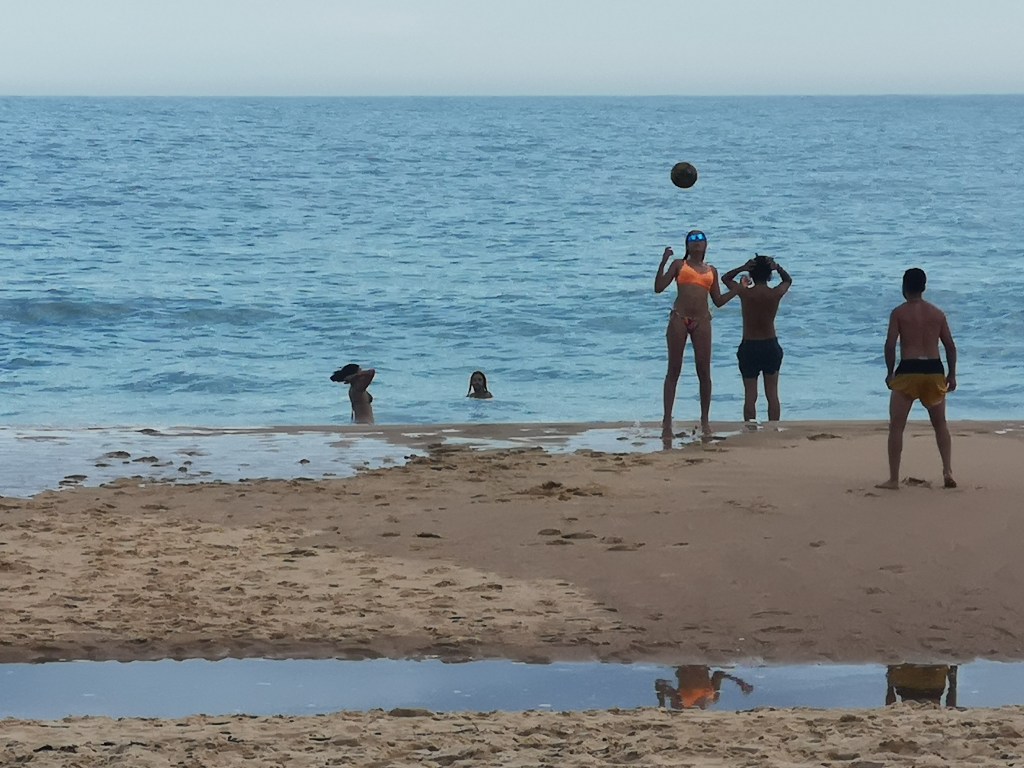
The post meridian on the world’s most perfect length of sandy coast passes in a pleasant reverie. This is the sure sign of a great beach. An even surer sign of skin damage to fair types like yours truly, seeing as the Capricorn sun is now at its apex. The to-ing and fro-ing of the tide complementing the to-ing and fro-ing of my regular forays, from the spot where our parasoled table stands in the granite shadow of a wall of dripping vegetation, down to the world’s clearest water. I sip the dregs of my lime cocktail and watch a boy and a girl on the beach volleying a football between them without it barely touching the ground. She heads, he chests, she volleys it back with the side of her foot. This is impressive stuff. Never let it be said that girls canna kick a ball for toffee.

The day passes both without incident and with plenty of it. In a kind of Schrödinger’s feline paradox, I experience one memorable incident after another without there being the manner of incidents one usually associates with beaches on a hot day: pissed up louts and boors, stealthy gangs of thieves, drowning in the surf, that kind of thing. The first such incidence in my incident-free day starts with an uncanny feeling that i’ve died without a coroner’s report and then gone to heaven without really believing in either God or his long-haired son. It’s a cheat, and can only be got visiting the world’s most breathtaking bit of coastline. It then continues by dipping under the crest of a pulsing sea with my girlfriend’s son, who is beyond delighted to have discovered that such a place as this can really be in this world. The incidents continue with my girlfriend – no swimmer by her own admission – being upended by a wave, screaming in pure terror she hates me, before proceeding to slap me in the face for having brought her not only to a wild coast, but also almost to her untimely demise. I love her even more after that tiff.

What to say other than that was the noblest, most gratifying slap I’ve ever had. And why? Because i found the best bit of coastline anywhere. You could have stripped me of all my worldly belongings, subjected me to summary humiliation, and even proclaimed me dead from cancer within six months, and so long as these awful things were performed there where that sand met that sea, I would forgive practically anyone their everything.

You know you’ve arrived when all along you thought beaches and coasts came a poor second to the mountains inland. Having witnessed this Shangri-La, I’m not so convinced anymore of the inherent superiority of mountains over coasts. It was the best-kept secret outside of Brazil until I shouted my mouth off about it. It’s now the worst-kept. So, here goes….

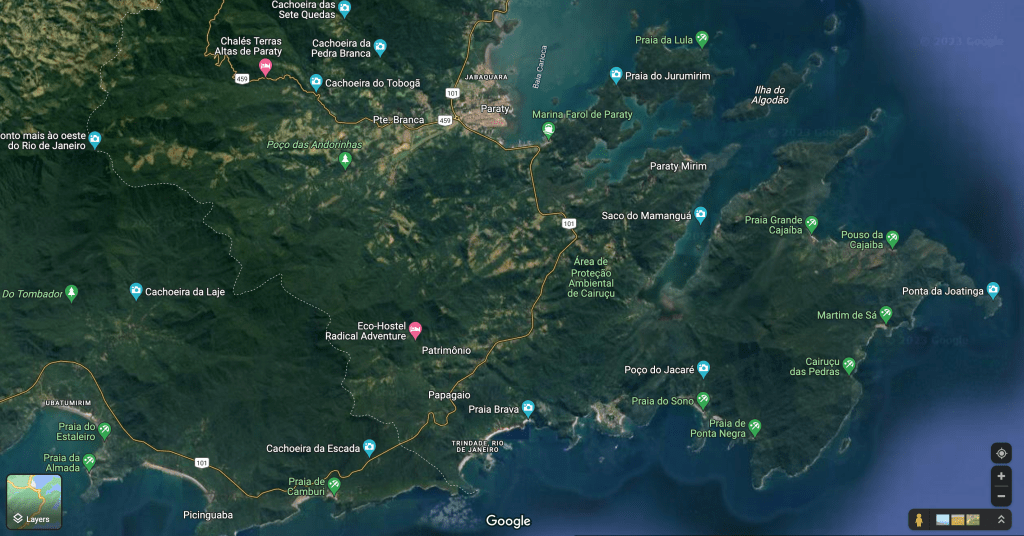
You’re looking, but are you listening? See that little bite out of the green land due south of Paraty? Right on the South Atlantic ocean. The beach is Trindade, just inside of Rio de Janeiro state. Follow Highway 101 from Santos to Rio, and at every twist and turn of what is actually a 4,000km squiggle of bitumen running from Brazil’s south to its north, you’ll be picking your jaw up off the ground. This coastline is the stuff of your wildest dreams. See it before you see your end.