




Month: Sep 2016

On The Mountain of God
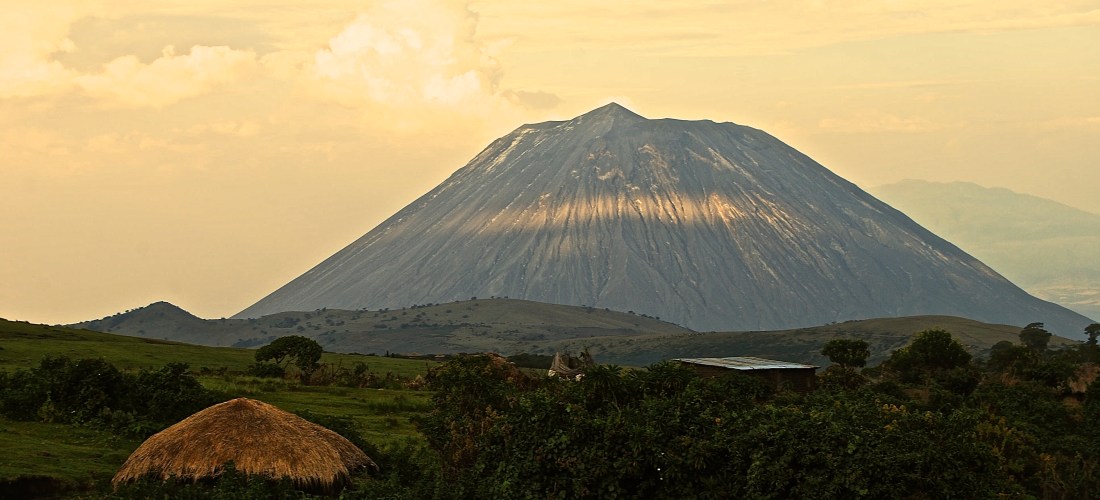
Africa, Danger, mountains, Oddities, Travel, Uncategorized, VolcanoI remember rounding that bend and it coming into view, as plain as day. It wasn’t like any normal geological feature. By seeming to fuse beautifully with the ground beneath them, most uplands rise and fold and generally harmonise with the physique of the surrounding landscape. But not this bulge in the earth. Not Ol Doinyo Lengai. Lengai intrudes like a gigantic unwanted visitor. Its flanks, gouged with the long and drawn scars on the cheeks of a street fighter, jar with the green and rolling highlands around. Too volatile to keep its clothes on, too uncivilised to wear them in the first place, the mountain of God is bare and bold as belief itself.
For a full day, maybe two, my shuka-clad guide and I had threaded down on paths from the Crater Highlands. On the descent, the heat was incipient. It rose in small but profound shifts for every hundred metres or so dropped. Like a great fuck up in the joinery of the Earth, the Rift Valley was a natural sight as arresting as any. The thrusting up one side, the slumping down of the other, so pronounced were both that it was hard to tell which side of the rift had done the thrusting and which side the slumping
As we descended onto the floor of what eventually becomes the boundless plains of the Serengeti, we lost the stature and the confidence that being on high ground had enabled us with. Contrastingly, it was Oldoinyo Lengai, the mountain of God, that rose in prominence. We were now standing on the same floor, no blocks under our feet to give that impression of fighting on equal terms. Born a stratovolcano and therefore devoid of facial form (forms like spurs and ridges, and bits that look a bit anthropomorphic if your strain your eyes hard enough), the mountain nevertheless looked on, taking the corner of my eye as its own. Rounding it, I was like a dog rounding a hackled opponent in the park. My eyes were fixed on it, and it on me. ‘I am going to the top of that,’ I muttered with a feeling of incredulity and a weary sigh of foreboding.
Now on the plains, Africa’s sun began to bite. We had traipsed all day and with temperatures topping 40 Celsius, even the leather-tough Masai said enough was enough. Calling on our jeep to come fetch us, for the last couple of kilometres to camp even scrawny trees appeared to offer a nod of understanding. In the wing mirror I caught a glance of it sliding away, that rumbling behemoth. We would be back the following night to tickle its flanks while hopefully it slumbered and let us do what bedbugs do while humans sleep on unwittingly. At this prospect I had misgivings. No slouch on the slopes I always considered myself, yet such misgivings I had rarely, if ever, felt. That was until now.
When dates are impending, they can leave us shaken and a whole lot stirred. When the following night arrived, our date was set. The afternoon had produced clear skies, but now that the equatorial night had plunged light into a bath of blackness we could sense a change in the weather. Pulling on those gloves, slipping into that climber’s cat suit, I felt like we were about to burgle the mountain.
‘Why are we climbing at midnight?’ I asked. ‘Do volcanoes only erupt during the day?’
‘It’s the heat,’ the Masai replied. ‘Cooler for climbing at night.’
‘Maybe so, but a whole lot darker, too.’
‘Don’t worry’, he foreswore. ‘You are safe with me.’ This he said holding his trademark sword by the hilt.
Over rough ground our jeep trundled until we reached the trailhead. One other jeep was there, its headlights trained on a sliver of mountain. The air was heavy and the moon raced across the sky. Darting behind walls of cloud, when it came into the open it cast a silvery accusation at the mountain. Barely able to look up for fear of what was to come, I kept my head low. It was then I noticed the first drops of rain on the bleached grass.
We started out well enough. My eyes on stalks, I did the natural thing by following my guide. Narrow beams of torchlight was all we had. Having done this before, he had that gait of a guy who just knows he’s going to make it. The incline started gentle, the floor of the lower flanks quite the strangest feel to the pitter-patter of human feet. Beneath our soles, the feel of it was akin to walking on glass. Sounding hollow, for some reason I adjudged that tiptoeing would not awaken the giant, as if creeping in my cat suit would improve my prospects, or change a damned thing.
Still the rain fell. Harder and steadier it came. From shower to unremitting rainfall, the carbonatite ground now turned into a paste. Beneath the paste was, as described, a weird substrate of thin ice or window glass. By now it was after midnight. No murmur was there from Lengai. Not a peep. This is why we climb a God at an unGodly hour, I surmised. Pitch black and alone, gauging height and position was all but impossible for me. My life was in my guide’s hands. After a while scaling ever steeper gradients, I grasped the ground, turned my head and, through the bombardment of rain through the beam, did see faint traces of light at the bottom of the mountain of God. ‘We have come far in short time’, I said to my guide. ‘No, he laughed. ‘We are still at the bottom.’
Soon enough, our hike became a scramble. The rain came down harder. The volcano rose to meet me nose to flank. It became apparent why gloves were the order of the day. Feet and feet alone were not going to suffice. Hands were deployed and the ascent took on a whole other complexion. Two limbs turned in to four. I had always thought that the pleasure in mountain hiking was that it was a hands-free experience, but this night was turning out different. Within two hours the gradient had gone from reasonable to completely unreasonable. The mountain of God might have been busying itself in answering prayer or meditation or whatever rock gods do, but by ensuring its slopes were not only slick but steep as shit, we had our work cut out. The trials of Job coupled with the labours of Heracles: and I was paying top dollar to be threatened with extinction by an anything-but-extinct zit on the face of the earth.
And so, up and up we went. My guide ahead, he paused periodically to check if I was still clinging on. Meanwhile, I could not help but look back and down. My clothes were soaked. The mountainside was by this point being drenched in a torrent of equatorial rain. Clumps of sticky carbonatite paste were coming away, like tufts from a chemo head, in my hands. Steadying oneself upright was turning into a nightmare. For once in my life I was wishing I were short and stocky and not tall and gangly.
Panic rising, about three-four hours up the mountain – 2,500m who can tell – I found myself alone. Craning my neck around in a moment I can only compare to the myth of ancient Greece when Orpheus, having rescued his lover, Eurydice, from the underworld, commits the fatal error of turning to look at her as she rises up behind him only to tumble back down forever, I saw the underworld with mine own eyes. The torch beam was powerful, but even it dissipated into the blackness immediately behind me. Initially I assumed it to be the void of night, before realising that the only void I was seeing was one involving the absence of solid earth behind. If you can imagine standing on a small meteor hurtling through deep space – that is exactly how it appeared to me.
To be continued……
On The Mountain Of God
Africa, Travel, UncategorizedTanzania’s Ol Doinyo Lengai is the Mountain of God to the Masai people who live in its shadow. So central is this iconic mountain to their folklore that these East Africans venerate it as the maker of the world. Geophysicists would agree, but not for spiritual reasons. For the rock boffins, Lengai is the mother lode of raw materials that makes this mountain truly exceptional.
Still, this little tale seeks not to dwell on the stuff from which exceptional volcanoes are made. Rather, it’s about the stuff that we discover we are made from when gripped by the struggle to overcome fear, gravity, and the raw elements to reach a summit like Lengai’s.
The Mountain of God strikes a chord. God! It’s a mountain alright. For any rich man or woman who has taken on this 3,000 metre deity in East Africa’s Rift Valley, ascending through the eye of a needle to heaven disguised as a camel might be easier. From the watery labyrinth of cenotes in the limestone shelf of Mexico to the deep crevasses on Greenland’s icecap, the underworld is below us for good reason. Few, if any, of Earth’s natural wonders place that underworld over our heads. However, there’s one place where one looks up to look down: on the terrifyingly steep and slippery slopes of Ol Doinyo Lengai where the journey to Hades is straight up on the most dizzying of gradients.
Now you might wonder why a modestly-proportioned mountain on the warm, sunlit uplands of the planet could be damned. There are harder. True. There are higher. True. There are more frigid. There are more rarefied. There are more technical and more ragged, more vertiginous and more spiteful. All true. It’s just that Ol Doinyo Lengai is no mountain in the sense of ordinary. So banished is it from the range, so weird in its makeup, that it ought to be bagged and quarantined.
Tanzania’s second most iconic cone after Kilimanjaro, like Africa’s tallest point ninety-nine miles to the east, Lengai is not even a mountain in the classic sense. Rather, it is a volcano. Unlike Kilimanjaro, Lengai is neither dormant nor ordinary. In fact, there is literally nothing like it anywhere else on the known Earth.
Before the tale is told, a little descriptive background needs to be sold.
Tanzania’s only active hotspot, Ol Doinyo Lengai is geologically-speaking a stratovolcano, a perfect cone of natrocarbonatite material that shares a chemistry with none upon none of the world’s other roughly fifteen-hundred active volcanoes. Still growing year on year, it lies in the Great Rift Valley with the Serengeti away to the northwest, Lake Natron to the north, and the Crater Highlands featuring the famous Ngorongoro to the south. A serene majesty, it shares the throne with no other. All its crater siblings are long dead and collapsed, whose green calderas are filled with either water or wildlife. Alone it presides. Trusted by nothing and trusting nothing surrounding it, Lengai cuts a lonely, slightly sinister figure to whomever makes the descent on foot from the pastures in the relative cool of the crater highlands to the baking soda lake of Natron on the Kenyan border, a shallow alkaline icon of a lake where congregate some of the largest migrant flocks of pink flamingos anywhere on the planet.
On the approach the Mountain of God plays a game of deception, dominating like the hunched back of some primordial giant. From the thatched roofs of Masai huts dotted on their simple homesteads many miles away Lengai looms. How could it be anything but a God among men? When clouds mass over its rim – hanging around for a piece of the action as they often do given its amplitude and the brazen attitude with which it punches the air over the rift valley – a somberness seems to fall over its flanks, if sombre is something both mountain and God can feel. Lengai, you could say, is a widower in a world full of happy marriages: the marriage of the African sky and the African earth; of the million-strong wildebeest herds and their precious migration; of the Masai and their beloved Brahman cattle; and, perhaps greatest of all, how the colour of the lion’s pelt and the parched grasslands marry into a perfect camouflage arrangement.
As mentioned, Ol Doinyo Lengai is made of sterner stuff. Out bubbling from the open wound on its head is lava tapped from some wellspring of hot matter in the Earth’s mantle. When the crater floor is spattered with its lava, that lava is cold blood geologically-speaking. It is born at five hundred degrees Celsius, less than half the temperature of your average volcano. So cool is it, in fact, that apparently it can be gathered up with a dessert spoon (but only a fool would eat it). Because, or in spite, of the cold reptilian blood in its vein, the stuff that makes Ol Doinyo Lengai a God among tall and slender tribesmen in red shuka robes emerges without the signature glow of hot orange magma. Black and muddy brown are the colours of the bile it spews, glowing a dull red only when night falls. When the rain touches Lengai’s lava, within minutes it turns a paste-like white with a hardness of cement. Another unique feature is that Lengai’s ejecta shatters as glass when it comes into contact with high-altitude air.
Bizarrely, its volcanic outpouring hardly carries with it any of the silicates that predominate in the earth’s crust. Instead what channels up consists of 90% whitish carbonates of potassium and sodium, leaving the crater floor a strange feat of nature. Black strings of pahoehoe basalt on Hawaii’s Mona Kea this is definitely not. Quite how the segregation of the dominant silica and lesser carbonates happens baffles even the greatest minds in geology. Be that as it may, how does it do it? How does Ol Doinyo Lengai offer up its burning treasures on a spoon? How does it make liquid turn to shattered glass?
Their answer: Ol Doinyo Lengai is of another planet. That in itself makes it worth a multi-modal Phileus Fogg journey to climb and, with the Gods appeased, conquer, too.
…In the next part of my real-life adventure, I go in search of Ol Doinyo Lengai’s summit on a week-long trek through the Crater Highlands to my ultimate destination on the shores of Lake Natron. A veritable expedition, with my trusty, sword-wielding Masai guide by my side, we travel with armed guards, porters, cooks, drivers and even two sad-looking mules to the mountain.
Truly underestimating its ferocity, on Ol Doinyo Lengai will come a Mountain God that wants only to punish the trespasser(ine). The starless night, the unremitting rain, the desperate scramble to stay on the edge of that terrible mountain falling away onto the valley floor thousands of feet beneath….
(Image, © Trespasserine, 2014)
 The Blind Salamander