
Where Mountains Let Off Steam

Iceland, Reflections, Travel, Uncategorized

There’s a place high in the North Atlantic where day by day America and Europe grow further apart in matters unrelated to politics. It’s no fun being the subject of a custody battle between mother Eurasia and father America.

Tectonic limbs all wrenched and popped from sockets by the selfish jostling of parents who should know better, this ‘kid’ is a work in geological progress. Only Hawaii experiences growth spurts like this.

There but for the grace of an ever-widening Atlantic goes it. It, of course, is Iceland. It, in its physical manifestation, looks like a green and white lesion on the skin of the Earth when seen from space. As lesions go, this one’s made of tough stuff: of gabbro, rhyolite, andesite and all the inanimate stuff of inner Earth, stuff whose quality reassures in both its lastingness and the sure-footing it provides our little feet on these hair-raising trips around our parent star.

When least expected, the lesion seeps hot puss onto Earth’s skin in the form of hot mantle rock. By night glowing rivulets of lava channel down from the frigid heights to where nature spins this rarely seen material on the loom of time. What spent aeons riding the currents of the hot, viscous ocean under the earth’s crust is now cooled under grey skies in these sub-polar environs. Evidence of it lies strewn everywhere, petrified fragments of magma now little charcoal-coloured sponges dissolved full of holes.

Iceland is rightly known as the land of fire and ice. There, hot geothermic forces that on most landmasses remain under a 70 km cap of insulating crust bring the insanely-hot upper mantle so close to the surface that green mountains blow jets of steam from their flanks. The sight is akin to seeing the smouldering embers of dozens of hillside campfires, except water is the fuel, and not the smouldering remains of firewood. Correspondingly, in rural Iceland, which is practically all of Iceland, drainage trenches cut into the roadside verge create curtains of hot vapour steaming up, making the driver feels he’s driving on a whistling kettle made of tarmac.

Known as Thule to the ancient Greeks, this place of black sand, ice-capped highland, stunted trees and primeval lime moss below the Arctic Circle is by no means mythical in spite of a temptation to deem it so. For to be mythical is to be ancient, and compared with granny Scotland to the south, Iceland is a geological laddie. Plus, its status is real enough to have a runway on its southwest peninsula bringing in an ever-increasing number of people curious to see what all the fuss is about. Not far out of the airport, and one can see why. A volcano, constructed by nature only yesterday so perfect is its conical shape, stamps the country’s character almost immediately.

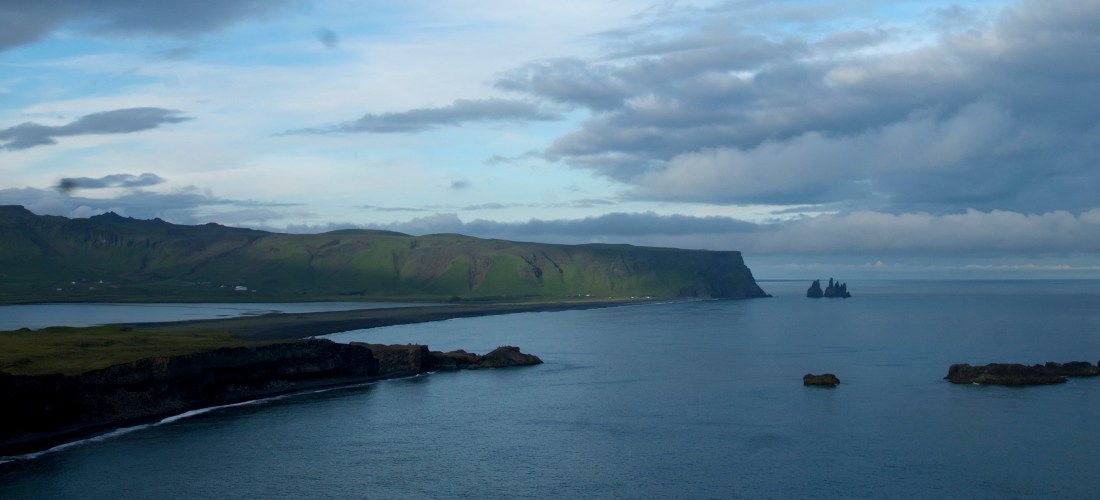
The south cape of Iceland is a sight like no other. Giving the savage beauty of the cape a human face is the village of Vik. Man, this is one cape that makes Superman’s look pointless. With its super-cooled hexagonal columns of basalt (think Fingal’s Cave in Iona, Scotland) propping up grass-coated cliffs that double as high rise apartments for legions of fulmars, puffins, terns and other tenants, the magic oozes right from the word go. Then there’s the headland that juts fearlessly into the freezing Atlantic. The sea stack at the outer perimeter of the headland is carved into the perfect stone arch which reaches high into the sky and through which a ship could pass unhindered. Pushing south into the North Atlantic, this point is the nearest Iceland will be to warmer waters, that is until it spews more submarine eruptions that give it that extra-territorial reach. No other island can undergo geology’s answer to a cosmetic makeover quite like this one. Stay alive long enough and you’ll see it morph into something else.

The innards of the earth ground down to grains, its black sand beaches stretch away into the past one way and into the future the other. We’re standing on a convergence point of time as it was, as it is, as it will be. All a bit disconcerting, in the nicest possible way. Behind it all looms the presence of the same Eyjafjallajokull volcano that belched thousands of transatlantic flights to a standstill five years ago. Iceland’s famed ponies stand in a huddle against the sheet rain. An endless supply of fresh grass is their only recompense for finding themselves stuck shivering in steel-grey of the mid-Atlantic.

All is not what it seems. Unlike most other places, where heat originates from above, Iceland feels it from below. A skein of hydro-thermal pipes run over old lava fields turned to moss. Blink and the pipes could be running oil. Denuded of trees, this place could be the hellish twin of the Persian Gulf, with its crude oil pipes running over equally barren lands. And like the deserts where winds blow sands into new arrangements, in Iceland it’s the restlessness of what lurks beneath that ensures that timelessness is no more than a cruel illusion. At least, Tolstoy would back me on that one if he were still around.

(The photograph was taken in Vik, on Iceland’s magnificent south cape).
The Kindness of Strangers

Uncategorized

Life’s quirky that way. What begins as calamitous in the making can end on a high. Not to put too fine a point on it, when misfortune starts befalling, serendipity has a reassuring habit of calling. And all this in a landscape so otherworldly you couldn’t make it up.

There we were, minding our own business, motoring up a 35km stretch of mountain road to a place of legend in central Oman. The car, with a reputation for inspiring confidence, had in these trying circumstances lost its bottle. Struggling to haul its five tonne ass up 2,000 metres from pillar to post, its passengers could feel its hurt. Relentless as alpinists pushing their weary porters on, we tried ignoring the signs. Over the apex, within sighting distance of our destination, the oil temperature drops and we quietly celebrate the triumph of the machine over the trials of nature. And then, as if taunting us all along, the VW goes clunk, clunk, clunk from the near-side wheel and judders to a standstill.

No amount of willing the thing to rouse itself does the trick. Like a feisty filly at the race stalls, she refuses to go on.

The air temperature gauge has decreased from 115 degrees Fahrenheit at sea level to a tolerable 82 Fahrenheit at 2,000 metres, small consolation in an otherwise disastrous showing.

The myth of German invincibility shattered, yours truly lets go a despondent cry followed by a petulant thump on the wheel. Oh God of Wolfsburg! How can you repay us for the faith we have instilled so unfailingly in you?

And then, like a handmaiden riding in from the wings in a stage production of Wagner’s Ring Cycle, our Omani Valkyrie in his starch-white dishdasha turns up to save our sorry souls.

Introducing himself as Thani, as if that’s not a name straight out of the mythological past, he smiles benignly and offers a gentleman’s hand. Wearing his custom-built headgear tipped forward (for the benefit of the blind reader, a kind of white embroidered fez minus the tassles), his nose is, all four inches of it, Semitic (or maybe Gallic), and his facial features not unpleasant. He refers to each of us as brother, even though one of us is categorically female. In the time it takes to make a quick phone call then whoosh his wand (Oman’s puritan neighbours in the Gulf always did accuse this fiercely independent nation of conjuring the djinns with their malevolent scorcery), the fate of the car – and more importantly of us – is sealed. It will live to see another day, and we burned-out pilgrims will live to savour this very day. But not as we had imagined.

It’s action stations, but not in the way a Westerner with neurotic tendencies might think. Defcon-4 this is not. That said, this guy is a natural when it comes to handling human and mechanical breakdowns. Whisked into town to raise a posse to return to the mountain top (well, actually, two Indian mechanics – one known affectionately as the Professor, personal friends of Thani), we’re back within minutes to patch the car up and take it back to the workshop for a bit of loving restoration. As a show of trust, Thani drives our car, and we follow in his. Halfway into town his arm extends out the driver’s window and a thumb is raised. This, we take, as an auspicious sign.

As places to break down go, Jebel Al Akhthar is both a blessing and a curse. A plateau of hanging gardens, elevation a God-merciful 2035 metres above broiling sea level, the green mountain (akhthar means ‘green’ in Arabic, and Jebel ‘mountain’) is a veritable Babylon to the insufferable and breathtaking heat of old Arabia surrounding it. Not only that, the green mountain is a heaven sent 27 Celsius. By the providence of geology, this high plateau (the Sayq in case you’re interested) of climate temperance rises above the basement levels of hell where nothing other than date palm and acacia can handle temperatures that top 50 degrees in June. In fact, its altitude-assisted climate is so perennially perfect that fruits more at home in the Mediterranean grow fat and juicy in midsummer. They’ve got pomegranate. They’ve got peach, fig, apricot and grape. They’ve got life in relative abundance, and not many places in the region can make that claim without complex agronomy, such as irrigation from desalination plants.

So you climb and climb and watch in sheer relief the car’s altimeter go up and up and its thermometer correspondingly go down and down. This all makes mechanical mischief a fact of life one could get used to, at a push. One can think of few other places in the vastness of Arabia where breaking down means not merely surviving but prospering, too, from the experience (other than the repair bill).

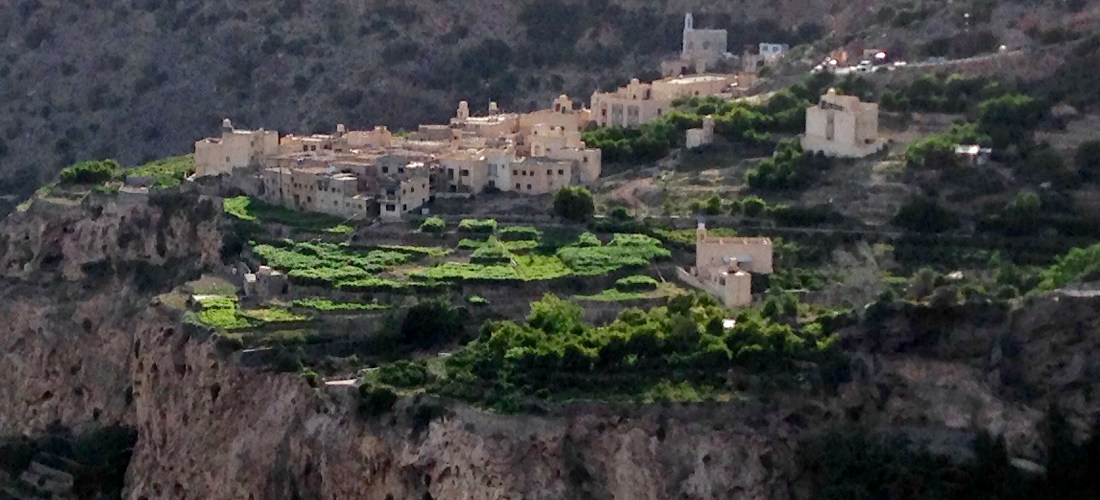
That evening, now rested and attuned to the peaceful vibe of the hilltop hotel, we are invited to join Thani at his house in a hamlet we can see from the hotel is a white limpet stuck fast to the rock of the canyon far below. As sundown painted the land around in pale pastels while the valley floor far, far in the distance still burned like a ember, a diaphanous shroud of white cloud brought the temperature down further still.

He came for us in his jeep, such was the host he was and the host I would hope one day to become. Before retiring to a majli (like a drawing room in an old Victorian house) in the presence of his brother and adorable daughters – but notably not his wife – to eat dates and dahl and sip Arabic coffee and tea, he led us down to the wadi where only a month previous the waters had been cascading down from the mesetas, taking every loose thing in their unstoppable path. This is how things work here. The rains make infrequent visits to this parched and scoured corner of Asia, but when they do, they come with a force and a magnanimity matched only by that of the locals toward us, the outsiders, who are as thirsty, helpless and in need as the land itself.