

For every action there is an equal and opposite reaction. For every human a doppelgänger. Every town a twin, but not always officially twinned in the sense of Bristol and Bordeaux or Birmingham and Chicago – towns that to all intents and purposes have little in common. Some towns are kindred spirits. Soul brothers. Sister cities. Take Edinburgh and Florence, two cities well matched both in grace and favour.

Not that many New Age & Main Stage-lovin’ aquarians, who show up perennially at the gates of Michael Eavis’ Somerset farm each and every summer, will ever go there (the UK festival circuit is pricier than budget adventure travel through South America), but no word of a lie, on a recent trip to São Thomé das letras I swear i met Glastonbury’s long lost twin. Though it would be fair to say they remain lost to one another, and there’s no telling when these long-lost brethren will be given the This is Your Life treatment. This is their historical destiny, given that Britain’s empire was kept in check in Latin America, and British interest there today is at best marginal.
Everyone who is no one knows England’s Glastonbury. There’s the annual arts and music festival, of course. The inevitable cat and mouse game between stewards and fence-jumpers, which results in ever higher fencing and standing charges for tickets that sell out within a hour. The periodical return of Van Morrison and Coldplay to the Pyramid Stage, just when everyone thought they might take a permanent rest. There’s the Tor, the grassy hump that everybody climbs to flee the rising floodwaters that beset the Somerset Levels with increasing regularity and ferocity. There’s the legend of Camelot, if you buy into that sugar-spun fairytale. (Until diets improved in the area, the locals were happy with Spamalot). Then there’s Jesus’ uncle, Joseph of Arimathea, who devotees believe house-swapped a life of danger in the Levant for bucolic Britannia, bringing only a cup with him in his 1st AD century removals caravan. There’s bombed-out deadheads that haunt the town, barefooted and extremely confused, months after the festival has ended, wandering into corner shops asking if this is where Hawkwind are playing this weekend.
Glastonbury is all that and some. Who can forget the quaint little cottages for sale at not such a quaint little price? And the annual orgy of money made in holiday rentals from well-heeled festival goers for whom a row of dripping, wet tents is just not appealing? And last but by no means least, what of those ley lines running under this most pagan of towns? This mystical grid force of supernatural, electromagnetic power is responsible for getting the crystals all excited. Spiritualists and necromancers follow this flow of uninterrupted energy like the children of Hamlin to the penny whistle tones of the pied piper.
That’s Glastonbury seen from a slightly flippant angle. But what about its southern counterpart?
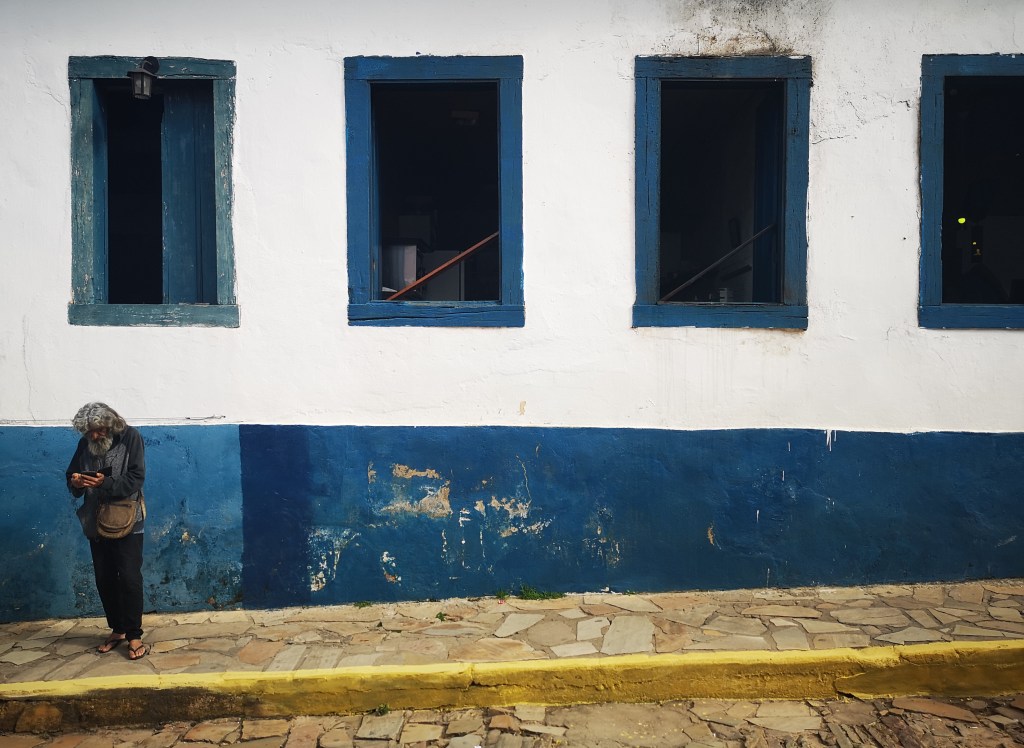
On the subject of Joseph and the Grail, São Thomé das letras was named in honour of another hero of the Jewish uprising against both Judaism and Roman Rule in 1st century Judaea: the doubting Thomas, apostle and man of my own heart. Quite what the letters (letras) part is about is the subject of much conjecture. But i would say it might have something to do with the Gospel of Thomas, and the fact that gospels were written into letters. One would assume that early Portuguese settlers, with God on their side and Christ in their hearts, in what was the colonially important and unromantically-named province of Minas Gerais (or General Mines), founded this little settlement long before the hippies started flocking. It is highly unlikely that whomever called the province General Mines and the town St Thomas of the Letters was much of a crystal-gazing spiritualist with animistic tendencies. In all likelihood they were a pragmatic, Catholic bunch who mined valuable stones all week for money while worshipping all weekend for salvation. Stranger things have happened at sea, where, luck would have it, the Portuguese spent much of their time conquering the then unknown world.

Brazil’s Glastonbury is a tenuous link at best, you shrug. A non-identical twin in a world obsessed with identical ones. I mean, São Thomé doesn’t attract the likes of Beyoncé, Dolly Parton, and The Foo Fighters over from the U.S. to join the rock and pop pantheon in a 5-day annual music blitz. Joesph of Aramathea never crossed the Atlantic. And Camelot’s influence couldn’t possibly have predated Pedro Álvares Cabral’s new world discovery of Rio de Janeiro in 1500. But look beyond the obvious – transcend the tawdry – and you’ll see that both towns coruscate with pixie dust.
Legends abound here and there. There’s a tunnel that runs from two undisclosed entrances: one at Machu Picchu and the other in Sáo Thomé 3,000km away. The ground beneath Sáo Thomé is so highly-charged with potions of motion that there’s a spot there where your car will drive itself. So many varieties of magic mushroom can be bought sealed and ready to nibble on that you’ll be hallucinating all the way under that tunnel to Machu Picchu, if only that entrance can be found. So potent are these so-called cogumelos that doubtless you’ll still be high when you emerge at the Peru end of the tunnel.

At the summit of all things heady in Sao Thomé is its very own Tor, but nothing like the old phallic one atop a hill in Glastonbury. Nevertheless, the same purpose is served: pilgrimage. The Brazilian construct is somewhat unorthodox, and a whole lot newer. Built sometime in the 20th century, of a quartzite now afforded Kryptonite powers, the Pyramid couldn’t be better named, given the invented similitude with Glastonbury. And, like Glastonbury’s sound-splitting, prismatic Pyramid this too is a stage, of sorts. Namely, a stage for all Brazil’s seekers of the transcendent realm that come here in search of whatever it is the rocks are emitting. It can’t be enlightenment they are after, as if it’s the light of truth they want bathed in, the sun here packs enough punch to drown them all. It must be the panorama that wows the crowd, because from there the rolling country of emerald Minas Gerais never looked so good.

Ascending and descending the Pyramid for yet another spectacular sunset is not unlike the Sermon of the Mount scene from Monty Python’s Life of Brian. There’s a sense of destiny about being in attendance for nature’s greatest revelation. And descending at dusk with all the others, there’s still the vendors at their makeshift stalls to pass, flogging everything from moonstones to magic potions, in this nation of ingenious artisans.
São Thomé das letras is more than worth the six-hour drive from Sáo Paulo (equidistant from Rio). Yes, seeing the promise of fadas and duendes – fairies and elves – is reason enough in itself to go, as every great traveller will tell you, it’s not about the destination. For lovers of o jogo bonito, en route you can stop off in Três Coraçōes to pay homage to the great Pelé in his place of birth. If Brazil beguiles you with its beautiful game, let it beguile you further with its beautiful countryside and magical realism, even if the analogies to Glastonbury are a tad far-fetched.
end

 The Blind Salamander