What Goes Down Must Come Up: Why You Should See the Colca Canyon

#adventure, adventure, Andes, backpacking, Landscapes, Latin America, Perú, Perú, Travel, Uncategorized

Olympian Among Canyons

Allow me to set the scene, if you will. The Colca Canyon is situated in Southern Peru, about a 3-hour drive northwest of the White City, Arequipa. By all measures, the Colca is the world’s third deepest canyon (some say fourth) after the Yarlung Tsangpo Grand Canyon in Tibet, followed by the jaw-dropping Kali Gandaki Gorge in the Annapurna region of Nepal.

The Colca Canyon cuts such a swathe through the Andean plateau that it bottoms out at about 11,000ft (3,400m). To offer up some idea of scale that clicks with most of us, that’s about twice the depth of the world’s most celebrated geological knife wound, Arizona’s Grand Canyon. So, one Grand Canyon nested on top of another, and the Colca will just about accommodate them both.

Where Humans Dare To Tread and Till

Farmed by Inca peoples since time immemorial, its steep slopes show abundant signs of continuous human occupation. At about 50 miles in length that’s one deep cut for Man; one deeper cut for the magisterial condor that has made a miraculous comeback there after decades of persecution from local livestock farmers. Its confidence soaring, the condor is one of the main attractions of the hordes of tour buses that stop at the various lookouts along the canyon rim.

For the adventurous few though, what awaits them is a gruelling descent to the canyon floor, where if lucky, they’ll see the condor soar not below them, but at eye level. It’s all downhill from here. And surprise, surprise, the prospects never looked so good.

I got teamed up with a nice bunch of continental Europeans half my age and double my knee flexibility. Among them a smattering of French and German. The Franco-Prussian alliance had sunk to new heights. Our guide was a native of Arequipa, a man who had led so many 3-day expeditions in and out of the canyon that, as can be expected, he was rather unfazed by the whole affair.

El Condor Pasa

One moment we were setting off along the canyon rim and the next a slow motion plunge down a zigzagging hoof trail that swallowed us whole. The view was stupendous, the scale was suddenly gargantuan, and the sky a blue bonanza between weeks of monsoon rain that would render it all but impassable before and after. With the heat rising and the sunlight penetrating the deepest, darkest rincones of this abyss, we fell into a hypnotic rhythm. Our guide pointed out geological features, and delved into a history of human geography. But in keeping with great journeys, what you rank as the best bits keep getting superseded by better bits. Half way down royalty dropped in. Condors swooping over us so near and so balletic on the hot air updrafts that by the time i reached for my oversized SLR camera, they had glided away into the shaded recesses under the canyon walls.

It’s All Downhill From Here

Serendipity had accompanied us that day. Our guide marvelled at how rare it was to come so close to the feathered emblem of the Andes. Then again, perhaps he said that to all his small tour groups. Down and down we traipsed until, looking up, the canyon walls closed in on us like great doors in some medieval banquet hall.
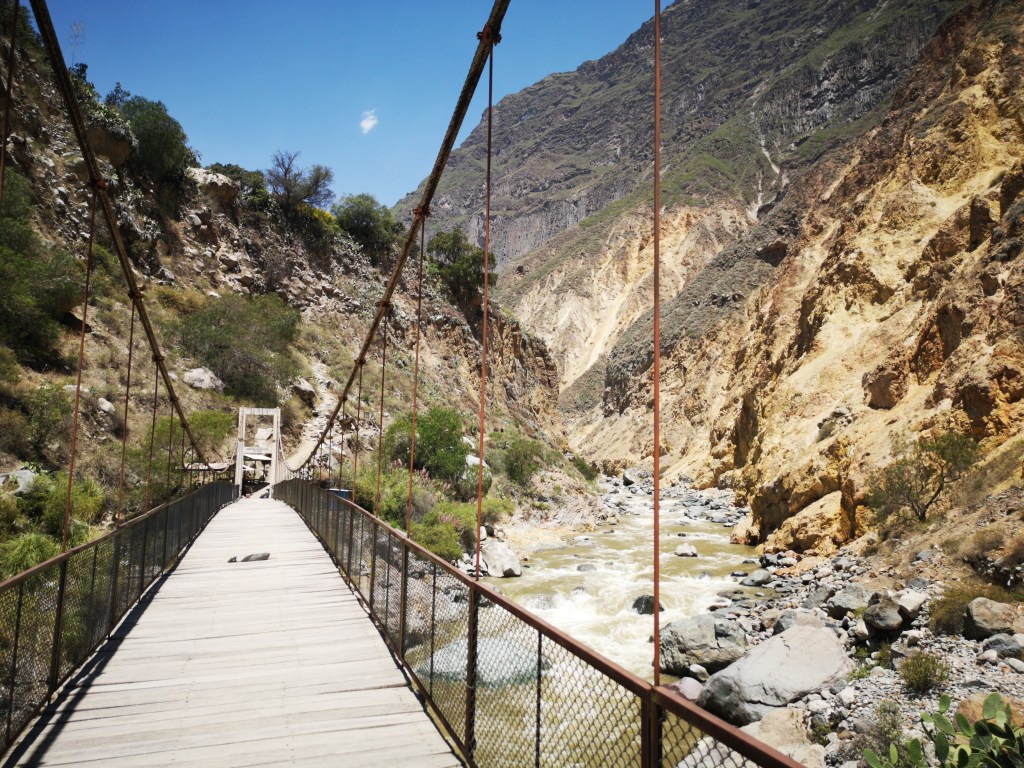
Having spent the better part of the day tiptoeing down about 3,000ft we found ourselves at the nadir. By no means the lowest point in our experience, crossing the iron suspension bridge over the Colca’s mazy river did signal the lowest point geographically-speaking. The sun was beyond its zenith, casting its brilliance on the east face of the canyon, making shadow creep gracefully up the west face.

Scraping the Barrel to Find an Oasis

We had been descending all this time. Now we were walking along the canyon floor adjacent to the watercourse. Festooning the margins of the clear crystal water were orchards of figs and other succulent fruits. Vegetation was abundant. Light and warmth caressing in a very special place where the wind and the winds of change were banished.

We walked and talked for the next couple of days along that canyon floor. We passed churches and villages, kids coming home from school, and guinea pigs flayed and hung out to dry. We stopped in a guesthouse with the most amazing swimming pool, fed to pure by an oasis. A classic desert oasis in the truest sense it was, fringed by date palms whose seedlings had come from half a world away.

It’s All Uphill From Here

On the third morning since taking the plunge into the world’s third deepest canyon, we gathered around our guide at 4am to face the trek back up and out. We obviously knew all along that what goes down must come up. But comfortable in our deep oasis on the previous evening, tipsy on rum and oxygen, I was contemplating a helicopter medevac out of there. The climb looked daunting, and was. 3,000ft straight up in the grip of incipient subtropical heat. Hence the reason we left before daybreak. As if to foreshadow what would be a gruelling hike out, my guide took one look at the packs I was carrying back and front, and shook his head in pity. “I told you to travel lightly, didn’t I?”

Half-light kissed the rim tops around an hour or two into the climb. Then, quick as ink blotting on paper, the dawn light seeped down until we rose to meet it a quarter of the way up. By then the pain of being a human packhorse had slowed my stride to a lumbering, teetering mess. My t-shirt was soaked with the sweat of my own labours. My bandana had to be wrung out every 100 metres or so. My eyes were weeping salty tears of pure perspiration. The line between myself and the other group members was attenuating fast, as they strode ahead. Overcome with guilt, eventually my guide offered, with a degree of reluctance visible in his grimace, to take one of my packs. But not before hailing a passing muleteer who refused.

Ghosts From the Past

Onward we clambered, inch by inch until at about 10am – a full 6 hours after setting off from the now microscopic guesthouse on the canyon floor – he and I emerged on the lip. Shattered, reddened to bursting, and vowing never to descend that far again with any baggage whatsoever, I collapsed in a heap. Beside me, by the grace of an ironic God, were a couple of Estonians I had climbed with a couple of weeks earlier. On that occasion, the altitude was so dizzying that it was they who struggled with hypoxia to the point of almost fainting, and me who offered a helping hand. Now there they were all smiles, relaxing after practically jogging up the Colca carrying nothing but a 7-litre daypack. And me, a sorry sight, temples pounding, eyes throbbing and near spent. Valió la pena? Was it worth the pain? Absolutamente!

TITICACA: Afterlife Vacation Spot #1

#adventure, Lakes, Perú, Reincarnation, South America, Titicaca, Titicaca, Travel

Did You Find Me, or Did I Find You?

For now that blue eye in the sky between Peru and Bolivia still exudes magic. Where others struggled to point, as a kid obsessed with the physical world I faced down that map of the world and prodded right at the X. Titicaca, there’s no hiding from my beady eye. In hindsight, it was my way of saying,


‘Don’t you go evaporating because one of these days I’m coming for you.’

It only took nearing thirty years of travelling to other Titicacas before the real thing found me wandering life’s lost highway. And now Titicaca is gone from sight, tucked away behind that annular world of rock and sky, she hasn’t really gone anywhere other than shrink inch by inch. As the lake was with me from the start, so she shall be to the end. And beyond. Maybe so far beyond that my ashes will linger longer than her vapours.

Early Onset Titicaca Syndrome

I might have mentioned, There’s not a time i can recall not knowing of the lake. Maybe it was the name itself banded around like M-i-s-s-i-s-s-i-p-p-i in the corridors of primary school. The hee-hee and ka-ka onomatopoeia of a laughing jackass, the repetition of the phonemes -ti and -ca, so alien to my English mother tongue. And the familiarity just deepened, breeding not contempt but a certain fascination. Ferocious battles of Trivial Pursuit at the tender age of ten taught me that Titicaca was Earth’s highest navigable body of water. That cool factoid stayed lodged in my hippocampus, planting some seed in the drifting dunes of the mind that would one day bring ephemeral rain enough to germinate that seed into an apparition of the lake itself. I could have sworn it was the real thing, though these days you never can tell.

The Old Ones Are The Best

Hands down, Lake Titicaca is stocked with knockout trivia the way Lake Malawi is stocked with cichlids. Off the bat, it’s where the supreme god Viracocha created the first man (and presumably woman, given that we’re all still here). But more importantly for their selfless service to all life on Earth compared with selfish man and woman, he sent up the sun and the moon from the dark waters. The sun, who went by the name of Inti, then ordered forth his two little suns, Manco Copac and Mama Ocllo (presumably more daughter than sun) to put Man, who was not only selfish but wayward, on the righteous path to Inca-dom. So they set forth over the primordial Altiplano to found Cusco, on a now well worn – if sublime – route covered by both the tourist bus and train between Puno and the aforesaid capital of the Inca’s Pan-Andean empire.

But Titicaca doesn’t even start with the same waist measurements, nor with those time-lost legends of Gods and monsters. Too many of us start skinny and move ever outward around the girth; the lake did the opposite. I read that about 12,000 years ago, when Göbekle Tepe was wowing forager crowds and ice was on the retreat from gigantic Andean glaciers, what now covers 8,370km2 between the modern political constructs we call Peru and Bolivia drowned a much larger area, was at least a hundred feet deeper, creating a liquid landscape bigger than my imagination. Think of it as a rooftop pool not just for Viracocha, but an infinity rooftop (of the world) pool for all the Incan pantheon. Now that’s a big pool of meltwater, all consecrated, it goes without saying.

But alas! Things ain’t what they used to be. In today’s balmy Holocene, all that’s left is a slow-disappearing puddle a few hundred feet deep about the size of Puerto Rico. Still, not to be sniffed at.


Ticking off the Ash Bucket List

Ever asked yourself where you’d like those ashes scattered when you are no more? I’ve roamed around looking for ideal ‘eternity’ spots rather like first-time buyers viewing properties in the housing market. In fact, I’ve been crying, ‘this must be the place!’, since the first time I crossed the Oakland Bridge as a greenhorn globetrotter of tender twenty-two and saw San Francisco shimmering like Oz before my very eyes. I was in love with it then and I’m in love with it now. There’s eternity spot #1. But who’s to say one’s vial of earthly remains have to be tipped out in the same place?

Why not entrust a dear friend, or maybe a kindly stranger, to sprinkle a little bit of yourself in more than one hotspot you visited and fell head over heels for? Call it a breadcrumbs trail of your brief appearance on this beautiful blue planet, there for your reincarnate self to rediscover on the great wheel of time.


Leave A Little Piece of You Wherever You’ve Gone

In Puno, Peru’s port town on the shore’s of Titicaca, I got the idea for this grand post-mortal plan. On the bus from Cusco i met two of the very few Englishman I found in three months of travelling this land north to south. Affable Liverpudlians, they too were heading to Titicaca for a special reason. One of them, the one not married to the Peruvian girl, was carrying valuable cargo. So priceless it could fit in his pocket; so symbolic it brought him all the way to the Southern Hemisphere.

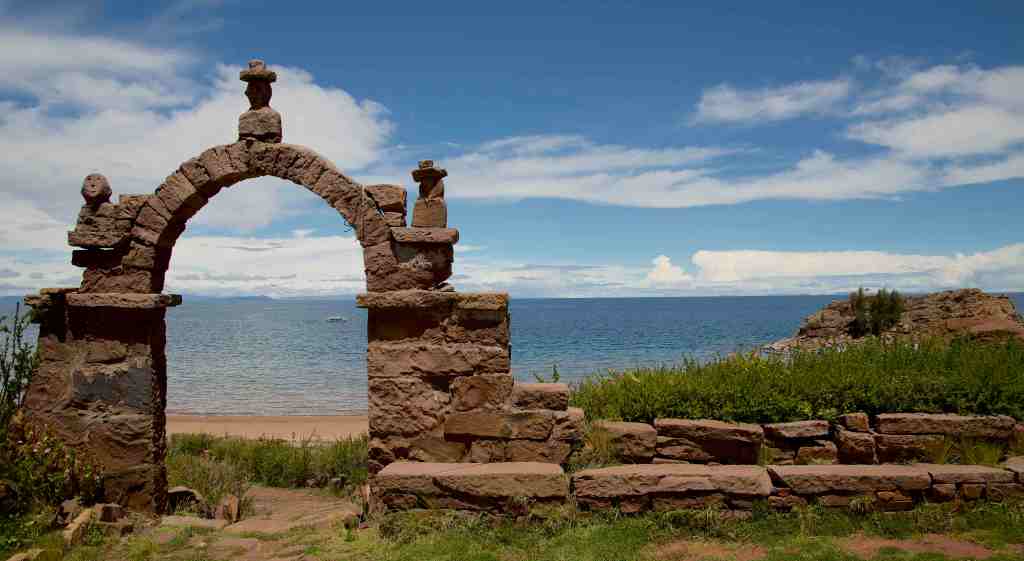
His dad had died a couple of years prior. The man’s dying wish was that his son would ration his ashes, setting aside enough to be able to scatter in a number of his favourite locations around the world. One such spot was Titicaca, though strangely i don’t think he had ever been there himself. Rather, he died with this long-harboured dream unfulfilled. So his son grasped the initiative. He and his friend took a boat from Puno to Isla Taquille – Avalon in the middle of the lake – and on the way there tipped the vial into inky waters of Titicaca. It was there he could say a final farewell to his father. It was there his father’s 21-gramme soul could say an initial hello to this lake so big and so mystical it could be a freshwater sea sailed by the sky people. There was something truly Arthurian about this tale. A power that never left me.


Beaches Where Clouds Ought To Be

Picture yourself on a beach, but no ordinary beach. Picture yourself instead on a soft, sandy beach on an isle ringed with clouds in the middle of Lake Titicaca, at 12,507ft above the bigger cousin of this sea way down there where the world’s intractable problems are deepening by the day. Imagine mountaintops in plain sight, yet so distant I’m not even going to guess how. Visualise a dirty storm front gathering over starboard waters on your Titicaca vessel when on the port side hills are bathed in pure sunlight. Stop and consider for a moment sleeping on a double bed in a floating lodge atop a huge, anchored raft of totora reeds 15ft thick. Being essentially grass this mythical totora, with which the proto-Inca built their distinctive canoes with their curlicue prow, is continuously waterlogged. If the Uro people, who have presumably lived this way since time immemorial, are to avoid a sailor’s death by sinking into 50ft of water, these totora reed mats need re-thatching every fortnight. Can you imagine having to re-thatch a Cotswolds cottage roof every two weeks? I’ve seen the sea peoples of the Andaman. I’ve seen the Junk-dwellers of Canton. Hell, I live on a boat myself. But I’ve seen nothing like this. No, the lake doesn’t add up. And that’s precisely why it does. And that’s why I want my ashes scattered there. Or at least a pinch of them.