On The First Day Of Brexit, My True Love Gave To Me…

Brexit, Uncategorized

ON THE FIRST DAY OF BREXIT, MY TRUE LOVE GAVE TO ME…

….A heavy dose of despair and despondency.

By the seventh day, that feeling still lingered.

These chills rattled me to the bone such that I thought nothing could be as bad. And then the realisation struck me. It could be about to get a whole lot worse. Maybe what is needed is a tincture of the kind of optimism that the Brexiteers have been taking.

A week on from B-day and the aftermath has come. Bewilderment is hanging like a fog. No one really knows where to go from here. A power vacuum has emerged. The political class is convulsed in a human drama the likes of which has not been seen since the bad old days of union-breaking in 1984, or even the Suez debacle of 1956. With emotions running wild, an equilibrium has yet to settle. A consensus on what direction the country will take seems unlikely, even in the long term. One thing is for sure, the polls reveal a nation we all knew was riven apart by the forces of class, geography, age, education and outlook, but were too afraid to face up to the fact. Now it’s official and the whole world knows. Hairline fractures are opening up elsewhere with similar socioeconomic conditions, which means everywhere in some form or another.

Believers in the European project let their despondency form dark clouds overhead. They know the corrective measures Europe has taken since the Treaty of Rome in 1957 not to repeat her woeful history of one war after another is a 60 year-old lesson in harmony about to be unlearned. The five stages of grief will almost certainly ensue. Right now the those on the side of defeat hover between disbelief and denial. The disenchanted outcasts, who were never really enchanted with anything continental, think this divorce is going to be a panacea for all their ills. And it will feel that way until many find out to their own dismay that not much will change so long as money’s moving east to the Pacific and globalisation is still outsmarting mother nature, making fools of men and gods of monsters. The fundamentals of their life will not change for the better because they will not change the world any more than the world will change them.

Brexiteers see the shackles coming off. Unfortunately, these shackles not only silenced the liberty bell, they also kept in check the primitivist and atavistic instincts that kept Europeans at each others throats for centuries. Far from a revolutionary spirit having been released from the bottle these past few days, the miasma in the air is more reactionary than anything. The majority of the rejectors snubbed the only metonym of a faceless globalisation they knew – the EU – not for radical reasons, but for deeply conservative ones. Brussels became that byword for all that was wrong in large part because the daily diet of tabloid drivel had been peddling it through decades of sniping and badmouthing, which of course stoked the latent prejudices of the home guard readership.

Left behind on the dock of change, Dad’s Army, which is basically what the Brexiteer movement is, watched their ship sail. Few boarded it; fewer still could afford the ticket. Globalisation didn’t work for them. Yet beyond the EU, globalisation will continue unabated and it still won’t work for them. And by then it’ll be too late to act on the truth that, however unwieldy it was, the EU was ultimately a force for human decency and restraint. It tried to do the right thing at the wrong time. It brought the tide of war into its refuge not because it wanted to further put a strain on already strained and fragmented communities; it did it because it wanted to ameliorate their suffering. That’s the moral thing to do. When the alternative is a Trump-like unsympathizer who considers outsiders as vermin, then even the most egregious decision made at the supranational level in Strasbourg or Brussels will somehow seem mitigated by the immensely difficult circumstances in which we find ourselves presently. Closing in on ourselves, if it’s to have any ultimate benefit, will at least expose the true ringleaders whose failures landed so many people in such a cycle of despair. The outing of this homegrown elite might level the playing field for the little man. They’re going to be sorely disappointed when the rogues who stand by and let their towns decay turn out to be their own fellow countrymen, albeit a new tiny class of merchant with their eyes on the prize from new markets in far flung places among old Commonwealth allies.

Plus ça change, plus c’est la même chose, as our former French political partners say.

Some of those who were quick to announce a long overdue divorce are already sullen with regret, unsure in the light of a new day whether it was right to storm out of the marital home. Emotion has stabbed an arrow into the eye of common sense. Even the blind are beginning to see that. The more egregious the mistake the sooner the realisation dawns on people.

To be quite honest, the British were already ambivalent about a club in which they considered themselves too good to play by the rules. Like a flaky lover who stays when the going is good and threatens to quit when the times are tough, the plebiscite who would seek set the nation adrift from the continent chose a perfect moment to deliver the death knell when the EU was down and reeling from a succession of blows. The rejection was cruel and humiliating in its untimeliness. When the very idea of Europe was under threat from agents both inside and outside its border, it needed its big guns to rally to its defence with new resolve. Instead its biggest military force and second largest economy, the UK, waited until the EU was under fire to desert and form its own faction. No wonder the moderates on the Continent are seething.

Perfidious Albion! The French coined that one, too. Maybe Napoleon was right, England is that nation of shopkeepers.

So after thirty years of getting chronically dissed by the British populist media, Brussels is now free to pursue a less persecuted agenda. The chickens have come home to roost on a British Government who have been itching for this moment. It was their spin doctors, backbenchers and press secretaries, after all, that fed the tabloids with a lifeline of meretricious slurs which they knew would be gobbled up by Saxon John Bull during his tea break, further reaffirming his lingering second world war suspicions about the intentions of politicians in far off Berlin and Paris, speaking funny tongues he doesn’t understand. That formula sold lots of newspapers. It also, ironically enough, ultimately sold the country up the river.

Onto what now will the tabloids heap ridicule? Now the most visible target has been riddled with bullshit buckshot, who now will come into the cross-hairs of English public opinion? Truth is, there’s nobody left for the popular press to pillory other than the real elites. Will John Bull turn his ire on his elders and betters with their posh accents and taste for black olive paste on ciabatta?

The shires have packed up and gone, in a direction not even they can tell, and Europe will be all the better for it.

Globalisation worked for those who were willing to get out there and seek. And one did not have to be an Oxbridge graduate to sign up for that adventure. For all but the most industrious and entrepreneurial who refused to budge, only the slim pickings from globalisation were left them – the wishbone instead of the breast, so to speak. It was their rejection of something that was always over a horizon they shunned that has set in train this decline of integration, across Europe and far beyond.
Those who agitate for a renaissance of their small town, postindustrial communities, many fail to appreciate that their now moribund surrounds were once gleaming products of nineteenth century globalisation and that their ancestors followed the new money trail there from the bleak prospects of country life in search of the opportunity that the rail and manufacturing revolution afforded them. They were migrant workers in search of a better life even then. In 2016 we head for the Middle East in search of a solvent future; in 1816 it was the Midlands.
Those who got left behind have little inclination to go forward. By voting for change many, in a paradoxical sense, want the world to change for them. Though, as we all know in our heart of hearts, it is we who shape the world. Middle England has spoken. But who among them will care to listen?
 

The Answer, My Friend, Ain’t Pissin’ in the Wind

Uncategorized

All life is chemistry. You both know it and show it when the molecules of ‘connection’ (that is to say, being connected to self, something or someone) are missing from reactions made in the humdrum-drumming of the quotidian life. You know this in a falling off the perch and rattling the head kind of fashion when you start watering the house plants with your own pee.

Now the idea is not to acidify the roots and thus kill the last chance anyone has got to connect with the only living thing that keeps growing on no more nurturing than a few bars of Bach, drops of water, spots of light and soluble elements found abundantly in human pee. A soluble gas like nitrogen, needed for photosynthesis, is a big fix for the love of the plant to grow, but let us never ignore the role of light in giving that plant a solid sense of purpose and direction in the life cycle. We can learn a lot from finding our purpose in life in the discreet manner plants do. Conclusively, for the misguided and the lost and the lonely among our legion, moving agonizingly slowly and relying on solar navigation might provide a new modus vivendi there to enrich life to levels considered incalculable by even the standards of Mork’s whacked-out planet Ork.

I digress. Back to the idea in hand. The whole idea of peeing on beloved house plants is not to hasten their demise. As every dog owner with a lawn knows, uric acid in urine turns the green, green grass of home to brown, brown shoots of dead. Rather, the idea of committing this seemingly warped act, when all other meaningful relationships to us have either crash-landed or else never got off the ground to begin with is, in actual fact, to fertilize the potential for beauty. In diluted form, naturally. I mean, let’s not kill the potential for a blossoming connection here by being too overwhelming with our acts of human kindness. Lavishing our love in yellow-brown concentrated form, you might say.

As every homeopath knows and every psychopath with a conscience should, weaken the solution while keeping the essence. As every psychopath knows and every homeopath facing bankruptcy should, making a connection by laying it on thick merely results in the recipient perishing by deeds fair or foul.

The generative qualities of our own bodily fluids go unheralded for the most part. Shoots spring up where little springs of pee shoot out. Watching, albeit with the benefit of time-lapse photography , something leafy with life grow within the sterile confines of a hotel-apartment has got to be tantamount to connection. And I mean the click factor. Transfusing a little of us into what could be loosely described as the bloodstream of the plant might just be an interim solution to that affliction many feel when they’re in a place, in a phase, where connecting on a deep and pervasive level seems the hardest thing to do. If this line of reasoning is reminiscent of ‘The Birdman of Alcatraz’ – you know, the lonely, cold-blooded killer tenderly raising baby sparrows – then you’re not far off approximating the true motives that underlie the theory.

You can let it drain pointlessly away down the toilet bowl or else donate it to needy household refugees: the ficus, the peace lily, the anthurium, the dracaena, or if you’re feeling adventurous, the Madagascan Dragon Tree. Falling by the wayside doesn’t need to be irreversible. Reaching out and making a difference to the being within and without needn’t be Herculean in task. The answer ain’t pissin’ in the wind. The answer is pissing on something that deserves your excess nitrogen. Suffice it to say, connect to more than the internet and let the green-hearted sentinel calm your pounding, postmodern heart with a silent and lasting bond. And, word of warning, if you want the human-plant connection to culminate in an enduring love, don’t stand menacingly over it poised like the Pissing Boy of Brussels, and try perfecting the Goldilocks effect of not too much, nor too little. That formula might just win your emboldened heart a fair maiden further down the line.

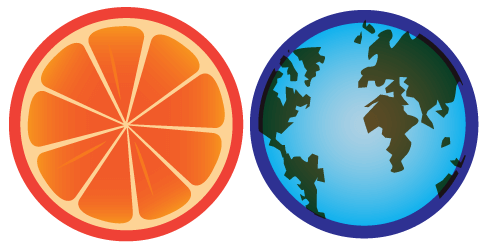
La Terre Est Bleue Comme Une Orange

Uncategorized

What note should we start playing to get this riff going? A few major milestones have been reached this week, both personal and impersonal. We’ll start on a personal note then.

It’s funny how nature wastes nothing, even in the recurrence of words both delivered and received in the course of our lives. A case in point, five years ago – years that feel to this writer like they belong to another dimension of reality – a quite splendiferous woman loomed over my recumbent frame, held out her clasped fingers and, in a theatrical rendition every inch Hamlet holding Yorick’s skull, said La Terre est Bleue Comme une Orange. She then repeated it with added French verve, La terrrre (actus dramaticus – herein she made the letter ‘r’ in terre sound sexily gutteral) est bleue (for this word, her lips were pursed to bursting) comme une orange. Et voilà!

If the phrase weren’t so nonsensical it would be irresistible. Coined originally by the formative surrealist, Paul Eluard, the sentence translated as The earth is blue like an orange. A phrase still etched into the cultural subconscious decades later, it became a motif for the surrealist movement. And I mention this because I picked up a Guardian article this week on surrealism and lo and behold there it was printed plain as day. La Terre est Bleue Comme une Orange. And at moment those memories of that girl whose natural self-effacement and feelings of not ‘être a la hauteur’ – being ‘good enough’, in other words – derailed her dreams of the stage, were brought back to me in a flood of blues and oranges. As she, like Eluard’s blue planet of citric fruit, never really disappeared from consciousness, I thought of the untimeliness of recurrence. It all comes back, but where and when who can tell. The waking dream that is life, now there’s the essence of the earth blue as an orange. What better way to make real what is surreal?

In other news, Paris is drowning. As the mighty Seine creeps higher and higher, even the doors of the Louvre have been sealed and the priceless artefacts contained therein boxed and evacuated. When the Luftwaffe reigned the skies back in the summer of 1940, the British Government did likewise by stuffing the Royal family into crates cushioned by scrunched newspaper, ready to ship them out to the Canadian Arctic where they could chill a while until Churchill had downed enough of their VSOP brandy to come good on his oratory.

The central European whirlpool of rain has been biblical. Cars bobbing on a rushing torrent of brown, churning water like they were rubber duckies. Although Europe has been on the receiving end throughout recorded history – think the rains that turned the 100 years war between England and France into a mud-bloodbath – there’s something disquieting about the extreme force with which mother nature is throwing atmospheric phenomena at us. Newton’s Third Law is exaggerated with these rains. For every man-made action there is an unequal and disproportionate reaction on the part of nature. The more we push her, the harder she’ll push back. Environmental provocateurs beware.

Speaking of counterbalancing forces, the holy month of Ramadan falls this year on the eventide of the 6th or 7th June, depending on the appearance of the moon. From the elliptical sighting of the new moon early next week, that being the start of the ninth month of the Hijara calendar, to the elliptical closing a month later, the overwhelming majority of Muslims will let nothing, other than words, pass their lips between suhoor (sunup, about 4am) to iftar (sundown, about 7pm). Wherein most of the Islamic world exists between the horse latitudes of twenty to thirty degrees north of the equator where deserts proliferate, the 40-45 Celsius heat at this time of the year by any reckoning makes 13 hours of abstinence a feat worthy of respect. That is, until you factor in the little problem that in the present reign of King petrodollar the benefactors no longer live a life which involves stepping outside for all but the briefest of moments.

In the oil-rich region known in Arabic as Khaleej (the Gulf), the economics of affluence and the concomitant greed that ensues throws dim light on the whole notion of self-sacrificing acts of the magnitude of Ramadan. Admittedly it’s only a small corner of an Ummah (Muslim community) extending from Java to Morocco, yet the Gulf, by virtue of no longer being a humble place, is a destabilizing influence in terms of the authenticity of these religious acts of poverty and humility. 

Unlike the rest of the Ummah, dispersed as it is throughout lands described at best as developing, at worst as failing, the native population of the mega-wealthy Gulf has gotten so used to being served hand over fist since the fruiting of oil in the 1980s that to perceive many of them serving anything but themselves is a tricky proposition. So accustomed to having others do their cleaning up after them, even if Ramadan remains an important force to moderate human excess, you wonder if during the month of remembering the plight of the poor, self-purification for some might be a bridge too far. The cloak of obligation suddenly feels a whole lot heavier. 

Not to exaggerate the point, Saudis themselves testified to these very ears that they cram more into their beaks every night of Ramadan than any other time of the year. They actually put weight on in a time of fasting, if you can see the paradox in that.

Enjoying excessive spending power has an endgame, which is crass consumerism for consumerism’s sake. Adopting the de facto title of ‘home of the mega mall’ belies a deeper irony come the month of Ramadan. Floating free in a bubble of wealth, confusing lucky oil money with rights of entitlement, is inimical to the earthiness of Ramadan, and the moral hypocrisy that flows from the disjuncture is not lost on some. For they know that to make any sacrifice that requires extreme self-denial you’ve got to to feel it in your bones, and passionately. Doing it as a necessary duty, because not to would land you outside the community bounds of acceptance, isn’t enough. Remembering the plight of the hungered is a memory that is bound to fade the more complacent a people become through having affluence which can only be described as surreal.

For all the sense it makes, the earth might as well be blue like an orange.