There’s a place high in the North Atlantic where day by day America and Europe grow further apart in matters unrelated to politics. It’s no fun being the subject of a custody battle between mother Eurasia and father America.
Tectonic limbs all wrenched and popped from sockets by the selfish jostling of parents who should know better, this ‘kid’ is a work in geological progress. Only Hawaii experiences growth spurts like this.
There but for the grace of an ever-widening Atlantic goes it. It, of course, is Iceland. It, in its physical manifestation, looks like a green and white lesion on the skin of the Earth when seen from space. As lesions go, this one’s made of tough stuff: of gabbro, rhyolite, andesite and all the inanimate stuff of inner Earth, stuff whose quality reassures in both its lastingness and the sure-footing it provides our little feet on these hair-raising trips around our parent star.
When least expected, the lesion seeps hot puss onto Earth’s skin in the form of hot mantle rock. By night glowing rivulets of lava channel down from the frigid heights to where nature spins this rarely seen material on the loom of time. What spent aeons riding the currents of the hot, viscous ocean under the earth’s crust is now cooled under grey skies in these sub-polar environs. Evidence of it lies strewn everywhere, petrified fragments of magma now little charcoal-coloured sponges dissolved full of holes.
Iceland is rightly known as the land of fire and ice. There, hot geothermic forces that on most landmasses remain under a 70 km cap of insulating crust bring the insanely-hot upper mantle so close to the surface that green mountains blow jets of steam from their flanks. The sight is akin to seeing the smouldering embers of dozens of hillside campfires, except water is the fuel, and not the smouldering remains of firewood. Correspondingly, in rural Iceland, which is practically all of Iceland, drainage trenches cut into the roadside verge create curtains of hot vapour steaming up, making the driver feels he’s driving on a whistling kettle made of tarmac.
Known as Thule to the ancient Greeks, this place of black sand, ice-capped highland, stunted trees and primeval lime moss below the Arctic Circle is by no means mythical in spite of a temptation to deem it so. For to be mythical is to be ancient, and compared with granny Scotland to the south, Iceland is a geological laddie. Plus, its status is real enough to have a runway on its southwest peninsula bringing in an ever-increasing number of people curious to see what all the fuss is about. Not far out of the airport, and one can see why. A volcano, constructed by nature only yesterday so perfect is its conical shape, stamps the country’s character almost immediately.
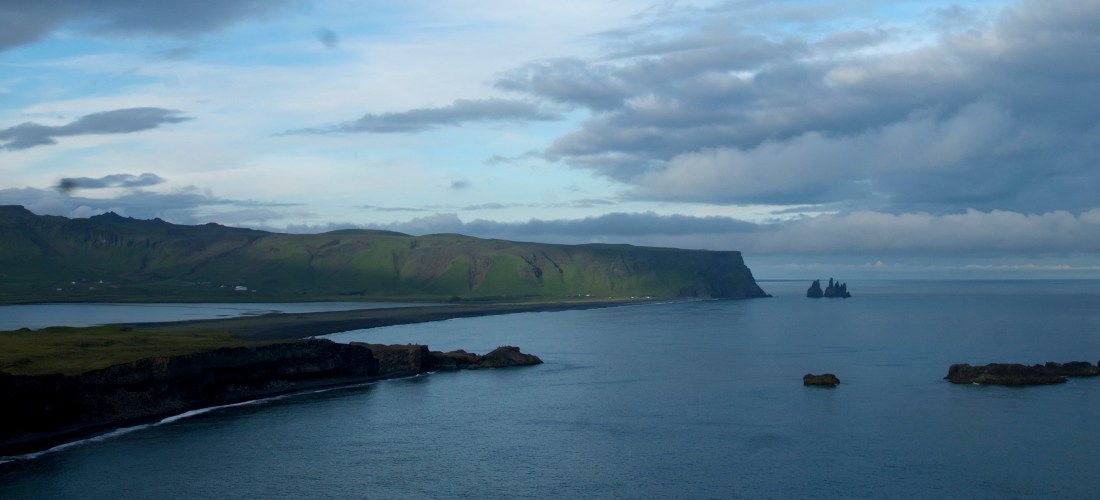
The south cape of Iceland is a sight like no other. Giving the savage beauty of the cape a human face is the village of Vik. Man, this is one cape that makes Superman’s look pointless. With its super-cooled hexagonal columns of basalt (think Fingal’s Cave in Iona, Scotland) propping up grass-coated cliffs that double as high rise apartments for legions of fulmars, puffins, terns and other tenants, the magic oozes right from the word go. Then there’s the headland that juts fearlessly into the freezing Atlantic. The sea stack at the outer perimeter of the headland is carved into the perfect stone arch which reaches high into the sky and through which a ship could pass unhindered. Pushing south into the North Atlantic, this point is the nearest Iceland will be to warmer waters, that is until it spews more submarine eruptions that give it that extra-territorial reach. No other island can undergo geology’s answer to a cosmetic makeover quite like this one. Stay alive long enough and you’ll see it morph into something else.
The innards of the earth ground down to grains, its black sand beaches stretch away into the past one way and into the future the other. We’re standing on a convergence point of time as it was, as it is, as it will be. All a bit disconcerting, in the nicest possible way. Behind it all looms the presence of the same Eyjafjallajokull volcano that belched thousands of transatlantic flights to a standstill five years ago. Iceland’s famed ponies stand in a huddle against the sheet rain. An endless supply of fresh grass is their only recompense for finding themselves stuck shivering in steel-grey of the mid-Atlantic.
All is not what it seems. Unlike most other places, where heat originates from above, Iceland feels it from below. A skein of hydro-thermal pipes run over old lava fields turned to moss. Blink and the pipes could be running oil. Denuded of trees, this place could be the hellish twin of the Persian Gulf, with its crude oil pipes running over equally barren lands. And like the deserts where winds blow sands into new arrangements, in Iceland it’s the restlessness of what lurks beneath that ensures that timelessness is no more than a cruel illusion. At least, Tolstoy would back me on that one if he were still around.
(The photograph was taken in Vik, on Iceland’s magnificent south cape).


 The Blind Salamander