Here’s to 2024. May you retreat into the past with all the obscurity you deserve.
Good riddance to you. Like all the worst salesmen, you promised so much while ultimately delivering so little. You raced off the blocks at the stroke of midnight last December 31st on a 10th floor balcony in Krakow. You even heralded a new year with pyrotechnics the likes of which I saw only once before over the Sydney Harbour Bridge during headier times. You were so presumptuous about how swimmingly the rest of the year would go that you exploded into life in an 1812 Overture by sending a chaotic crescendo of fireworks in a great ring around Poland’s southern capital.
It boded so well for the year to come. Despite the January rain, signs were green that ’24 would ripen into a vintage. You gave me late January in Italy. O Italy, si bella e perduta. You followed that little boon by gifting me February on Brazil’s emerald coast, March in the otherworldly beauty of the Atacama desert, and April where Eve’s apple fell, right in the heart of Rio. But that was where the year peaked, before spring hadn’t even had the chance to spring.
You made it hard on me after that. I’m convinced your ultimate aim was to humble me. Is that because I returned to the place whose welcome I had long outstayed? You tamped down my hopes in one disappointment after the other; too long a rap sheet even to mention. Or maybe you were teaching me a lesson that when it comes to little lost souls, they can’t always get what they want but if they try sometimes they might find they get what they need. You taught me that life doesn’t always go our way, but if we hold on for long enough with our pleading hand outstretched it probably will pour us a cup of kindness, mainly out of pity for our unwavering stoicism. So good riddance to you, but not without a begrudging thanks for staying true to your unpredictable self. Everything is as it has to be, and when contextualised by subsequent events even duds like 2024 will start to unravel the mystery of why they had to act so mean.
I have a feeling that you were a spiteful bitch to many a poor soul. You thwarted many a dream while compounding many a misery. And hey, while you were putting the squeeze on many of us, you also managed to serve up a dull summer marred by clouds. At least you did your damage at a brisk pace. You raced through yourself, burned your candle from both ends with a ferocity even faster than the year you buried. You were a bull in china shop minus the valuable crockery, but not minus the awful sound of shattering plates.
So, there it is. I won’t miss you unless your replacement turns out to tread still harder on my dreams. But given how salutary a lesson you delivered, for the sake of harmony 2025 really needs to play good cop to your bad. When I look at the wider world with a cold and hard stare, the augurs don’t look great for times ahead. The view out the window on day one of 2025 is hardly inspiring. A hard rain is already fallin’, and I’m thinking it can only get better.
24? What kind of number is that, anyway? Divisible by 12, 8, 6, 4, 3, 2, 1, and itself. Broken down by a host of lesser numbers, it’s impossible to predict which way you’ll go and with whom you’ll decide to sub-divide. From the end of the first quarter of your ignominious year, you chose rather selfishly to divide into yourself, but instead of the wholeness of 1, you left me with less than that. Come on, maybe you were mean because we deserved it with our collective stupidity, a flirtation with human disaster that shows no sign of abatement. But please spare the individuals among us who just want you gone and your successor to show a little clemency and a lot of succour to guide us along on our life’s journey. ’25 is only divisible by 5, 1 and itself, so surely cannot go off the rails like ’24. I’m banking on the new year multiplying by 4 to give me the perfect 100, but perhaps a little overly optimistic.
In case you didn’t hear it the first time around, good riddance and don’t come back any time soon. Here’s a parting shot: we can only hope and pray that in 364 days from now our resolutions don’t involve pining nostalgically for you. For that will surely mean that the year to come has been even more of an eventual let down. Keep wearing that epitaph, the year to remember for mostly the wrong reasons. When all is said and done, at least you left me with my health intact, and, well, you did show me the Atacama desert. Okay, granted. You were a mean bastard and refused to show me the way ahead, but in your defence at least you showed me emphatically where not to go, And, more indirectly, how to call upon the power of grace to let go of the things not meant for me, even though I remain puzzled as to what is.
Today, I was reading a comment posted on Quora. The leading question was: What Do Britons Envy Most About the US? To which – and I am sorry to resort to the social media art of backbiting – this particular member of Quora’s burgeoning commentariat decided to put down his Daily Mail for a moment to consider the question. If i may add, with a degree of ignorance I have long suspected in my fellow countryman, but hitherto have been unable to prove. This one’s a game changer.
His answer – hardly surprising coming from a reader of a newspaper with a long and illustrious history of jingoism, xenophobia, and acute insular-mindedness – left me wondering two things :
Firstly, whether this man had actually ever travelled anywhere beyond the house he so proudly owns; and secondly, what is it I envy most about America.
Returning momentarily to the Quora contributor, he went about answering the question of envy by singularly failing to address the meaning of what was being asked. So what does the average Briton envy most about America? Well, it helps to know the place by means other than what is daily reported in his favourite Little Britain news rag. His answer? To paraphrase: I’ve just had a full English breakfast and now I’m resting contentedly with coffee and tabloid in hand, admiring the four walls of the house I own outright (as if Americans don’t own homes). Then, for good measure, he throws in a little mockingly-good dose of British sarcasm about how he wished he’d had all that American Free-Dumb (as if Britons own sarcasm).
Upon reading this, I bristle with uncustomary outrage, as i am not an American. However, I think a little part of me might be. My mind is busy thinking, just because a man can enjoy digesting an English breakfast of bacon, eggs, sausage, beans, and fried tomatoes, accompanied by 100 pages of right-wing tabloid bile, and all within the comfort of one’s own home, does in no way negate America’s dizzying roadside attractions.
Comparisons are dangerous when you have little idea what it is you are comparing. In the case of UK-US country comparisons, chalk and cheese.
Does he know that the US is not so much a country as it is a continent? If he cared to step out of his zone de comfort and board a plane to the four far flung corners of the continental United States – Anchorage to the Florida Keys, San Diego to Cape Cod – he might tone down his prejudices a bit.
Ach! Why should I care what others think? Their loss, my gain. The more of them remain at home admiring the wallpaper, the more of America I’ve got all to myself. So, back to the matter in hand: what do i envy most about the United States of America? That is to say, what do they have that we don’t? That I don’t possess?
Well, turns out, a lot.
For format’s sake, here’s my top five:
World-class National Parks, some the size of English counties. These are designated wild places. Mother nature’s property portfolio. They contain wilderness that belongs to no one in particular and to everyone in general. See Yosemite valley and weep, just as the great Scots-American pioneer, John Muir, did. And that’s just one of many parks that range across thousands of miles from Denali NP in Alaska to the Big Bend in Texas, from Sequoia NP in California to Acadia NP in Maine. Although the designation ‘National Park’ has been awarded to 63 sites across the US, there are literally hundreds more state parks, national monuments, national forests, and so on and so forth. One could spend the multi-millennial lifetime of a redwood tree exploring them, and probably still not reach the end. America’s national parks are some of the greatest entities ever created, and humanity didn’t have to create a damn thing doing so.
It would be naive to state that the US is a classless society, but it would also be a gross overstatement to say that it’s anywhere near as class-conscious as England. There is a proud tradition of meritocracy in the US, which harks back to the days of huddled, squalid masses pouring off the Atlantic liners in search of a better life in a new world. In the US, aristocracy is a term loosely applied to old New England families, and Hollywood film stars. In Britain, aristocracy is real and to this day responsible for walling off vast swathes of land for personal gain. A land grab and power consolidation that has gone on for centuries. This deference to the landed gentry shows no sign of abating, even in the face of 20th century political progress. America’s anti-monarchical revolution of 1776 had its origins in English dissident, radical liberalism. It was then joined by a republican France to become a place where, if you were white and Northern European, the average person was thrust centre stage, and the inalienable right of kings tossed out. Suddenly, we were all kings in a savage land.
Abundant sunlight that mottles a stunning geographical diversity. They used to rhapsodise about the sun never setting on the British empire, as the empire stretched across all time zones. Well, if it’s mizzle in Maine, you can bet Texas will be toasted by UV. If clouds reign over Kalamazoo, rest assured, winter sunlight will dazzle downtown Denver. Fog in Philly? Photons in ‘Frisco. You see the alliteration? Dazzling, isn’t it? Maybe, but it don’t dazzle like downtown Daytona. Who loves the sun? Not just the Velvet Underground.
On the Road right through American popular culture. The tradition of hitting the road, Jack, and not coming back no more, is enshrined not only in American literary culture, but in real life, too. I have a friend from New Jersey. One day, he decided to follow his doctor sister to Las Vegas, a mere 2,000 miles away. Hopped into a car, and headed west. Stopped here and there along the way, but kept going. Within a week he had gone from icy winter to a hot desert where he picked up work as a wilderness guide, in no time. Americans, unlike Brexit Brits, have choices. And believe me, many – through restlessness or desperation – pack up their bindlestiffs and seek emigration within their own nation. They can quit some insufferable place and start again somewhere utterly different, which really just nourishes the soul, and keeps that wonderful literary tradition going strong (see the award-winner Nomadland for a case in point).
Wilderness. Unashamedly, I keep coming back to it. America’s untouched places, which I have seen in the flesh, and continue to see shining in my mind’s eye, are truly a thing of wonder. The Pacific Crest Trail alone runs for 2,650 miles from an iconic bridge on the Washington/British Columbia border, to the Mexican border. The trail bisects some of the greatest wilderness on Earth. Americans, seeking spiritual solutions for materialist problems, set out on the trail. 5 months later they emerge changed forever and for the better, having read the signs that nature put before them. Meanwhile, where do we Brits go for a spot of soul-washing? Wherever it is, we can be sure of encountering signs of a different kind along the way: Private/No Entry/Keep Out/No Trespassing….you get the idea. Envy might be a deadly sin, but nowhere near as deadly as that old assassin, ignorance.
I was born out of place and out of time. In a previous reincarnation i’m damned convinced i was an émigré from an impoverished and burgeoning family of lowly, lowland Scots, leaving the brutal industrial heartlands and zero prospects in search of a better life in a land so exotic only the language reminded me of myself and my roots. My medium thinks the year was 1872 and the family was from Ireland. But either way, I discarded the old world for a taste of the new. I took the iron railroad west and found the place my dreams had been alluding to for all those years. I traded in the gloom for the boom, the shite for the light. And never stopped to looked back. Not for a minute.
Am I right in thinking love spans not only generations but species, too? The most obvious case in point is man’s enduring love for canis lupus familiaris. When did it all begin, this love affair between Man and dog? Round a neolithic campfire on long winter nights with that wolf cub with the soft, ticklish underbelly? I know it can happen in the unlikeliest of places, as interspecies love did with me on a beach in a little balneario near where Peru meets Ecuador.
I fell head over heels for Totoro. King of all he surveys. Totoro, a regent in a republic of waifs and strays.
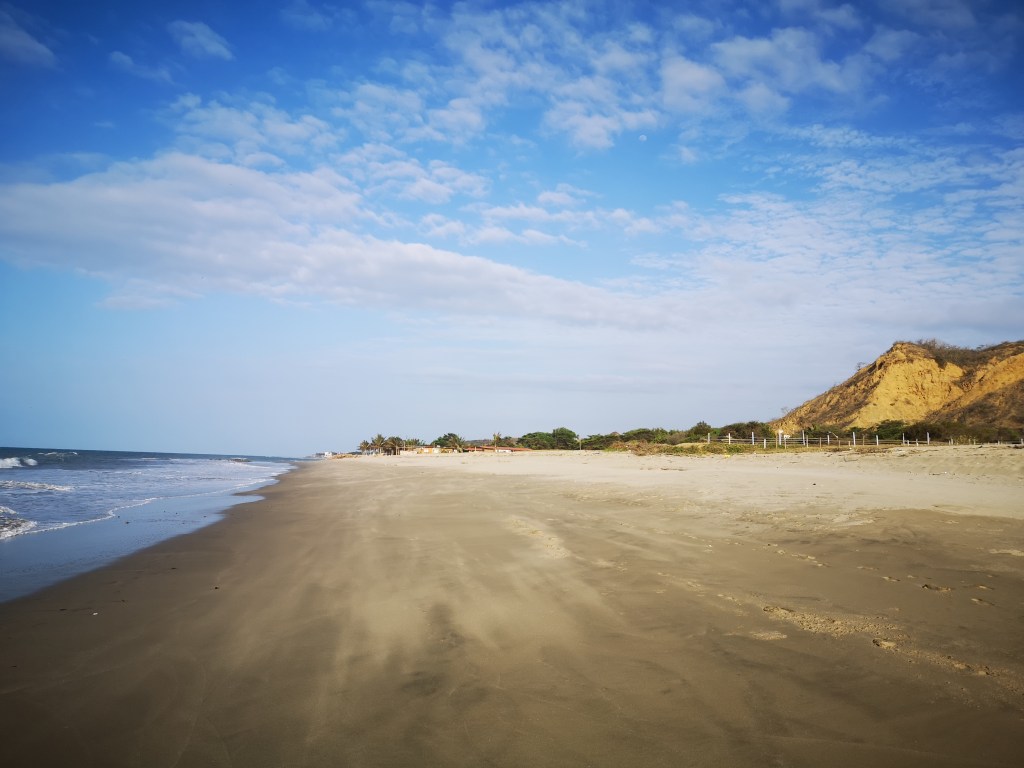
Totoro lives in Perú’s far north region of Tumbes. He is, quite simply, a regional celebrity. As every dog needs a home, even free spirits like Totoro become attached to somewhere. His somewhere is a beach hostel: a ramshackle beast of a place, oozing character, built metres from the warm Pacific surf.
Totoro is no ordinary dog. In fact, he is such a heartthrob that – and i kid you not – his name is cited in multiple booking.com reviews of La Casa de Diego. At his beachfront hostel home oftentimes he can be found disappearing into a hole in the sand, nuzzling into a smitten guest, or else chasing down pelicans full pelt along the beach. One review, as I recall, lauded this canine character so much the couple in question decided to stay another week, mainly because they were the ones with separation anxiety, and not the dog.
Like many great acquaintances in life, I made Totoro’s quite by chance. I was staying in a dive further up the beach in the balneário town of Zorritos (little foxes in English), on the scale of Peru a stone’s throw from a Covid-closed Ecuador. How did I even end up there? Being on the road makes no sense at times, because one minute you’re planning a jaunt into the hinterland of the jungle and the next minute you find yourself on a 12-hour coach journey up Peru’s long and parched coastline. Frankly, i was expecting more from this little hideaway. I don’t know what I was searching for. I was the only Northern European face on a coastal highway littered with refugees fleeing the human catastrophe which is Venezuela. Zorritos was, and is, a side of Perú that foreign tourists don’t often care much to see. It wasn’t until i checked into La Casa de Diego a little ways out of town that the other side of that other side revealed itself.
In no small measure because of Totoro.
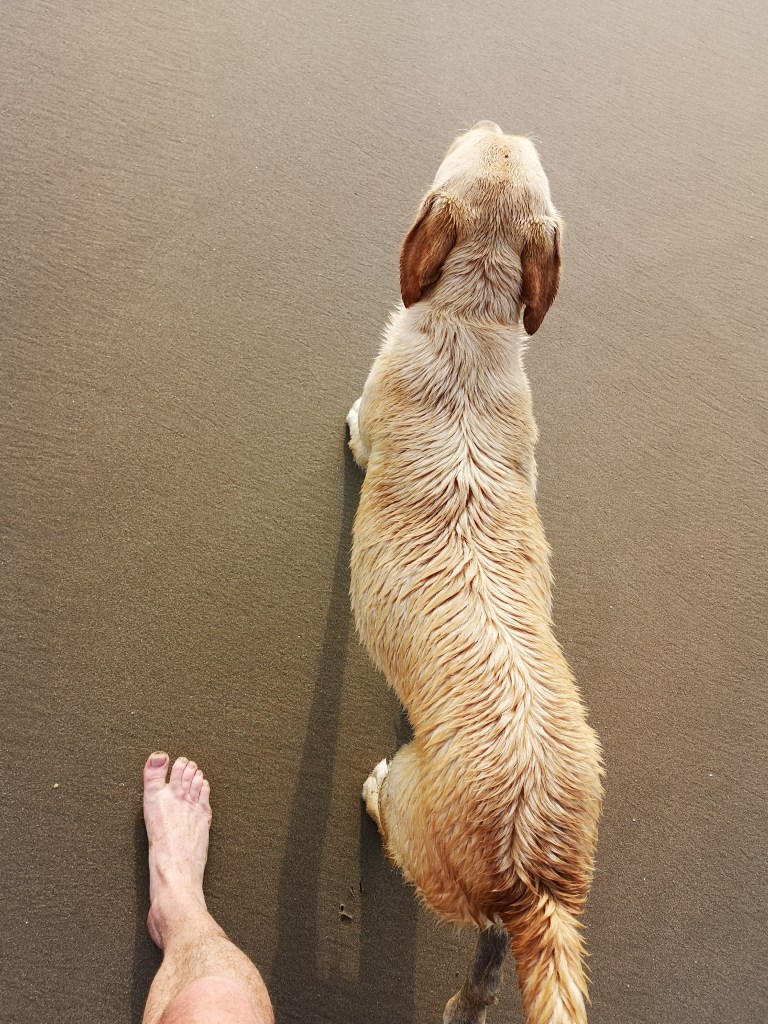
Monday morning, beginning of December. The height of summer 3 degrees south of the equator where – as you know – summer is a permanent fixture. There’s not a sole around. I’m sitting under a coconut palm, and who should sally into view but this regal-looking Nordic beauty of a dog – half pure-bred golden retriever, half Brad Pitt.
Like a stage actor he makes his grand entrance from the wings. Assuming he’s just another of Peru’s legion of wandering dogs, I note with surprise the lustre of his coat. Lingering on him, i watch him cosying up to a guest who’s readying to leave. He looks completely at home with humans, which is by no means a given in a land where dogs manage to coexist with the population while still maintaining a certain wariness of humans, who to be fair do not fetter them with cuddles and coo-ing affection quite as we do in rich countries. This confidence he airs strikes me as uncommon.
The lady disappears forever from view, leaving Totoro alone on the beach facing the hostel. As if she never existed, he immediately seeks new thrills. Sensing treasure deep below, like a pooch possessed he starts digging. He scoops with such fury that the damp sand sprays six feet behind him. Soon, he has excavated a large mound of sand while simultaneously being swallowed up by the beach. Only his little tush and tail remain aloft.
At length his head shoots up from the sand pit of his own making. He swivels it. Finally he notices me. Trotting over, for that’s what confident dogs do, he introduces himself. It’s love at first sight, for my part anyway. He’s in love with everyone. Moreover, he’s in love with life. ‘Come on,’ he intimates, ‘let ME take YOU for a long walk.’
Plastic rubbish litters the beach. The type of litter that doesn’t biodegrade is a real problem in Peru. But for dogs like Tororo, plastic bottles present an opportunity to play fetch. I pick up a 500ml Coke bottle half filled with seawater and feign a throw. This excites him. I feign again. This piques his annoyance. He barks, but not as a mindless utterance, rather a form of modified speech. His bellow cries, ‘stop fannying around, and throw that thing as far as you can.’ I do and he hurtles off after it like a pro.
We walk for miles together, Totoro and I. Together in the loosest sense of the term, for Totoro is way too individualistic to be walking with anyone. He is a pioneer, this dog. A pathfinder. He goes at a canter, leaving me miles behind, only to find me again, the pinball that he is. When the bottle winds up churning in the surf, he barks at me to find a suitable replacement. Finding one, once that goes the way of the coke bottle he tires of the game and goes off in high pursuit of seabirds skimming the waves in the intertidal zone. Crashing through the surf, he launches himself, almost snagging one in his mouth.
People approach. As they pass, they look on in bemusement at Totoro who is rounding me, corralling me as if I’m a sheep, which I am compared to this lion. He’s calling out to me in a voice so powerful to give him a reason to run. The strangers can’t tell if the dog is showing aggression or is being playful. Totoro trots past a dead and bloated sea lion, showing little interest. An American in a stockman’s hat walks toward us. He asks if the dog is mine. That dog is no one’s, i tell him. He’s a fine dog, the man adds. A dog you might see in America, i say. Yeah, he goes on. He’s not your usual kind of dog here. I reply, i think he belongs to the hostel, but he comes and goes as he pleases.
We walk directly into the sunset until i can no longer visualise where i am. I call him and he responds right away. He knows the score. I am not the first guest at La Casa de Diego to have walked Totoro. Rather, he walks the guests as he sees fit. I happen to be the only one resident at this time, which pleases him while offering me exclusivity. We turn our backs to the tropical sun and head home. Totoro spots another sortie of seabirds skirting the rolling surf and goes hell for leather after them, stomping on the water’s edge like his life depended on it.
On the verandah outside my room, the day is ending. I rock rhythmically on the hammock while under me he settles down to rest. Finally, I think, this elegant brute is settling into the Sphinx position. Every part of him is washed by the Pacific surf. I watch his chest gently rise, gently fall. Every part of him is perfection. His paws are large as a mountain lion. He is in the prime of his life, and that saddens me because at that moment I feel my prime has gone. Well, at least i am as free as Totoro. The difference is, though, Totoro exists only and always in the moment, and I do not. So who now is the freer of us both?
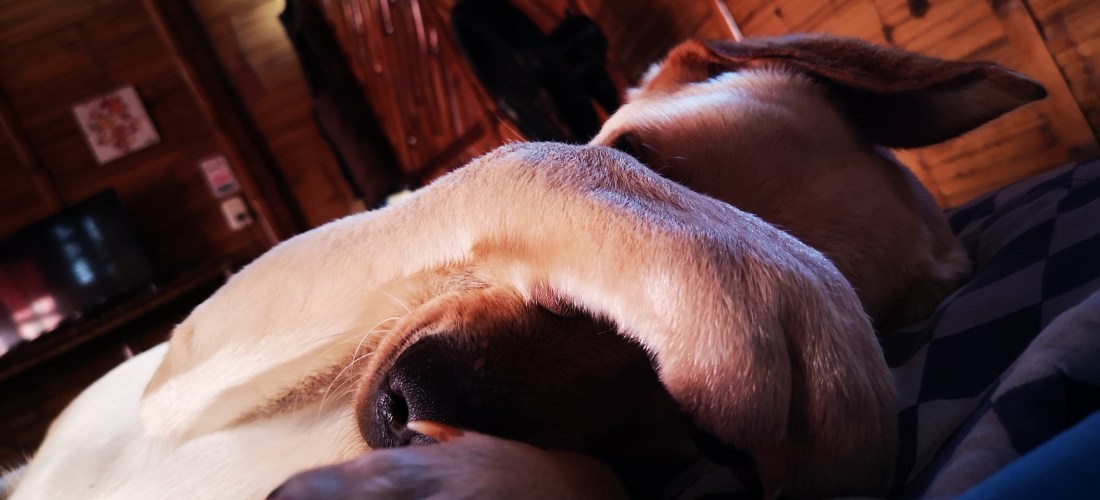
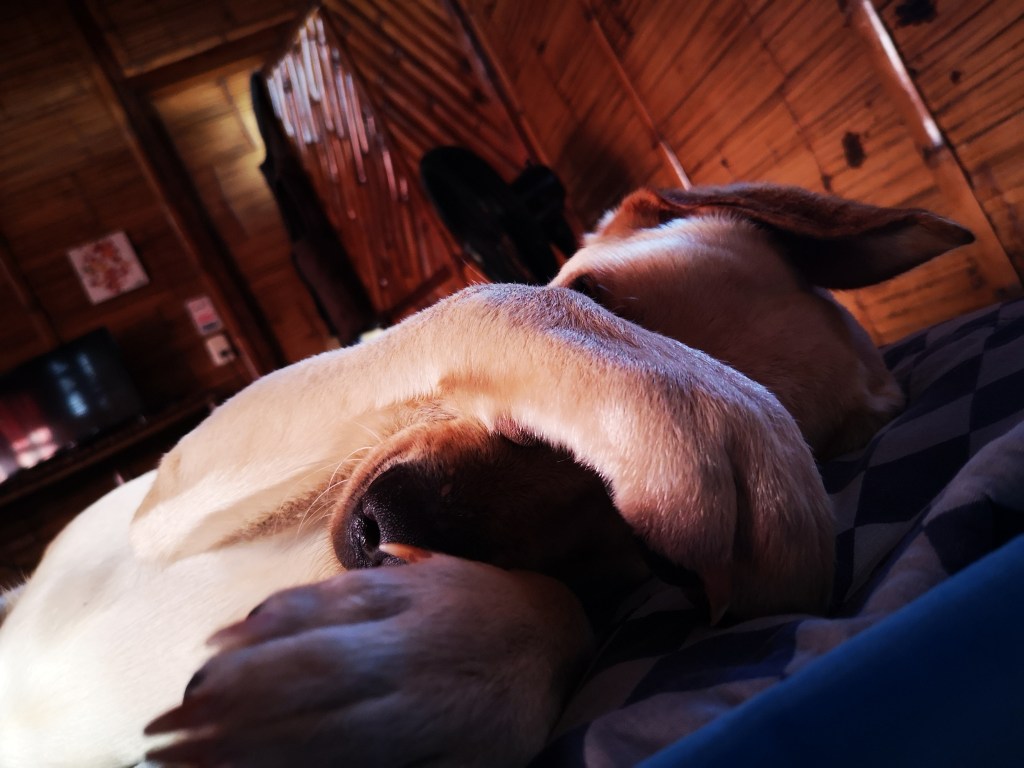
In the morning when I awake, he is there sprawled out over three-quarters of the double bed while I’m shunted to the edge. As if he has learned from other guests the art of manipulation, he hides his eyes coyly with his enormous paws. ‘Sorry for commandeering your bed,’ he says without words. ‘But, on second thoughts, I’m not actually sorry at all. This is what I do when people like you come to stay.’
The day is bright, the heat incipient. Opening the rattan door Totoro bounds down the rickety staircase to the sand below. Like yesterday and all the days preceding, this is the first day of his life. The excitement of new adventures in familiar places is suitably matched by his enthusiasm for the chase.
He waits patiently for me to eat breakfast. Once done, with that stentorian voice of his, he orders me to get up so he can take me for a walk; a long walk on the wet sand of the Gulf of Guayaquil, its lukewarm Pacific waters bobbing gently under twine-bound fishing rafts already poised for the day’s catch.
We walk for hours, leaving fleeting imprints in the sand near the water’s edge. He hurtles off, chasing down whatever has the temerity to try and outrun him. The seabirds that fly in single file inches above the waves are always one step ahead. This frustrates him, and even from a quarter mile away, I hear his voice boom with rage and his long legs pummel the shore. He is in his element in ways I could only dream of.
On the evening of the fourth day of my stay at La Casa de Diego, the curtain comes down on our love affair. I stack my bags up against the fence in readiness for the moto-taxi driver to collect me. Totoro stays by my side but knows what to expect. I am not the first to fall for him, nor will I be the last. I so want to leash him and take him with me on the overnight bus south. But I know that an organism needs its habitat; that to deprive him of this world over which he rules would be to strip a king of his crown.
I can still see him now, digging up the beach, beguiling locals with his brazen beauty and confidence, bounding, like a straw-coloured stallion, after those shore birds that artfully skim the waves single file in a game he’ll never stop playing until he is old and dignified enough to know that against the pelicans he can never win. But winning is a strategy and strategy is not the point. It is capturing every moment that counts, and few embody this true meaning of happiness more than him.






 The Blind Salamander