
São Thomé das letras: Brazil’s Glastonbury

#adventure, #alternative lifestyle, #Brazil, Brazil, duendes, Latin America, Lifestyle, Minas Gerais, Sâo Thomé das letras, South America, Spiritualism, Spirituality, Três Corações

For every action there is an equal and opposite reaction. For every human a doppelgänger. Every town a twin, but not always officially twinned in the sense of Bristol and Bordeaux or Birmingham and Chicago – towns that to all intents and purposes have little in common. Some towns are kindred spirits. Soul brothers. Sister cities. Take Edinburgh and Florence, two cities well matched both in grace and favour.


Not that many New Age & Main Stage-lovin’ aquarians, who show up perennially at the gates of Michael Eavis’ Somerset farm each and every summer, will ever go there (the UK festival circuit is pricier than budget adventure travel through South America), but no word of a lie, on a recent trip to São Thomé das letras I swear i met Glastonbury’s long lost twin. Though it would be fair to say they remain lost to one another, and there’s no telling when these long-lost brethren will be given the This is Your Life treatment. This is their historical destiny, given that Britain’s empire was kept in check in Latin America, and British interest there today is at best marginal.  

Everyone who is no one knows England’s Glastonbury. There’s the annual arts and music festival, of course. The inevitable cat and mouse game between stewards and fence-jumpers, which results in ever higher fencing and standing charges for tickets that sell out within a hour. The periodical return of Van Morrison and Coldplay to the Pyramid Stage, just when everyone thought they might take a permanent rest. There’s the Tor, the grassy hump that everybody climbs to flee the rising floodwaters that beset the Somerset Levels with increasing regularity and ferocity. There’s the legend of Camelot, if you buy into that sugar-spun fairytale. (Until diets improved in the area, the locals were happy with Spamalot). Then there’s Jesus’ uncle, Joseph of Arimathea, who devotees believe house-swapped a life of danger in the Levant for bucolic Britannia, bringing only a cup with him in his 1st AD century removals caravan. There’s bombed-out deadheads that haunt the town, barefooted and extremely confused, months after the festival has ended, wandering into corner shops asking if this is where Hawkwind are playing this weekend.

Glastonbury is all that and some. Who can forget the quaint little cottages for sale at not such a quaint little price? And the annual orgy of money made in holiday rentals from well-heeled festival goers for whom a row of dripping, wet tents is just not appealing? And last but by no means least, what of those ley lines running under this most pagan of towns? This mystical grid force of supernatural, electromagnetic power is responsible for getting the crystals all excited. Spiritualists and necromancers follow this flow of uninterrupted energy like the children of Hamlin to the penny whistle tones of the pied piper.

That’s Glastonbury seen from a slightly flippant angle. But what about its southern counterpart?
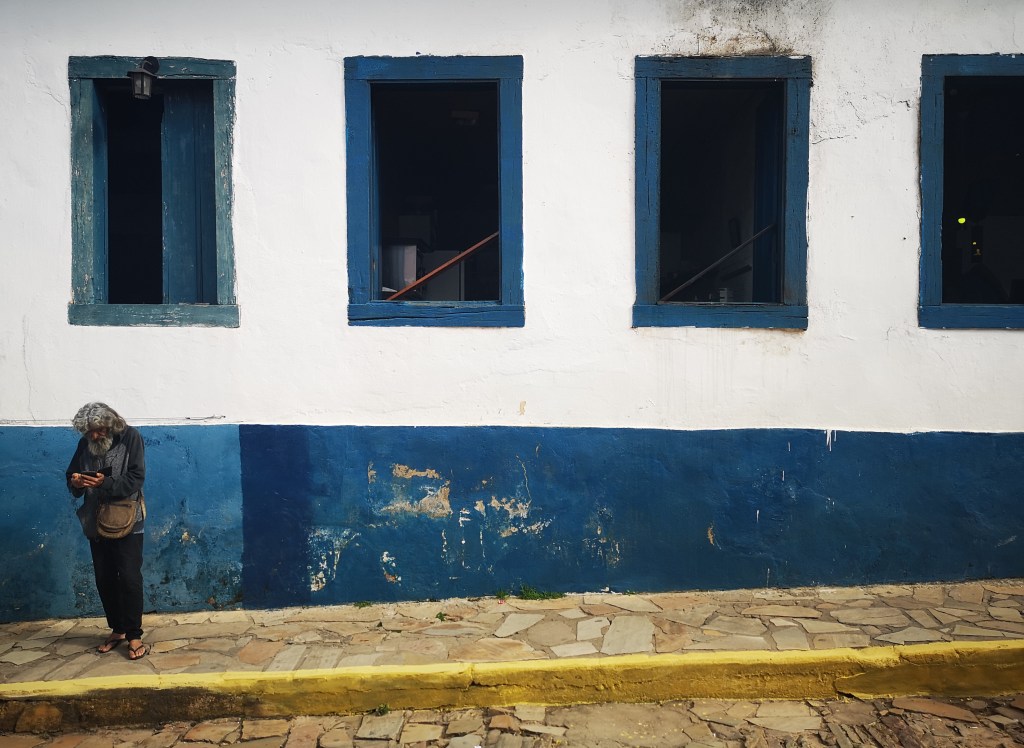
 

On the subject of Joseph and the Grail, São Thomé das letras was named in honour of another hero of the Jewish uprising against both Judaism and Roman Rule in 1st century Judaea: the doubting Thomas, apostle and man of my own heart. Quite what the letters (letras) part is about is the subject of much conjecture. But i would say it might have something to do with the Gospel of Thomas, and the fact that gospels were written into letters. One would assume that early Portuguese settlers, with God on their side and Christ in their hearts, in what was the colonially important and unromantically-named province of Minas Gerais (or General Mines), founded this little settlement long before the hippies started flocking. It is highly unlikely that whomever called the province General Mines and the town St Thomas of the Letters was much of a crystal-gazing spiritualist with animistic tendencies. In all likelihood they were a pragmatic, Catholic bunch who mined valuable stones all week for money while worshipping all weekend for salvation. Stranger things have happened at sea, where, luck would have it, the Portuguese spent much of their time conquering the then unknown world.


Brazil’s Glastonbury is a tenuous link at best, you shrug. A non-identical twin in a world obsessed with identical ones. I mean, São Thomé doesn’t attract the likes of Beyoncé, Dolly Parton, and The Foo Fighters over from the U.S. to join the rock and pop pantheon in a 5-day annual music blitz. Joesph of Aramathea never crossed the Atlantic. And Camelot’s influence couldn’t possibly have predated Pedro Álvares Cabral’s new world discovery of Rio de Janeiro in 1500. But look beyond the obvious – transcend the tawdry – and you’ll see that both towns coruscate with pixie dust.

Legends abound here and there. There’s a tunnel that runs from two undisclosed entrances: one at Machu Picchu and the other in Sáo Thomé 3,000km away. The ground beneath Sáo Thomé is so highly-charged with potions of motion that there’s a spot there where your car will drive itself. So many varieties of magic mushroom can be bought sealed and ready to nibble on that you’ll be hallucinating all the way under that tunnel to Machu Picchu, if only that entrance can be found. So potent are these so-called cogumelos that doubtless you’ll still be high when you emerge at the Peru end of the tunnel.


At the summit of all things heady in Sao Thomé is its very own Tor, but nothing like the old phallic one atop a hill in Glastonbury. Nevertheless, the same purpose is served: pilgrimage. The Brazilian construct is somewhat unorthodox, and a whole lot newer. Built sometime in the 20th century, of a quartzite now afforded Kryptonite powers, the Pyramid couldn’t be better named, given the invented similitude with Glastonbury. And, like Glastonbury’s sound-splitting, prismatic Pyramid this too is a stage, of sorts. Namely, a stage for all Brazil’s seekers of the transcendent realm that come here in search of whatever it is the rocks are emitting. It can’t be enlightenment they are after, as if it’s the light of truth they want bathed in, the sun here packs enough punch to drown them all. It must be the panorama that wows the crowd, because from there the rolling country of emerald Minas Gerais never looked so good.


Ascending and descending the Pyramid for yet another spectacular sunset is not unlike the Sermon of the Mount scene from Monty Python’s Life of Brian. There’s a sense of destiny about being in attendance for nature’s greatest revelation. And descending at dusk with all the others, there’s still the vendors at their makeshift stalls to pass, flogging everything from moonstones to magic potions, in this nation of ingenious artisans.

São Thomé das letras is more than worth the six-hour drive from Sáo Paulo (equidistant from Rio). Yes, seeing the promise of fadas and duendes – fairies and elves – is reason enough in itself to go, as every great traveller will tell you, it’s not about the destination. For lovers of o jogo bonito, en route you can stop off in Três Coraçōes to pay homage to the great Pelé in his place of birth. If Brazil beguiles you with its beautiful game, let it beguile you further with its beautiful countryside and magical realism, even if the analogies to Glastonbury are a tad far-fetched.

end

Surviving a Wilderness of Weirdness with Philosophy as the Weapon of Choice

ethics, fate, free will, future, greek philosophy, human mind, Life, marcus aurelius, meditations, natural philosophy, natural world, philosophy, Spiritualism, stoicism, thoughts

220px-Zeno_of_Citium_Nuremberg_Chronicle

The media report much fear and trepidation in the wider world, although judging by the look of contentment on the face of passersby, you’d be hard pressed to think so.

(and I swear even the dogs grin, or is that the outward appearance of having a stick lodged in one’s mouth?)

There’s also the unintended consequence of having a lot of people who find themselves with oodles of time on their hands while Covid-19 does the rounds. So how do they while away the hours until the spectre of death subsides, and we can get back to servicing the toothed machine of human progress? Some trek to Everest Basecamp in the confines of their home by scaling the staircase until the carpet goes bald and they follow suit. Others turn their hand to a spot of home teaching the kids until, realising that the transmission of knowledge through didactic discipline is harder than it looks, they dismiss their tiny class early. Others, like me, write obscure blogs that few dare to read, worse still understand. Still others take up new housebound hobbies with aplomb: such as taking 360˚ virtual trips to the Great Namib Desert courtesy of their much-abused smart phones, or else the wise few keep reciting ‘No wild animals in my delicious hotpot, please’ in Mandarin until the phrase sticks.

With this golden opportunity not to go nuts inside a tiny flat in Basingstoke, how many out there have given over their enquiring mind to the acquisition of a philosophy? Ancients, who weren’t busy warring in a sackcloth and sandals, were rather adept at offering sound advice based on the principle that once a man had found a philosophy to suit his ontological needs, he had succeeded in finding the map that would guide a clear path through this impenetrable life. The bold and the beautiful in the Greco-Roman universe swore by this dictum, going so far as to stitch their new ethos into their imperator tunics while on campaign against troublesome Germanic tribes.

The last of the five ‘good emperors’, Marcus Aurelius, was a man revered for being an enlightened and compassionate allrounder with a mind given over to self-examination in ways inconceivable to other emperors, for whom pleasures of the flesh all too often outweighed the pain of asking what does it all mean and what is my true place in the grand scheme? Given the unenviable task of leading the decades-long charge against tribes terrifying the fragile borderlands of the Roman Empire, the good emperor still managed to fit in a famous philosophical treatise before he died. Known as The Meditations of Marcus Aurelius, it was in essence a late second century A.D. reinterpretation of an ethical code dating back to a school of philosophy which had flourished ever since Zeno inscribed it in the minds of 4th century B.C.E. Athenians fed up with Cynicism.

Known as Stoicism, this branch of philosophy sought to strip away the bark of long-established wisdom to reveal the true sap oozing out of life: that is to say something vaguely along the lines of a cosmos working in cycles that start and end in fire. All matter that makes up the physical and, by extension, metaphysical questions that Man struggles to intepret works on a rational and logical basis (or ought to). Hence we humans do best when we are exercising reason over hot-headed emotion; hence we attain more understanding of how things are when explaining that phenomena using language built upon the rational rules of grammar instead of, say, an abstract picture or an incoherent grunt.

Sandwiched between the grand cosmological cycles is something we know as nature. Hence. stoicism is arguably the most influential of natural philosophies in its insistence that you and me are very small and limited in the grand scheme of things. By accepting each our minor yet vital role, the pressure is off and therefore happiness through simplicity becomes viable. Nature has a grand design, and if you let it into your heart you’ll soon realise both you are very insignificant and that, in spite of our own individual position far from centre, the universe nevertheless has your best interests at stake. All things occur for a reason. Fate doesn’t have to explain why it behaves in seemingly random ways. If it did, we’d know there’s nothing random about it. Even if an event seems uniquely cruel or inexplicable, natural forces will use the injustice to take corrective measures later on that symmetrically redress the balance, leading to the ‘Ah!’ epiphany that ‘it all makes sense now’. The interconnectivity of events is so blindingly intricate, not even a genius could spot it (shit! Did I just spot it where better people failed?)

Zeno, the father of stoicism himself, is reputed to have said that fate is an endless chain of causation whereby things are: the reason or formula by which the world goes on. In spite of this complex pattern, nature’s inner workings are, obversely, not mystical and esoteric at all; they are beautiful because true beauty lies in simplicity. That nature is beneficent – an unstoppable force that looks out for each of us if only we’d realise it – is contingent on you, the stoic, playing life as a game involving a basic blueprint of virtues to carry through life’s interactions into every little thing. Seek the four cardinal virtues – 1) justice/fairness/decency 2) wisdom/prudence/deliberation 3) courage/fortitude/endurance, and 4) temperance/self-discipline/modesty – and ye shall find yourself on course for a good death. That’s the idea, as I see it. The moment of death is all that your life ultimately amounts to, so life had better be conducted virtuously if death is to be faced head on, without anguish. There is such an aspiration as a good death, but it must be preluded by a life of self-discipline, fairness, examination, and strength of heart and mind. By the way, a good stoic would urge you not to be virtuous only to for the reward of a least hideous death. Be good, in and of itself, not for what it may give you back. Life is not a financial investment. Do the right thing because that is the natural order of things and to speak the language of life eloquently, we must first understand its grammar and morphology.
For stoics, like Seneca, Epictetus or Marcus Aurelius, life exists to be lived, literally like there is no tomorrow. William Faulkener wrote, The past is never dead. It’s not even past. How I do admire that wordplay. That said, Faulkener was no devotee of Seneca the Stoic. To stoics like Seneca, the past is a foreign country. Events that created the mosaic of that life have moved away forever, never to be relived with the veracity of how they were first meted out. Memories are not to be trusted, nor to be dwelt on. And death is not a loss of a whole life but rather just a loss of a moment at the close of that life. The ideal life, according to Seneca, was to be lived in the now, without dwelling on what’s gone, nor the irrelevance of what’s to come. It was to find contentedness in the simple here and now, and to want for nothing. How else to understand what golden threads of alchemy the cosmic fabric is made of other than to look closely at what is all around you NOW?

What the world needs now is love, sweet love, so goes the song. The world also needs Stoicism, meant not as the character-building prototype of the rugged Victorian imperialist (sword in one hand, dove in the other, pen between the toes, and pipe contemplatively in the mouth). Rather, the stoicism that emanated from ancient Athens and Rome was one that understood its demoted place in the natural order. We face a twenty-first century reckoning because we took stoicism to mean putting up with any old shit that life throws at us. Overwhelmingly, that shit was of our own making because we got way, way ahead of ourselves, thinking that two thousand years of Christianity and Islam had transformed each of us into little gods and sinners to be forgiven through atonement and religious devotion. So it was okay to break the ancient covenant with the natural order and go forth and multiply exponentially while scorching the Earth to conquer all before us because it was sanctioned first by the scriptures, and secondly by the arrogance bestowed on us by virtue of having reached a state of civilisation that was deemed far removed from lowly animals (this civilisation, it should be post-scripted, built its sandcastle empire not always on virtue alone).

In an age of uncertainty, rocked by the unvoiced realisation that there are too many of us vying for limited resources in a world wrecked in the search for these valuables, what needs resurrecting from the ashes of a self-deceptive human race is the idea that there are greater forces out there writing the book of life. That we are not gods but men and women who are fallible may seem self-evident, but any visitor from Andromeda would think we had promoted ourselves to that elevated rank. Every one of us might be just a mote of dust in the wind, but life affords us one chance to show our mettle: that if each of us face our remaining days in the pursuit of justice and courage and wisdom and self-restraint we shall once again feel humbled by the enormity of all that surrounds us. While no one gets out here alive, use this present lockdown to fashion your own system of practical ethics. As well as dying with a smile on your face, you might just make a small difference to your own and to the innumerable small lives that together construct the rich tapestry of everything we see and, more importantly, everything we don’t.

Everybody has an answer, but few a philosophy. Everyone wants a life, but not everyone holds the ethical guidebook to embark upon one worth living. Millions likes posting big pictures on Instagram, but how many consider the bigger picture and their own role as but one pixel within it? Why go in search of happiness as if it be a commodity to be acquired when, with the right tools at your disposal, you may reach inside and find it there? Thousands are dying out there (of malaria more than of Covid-19). So why stay at home wondering how you’re going to avoid it when you can stay at home and work out a formula for how to pursue a good life befitting of an equally good death.