What Goes Down Must Come Up: Why You Should See the Colca Canyon

#adventure, adventure, Andes, backpacking, Landscapes, Latin America, Perú, Perú, Travel, Uncategorized

Olympian Among Canyons

Allow me to set the scene, if you will. The Colca Canyon is situated in Southern Peru, about a 3-hour drive northwest of the White City, Arequipa. By all measures, the Colca is the world’s third deepest canyon (some say fourth) after the Yarlung Tsangpo Grand Canyon in Tibet, followed by the jaw-dropping Kali Gandaki Gorge in the Annapurna region of Nepal.

The Colca Canyon cuts such a swathe through the Andean plateau that it bottoms out at about 11,000ft (3,400m). To offer up some idea of scale that clicks with most of us, that’s about twice the depth of the world’s most celebrated geological knife wound, Arizona’s Grand Canyon. So, one Grand Canyon nested on top of another, and the Colca will just about accommodate them both.

Where Humans Dare To Tread and Till

Farmed by Inca peoples since time immemorial, its steep slopes show abundant signs of continuous human occupation. At about 50 miles in length that’s one deep cut for Man; one deeper cut for the magisterial condor that has made a miraculous comeback there after decades of persecution from local livestock farmers. Its confidence soaring, the condor is one of the main attractions of the hordes of tour buses that stop at the various lookouts along the canyon rim.

For the adventurous few though, what awaits them is a gruelling descent to the canyon floor, where if lucky, they’ll see the condor soar not below them, but at eye level. It’s all downhill from here. And surprise, surprise, the prospects never looked so good.

I got teamed up with a nice bunch of continental Europeans half my age and double my knee flexibility. Among them a smattering of French and German. The Franco-Prussian alliance had sunk to new heights. Our guide was a native of Arequipa, a man who had led so many 3-day expeditions in and out of the canyon that, as can be expected, he was rather unfazed by the whole affair.

El Condor Pasa

One moment we were setting off along the canyon rim and the next a slow motion plunge down a zigzagging hoof trail that swallowed us whole. The view was stupendous, the scale was suddenly gargantuan, and the sky a blue bonanza between weeks of monsoon rain that would render it all but impassable before and after. With the heat rising and the sunlight penetrating the deepest, darkest rincones of this abyss, we fell into a hypnotic rhythm. Our guide pointed out geological features, and delved into a history of human geography. But in keeping with great journeys, what you rank as the best bits keep getting superseded by better bits. Half way down royalty dropped in. Condors swooping over us so near and so balletic on the hot air updrafts that by the time i reached for my oversized SLR camera, they had glided away into the shaded recesses under the canyon walls.

It’s All Downhill From Here

Serendipity had accompanied us that day. Our guide marvelled at how rare it was to come so close to the feathered emblem of the Andes. Then again, perhaps he said that to all his small tour groups. Down and down we traipsed until, looking up, the canyon walls closed in on us like great doors in some medieval banquet hall.
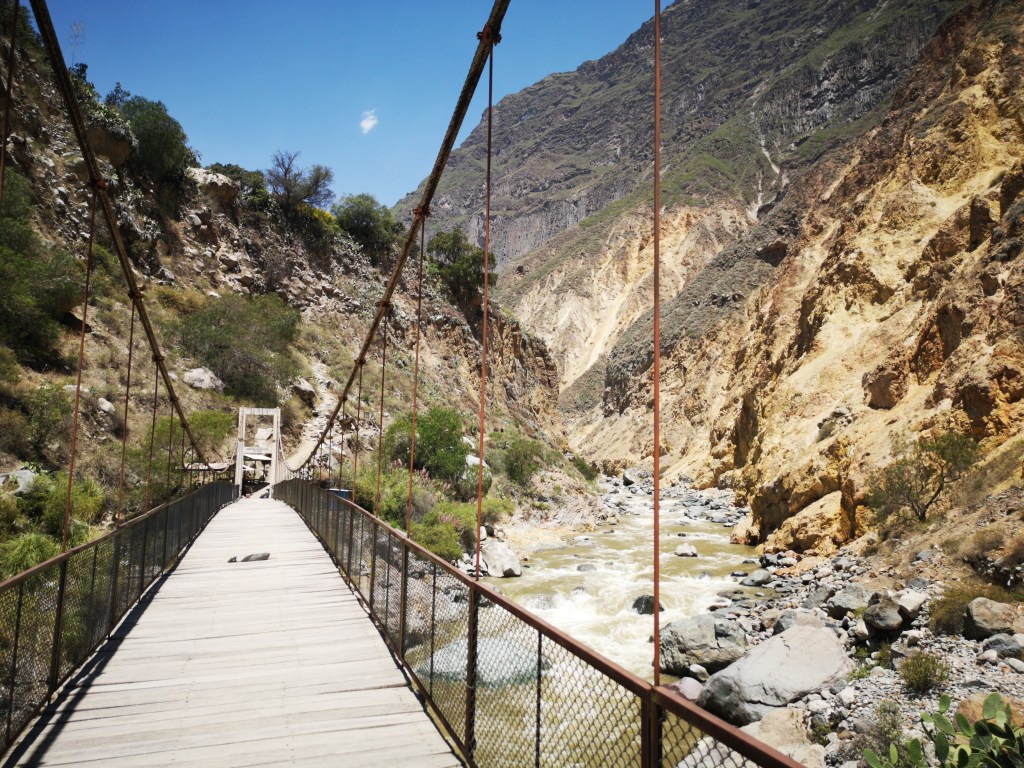
Having spent the better part of the day tiptoeing down about 3,000ft we found ourselves at the nadir. By no means the lowest point in our experience, crossing the iron suspension bridge over the Colca’s mazy river did signal the lowest point geographically-speaking. The sun was beyond its zenith, casting its brilliance on the east face of the canyon, making shadow creep gracefully up the west face.

Scraping the Barrel to Find an Oasis

We had been descending all this time. Now we were walking along the canyon floor adjacent to the watercourse. Festooning the margins of the clear crystal water were orchards of figs and other succulent fruits. Vegetation was abundant. Light and warmth caressing in a very special place where the wind and the winds of change were banished.

We walked and talked for the next couple of days along that canyon floor. We passed churches and villages, kids coming home from school, and guinea pigs flayed and hung out to dry. We stopped in a guesthouse with the most amazing swimming pool, fed to pure by an oasis. A classic desert oasis in the truest sense it was, fringed by date palms whose seedlings had come from half a world away.

It’s All Uphill From Here

On the third morning since taking the plunge into the world’s third deepest canyon, we gathered around our guide at 4am to face the trek back up and out. We obviously knew all along that what goes down must come up. But comfortable in our deep oasis on the previous evening, tipsy on rum and oxygen, I was contemplating a helicopter medevac out of there. The climb looked daunting, and was. 3,000ft straight up in the grip of incipient subtropical heat. Hence the reason we left before daybreak. As if to foreshadow what would be a gruelling hike out, my guide took one look at the packs I was carrying back and front, and shook his head in pity. “I told you to travel lightly, didn’t I?”

Half-light kissed the rim tops around an hour or two into the climb. Then, quick as ink blotting on paper, the dawn light seeped down until we rose to meet it a quarter of the way up. By then the pain of being a human packhorse had slowed my stride to a lumbering, teetering mess. My t-shirt was soaked with the sweat of my own labours. My bandana had to be wrung out every 100 metres or so. My eyes were weeping salty tears of pure perspiration. The line between myself and the other group members was attenuating fast, as they strode ahead. Overcome with guilt, eventually my guide offered, with a degree of reluctance visible in his grimace, to take one of my packs. But not before hailing a passing muleteer who refused.

Ghosts From the Past

Onward we clambered, inch by inch until at about 10am – a full 6 hours after setting off from the now microscopic guesthouse on the canyon floor – he and I emerged on the lip. Shattered, reddened to bursting, and vowing never to descend that far again with any baggage whatsoever, I collapsed in a heap. Beside me, by the grace of an ironic God, were a couple of Estonians I had climbed with a couple of weeks earlier. On that occasion, the altitude was so dizzying that it was they who struggled with hypoxia to the point of almost fainting, and me who offered a helping hand. Now there they were all smiles, relaxing after practically jogging up the Colca carrying nothing but a 7-litre daypack. And me, a sorry sight, temples pounding, eyes throbbing and near spent. Valió la pena? Was it worth the pain? Absolutamente!
Three Days with Totoro

adventure, Birds, dogs, Happiness, Life, Meaning, natural world, nature, Perú, peru, Photography, Seaside, thoughts, Travel, Uncategorized

Am I right in thinking love spans not only generations but species, too? The most obvious case in point is man’s enduring love for canis lupus familiaris. When did it all begin, this love affair between Man and dog? Round a neolithic campfire on long winter nights with that wolf cub with the soft, ticklish underbelly? I know it can happen in the unlikeliest of places, as interspecies love did with me on a beach in a little balneario near where Peru meets Ecuador.

I fell head over heels for Totoro. King of all he surveys. Totoro, a regent in a republic of waifs and strays.

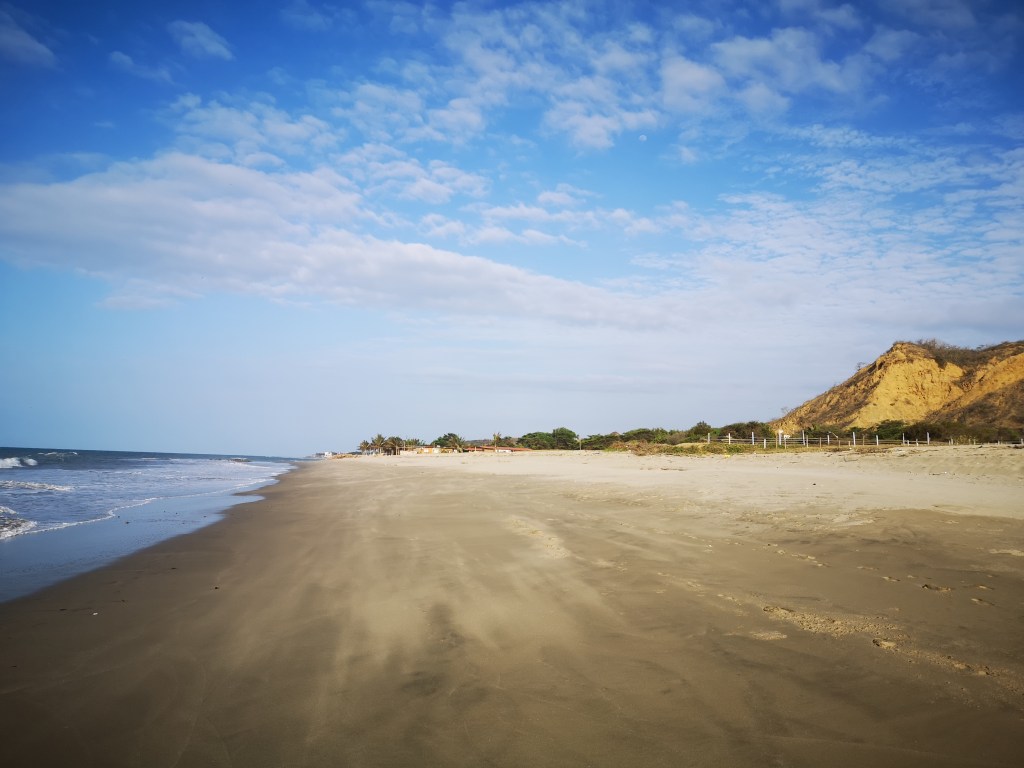
Totoro lives in Perú’s far north region of Tumbes. He is, quite simply, a regional celebrity. As every dog needs a home, even free spirits like Totoro become attached to somewhere. His somewhere is a beach hostel: a ramshackle beast of a place, oozing character, built metres from the warm Pacific surf.

Totoro is no ordinary dog. In fact, he is such a heartthrob that – and i kid you not – his name is cited in multiple booking.com reviews of La Casa de Diego. At his beachfront hostel home oftentimes he can be found disappearing into a hole in the sand, nuzzling into a smitten guest, or else chasing down pelicans full pelt along the beach. One review, as I recall, lauded this canine character so much the couple in question decided to stay another week, mainly because they were the ones with separation anxiety, and not the dog. 

Like many great acquaintances in life, I made Totoro’s quite by chance. I was staying in a dive further up the beach in the balneário town of Zorritos (little foxes in English), on the scale of Peru a stone’s throw from a Covid-closed Ecuador. How did I even end up there? Being on the road makes no sense at times, because one minute you’re planning a jaunt into the hinterland of the jungle and the next minute you find yourself on a 12-hour coach journey up Peru’s long and parched coastline. Frankly, i was expecting more from this little hideaway. I don’t know what I was searching for. I was the only Northern European face on a coastal highway littered with refugees fleeing the human catastrophe which is Venezuela. Zorritos was, and is, a side of Perú that foreign tourists don’t often care much to see. It wasn’t until i checked into La Casa de Diego a little ways out of town that the other side of that other side revealed itself.

In no small measure because of Totoro.

Monday morning, beginning of December. The height of summer 3 degrees south of the equator where – as you know – summer is a permanent fixture. There’s not a sole around. I’m sitting under a coconut palm, and who should sally into view but this regal-looking Nordic beauty of a dog – half pure-bred golden retriever, half Brad Pitt.

Like a stage actor he makes his grand entrance from the wings. Assuming he’s just another of Peru’s legion of wandering dogs, I note with surprise the lustre of his coat. Lingering on him, i watch him cosying up to a guest who’s readying to leave. He looks completely at home with humans, which is by no means a given in a land where dogs manage to coexist with the population while still maintaining a certain wariness of humans, who to be fair do not fetter them with cuddles and coo-ing affection quite as we do in rich countries. This confidence he airs strikes me as uncommon.

The lady disappears forever from view, leaving Totoro alone on the beach facing the hostel. As if she never existed, he immediately seeks new thrills. Sensing treasure deep below, like a pooch possessed he starts digging. He scoops with such fury that the damp sand sprays six feet behind him. Soon, he has excavated a large mound of sand while simultaneously being swallowed up by the beach. Only his little tush and tail remain aloft.

At length his head shoots up from the sand pit of his own making. He swivels it. Finally he notices me. Trotting over, for that’s what confident dogs do, he introduces himself. It’s love at first sight, for my part anyway. He’s in love with everyone. Moreover, he’s in love with life. ‘Come on,’ he intimates, ‘let ME take YOU for a long walk.’

Plastic rubbish litters the beach. The type of litter that doesn’t biodegrade is a real problem in Peru. But for dogs like Tororo, plastic bottles present an opportunity to play fetch. I pick up a 500ml Coke bottle half filled with seawater and feign a throw. This excites him. I feign again. This piques his annoyance. He barks, but not as a mindless utterance, rather a form of modified speech. His bellow cries, ‘stop fannying around, and throw that thing as far as you can.’ I do and he hurtles off after it like a pro.

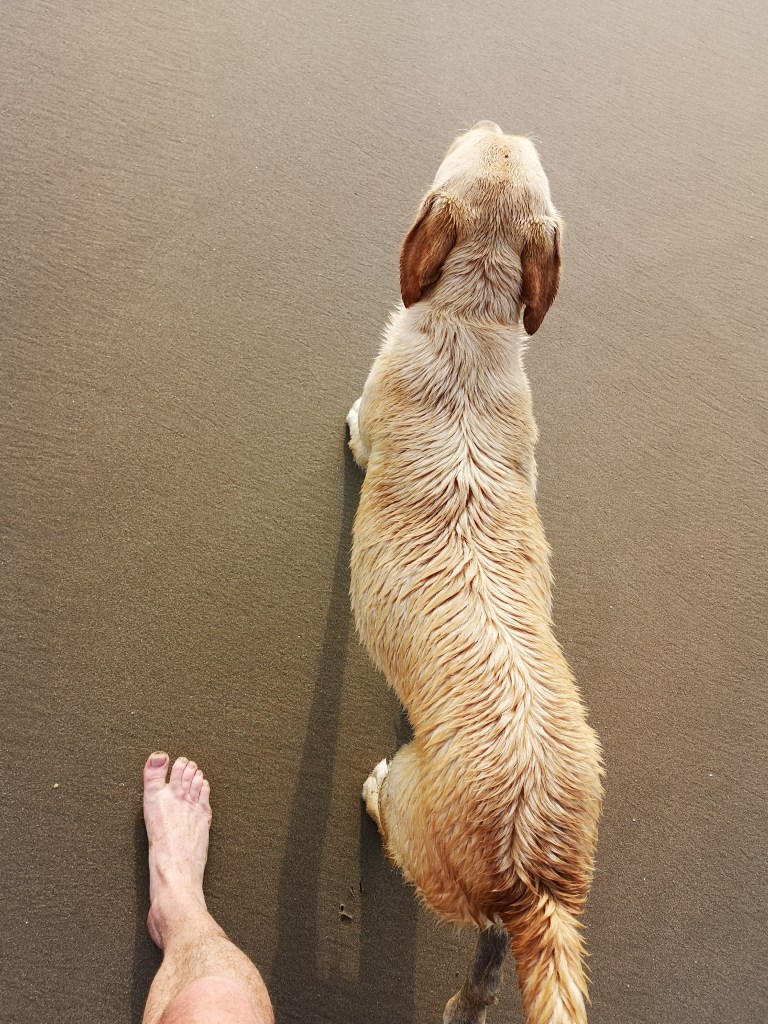
We walk for miles together, Totoro and I. Together in the loosest sense of the term, for Totoro is way too individualistic to be walking with anyone. He is a pioneer, this dog. A pathfinder. He goes at a canter, leaving me miles behind, only to find me again, the pinball that he is. When the bottle winds up churning in the surf, he barks at me to find a suitable replacement. Finding one, once that goes the way of the coke bottle he tires of the game and goes off in high pursuit of seabirds skimming the waves in the intertidal zone. Crashing through the surf, he launches himself, almost snagging one in his mouth.

People approach. As they pass, they look on in bemusement at Totoro who is rounding me, corralling me as if I’m a sheep, which I am compared to this lion. He’s calling out to me in a voice so powerful to give him a reason to run. The strangers can’t tell if the dog is showing aggression or is being playful. Totoro trots past a dead and bloated sea lion, showing little interest. An American in a stockman’s hat walks toward us. He asks if the dog is mine. That dog is no one’s, i tell him. He’s a fine dog, the man adds. A dog you might see in America, i say. Yeah, he goes on. He’s not your usual kind of dog here. I reply, i think he belongs to the hostel, but he comes and goes as he pleases.

We walk directly into the sunset until i can no longer visualise where i am. I call him and he responds right away. He knows the score. I am not the first guest at La Casa de Diego to have walked Totoro. Rather, he walks the guests as he sees fit. I happen to be the only one resident at this time, which pleases him while offering me exclusivity. We turn our backs to the tropical sun and head home. Totoro spots another sortie of seabirds skirting the rolling surf and goes hell for leather after them, stomping on the water’s edge like his life depended on it.

On the verandah outside my room, the day is ending. I rock rhythmically on the hammock while under me he settles down to rest. Finally, I think, this elegant brute is settling into the Sphinx position. Every part of him is washed by the Pacific surf. I watch his chest gently rise, gently fall. Every part of him is perfection. His paws are large as a mountain lion. He is in the prime of his life, and that saddens me because at that moment I feel my prime has gone. Well, at least i am as free as Totoro. The difference is, though, Totoro exists only and always in the moment, and I do not. So who now is the freer of us both?

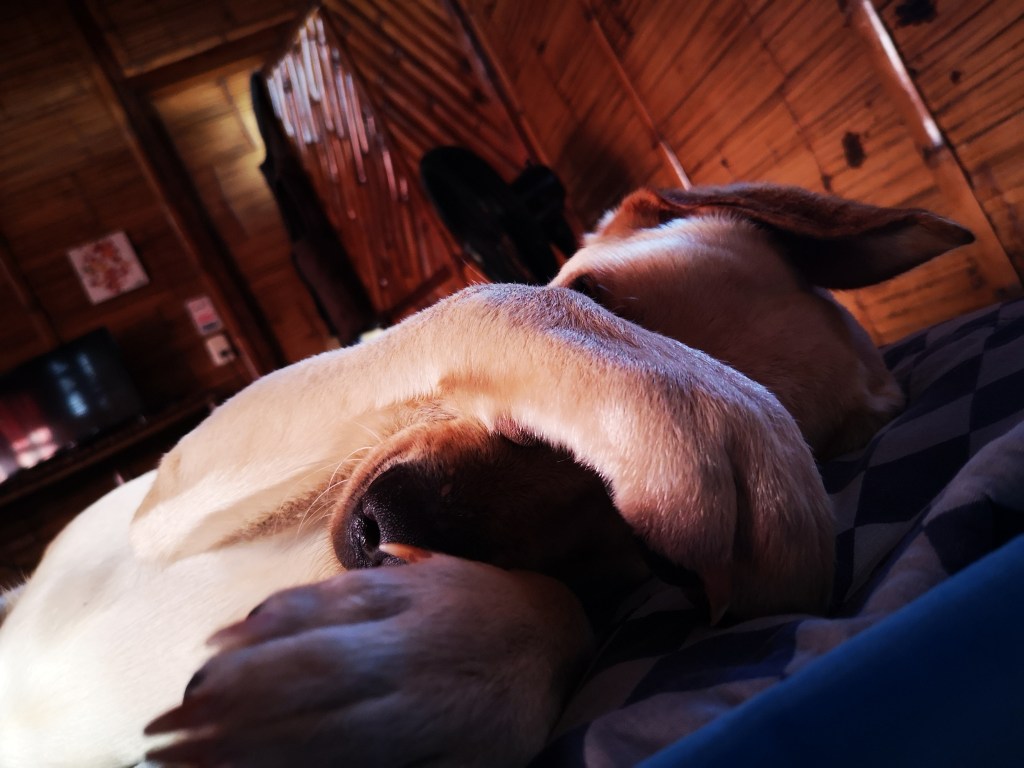
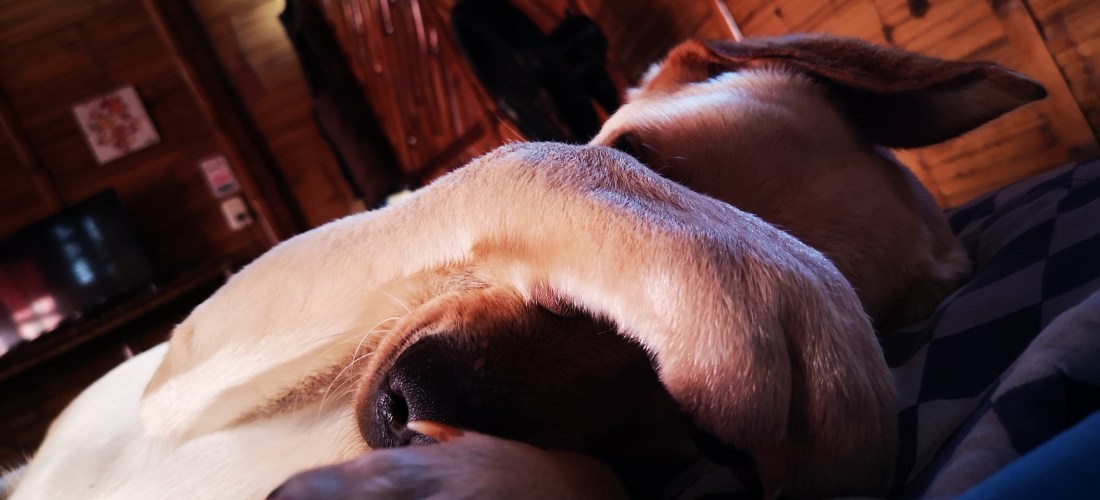
In the morning when I awake, he is there sprawled out over three-quarters of the double bed while I’m shunted to the edge. As if he has learned from other guests the art of manipulation, he hides his eyes coyly with his enormous paws. ‘Sorry for commandeering your bed,’ he says without words. ‘But, on second thoughts, I’m not actually sorry at all. This is what I do when people like you come to stay.’

The day is bright, the heat incipient. Opening the rattan door Totoro bounds down the rickety staircase to the sand below. Like yesterday and all the days preceding, this is the first day of his life. The excitement of new adventures in familiar places is suitably matched by his enthusiasm for the chase.

He waits patiently for me to eat breakfast. Once done, with that stentorian voice of his, he orders me to get up so he can take me for a walk; a long walk on the wet sand of the Gulf of Guayaquil, its lukewarm Pacific waters bobbing gently under twine-bound fishing rafts already poised for the day’s catch.

We walk for hours, leaving fleeting imprints in the sand near the water’s edge. He hurtles off, chasing down whatever has the temerity to try and outrun him. The seabirds that fly in single file inches above the waves are always one step ahead. This frustrates him, and even from a quarter mile away, I hear his voice boom with rage and his long legs pummel the shore. He is in his element in ways I could only dream of.

On the evening of the fourth day of my stay at La Casa de Diego, the curtain comes down on our love affair. I stack my bags up against the fence in readiness for the moto-taxi driver to collect me. Totoro stays by my side but knows what to expect. I am not the first to fall for him, nor will I be the last. I so want to leash him and take him with me on the overnight bus south. But I know that an organism needs its habitat; that to deprive him of this world over which he rules would be to strip a king of his crown.

I can still see him now, digging up the beach, beguiling locals with his brazen beauty and confidence, bounding, like a straw-coloured stallion, after those shore birds that artfully skim the waves single file in a game he’ll never stop playing until he is old and dignified enough to know that against the pelicans he can never win. But winning is a strategy and strategy is not the point. It is capturing every moment that counts, and few embody this true meaning of happiness more than him.