
São Thomé das letras: Brazil’s Glastonbury

#adventure, #alternative lifestyle, #Brazil, Brazil, duendes, Latin America, Lifestyle, Minas Gerais, Sâo Thomé das letras, South America, Spiritualism, Spirituality, Três Corações

For every action there is an equal and opposite reaction. For every human a doppelgänger. Every town a twin, but not always officially twinned in the sense of Bristol and Bordeaux or Birmingham and Chicago – towns that to all intents and purposes have little in common. Some towns are kindred spirits. Soul brothers. Sister cities. Take Edinburgh and Florence, two cities well matched both in grace and favour.


Not that many New Age & Main Stage-lovin’ aquarians, who show up perennially at the gates of Michael Eavis’ Somerset farm each and every summer, will ever go there (the UK festival circuit is pricier than budget adventure travel through South America), but no word of a lie, on a recent trip to São Thomé das letras I swear i met Glastonbury’s long lost twin. Though it would be fair to say they remain lost to one another, and there’s no telling when these long-lost brethren will be given the This is Your Life treatment. This is their historical destiny, given that Britain’s empire was kept in check in Latin America, and British interest there today is at best marginal.  

Everyone who is no one knows England’s Glastonbury. There’s the annual arts and music festival, of course. The inevitable cat and mouse game between stewards and fence-jumpers, which results in ever higher fencing and standing charges for tickets that sell out within a hour. The periodical return of Van Morrison and Coldplay to the Pyramid Stage, just when everyone thought they might take a permanent rest. There’s the Tor, the grassy hump that everybody climbs to flee the rising floodwaters that beset the Somerset Levels with increasing regularity and ferocity. There’s the legend of Camelot, if you buy into that sugar-spun fairytale. (Until diets improved in the area, the locals were happy with Spamalot). Then there’s Jesus’ uncle, Joseph of Arimathea, who devotees believe house-swapped a life of danger in the Levant for bucolic Britannia, bringing only a cup with him in his 1st AD century removals caravan. There’s bombed-out deadheads that haunt the town, barefooted and extremely confused, months after the festival has ended, wandering into corner shops asking if this is where Hawkwind are playing this weekend.

Glastonbury is all that and some. Who can forget the quaint little cottages for sale at not such a quaint little price? And the annual orgy of money made in holiday rentals from well-heeled festival goers for whom a row of dripping, wet tents is just not appealing? And last but by no means least, what of those ley lines running under this most pagan of towns? This mystical grid force of supernatural, electromagnetic power is responsible for getting the crystals all excited. Spiritualists and necromancers follow this flow of uninterrupted energy like the children of Hamlin to the penny whistle tones of the pied piper.

That’s Glastonbury seen from a slightly flippant angle. But what about its southern counterpart?
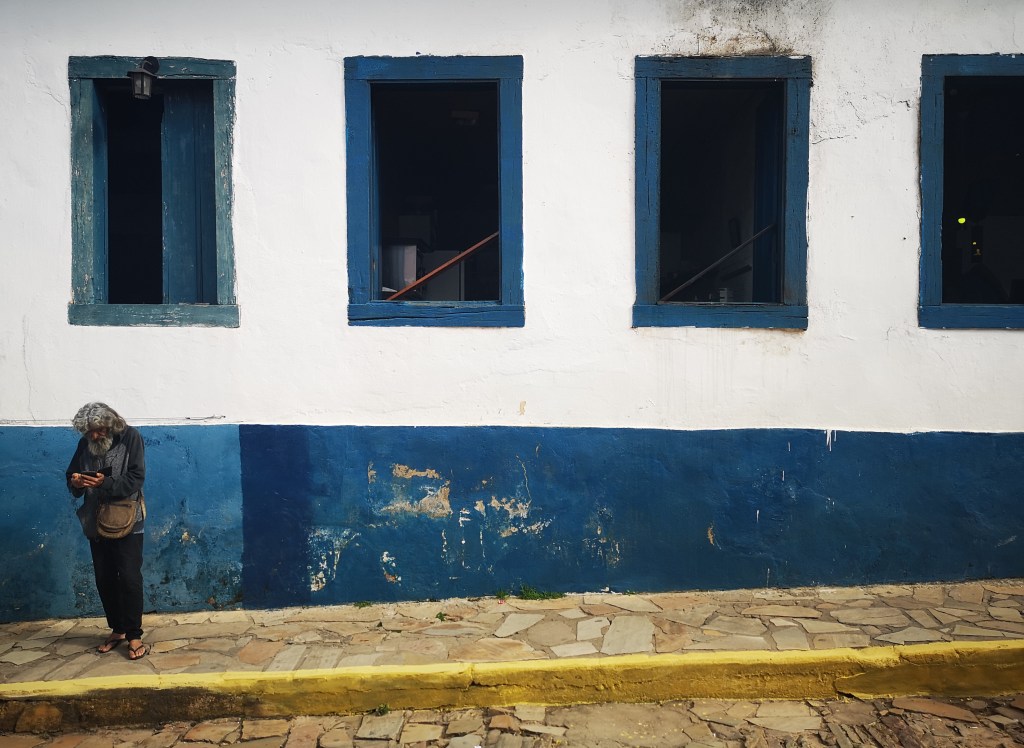
 

On the subject of Joseph and the Grail, São Thomé das letras was named in honour of another hero of the Jewish uprising against both Judaism and Roman Rule in 1st century Judaea: the doubting Thomas, apostle and man of my own heart. Quite what the letters (letras) part is about is the subject of much conjecture. But i would say it might have something to do with the Gospel of Thomas, and the fact that gospels were written into letters. One would assume that early Portuguese settlers, with God on their side and Christ in their hearts, in what was the colonially important and unromantically-named province of Minas Gerais (or General Mines), founded this little settlement long before the hippies started flocking. It is highly unlikely that whomever called the province General Mines and the town St Thomas of the Letters was much of a crystal-gazing spiritualist with animistic tendencies. In all likelihood they were a pragmatic, Catholic bunch who mined valuable stones all week for money while worshipping all weekend for salvation. Stranger things have happened at sea, where, luck would have it, the Portuguese spent much of their time conquering the then unknown world.


Brazil’s Glastonbury is a tenuous link at best, you shrug. A non-identical twin in a world obsessed with identical ones. I mean, São Thomé doesn’t attract the likes of Beyoncé, Dolly Parton, and The Foo Fighters over from the U.S. to join the rock and pop pantheon in a 5-day annual music blitz. Joesph of Aramathea never crossed the Atlantic. And Camelot’s influence couldn’t possibly have predated Pedro Álvares Cabral’s new world discovery of Rio de Janeiro in 1500. But look beyond the obvious – transcend the tawdry – and you’ll see that both towns coruscate with pixie dust.

Legends abound here and there. There’s a tunnel that runs from two undisclosed entrances: one at Machu Picchu and the other in Sáo Thomé 3,000km away. The ground beneath Sáo Thomé is so highly-charged with potions of motion that there’s a spot there where your car will drive itself. So many varieties of magic mushroom can be bought sealed and ready to nibble on that you’ll be hallucinating all the way under that tunnel to Machu Picchu, if only that entrance can be found. So potent are these so-called cogumelos that doubtless you’ll still be high when you emerge at the Peru end of the tunnel.


At the summit of all things heady in Sao Thomé is its very own Tor, but nothing like the old phallic one atop a hill in Glastonbury. Nevertheless, the same purpose is served: pilgrimage. The Brazilian construct is somewhat unorthodox, and a whole lot newer. Built sometime in the 20th century, of a quartzite now afforded Kryptonite powers, the Pyramid couldn’t be better named, given the invented similitude with Glastonbury. And, like Glastonbury’s sound-splitting, prismatic Pyramid this too is a stage, of sorts. Namely, a stage for all Brazil’s seekers of the transcendent realm that come here in search of whatever it is the rocks are emitting. It can’t be enlightenment they are after, as if it’s the light of truth they want bathed in, the sun here packs enough punch to drown them all. It must be the panorama that wows the crowd, because from there the rolling country of emerald Minas Gerais never looked so good.


Ascending and descending the Pyramid for yet another spectacular sunset is not unlike the Sermon of the Mount scene from Monty Python’s Life of Brian. There’s a sense of destiny about being in attendance for nature’s greatest revelation. And descending at dusk with all the others, there’s still the vendors at their makeshift stalls to pass, flogging everything from moonstones to magic potions, in this nation of ingenious artisans.

São Thomé das letras is more than worth the six-hour drive from Sáo Paulo (equidistant from Rio). Yes, seeing the promise of fadas and duendes – fairies and elves – is reason enough in itself to go, as every great traveller will tell you, it’s not about the destination. For lovers of o jogo bonito, en route you can stop off in Três Coraçōes to pay homage to the great Pelé in his place of birth. If Brazil beguiles you with its beautiful game, let it beguile you further with its beautiful countryside and magical realism, even if the analogies to Glastonbury are a tad far-fetched.

end

Could Life’s True Calling Be Life Itself?

#adventure, #alternative lifestyle, #Brazil, adventure, Brazil, Latin America, Lifestyle, natural philosophy, South America

Fretting the whole weekend about this and that, I found myself facing down that age-old question: do each of us have a true life’s calling? If so, what is mine? And while I’m on the subject, is there an upper age bracket beyond which the only calling you’re ever going to get is from the archangel Gabriel to notify you the Big Man is tapping his sandalled feet impatiently at the pearly gates?

I’m 51. Does that place me in that liminal space between youthful optimism and senescent dread? And anyway, aren’t callings for the ocularly able, who tend to be young and sharp enough to hear their future purpose drop like a pin before their quivering feet? Not like we mid-lifers, lugs clogged with 50 years of bullshit curdled with earwax. Ask any self-respecting 60-something and they’ll tell you that by the seventh decade of life a man’s true calling is the bathroom, given that the old bladder is becoming compromised by the ever-expanding prostate tucked under it.

Callings schmallings! You’re never too old to grow bold. In Scotland, never too auld to grow bald. History is littered with stories of now-forgotten legends who reinvented themselves while their contemporaries were busy nursing their grandchildren while their sons were dying on a foreign field for some megalomaniacal noble, and their daughters had already bled out in a dead pool of childbirth.

I am unreliably informed that 50 is the new 40, 40 is the new 30, and anything under that age is not worth exalting because for that you’d need to qualify as either Gen-Zedder or New-Millennial, and we all know that their idea of a true calling will trend anytime soon on Instagram. Likes are callings in and of themselves. The sooner we tiresome analogues realise that callings happen online, the better.

My hippocampus doing backward spooling all the way to the source of my weekend existential nail-biting, i found myself back in 1990 lamenting my choice of first undergraduate degree. Back then, the 60’s still reverberated through our Liberal Arts and Social Sciences curriculum with a modicum of respectability long eclipsed by today’s neurotic climate of S.T.E.M.. Don’t knock a good acronym when it makes POTUS declare one SNAFU too many. If you ain’t on board with coding, computational mathematics and the suffocating empirics of big data, you’re not worth the paper you are written on (or not, as paper is so 20th century). Back then, you didn’t have to be a loser with a capital L emblazoned across your forehead. Aspiring to become rounded in one’s repository of knowledge – a generalist as opposed to a specialist – was seen as, if not quite a conduit to becoming an all-round more complete human being, and therefore of the highest utilitarian value, then more or less acceptable. The trouble was, for us generalists the whole notion of a singular calling in life was kind of postponed indefinitely. Some felt the epiphany of true calling a few years later, while the rest of us went into teaching.

But I digress. I entered the weekend gnawing fingernails and bemoaning the absence of a true calling. (Or perhaps bemoaning my lack of perseverance. Some years before, I did find my calling but couldn’t stick at it long enough to monetise it because I was so distracted with serial callings, usually taking off on a big adventure somewhere in the world.) But where there’s a foreground of sorrow and self-pity, there’s also a background of various hues. Some either 1) reassuringly familiar or 2) depressingly familiar; others either 3) shockingly unfamiliar or 4) spectacularly unfamiliar. Was this trip a 4 in the making? So, there we were, motoring out of Säo Paulo en route to the Costa Verde (Green Coast), on Säo Paulo’s Litoral Norte.

The voyage starts in the dense concrete undergrowth of inner-city Säo Paulo. Being the world’s 4th largest metropolis and spilling forth outward in a haphazard forest of 20-storey tower blocks, barred street frontages, impromptu favelas, and shacks for the destitute erected in the central reservations of multi-lane highways choked with cars, it’s impossible to know where the inner city ends and the outer suburbs begin. First the unwary foreigner must escape a road system designed by 1960s civil engineers who, judging by the asphalt layout, were tripping on wachuma and ayahuasca over their draughtsman boards.

South America’s biggest urban sprawl is indeed a nightmare from which to escape but, once free of its insane hold, the surrounding countryside is a joy to behold. And on that ribbonous Rio highway that meets with the road that runs up and over the Serra of the Atlantic rainforest and down to the green and sumptuous coast of Säo Paulo state, my life’s calling started to take a weird and wonderful form. The rolling hills and fat, old Capricorn sun going down. The termite hills erupting on steep, grassy knolls like molehills from another dimension. The music. The light. The prospect of new horizons. Old memories to rekindle from the last visit to Brazil; new memories to forge.

And on that road through that cloud forest – roadsigns of capybaras, sloths and vipers reminding reckless drivers that the world is still hiding mystery and magic – that opened onto panoramas of steaming paradise it struck me like a lightning bolt from one of Brazil’s epic summer electrical storms: maybe my life’s true calling is life itself. Real living has nothing to do with science. It’s art all that way.

end.

I have nothing to envy except envy itself: Five Cheers for Embattled America.

#adventure, #alternative lifestyle, #living off-grid, adventure, America, Britain, British Isles, California, conservation, England, environment, ethics, global, globalisation, Great Britain, Happiness, history, land ownership, Liberalism, Life, Lifestyle, National Parks, natural world, nature, Reflections, social attitudes, social issues, Society, success, thoughts, Travel, travelogue, United States, Wilderness, Wildlife

Today, I was reading a comment posted on Quora. The leading question was: What Do Britons Envy Most About the US? To which – and I am sorry to resort to the social media art of backbiting – this particular member of Quora’s burgeoning commentariat decided to put down his Daily Mail for a moment to consider the question. If i may add, with a degree of ignorance I have long suspected in my fellow countryman, but hitherto have been unable to prove. This one’s a game changer.

His answer – hardly surprising coming from a reader of a newspaper with a long and illustrious history of jingoism, xenophobia, and acute insular-mindedness – left me wondering two things :

Firstly, whether this man had actually ever travelled anywhere beyond the house he so proudly owns; and secondly, what is it I envy most about America.

Returning momentarily to the Quora contributor, he went about answering the question of envy by singularly failing to address the meaning of what was being asked. So what does the average Briton envy most about America? Well, it helps to know the place by means other than what is daily reported in his favourite Little Britain news rag. His answer? To paraphrase: I’ve just had a full English breakfast and now I’m resting contentedly with coffee and tabloid in hand, admiring the four walls of the house I own outright (as if Americans don’t own homes). Then, for good measure, he throws in a little mockingly-good dose of British sarcasm about how he wished he’d had all that American Free-Dumb (as if Britons own sarcasm).

Upon reading this, I bristle with uncustomary outrage, as i am not an American. However, I think a little part of me might be. My mind is busy thinking, just because a man can enjoy digesting an English breakfast of bacon, eggs, sausage, beans, and fried tomatoes, accompanied by 100 pages of right-wing tabloid bile, and all within the comfort of one’s own home, does in no way negate America’s dizzying roadside attractions. 

Comparisons are dangerous when you have little idea what it is you are comparing. In the case of UK-US country comparisons, chalk and cheese.

Does he know that the US is not so much a country as it is a continent? If he cared to step out of his zone de comfort and board a plane to the four far flung corners of the continental United States – Anchorage to the Florida Keys, San Diego to Cape Cod – he might tone down his prejudices a bit.  

Ach! Why should I care what others think? Their loss, my gain. The more of them remain at home admiring the wallpaper, the more of America I’ve got all to myself. So, back to the matter in hand: what do i envy most about the United States of America? That is to say, what do they have that we don’t? That I don’t possess?

Well, turns out, a lot.

For format’s sake, here’s my top five:

  1. World-class National Parks, some the size of English counties. These are designated wild places. Mother nature’s property portfolio. They contain wilderness that belongs to no one in particular and to everyone in general. See Yosemite valley and weep, just as the great Scots-American pioneer, John Muir, did. And that’s just one of many parks that range across thousands of miles from Denali NP in Alaska to the Big Bend in Texas, from Sequoia NP in California to Acadia NP in Maine. Although the designation ‘National Park’ has been awarded to 63 sites across the US, there are literally hundreds more state parks, national monuments, national forests, and so on and so forth. One could spend the multi-millennial lifetime of a redwood tree exploring them, and probably still not reach the end. America’s national parks are some of the greatest entities ever created, and humanity didn’t have to create a damn thing doing so.
  2. It would be naive to state that the US is a classless society, but it would also be a gross overstatement to say that it’s anywhere near as class-conscious as England. There is a proud tradition of meritocracy in the US, which harks back to the days of huddled, squalid masses pouring off the Atlantic liners in search of a better life in a new world. In the US, aristocracy is a term loosely applied to old New England families, and Hollywood film stars. In Britain, aristocracy is real and to this day responsible for walling off vast swathes of land for personal gain. A land grab and power consolidation that has gone on for centuries. This deference to the landed gentry shows no sign of abating, even in the face of 20th century political progress. America’s anti-monarchical revolution of 1776 had its origins in English dissident, radical liberalism. It was then joined by a republican France to become a place where, if you were white and Northern European, the average person was thrust centre stage, and the inalienable right of kings tossed out. Suddenly, we were all kings in a savage land.
  3. Abundant sunlight that mottles a stunning geographical diversity. They used to rhapsodise about the sun never setting on the British empire, as the empire stretched across all time zones. Well, if it’s mizzle in Maine, you can bet Texas will be toasted by UV. If clouds reign over Kalamazoo, rest assured, winter sunlight will dazzle downtown Denver. Fog in Philly? Photons in ‘Frisco. You see the alliteration? Dazzling, isn’t it? Maybe, but it don’t dazzle like downtown Daytona. Who loves the sun? Not just the Velvet Underground.
  4. On the Road right through American popular culture. The tradition of hitting the road, Jack, and not coming back no more, is enshrined not only in American literary culture, but in real life, too. I have a friend from New Jersey. One day, he decided to follow his doctor sister to Las Vegas, a mere 2,000 miles away. Hopped into a car, and headed west. Stopped here and there along the way, but kept going. Within a week he had gone from icy winter to a hot desert where he picked up work as a wilderness guide, in no time. Americans, unlike Brexit Brits, have choices. And believe me, many – through restlessness or desperation – pack up their bindlestiffs and seek emigration within their own nation. They can quit some insufferable place and start again somewhere utterly different, which really just nourishes the soul, and keeps that wonderful literary tradition going strong (see the award-winner Nomadland for a case in point).
  5. Wilderness. Unashamedly, I keep coming back to it. America’s untouched places, which I have seen in the flesh, and continue to see shining in my mind’s eye, are truly a thing of wonder. The Pacific Crest Trail alone runs for 2,650 miles from an iconic bridge on the Washington/British Columbia border, to the Mexican border. The trail bisects some of the greatest wilderness on Earth. Americans, seeking spiritual solutions for materialist problems, set out on the trail. 5 months later they emerge changed forever and for the better, having read the signs that nature put before them. Meanwhile, where do we Brits go for a spot of soul-washing? Wherever it is, we can be sure of encountering signs of a different kind along the way: Private/No Entry/Keep Out/No Trespassing….you get the idea. Envy might be a deadly sin, but nowhere near as deadly as that old assassin, ignorance.

I was born out of place and out of time. In a previous reincarnation i’m damned convinced i was an émigré from an impoverished and burgeoning family of lowly, lowland Scots, leaving the brutal industrial heartlands and zero prospects in search of a better life in a land so exotic only the language reminded me of myself and my roots. My medium thinks the year was 1872 and the family was from Ireland. But either way, I discarded the old world for a taste of the new. I took the iron railroad west and found the place my dreams had been alluding to for all those years. I traded in the gloom for the boom, the shite for the light. And never stopped to looked back. Not for a minute.