
What Goes Down Must Come Up: Why You Should See the Colca Canyon

#adventure, adventure, Andes, backpacking, Landscapes, Latin America, Perú, Perú, Travel, Uncategorized

Olympian Among Canyons

Allow me to set the scene, if you will. The Colca Canyon is situated in Southern Peru, about a 3-hour drive northwest of the White City, Arequipa. By all measures, the Colca is the world’s third deepest canyon (some say fourth) after the Yarlung Tsangpo Grand Canyon in Tibet, followed by the jaw-dropping Kali Gandaki Gorge in the Annapurna region of Nepal.

The Colca Canyon cuts such a swathe through the Andean plateau that it bottoms out at about 11,000ft (3,400m). To offer up some idea of scale that clicks with most of us, that’s about twice the depth of the world’s most celebrated geological knife wound, Arizona’s Grand Canyon. So, one Grand Canyon nested on top of another, and the Colca will just about accommodate them both.

Where Humans Dare To Tread and Till

Farmed by Inca peoples since time immemorial, its steep slopes show abundant signs of continuous human occupation. At about 50 miles in length that’s one deep cut for Man; one deeper cut for the magisterial condor that has made a miraculous comeback there after decades of persecution from local livestock farmers. Its confidence soaring, the condor is one of the main attractions of the hordes of tour buses that stop at the various lookouts along the canyon rim.

For the adventurous few though, what awaits them is a gruelling descent to the canyon floor, where if lucky, they’ll see the condor soar not below them, but at eye level. It’s all downhill from here. And surprise, surprise, the prospects never looked so good.

I got teamed up with a nice bunch of continental Europeans half my age and double my knee flexibility. Among them a smattering of French and German. The Franco-Prussian alliance had sunk to new heights. Our guide was a native of Arequipa, a man who had led so many 3-day expeditions in and out of the canyon that, as can be expected, he was rather unfazed by the whole affair.

El Condor Pasa

One moment we were setting off along the canyon rim and the next a slow motion plunge down a zigzagging hoof trail that swallowed us whole. The view was stupendous, the scale was suddenly gargantuan, and the sky a blue bonanza between weeks of monsoon rain that would render it all but impassable before and after. With the heat rising and the sunlight penetrating the deepest, darkest rincones of this abyss, we fell into a hypnotic rhythm. Our guide pointed out geological features, and delved into a history of human geography. But in keeping with great journeys, what you rank as the best bits keep getting superseded by better bits. Half way down royalty dropped in. Condors swooping over us so near and so balletic on the hot air updrafts that by the time i reached for my oversized SLR camera, they had glided away into the shaded recesses under the canyon walls.

It’s All Downhill From Here

Serendipity had accompanied us that day. Our guide marvelled at how rare it was to come so close to the feathered emblem of the Andes. Then again, perhaps he said that to all his small tour groups. Down and down we traipsed until, looking up, the canyon walls closed in on us like great doors in some medieval banquet hall.
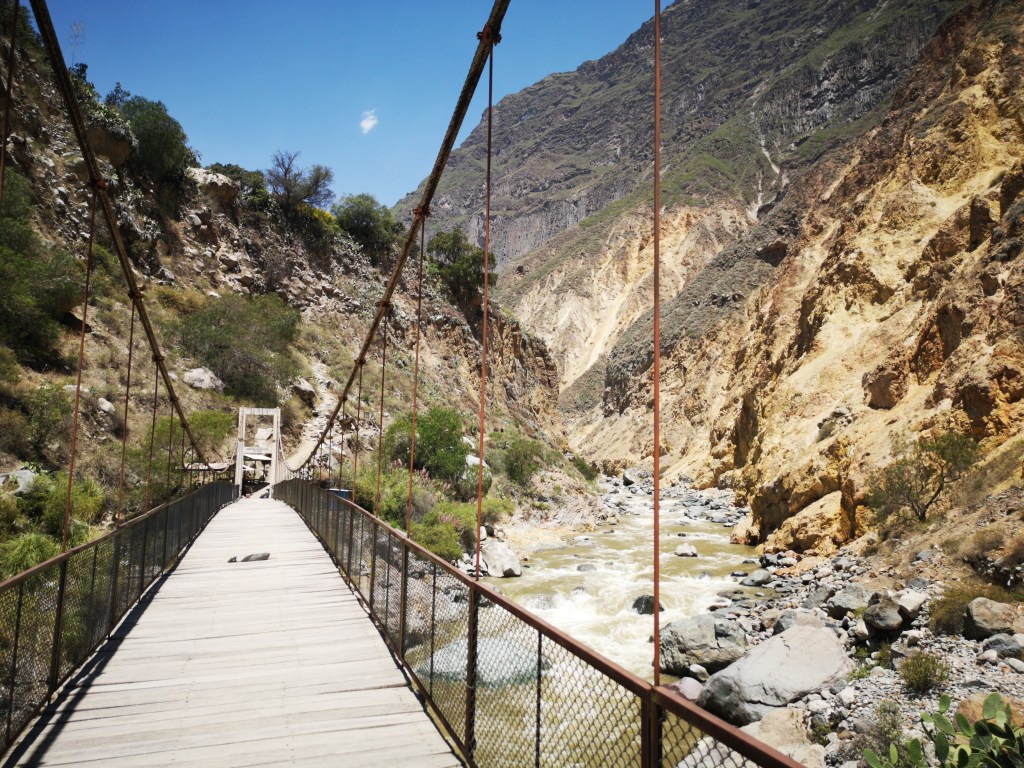
Having spent the better part of the day tiptoeing down about 3,000ft we found ourselves at the nadir. By no means the lowest point in our experience, crossing the iron suspension bridge over the Colca’s mazy river did signal the lowest point geographically-speaking. The sun was beyond its zenith, casting its brilliance on the east face of the canyon, making shadow creep gracefully up the west face.

Scraping the Barrel to Find an Oasis

We had been descending all this time. Now we were walking along the canyon floor adjacent to the watercourse. Festooning the margins of the clear crystal water were orchards of figs and other succulent fruits. Vegetation was abundant. Light and warmth caressing in a very special place where the wind and the winds of change were banished.

We walked and talked for the next couple of days along that canyon floor. We passed churches and villages, kids coming home from school, and guinea pigs flayed and hung out to dry. We stopped in a guesthouse with the most amazing swimming pool, fed to pure by an oasis. A classic desert oasis in the truest sense it was, fringed by date palms whose seedlings had come from half a world away.

It’s All Uphill From Here

On the third morning since taking the plunge into the world’s third deepest canyon, we gathered around our guide at 4am to face the trek back up and out. We obviously knew all along that what goes down must come up. But comfortable in our deep oasis on the previous evening, tipsy on rum and oxygen, I was contemplating a helicopter medevac out of there. The climb looked daunting, and was. 3,000ft straight up in the grip of incipient subtropical heat. Hence the reason we left before daybreak. As if to foreshadow what would be a gruelling hike out, my guide took one look at the packs I was carrying back and front, and shook his head in pity. “I told you to travel lightly, didn’t I?”

Half-light kissed the rim tops around an hour or two into the climb. Then, quick as ink blotting on paper, the dawn light seeped down until we rose to meet it a quarter of the way up. By then the pain of being a human packhorse had slowed my stride to a lumbering, teetering mess. My t-shirt was soaked with the sweat of my own labours. My bandana had to be wrung out every 100 metres or so. My eyes were weeping salty tears of pure perspiration. The line between myself and the other group members was attenuating fast, as they strode ahead. Overcome with guilt, eventually my guide offered, with a degree of reluctance visible in his grimace, to take one of my packs. But not before hailing a passing muleteer who refused.

Ghosts From the Past

Onward we clambered, inch by inch until at about 10am – a full 6 hours after setting off from the now microscopic guesthouse on the canyon floor – he and I emerged on the lip. Shattered, reddened to bursting, and vowing never to descend that far again with any baggage whatsoever, I collapsed in a heap. Beside me, by the grace of an ironic God, were a couple of Estonians I had climbed with a couple of weeks earlier. On that occasion, the altitude was so dizzying that it was they who struggled with hypoxia to the point of almost fainting, and me who offered a helping hand. Now there they were all smiles, relaxing after practically jogging up the Colca carrying nothing but a 7-litre daypack. And me, a sorry sight, temples pounding, eyes throbbing and near spent. Valió la pena? Was it worth the pain? Absolutamente!

In a Kingdom of Rains, How to Depose the Monarch?

climate, desert, England, Landscapes, Life, Lifestyle, meditations, nature, oman, philosophy, Travel, Uncategorized

There’s nothing quite like a hard landing. For anyone in the business of staying sane, perhaps a misguided strategy is to go, without the alleviating effect of a transition, from one extreme of climate to another. The worst delusion of all is to think the chances of acclimatising successfully in such contrasting conditions of sun and rain as being favourable.

To put you in the frame, outside my window the rain rolls down the pane all triumphant. Now this feature has become somewhat of a stock-in-trade as far as this wet, SouthWest English climate is concerned. For what seems like time immemorial (the statistical truth is that the rain has fallen prodigiously on an already damp-prone region over the past two months, and if anything the nearby North Atlantic has gone a bit more bonkers around the annual Hurricane season than usual) outdoor pursuits have been notably curtailed. Living on a boat, at least I’ve got hatches to literally batten down, so i’m true to the old adage. Cold comfort there. That feeling of being imprisoned within four dry walls under a roof where the rain hasn’t yet found a means of ingress feels like an addition to that custodial sentence. In fact, i’d go as far as to aver that the time-added-on to the sentence is taking on an air of the old Gulag justice, not knowing when or indeed if you’ll ever see daylight again.

The damp air of despondency wouldn’t rankle so much if, say, what came before I strayed into this realm of rains was something akin. That would entail, for instance, preceding this by living somewhere in Northern Europe where it doesn’t rain quite as exaggeratedly, but rains healthily nonetheless between fairly sustained bouts of strong sunlight. Let’s face it, you could even use Spain as a transitory point to reacclimatise to the England’s SouthWest. Contrary to popular belief, the rain in Spain does not fall mainly on the plain; it falls everywhere, too. Here in cider country (i knew where they got the apples, and now i know where they get the water to make the brew) man cannot live on puddles alone, but these men and women find that they do, coping quite stolidly along the way. Anyhoo, in my case, I started this climate odyssey from the borderlands of Oman. I spent years by the Indian Ocean under the blazing eye of the Arabian sun, where rain, when it occasioned to visit, brought gasps of astonishment from local Arabs who saw its presence as proof positive that God had not forsaken them. For the many Indians there I think the sight of black clouds reminded them of the relief of the monsoon. The rain there took with it all the microscopic motes of dust that hung suspended for months in the lower atmosphere, so when eventually a freak raincloud did pass over, it fell with all the dust contained within its droplets. It turned rusted, deadened mountains green overnight. Dusty but overdue, That is rain most would agree is very welcome for a short, intense stay.

Cut to Somerset. Now, i don’t doubt that these are exceptional times. Extreme human rapacity and a striking lack of care and sensitive handling with respect to our natural world, have, some say, pushed Gaia into reacting violently at her manhandling (who can blame Her?). For every (bastard human) action, there is an equal and opposite (natural) reaction. I get it. We take the axe to forests (nature’s proud crewcut), and the jet stream slinks over the benighted Britons like an anaconda trying to evade capture. We burn fifty million years of the Carboniferous period in the short space of a century, building up so much heat that the Atlantic gets whipped into a frenzy just to dissipate that heat. This all falls as the rain of our own selfish doing. And, it seems, most of it falls right on my head.

It’s not the rain that’s driving me mad, it’s the incessant nature of it. Hold on, it’s not the incessant nature of it that’s driving me mad; it’s that i had practically none of it for years and, oftentimes, didn’t miss it. I’ve gone from one dust-laden droplet every six months to a veritable deluge in a short space of time. It’s these extremes – like those that make for our current political discourse or for those that come in the form of wild, angered, weather – that bring a feeling of woe.

The rain is off. A brief window of time has emerged before the next soaking. I never thought the climate would come to resemble a drive-through car wash, but there you go. All we need are the big blue spinning brushes whipping down from the grey sky. But i suppose that in a world of smoking vehicles and drive-in fast food joints selling substandard beef from bemused cattle slaughtered for grazing on pasture once boasting tropical hardwood trees and megadiversity, a drive-thru carwash climate was always on the cards. Be that as it may, the ultimate moral of this story: avoid extremes if you are of a gentle disposition (or if you hate damp, sun-starved climates as vengefully as me). Find the middle ground if all you have known is either a kingdom of sands or one of rains. I suppose not everyone is averse to these wild fluctuations in lifestyle. My old boss went directly from the Canadian Artic to Saudi Arabia, and he doesn’t seem to care. There’s no pleasing some.

The Urge for Going

Britain, British Isles, Landscapes, Musings, nature, philosophy, Reflections, thoughts, Travel, weather, Wildlife

Now is the autumn of our discontent. We haven’t even got to winter yet and I’m slumping badly. What’s next? The summer of our discontent? Is it just a matter of time until discontent will no longer be subject to seasonality?

Bang goes the singularity of Shakespeare’s immortal line. Now is the four seasons of our discontent. How bleak is that assessment?

I was prepared to ignore the subliminal messages coming at me with respect to the season’s eagerness to come at us all, and my reluctance for either it or myself to flee in the other direction. That is, until I switched on the radio and what did i hear? Joni Mitchell’s ‘Urge for Going’. If you know the song, you’ll know the lyrics allude to this very thing. Take these lines for instance:

When the sun turns traitor cold
And all trees are shivering in a naked row
I get the urge for going but I never seem to go

A man can find reasons to quell his urge for going, but ignoring the urge to respond to stimuli of the kind that bombards the senses is rather harder to do.

Temperatures have plummeted. Light has diminished markedly. The sky has drafted in its shock troops to launch wave after grey wave of attack on the very walls that keep us sheltered from the tropospheric war which plays out between summer’s end and winter’s onset.

We are besieged.

We are trying to adjust to the changing of the season, but a hard task it remains. The nights are longer, the sleep is deeper, and much time there is to let the mind migrate to warmer latitudes.

By no real stretch of the imagination can we appreciate that our type were once East African. We were baked into bread in an oven of pure sunlight. One hundred thousand years on, we have ventured far outside of our comfort zone. How did it come to this? How did we end up walking this far from our place in the sun? Not only did we lose our healthy colour, we lost a lot more than that: we lost our bearings, our true north. Our body strives for homeostasis – that is to say, all its internal systems operating beautifully in sync. But winters in the high latitudes make heavy going for homeostasis to fall into place.

Things fall apart‘. I keep hearing that figure of speech framed in reference to the coming civilisational collapse. But it’s what going on inside that really counts. The centre cannot hold’. The centre can hold if only we turn our attentions inward; if only we go to it and prop it up.
How do we stop things from falling apart when we are not even in the midst of winter yet? Head for the centre. The answers to our S.A.D.ness are not out beyond the reach of rainclouds; they lie inside where weather cannot touch us. Ignore them at your peril.

I’m trying to see the best in things here. I’m trying to tie together the clues that nature in all her edginess brings with the responses that the nightly dream-state brings. Days and weeks of rain, seemingly incessant rain, waters the autumnal subconscious. While it draws a veil of grey gloom, bringing low the sky, the deluge has a habit of lifting the mind. Call it a high front of dreams.

These wisps of cirrus cloud you see from the porthole of your window seat once the aircraft has punched through that Venusian blanket of cloud, that’s the type that drift across the mind’s eye during the long dream stage of an even longer night.

Last night I dreamed I was on the apron, turning in a great Boeing circle to face the runway. There wasn’t many of us aboard; just me and a shadowy figure (the me i was leaving behind amid the gloom of the coming winter? The me who is unsure of what to do and where to go in what remains of a life that has involved much going and doing). There might have been a four-legged friend, I cannot recall thus. I know this for sure: this flight was long-haul. We were going (back) to Australia. Somewhere in that great wilderness of my past, I lived there. Time it was, and what a time it was, it was….it was jetting off from London on twilit days of early February into the polarized light of the southern hemisphere. It was those ocular adjustments when first you strain because the half light of winter in England renders it hard to make out darkened objects, followed by the landing in a Southern Hemisphere summer and the ocular strain because the light dazzles: a million million lumens irradiating before your very eyes, like the death chamber we all long to enter.

I’ve been having these visions of late. This is my first November in England since 2010, a fact that i believe belies the intensity of these visions. I’m wearing the thought of winter like a greatcoat, the type the troops used to wear as they trudged home alone on country roads from yet another pointless battle.

The swallows have gone, but were they ever here to begin with? Didn’t the southern Europeans shoot them en masse just for the sake of it as they were migrating across the Med after facing down the Sahara? Did we imagine them dancing on the air to the tune of summer? The swans remain. I saw one last night, but it wasn’t in a dream. A volley of shots, a cacophonous, Edinburgh Tattoo of cannons – or was it fireworks on amphetamine? – was ringing out in the valley below. The air blasts seemed to get closer, not unlike winter itself, and as i opened the bow doors of the boat to look over the prow on this cold and still night, i saw the dark outline of a swan, terrified by the boom, come in to land on the canal right next to me. He quickly pulled in his great wings and settled down such that he didn’t even tell the water of his arrival. I looked at him and i saw a survivor in the making. No matter what ills winter will infect our bodies and minds with, this guy evolved immunity to discontent a long time in the deep past.

Was the swan the plane i was flying in later that night? Was he trying to tell me something about the person I am and my place in this unfathomable world we call home?

The leaves are mounting in the rain channels along the length of the boat. I sweep them up and into a putrid heap they go. The trees have seen what is coming, yet they shun their coat in seeing so. Soon they shall be naked, ready to give up a little more of the blue in the sky just when we need that window on the world most. The mind’s eye keeps a careful watch on the quickening days.