Flying Over Planet Lockdown on a Magic Carpet Ride

adventure, agriculture, Cities, climate, conservation, Coronavirus, counter-culture, developing world, environment, ethics, EU, future, futurology, Imagination, Life, Lifestyle, natural philosophy, natural world, philosophy, Reflections, revolution, Society, Socioeconomics, thoughts, Travel

It’s 2030. Imagine you could select anything from home to power your low-level flight around the planet. It wouldn’t be the stressed planet we have come to know. It would still be a human planet, but one rather unashamedly changed from the one you knew and despaired of back in 2020.

The overhyped pandemic of 2020, the one that had the world all in a panic to the point where it effectively closed human activity down, produced unexpected outcomes. No one quite knew it at the time, but the quarantining of humanity inadvertently gave breathing space to all terrestrial life that had been trampled in the poisoned dirt since the mid-20th century. Gone were the crisscross scars of vapour trails from planes all across the sky. Gone too were the ‘conjunctivitis domes’ that enclosed all but a few cities and towns in hazy, acrid pollution. More than anything, gone was the constant background noise of society consuming itself into an early grave. At first, even the most misanthropic kept tight-lipped about how the lockdown was having anything but a deleterious effect on them. They wanted to tell everyone about how delirious with happiness they were, that they were reconnecting with the world around, how the spring had never seemed so polarised with deep colours, and how the silence of everywhere had led to a great sonic peace across the entire sky. While patients with Coronavirus were gasping for their last breath, the guilty enjoyment of the majority who bore no symptoms seemed unutterable. But as the lockdown went on, more and more started to admit there was an upside to the downside of putting industrial society on ice for a while. While they cited different reasons for secretly enjoying the mass meditation retreat that the world had become, a common theme began to emerge. The average Joe and Joanne hadn’t been happy for a long time, but it was only through the Covid lockdown that it struck them exactly why.

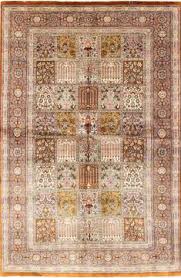
I would select my cherished silk-on-silk rug from Kashmir as my means of transport, the one I bought for a princely sum from Kashmiris in a bazaar in old Kathmandu. The colour is light green with pink woven into the borders. When you brush your hand across it, the sweep turns it darker or lighter, not unlike suede. The pattern is distinctive: 32 geometric panels depicting the Islamic Garden of Paradise, including pomegranate trees, arbours, plant pots and rambling rose. Tradition tells that this is a design from the revered Iranian town of Qom, from where the finest silk rugs and carpets on Earth are spun by weavers with magic fingers. Hence, magic carpets. If not that precious (and surprisingly tough) silk rug, I have another I’d consider riding on over a changed world in 2021. This one is an Islamic prayer rug (although I do not profess to be a man of any faith, other than faith in myself). I bought it from a reliable dealer in the Emirates, but the thing itself was woven in Northern Afghanistan and is exceptionally beautiful. Not of silk, this short-pile rug is of the finest wool dyed with the madder root into a colour resembling the dark dried blood of many an Afghan who has spilled their veins throughout the long war. Yes, my choice of long-haul air transport would be either the Kashmir silk rug or the Afghan prayer rug. Then again, for spaciousness there’s also that large tribal kilim from Tabriz in my collection. I could spread out on that during my transcontinental flyover. I’ll need a flying jacket and goggles, as it might get chilly, breezy and bumpy riding up there on the thermals. Oh, and my Leica monocular, too, so I can peer into the lives of others, and to see how the wildlife is coming along.

The roots of popular unhappiness, more and more started to realise, were becoming evident in the pleasant results the lockdown had produced on the wider world. Where the pace of life had been pulling us at 5Gs in a centrifuge, instead of being forced outwards the lockdown had now turned the force inward, to where we were all falling forward together into an attractive centre, which I call a natural equilibrium. Where previously few had any time for anyone else, they now found themselves devoting newfound time to the human relations they once held at the fulcrum of their world. Where many were being sucked into deadly debt traps, they now saw another possibility for an economic model that extolled the simple, organic life. Where many couldn’t sleep for the din of a society that had turned into a screaming lunatic asylum, quiet lockdown nights brought quiescence to tortured minds. It also revealed what had always been there but droned out: birdsong, and other naturally-occurring sounds. Where tens of thousand of species teetered on the brink of extinction due to human unwillingness to share, humanity finally agreed that the wild places were too few and the tamed ones too many. Monoculture changed in the agri business. Farmers were now harvesting goodies from the broad-leafed forests they had let grow in the vacuum of brown fields whose soil was depleted to the point of exhaustion. Animals that had resisted extirpation by laying low during the worst of our planetary abuses, and generally driven to the edge by our selfish species, followed suit. Population policy aimed at natural reduction, allowing crops to be grown vertically in great agri-towers that ran on sunlight. Where our industrial-age fear of the dark had produced so much halogen light to power society through night after night, so the lights went off and the stars returned to twinkle over what were sulphurous megacities. Something else unexpected returned: the sun. The industrial age had whipped up a dynasty of stormy weather by seeding every cloud with effluents and contaminants into raining. Gone was the chromatic aberration caused by poor air quality. Now the portrait of the planet looked pin sharp and didn’t we know it.

A revolution in the mind happened soon after the lifting of the 2020 lockdown. People wanted it back. They may not have professed to wanting thousands dead of a pathogen, but what they did want was to mitigate the disastrous effects of the human project by blocking off one month in every year where systems ground practically to a halt; where only essential distribution services, such as food and medicine and so forth remained a mainstay priority. Of course, they were compensated financially, but this would decrease over time as we moved away from heavy borrowing and high expenditure market economics to an ecological model of sustainable productivity. So, there you are on the magic carpet, skirting over the planet.

Ten years have past since the lockdown revolution/revelation of 2020. The annual month of fallow is now enshrined in UN law. Every nation is a signatory. Even the U.S., that resisted for so long because it was a concept engineered through the myth of the American Dream to exist only by maximising capital gains in every overworked American, even they got on board. China remains the dark horse: tense on the issue because the Chinese are caught between their philosophical tradition of Taoism and their love of making money by ramping up industry to ridiculous levels. Europe, being the old man, was at the forefront of the new paradigm for living. The Continentals approved wholeheartedly of this nouvelle approach to tempering things down.

Mechanisms were put in place to ensure that the other eleven months are not abused by the rush to over-productivity, as this habit came to be scoffed at for its backward greed motive. As a burned-out race we started mellowing. Our eyes were evermore open to the great clockwork of nature and how we – contrary to the proud fools that modernity and progress had made us – had broadly accepted our fixed role as a cog in that natural machinery, and not – contrary to the arrogance of our predecessors – as its clockmaker. Delegates even took to doling out liberal sprinklings of Gandhi’s wisdom that we live simply so that we may simply live.

What do you see, future me, when you look down from way up high on that Afghan rug in the new blue sky?

B-Day or Bidet?Nothing washes the soul like Brexit.

Brexit, Britain, British Isles, England, EU, europe, fate, future, humour, meditations, Politics, Society, Socioeconomics, thoughts, Travel, Uncategorized, United States

Brexit Day, or B-Day to those who cannot bring themselves to utter the shibboleth, is here, and predictably grey clouds are settled on the old England outside my porthole.

Well, here we are at the end of a 47-year marriage. My whole life, no more and no less. The EU is a polygamous arrangement of course, being that twenty-eight spouses took their vows to have and to hold from this day forth, albeit at different times. The European Union has become a kind of rolling nuptial. From the original six postwar players who signed the Treaty of Rome in 1957, to the swelled ranks of today’s fragile union, this political/cultural/economic/existential arrangement can be viewed as a flexible Mormon marriage, with the exception of there being more of the gender equal and less of the patrilineal in Brussels than in Salt Lake City.

Anyone who has not lived in solitary confinement for the past four years, which is nearly all of us (Jesus! Even Tibetan monks wield mobile phones these days!) will know that one of these spouses – the troublesome, quarrelsome old bag who thinks even in her dotage she can still bank on better marriage prospects – has called a divorce. For a long three and a half years, she’s been humming and ha-ing about delivering the death knell, a drama that played out in a frenzied Westminster, but seeing that she never really bothered to master the language of any of her spouses, the despedida, adieu, auf wiedersehen, and ci vediamo, has been a while in the coming. Awkward moments do tend to happen when you can’t be arsed learning at least a few phrases in the native language of your in-laws. Now Britannia is a ‘free woman’ (I’m not implying women are uniquely feckless here; Britannia, in this case could be equally be a feckless, whimsical man, except that Britannia has historically been depicted as a Athena-esque Greek Goddess with shield and trident in hand) she can galavant around, courting new paramours in the search for a new and improved polygamous arrangement. Or, if she’s strikes gold, an exclusive one.

Now you know and I know that unless you’ve already opened other arms to fall into, the prospect of leaving a marriage nearing its golden anniversary can be a calculated risk. Tomorrow, Britannia will sail off on a P&O Singles cruise around the world. First stop – and some say last – will be New York, where Britannia will court old Uncle Sam with an irresistible combo of knowing and coquettishness. To achieve this, she’ll have to get exceedingly drunk on Italian bubbly, which admittedly she’s already a dab hand at, having imported oodles of the stuff cheaply by virtue of being in existing marriage with Italy since 1973. But Prosecco will be off the menu ’cause we’re now in America, so she’ll be forced to quaff what the Americans are offering, which is either watery beer or rocket-fuelled cocktails. Once she’s woken up in her cabin after one too many Long Island ice teas the awful realisation will hit her hard that Uncle Sam is a selfish bastard who goes through girlfriends like a snivelling little git goes through Kleenex. He’s a tough, uncompromising type is old Sam, and won’t she know this before soon. He’s not a the callow youth she used to boss around two centuries ago when she was younger. He’s all grown up and this she’ll find hard to reconcile.

Dissatisfied, she’ll pick up the ship in L.A., after being feted by Hollywood’s liberatti who will plead she replaces the incumbent crooks in Washington as new sovereign of the American West (mainly on account of their weakness for British RSC-trained thespians/baddies with gritty authority in their voice). But that won’t wash with Washington, who’ll now treat her as a meddlesome strumpet keen to break up the chronically unhappy American family. Glancing north to faithful Canada, she’ll spot Meghan and Harry, who are even more shameless than her. There’ll be no chatting Canada up with those two fifth-columnists languishing there. There’ll be no more chatting up America either. Chastened by the threat of a nuclear arsenal whose each warhead you could slot into the bandolier of a mythical giant (or threatened by sanctions, the State Dept’s favourite tough love tactic), Britannia will sail on into that blue yonder where, contrary to the tub-thumping exhortations of the Brexiteer’s predecessors, the New Imperialists, the sun did eventually set forever on the British Empire.
Next up will be Oz and NZ. We can always rely on those two jilted lovers to come back for seconds. Except they are beholden nowadays to what’s going down in the Asia-Pacific bloc, ruled as it is by a giant even more selfish than America: China. So the ageing widow will need to rattle her jewellery hard to be heard amid all that eucalyptus smoke and barking Cantonese. Disillusioned by the tyranny of distance and the realpolitik of wanting to brazenly burst in on China’s well-defended patch, Britannia will sail onward to Hong Kong and Singapore. There’s she’ll find little Thumbelinas of herself in her prime. Oh to be Singapore on the silty Thames, she’ll sing. Noticing how disturbingly dystopian Singapore is, where a wad of chewing gum pinned under a park bench will inevitably result in a lengthy prison term, Britannia will graciously, if reluctantly, concede that we are not those men. That’s right, Britannia, we men are free to pin our concealed blades to the wad of chewing gum under the park bench, you know, just in case anyone fucks with us.

With potential paramours running out, P&O will propel us around the Malay Peninsula (yes, that was ours as well, but these days it’s showing a bit too much hijab for our liking) and onto India, the jewel in the crown. Where all others disappoint, India shall delight. She shall tantalise our senses, awaken our dormant soul with colours we can smell and smells that make our eyes water. The cruise liner will dock first in Chennai, which Britannia won’t even recognise, as it had its name changed by deed poll from Madras just so it could move on from an earlier, and some say skewed, marriage to Britannia. Then around beautiful Sri Lanka we shall sail and up past the Western Ghats to Mumbai, which also changed its name to erase the memory of us pre-1947. Mercifully, by now Britannia has gotten a bit more used to being jilted, so she can almost forgive the desecration of the name Bombay to a new ‘Hindu-ized’ moniker that sounds like saying farewell to the woman who birthed you, ironically enough.

The footsie playing out under the table between Modi’s new and assertive India and Britannia’s old and assertive Britain will give the media back home pause to consider. This could be the one, they’ll declare. A new old partnership forged the way we Brits like it, i.e. the bigger of the two defers to the smaller of the two – we know their size and they know their place. But you know and I know that this flirtation is bound to failure. Trying to resurrect old relationships in the mould of an old relationship is like trying to turn back the clock when all it wants to do is fly alongside time’s arrow. The Indians will do that irresistibly cute thing they do with the sideways nodding of the head. Benighted old Blighty will go mad wondering whether India is saying yes or no to her propositions. Exasperated, she’ll board the Cruise as is slides past Bombay’s Gateway to India monument while looking on wistfully from the prow at what might have been had we just not acceded to Gandhi’s wishes. I mean, come on, he wasn’t even armed at the time.

Ah well, at least there’s always the T-20. Consolation bobs nicely on the placid Indian Ocean. They can take our freedom but they can’t take our beloved cricket away from us.

Pulling into port in Cape Town, all eyes will be on the covetous prize of Africa. However, after being robbed at gunpoint at the ATM soon after disembarkation, Britannia will wonder whether Africa’s worth it. Upon closer inspection, she’ll baulk at the nightmarish statistics applied to a future Africa and say to herself, ‘How could Joy and George Adamson ever raise Elsa the Lion in these crowded, chaotic conditions?’ And she’d be right. Any anyway, China has got Africa all stitched up. While we’ve been squabbling with Brussels – but mainly among ourselves – the Chinese have been scrambling for Africa 2.0. But naturally, the Chinese are there out of the goodness of their Hubei hearts, just like the British and French were during their 19th century so-called ‘civilizing mission’. You want a brand new asphalt highway, no strings attached?? Sure! All we ask is that you take out a 100-year high-interest loan with the Chinese Communist Party (whose socialist principles are somewhat compromised by their partiality for usury, but hey that Capitalism, Chinese-style for ya!). Failing that, we’ll take a 999-year lease on your most prized ports. No 14-day cooling-off period here.

Wearily, the ship marches on, with lonely old Britannia still rattling her jewellery up on the prow, G&T in hand. Round NW Africa she sails, and past the Atlas Mountains of Morocco. Right there, coming into view will be Gibraltar, a brave and solitary outpost of empire surrounded by a bruised but recovering European Union. By this time, Britannia will be so sunburnt and permanently pissed, she’ll stagger down the gangplank into the waiting arms of a Barbary ape, who’ll greet her with bare-toothed howls of ‘Welcome Home!’ It will occur precisely in that moment of utter deflation that the old girl will have an epiphany, the first one she’s had since sobering up. She realise, all these suitors are selfish arseholes. You know, it wasn’t so bad being in that polygamous marriage with Brussels after all. I sat back and got most of what I wanted. When they screamed ‘black!’, I yelled back ‘white!’. And still they tolerated me. When they wanted a shared bank account, i insisted on having my own, and still they tolerated me. When they wanted me to meet them even a quarter of the way, i snubbed them, ’cause that’s what you do, right, when folks ask for just enough but not too much?’ They even came around to my language, and quite possibly my way of thinking. Aw fuck it! What kind of pusillanimous pussy goes easy on the fool who is willing to offer so many concessions, anyhoo?

Hmm, maybe I was a little hasty. Maybe is not the same as definitely (unless you happen to be Oasis who did a record called Definitely Maybe). Just you remember that.

Steaming across the Bay of Biscay on the homeward leg, storms blight the passage. Around Britanny and the Cote D’Armour, Britannia stares out from her porthole. Her mood changes from one of defiance to one of remorse. She has seen the world many times that she has seen the world not at all. She does not like what she sees. She is elderly and alone and the world owes her no favours.

On the final day of her RTW cruise, the captain announces that home port is not where it was when they left. Where there was a wharf there is now only sea. The island, it would seem, has retreated into deeper Atlantic water. They sail on. Shorn of ideas, Britannia retires to the bar where a G&T will await her. Now this isn’t your average Gin & Tonic. She wants hers large. Very Large.

Ice & Lemon, Madame?

Yes, if there’s enough room in the glass.

He pours. She collects. ‘But it’s half empty,’ she complains.

‘If I may comment, Madame, that’s not what you were saying when you joined the cruise.’