Flying Over Planet Lockdown on a Magic Carpet Ride

adventure, agriculture, Cities, climate, conservation, Coronavirus, counter-culture, developing world, environment, ethics, EU, future, futurology, Imagination, Life, Lifestyle, natural philosophy, natural world, philosophy, Reflections, revolution, Society, Socioeconomics, thoughts, Travel

It’s 2030. Imagine you could select anything from home to power your low-level flight around the planet. It wouldn’t be the stressed planet we have come to know. It would still be a human planet, but one rather unashamedly changed from the one you knew and despaired of back in 2020.

The overhyped pandemic of 2020, the one that had the world all in a panic to the point where it effectively closed human activity down, produced unexpected outcomes. No one quite knew it at the time, but the quarantining of humanity inadvertently gave breathing space to all terrestrial life that had been trampled in the poisoned dirt since the mid-20th century. Gone were the crisscross scars of vapour trails from planes all across the sky. Gone too were the ‘conjunctivitis domes’ that enclosed all but a few cities and towns in hazy, acrid pollution. More than anything, gone was the constant background noise of society consuming itself into an early grave. At first, even the most misanthropic kept tight-lipped about how the lockdown was having anything but a deleterious effect on them. They wanted to tell everyone about how delirious with happiness they were, that they were reconnecting with the world around, how the spring had never seemed so polarised with deep colours, and how the silence of everywhere had led to a great sonic peace across the entire sky. While patients with Coronavirus were gasping for their last breath, the guilty enjoyment of the majority who bore no symptoms seemed unutterable. But as the lockdown went on, more and more started to admit there was an upside to the downside of putting industrial society on ice for a while. While they cited different reasons for secretly enjoying the mass meditation retreat that the world had become, a common theme began to emerge. The average Joe and Joanne hadn’t been happy for a long time, but it was only through the Covid lockdown that it struck them exactly why.

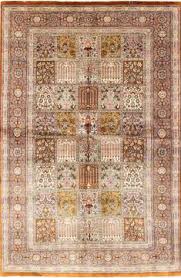
I would select my cherished silk-on-silk rug from Kashmir as my means of transport, the one I bought for a princely sum from Kashmiris in a bazaar in old Kathmandu. The colour is light green with pink woven into the borders. When you brush your hand across it, the sweep turns it darker or lighter, not unlike suede. The pattern is distinctive: 32 geometric panels depicting the Islamic Garden of Paradise, including pomegranate trees, arbours, plant pots and rambling rose. Tradition tells that this is a design from the revered Iranian town of Qom, from where the finest silk rugs and carpets on Earth are spun by weavers with magic fingers. Hence, magic carpets. If not that precious (and surprisingly tough) silk rug, I have another I’d consider riding on over a changed world in 2021. This one is an Islamic prayer rug (although I do not profess to be a man of any faith, other than faith in myself). I bought it from a reliable dealer in the Emirates, but the thing itself was woven in Northern Afghanistan and is exceptionally beautiful. Not of silk, this short-pile rug is of the finest wool dyed with the madder root into a colour resembling the dark dried blood of many an Afghan who has spilled their veins throughout the long war. Yes, my choice of long-haul air transport would be either the Kashmir silk rug or the Afghan prayer rug. Then again, for spaciousness there’s also that large tribal kilim from Tabriz in my collection. I could spread out on that during my transcontinental flyover. I’ll need a flying jacket and goggles, as it might get chilly, breezy and bumpy riding up there on the thermals. Oh, and my Leica monocular, too, so I can peer into the lives of others, and to see how the wildlife is coming along.

The roots of popular unhappiness, more and more started to realise, were becoming evident in the pleasant results the lockdown had produced on the wider world. Where the pace of life had been pulling us at 5Gs in a centrifuge, instead of being forced outwards the lockdown had now turned the force inward, to where we were all falling forward together into an attractive centre, which I call a natural equilibrium. Where previously few had any time for anyone else, they now found themselves devoting newfound time to the human relations they once held at the fulcrum of their world. Where many were being sucked into deadly debt traps, they now saw another possibility for an economic model that extolled the simple, organic life. Where many couldn’t sleep for the din of a society that had turned into a screaming lunatic asylum, quiet lockdown nights brought quiescence to tortured minds. It also revealed what had always been there but droned out: birdsong, and other naturally-occurring sounds. Where tens of thousand of species teetered on the brink of extinction due to human unwillingness to share, humanity finally agreed that the wild places were too few and the tamed ones too many. Monoculture changed in the agri business. Farmers were now harvesting goodies from the broad-leafed forests they had let grow in the vacuum of brown fields whose soil was depleted to the point of exhaustion. Animals that had resisted extirpation by laying low during the worst of our planetary abuses, and generally driven to the edge by our selfish species, followed suit. Population policy aimed at natural reduction, allowing crops to be grown vertically in great agri-towers that ran on sunlight. Where our industrial-age fear of the dark had produced so much halogen light to power society through night after night, so the lights went off and the stars returned to twinkle over what were sulphurous megacities. Something else unexpected returned: the sun. The industrial age had whipped up a dynasty of stormy weather by seeding every cloud with effluents and contaminants into raining. Gone was the chromatic aberration caused by poor air quality. Now the portrait of the planet looked pin sharp and didn’t we know it.

A revolution in the mind happened soon after the lifting of the 2020 lockdown. People wanted it back. They may not have professed to wanting thousands dead of a pathogen, but what they did want was to mitigate the disastrous effects of the human project by blocking off one month in every year where systems ground practically to a halt; where only essential distribution services, such as food and medicine and so forth remained a mainstay priority. Of course, they were compensated financially, but this would decrease over time as we moved away from heavy borrowing and high expenditure market economics to an ecological model of sustainable productivity. So, there you are on the magic carpet, skirting over the planet.

Ten years have past since the lockdown revolution/revelation of 2020. The annual month of fallow is now enshrined in UN law. Every nation is a signatory. Even the U.S., that resisted for so long because it was a concept engineered through the myth of the American Dream to exist only by maximising capital gains in every overworked American, even they got on board. China remains the dark horse: tense on the issue because the Chinese are caught between their philosophical tradition of Taoism and their love of making money by ramping up industry to ridiculous levels. Europe, being the old man, was at the forefront of the new paradigm for living. The Continentals approved wholeheartedly of this nouvelle approach to tempering things down.

Mechanisms were put in place to ensure that the other eleven months are not abused by the rush to over-productivity, as this habit came to be scoffed at for its backward greed motive. As a burned-out race we started mellowing. Our eyes were evermore open to the great clockwork of nature and how we – contrary to the proud fools that modernity and progress had made us – had broadly accepted our fixed role as a cog in that natural machinery, and not – contrary to the arrogance of our predecessors – as its clockmaker. Delegates even took to doling out liberal sprinklings of Gandhi’s wisdom that we live simply so that we may simply live.

What do you see, future me, when you look down from way up high on that Afghan rug in the new blue sky?


Surviving a Wilderness of Weirdness with Philosophy as the Weapon of Choice

ethics, fate, free will, future, greek philosophy, human mind, Life, marcus aurelius, meditations, natural philosophy, natural world, philosophy, Spiritualism, stoicism, thoughts

220px-Zeno_of_Citium_Nuremberg_Chronicle

The media report much fear and trepidation in the wider world, although judging by the look of contentment on the face of passersby, you’d be hard pressed to think so.

(and I swear even the dogs grin, or is that the outward appearance of having a stick lodged in one’s mouth?)

There’s also the unintended consequence of having a lot of people who find themselves with oodles of time on their hands while Covid-19 does the rounds. So how do they while away the hours until the spectre of death subsides, and we can get back to servicing the toothed machine of human progress? Some trek to Everest Basecamp in the confines of their home by scaling the staircase until the carpet goes bald and they follow suit. Others turn their hand to a spot of home teaching the kids until, realising that the transmission of knowledge through didactic discipline is harder than it looks, they dismiss their tiny class early. Others, like me, write obscure blogs that few dare to read, worse still understand. Still others take up new housebound hobbies with aplomb: such as taking 360˚ virtual trips to the Great Namib Desert courtesy of their much-abused smart phones, or else the wise few keep reciting ‘No wild animals in my delicious hotpot, please’ in Mandarin until the phrase sticks.

With this golden opportunity not to go nuts inside a tiny flat in Basingstoke, how many out there have given over their enquiring mind to the acquisition of a philosophy? Ancients, who weren’t busy warring in a sackcloth and sandals, were rather adept at offering sound advice based on the principle that once a man had found a philosophy to suit his ontological needs, he had succeeded in finding the map that would guide a clear path through this impenetrable life. The bold and the beautiful in the Greco-Roman universe swore by this dictum, going so far as to stitch their new ethos into their imperator tunics while on campaign against troublesome Germanic tribes.

The last of the five ‘good emperors’, Marcus Aurelius, was a man revered for being an enlightened and compassionate allrounder with a mind given over to self-examination in ways inconceivable to other emperors, for whom pleasures of the flesh all too often outweighed the pain of asking what does it all mean and what is my true place in the grand scheme? Given the unenviable task of leading the decades-long charge against tribes terrifying the fragile borderlands of the Roman Empire, the good emperor still managed to fit in a famous philosophical treatise before he died. Known as The Meditations of Marcus Aurelius, it was in essence a late second century A.D. reinterpretation of an ethical code dating back to a school of philosophy which had flourished ever since Zeno inscribed it in the minds of 4th century B.C.E. Athenians fed up with Cynicism.

Known as Stoicism, this branch of philosophy sought to strip away the bark of long-established wisdom to reveal the true sap oozing out of life: that is to say something vaguely along the lines of a cosmos working in cycles that start and end in fire. All matter that makes up the physical and, by extension, metaphysical questions that Man struggles to intepret works on a rational and logical basis (or ought to). Hence we humans do best when we are exercising reason over hot-headed emotion; hence we attain more understanding of how things are when explaining that phenomena using language built upon the rational rules of grammar instead of, say, an abstract picture or an incoherent grunt.

Sandwiched between the grand cosmological cycles is something we know as nature. Hence. stoicism is arguably the most influential of natural philosophies in its insistence that you and me are very small and limited in the grand scheme of things. By accepting each our minor yet vital role, the pressure is off and therefore happiness through simplicity becomes viable. Nature has a grand design, and if you let it into your heart you’ll soon realise both you are very insignificant and that, in spite of our own individual position far from centre, the universe nevertheless has your best interests at stake. All things occur for a reason. Fate doesn’t have to explain why it behaves in seemingly random ways. If it did, we’d know there’s nothing random about it. Even if an event seems uniquely cruel or inexplicable, natural forces will use the injustice to take corrective measures later on that symmetrically redress the balance, leading to the ‘Ah!’ epiphany that ‘it all makes sense now’. The interconnectivity of events is so blindingly intricate, not even a genius could spot it (shit! Did I just spot it where better people failed?)

Zeno, the father of stoicism himself, is reputed to have said that fate is an endless chain of causation whereby things are: the reason or formula by which the world goes on. In spite of this complex pattern, nature’s inner workings are, obversely, not mystical and esoteric at all; they are beautiful because true beauty lies in simplicity. That nature is beneficent – an unstoppable force that looks out for each of us if only we’d realise it – is contingent on you, the stoic, playing life as a game involving a basic blueprint of virtues to carry through life’s interactions into every little thing. Seek the four cardinal virtues – 1) justice/fairness/decency 2) wisdom/prudence/deliberation 3) courage/fortitude/endurance, and 4) temperance/self-discipline/modesty – and ye shall find yourself on course for a good death. That’s the idea, as I see it. The moment of death is all that your life ultimately amounts to, so life had better be conducted virtuously if death is to be faced head on, without anguish. There is such an aspiration as a good death, but it must be preluded by a life of self-discipline, fairness, examination, and strength of heart and mind. By the way, a good stoic would urge you not to be virtuous only to for the reward of a least hideous death. Be good, in and of itself, not for what it may give you back. Life is not a financial investment. Do the right thing because that is the natural order of things and to speak the language of life eloquently, we must first understand its grammar and morphology.
For stoics, like Seneca, Epictetus or Marcus Aurelius, life exists to be lived, literally like there is no tomorrow. William Faulkener wrote, The past is never dead. It’s not even past. How I do admire that wordplay. That said, Faulkener was no devotee of Seneca the Stoic. To stoics like Seneca, the past is a foreign country. Events that created the mosaic of that life have moved away forever, never to be relived with the veracity of how they were first meted out. Memories are not to be trusted, nor to be dwelt on. And death is not a loss of a whole life but rather just a loss of a moment at the close of that life. The ideal life, according to Seneca, was to be lived in the now, without dwelling on what’s gone, nor the irrelevance of what’s to come. It was to find contentedness in the simple here and now, and to want for nothing. How else to understand what golden threads of alchemy the cosmic fabric is made of other than to look closely at what is all around you NOW?

What the world needs now is love, sweet love, so goes the song. The world also needs Stoicism, meant not as the character-building prototype of the rugged Victorian imperialist (sword in one hand, dove in the other, pen between the toes, and pipe contemplatively in the mouth). Rather, the stoicism that emanated from ancient Athens and Rome was one that understood its demoted place in the natural order. We face a twenty-first century reckoning because we took stoicism to mean putting up with any old shit that life throws at us. Overwhelmingly, that shit was of our own making because we got way, way ahead of ourselves, thinking that two thousand years of Christianity and Islam had transformed each of us into little gods and sinners to be forgiven through atonement and religious devotion. So it was okay to break the ancient covenant with the natural order and go forth and multiply exponentially while scorching the Earth to conquer all before us because it was sanctioned first by the scriptures, and secondly by the arrogance bestowed on us by virtue of having reached a state of civilisation that was deemed far removed from lowly animals (this civilisation, it should be post-scripted, built its sandcastle empire not always on virtue alone).

In an age of uncertainty, rocked by the unvoiced realisation that there are too many of us vying for limited resources in a world wrecked in the search for these valuables, what needs resurrecting from the ashes of a self-deceptive human race is the idea that there are greater forces out there writing the book of life. That we are not gods but men and women who are fallible may seem self-evident, but any visitor from Andromeda would think we had promoted ourselves to that elevated rank. Every one of us might be just a mote of dust in the wind, but life affords us one chance to show our mettle: that if each of us face our remaining days in the pursuit of justice and courage and wisdom and self-restraint we shall once again feel humbled by the enormity of all that surrounds us. While no one gets out here alive, use this present lockdown to fashion your own system of practical ethics. As well as dying with a smile on your face, you might just make a small difference to your own and to the innumerable small lives that together construct the rich tapestry of everything we see and, more importantly, everything we don’t.

Everybody has an answer, but few a philosophy. Everyone wants a life, but not everyone holds the ethical guidebook to embark upon one worth living. Millions likes posting big pictures on Instagram, but how many consider the bigger picture and their own role as but one pixel within it? Why go in search of happiness as if it be a commodity to be acquired when, with the right tools at your disposal, you may reach inside and find it there? Thousands are dying out there (of malaria more than of Covid-19). So why stay at home wondering how you’re going to avoid it when you can stay at home and work out a formula for how to pursue a good life befitting of an equally good death.