It’s Hotel Life, Jim, But Not As We Know It.

#adventure, Uncategorized

Who Needs Breakfast at Tiffany’s?

Who needs Breakfast at Tiffany’s when you can have evangelical Nigerian generals for breakfast? A fair question, you might ask, but one that stands out as a trifle bizarre.

I’m holed up in the Al-Rayyan Doha Hilton for three months. We’re currently three weeks into a long, luxurious stay, with two months of room service to run. Outside it might be 43 celsius, but the hotel is an air-conned hotbed of the weird and the wonderful. They dump their bags from all over the world before disappearing behind fancy room numbers in this six-storey prism of marble and bronze leaf. The atrium is magnificent, it must be acknowledged. Tiered on two sides with hotel rooms tastefully set back from balustrades. On the third side, resplendent as you enter the vast lobby, is a kind of architectural fixture – I know not the technical term for it – a 100ft-high banner of bronze, cross-hatched glass panels, and abstractions of light and three-dimensional relief, perhaps. Whatever it is, it’s a showstopper. There’s so much marble in this one establishment that the mountain it was quarried from lies now in ransacked ruin. Trump was here in Qatar last week. He quipped something about loving all that marble. Trust me, he wasn’t kidding.

Back to the breakfast anecdote. It was Friday, first day of the weekend, and I was sitting there digesting yet another unnecessarily generous buffet breakfast, minding my own business, when in walks a black man, middle-aged, definitely West African. I had a feeling he might be Nigerian, as a large delegation had encamped there on official business as few days before. In fact, i was chatting with one of them at dinner the previous evening.

The chap turned to me and asked, “Are you South African?”

I answered i wasn’t but that the question had been asked of me in the past.

“Is there something about me that has that Afrikaner ring to it?”

“Well, yes”, he said. “Your face. And you are tall and white, so why not.”

I wanted to reassure him that in various parts of the world, stretching from Dunedin to Dundee, Manitoba to Moscow, there are a lot of white fellas over 6′ tall, and who could pass for a Springbok.

Soon, we fell into talking. Not afraid of physical proximity, as West Africans have to be, he shifted across the padded bench until inches away and proceeded to tell me that he was none other than a general in the Nigerian army.

“Funny, that,” I countered. ‘Until last week, I can’t recall ever meeting a senior military officer. But since then I’ve rubbed up against British Lt Colonels and Qatari Brigadiers.”

Life is either predictably predictable or else bloody bizarre. You wait an age on one red double decker and then three turn up in rapid succession.

Our conversation went from surface to deep sea within minutes. Our first scheduled stop on the pelagic dive was about the conspicuous wealth in the Gulf. Another hundred metres into the inky leviathan and we were on the subject of the corruption of money and greed in public life. Deeper still, it was the ecological crisis, rampant deforestation and Africa’s – and the planet’s – dwindling biota of all creatures great and small. But it was our next scheduled rest on the deep dive into the profound that he strong-armed me with a term i had never heard of before: prebendalism. What the? Can you repeat that, Emmanuel? P-r-e-b-e-n-d-a-l-i-s-m. The politics of cronyism and corruption and the curse of a democratic Nigeria. It refers to a closed culture in which state offices and civil service privileges result in a shared feeling of entitlement among elected officials to basically cannibalise the state’s resources for their own ends when that commonwealth should instead be fairly redistributed to those most in need. And among Nigeria’s 200 million there are many. It was, alleged my newfound general friend, Emmanuel, the reason for Nigeria’s impending doom. Reason further still to suspend democracy and restore military rule. He had a point, to be fair. He claimed, plausibly, that when civilian governments rule, they cannot help but slide in a culture of prebendalism. Popular vote by virtue of self-interest groups close to government demand booty in exchange for ballot loyalty. Those entitlements can be as innocent as a bag of rice or as sinister as cash bundles. A military government, on the other hand, seeks no such alliances of convenience and is therefore more adept at tackling strategic problems, like bringing immediate aid to whole regional populations who have, say, had their crops fail due to extreme weather, or civil unrest.

Emmanuel propounded a theory massively unpopular in the condescending West. But a theory nonetheless that made me sit back and think from the perspective of one of the heads of the Army who frames his country’s current plight in near-calamitous terms requiring martial law, redefining martial rule as a corrective instrument for a nation gone badly off the rails. Though in spite of the prebendalism hollowing out Nigeria’s (and i suspect much of Africa’s) civil governance, it was something else that led me to turn a quirky but original experience into this written record: namely, Emmanuel’s confession that he would rather be saving souls than saving lives. There is a deep evangelical streak running through the heart of all human life in developing nations with runaway population pressure. I saw it in Brazil. In him I saw it as casting a divine shadow over realities we in the west cannot imagine: where someone like Emmanuel’s father loses his own father to preventable disease aged six, before wandering alone across brutally hot savannah for weeks before being rescued by European missionaries – Anglicans, actually. From that trauma to the balm of Christ, in a West Africa preceded for millennia by animistic shamanism, the superimposition of Western scriptural doctrine onto little lost sheep has this intoxicating effect. Not only was the son fervently Christian in both beliefs and deeds in a way we in the secular West could no longer be, Emmanuel had the shaman in him too, for he believed that God spoke through him, anointing him with divine powers to change others’ fate. He was convinced, for instance, that he was able to grant his father a stay of death until the time was right to lose him. Like the missionaries who plucked his father from sad obscurity aged six, beyond the temporal to the spiritual Emmanuel considered being a general a drop in the ocean compared to being a servant of the people prosecuting God’s work.

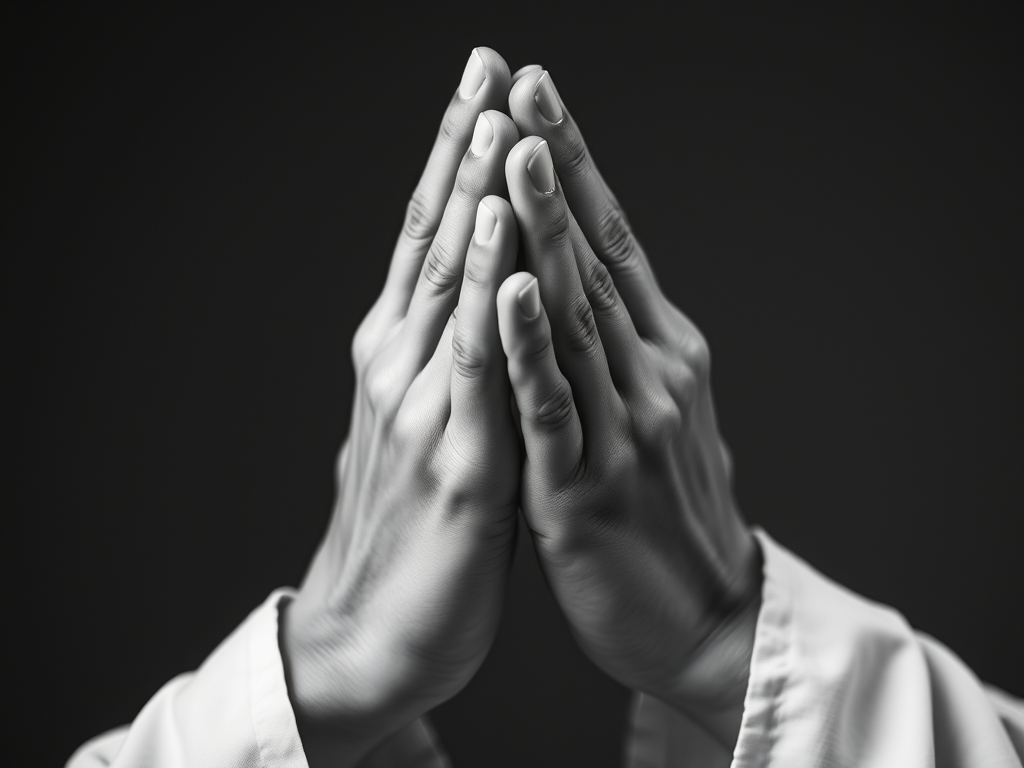
Pitying my inbuilt scepticism, and mocking my quasi-Darwinian metaphor of the chimpanzee and the human hand being one in the same, he was not going to let me go without taking my hand in his, and praying for an end to my lifetime of doubt. Clasping a white hand in two warm, black hands he squeezed with all the conviction of a man who knew nothing but. He sealed his eyes and screwed up his face, beseeching God to give Scott a long life. And when it was over, gave me his number and invited me to stay with his family the next time i was in Nigeria.

Who needs Breakfast at Tiffany’s when you can have breakfast in Babylon?

What Goes Down Must Come Up: Why You Should See the Colca Canyon

#adventure, adventure, Andes, backpacking, Landscapes, Latin America, Perú, Perú, Travel, Uncategorized

Olympian Among Canyons

Allow me to set the scene, if you will. The Colca Canyon is situated in Southern Peru, about a 3-hour drive northwest of the White City, Arequipa. By all measures, the Colca is the world’s third deepest canyon (some say fourth) after the Yarlung Tsangpo Grand Canyon in Tibet, followed by the jaw-dropping Kali Gandaki Gorge in the Annapurna region of Nepal.

The Colca Canyon cuts such a swathe through the Andean plateau that it bottoms out at about 11,000ft (3,400m). To offer up some idea of scale that clicks with most of us, that’s about twice the depth of the world’s most celebrated geological knife wound, Arizona’s Grand Canyon. So, one Grand Canyon nested on top of another, and the Colca will just about accommodate them both.

Where Humans Dare To Tread and Till

Farmed by Inca peoples since time immemorial, its steep slopes show abundant signs of continuous human occupation. At about 50 miles in length that’s one deep cut for Man; one deeper cut for the magisterial condor that has made a miraculous comeback there after decades of persecution from local livestock farmers. Its confidence soaring, the condor is one of the main attractions of the hordes of tour buses that stop at the various lookouts along the canyon rim.

For the adventurous few though, what awaits them is a gruelling descent to the canyon floor, where if lucky, they’ll see the condor soar not below them, but at eye level. It’s all downhill from here. And surprise, surprise, the prospects never looked so good.

I got teamed up with a nice bunch of continental Europeans half my age and double my knee flexibility. Among them a smattering of French and German. The Franco-Prussian alliance had sunk to new heights. Our guide was a native of Arequipa, a man who had led so many 3-day expeditions in and out of the canyon that, as can be expected, he was rather unfazed by the whole affair.

El Condor Pasa

One moment we were setting off along the canyon rim and the next a slow motion plunge down a zigzagging hoof trail that swallowed us whole. The view was stupendous, the scale was suddenly gargantuan, and the sky a blue bonanza between weeks of monsoon rain that would render it all but impassable before and after. With the heat rising and the sunlight penetrating the deepest, darkest rincones of this abyss, we fell into a hypnotic rhythm. Our guide pointed out geological features, and delved into a history of human geography. But in keeping with great journeys, what you rank as the best bits keep getting superseded by better bits. Half way down royalty dropped in. Condors swooping over us so near and so balletic on the hot air updrafts that by the time i reached for my oversized SLR camera, they had glided away into the shaded recesses under the canyon walls.

It’s All Downhill From Here

Serendipity had accompanied us that day. Our guide marvelled at how rare it was to come so close to the feathered emblem of the Andes. Then again, perhaps he said that to all his small tour groups. Down and down we traipsed until, looking up, the canyon walls closed in on us like great doors in some medieval banquet hall.

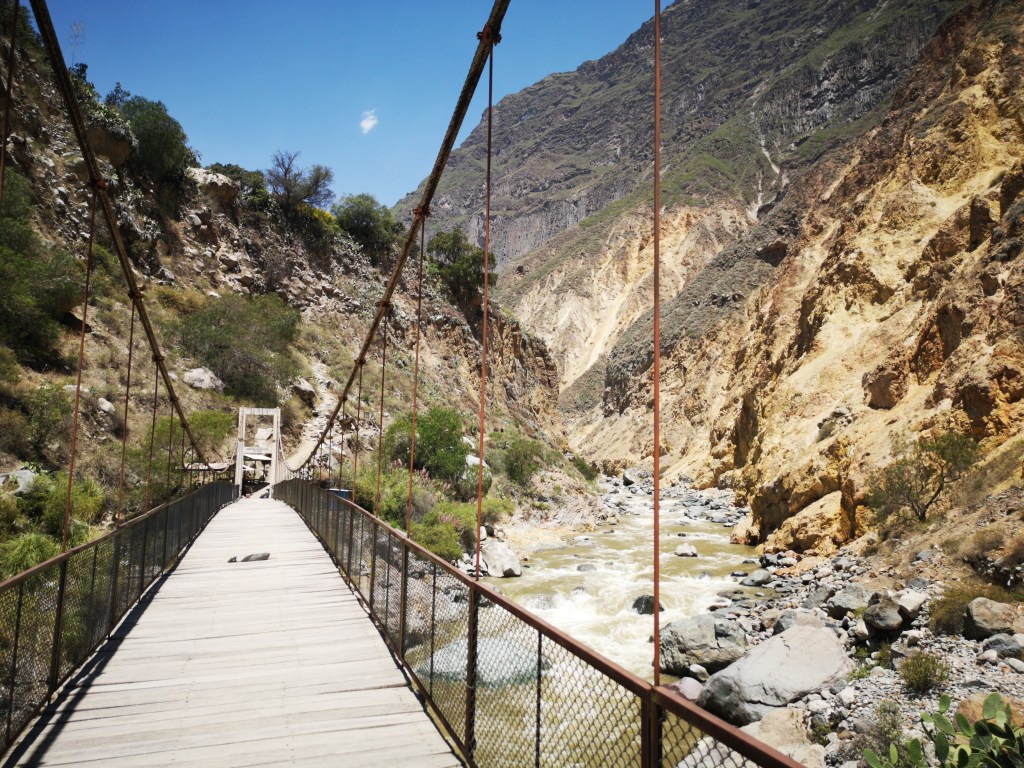
Having spent the better part of the day tiptoeing down about 3,000ft we found ourselves at the nadir. By no means the lowest point in our experience, crossing the iron suspension bridge over the Colca’s mazy river did signal the lowest point geographically-speaking. The sun was beyond its zenith, casting its brilliance on the east face of the canyon, making shadow creep gracefully up the west face.

Scraping the Barrel to Find an Oasis

We had been descending all this time. Now we were walking along the canyon floor adjacent to the watercourse. Festooning the margins of the clear crystal water were orchards of figs and other succulent fruits. Vegetation was abundant. Light and warmth caressing in a very special place where the wind and the winds of change were banished.

We walked and talked for the next couple of days along that canyon floor. We passed churches and villages, kids coming home from school, and guinea pigs flayed and hung out to dry. We stopped in a guesthouse with the most amazing swimming pool, fed to pure by an oasis. A classic desert oasis in the truest sense it was, fringed by date palms whose seedlings had come from half a world away.

It’s All Uphill From Here

On the third morning since taking the plunge into the world’s third deepest canyon, we gathered around our guide at 4am to face the trek back up and out. We obviously knew all along that what goes down must come up. But comfortable in our deep oasis on the previous evening, tipsy on rum and oxygen, I was contemplating a helicopter medevac out of there. The climb looked daunting, and was. 3,000ft straight up in the grip of incipient subtropical heat. Hence the reason we left before daybreak. As if to foreshadow what would be a gruelling hike out, my guide took one look at the packs I was carrying back and front, and shook his head in pity. “I told you to travel lightly, didn’t I?”

Half-light kissed the rim tops around an hour or two into the climb. Then, quick as ink blotting on paper, the dawn light seeped down until we rose to meet it a quarter of the way up. By then the pain of being a human packhorse had slowed my stride to a lumbering, teetering mess. My t-shirt was soaked with the sweat of my own labours. My bandana had to be wrung out every 100 metres or so. My eyes were weeping salty tears of pure perspiration. The line between myself and the other group members was attenuating fast, as they strode ahead. Overcome with guilt, eventually my guide offered, with a degree of reluctance visible in his grimace, to take one of my packs. But not before hailing a passing muleteer who refused.

Ghosts From the Past

Onward we clambered, inch by inch until at about 10am – a full 6 hours after setting off from the now microscopic guesthouse on the canyon floor – he and I emerged on the lip. Shattered, reddened to bursting, and vowing never to descend that far again with any baggage whatsoever, I collapsed in a heap. Beside me, by the grace of an ironic God, were a couple of Estonians I had climbed with a couple of weeks earlier. On that occasion, the altitude was so dizzying that it was they who struggled with hypoxia to the point of almost fainting, and me who offered a helping hand. Now there they were all smiles, relaxing after practically jogging up the Colca carrying nothing but a 7-litre daypack. And me, a sorry sight, temples pounding, eyes throbbing and near spent. Valió la pena? Was it worth the pain? Absolutamente!

São Thomé das letras: Brazil’s Glastonbury

#adventure, #alternative lifestyle, #Brazil, Brazil, duendes, Latin America, Lifestyle, Minas Gerais, Sâo Thomé das letras, South America, Spiritualism, Spirituality, Três Corações

For every action there is an equal and opposite reaction. For every human a doppelgänger. Every town a twin, but not always officially twinned in the sense of Bristol and Bordeaux or Birmingham and Chicago – towns that to all intents and purposes have little in common. Some towns are kindred spirits. Soul brothers. Sister cities. Take Edinburgh and Florence, two cities well matched both in grace and favour.


Not that many New Age & Main Stage-lovin’ aquarians, who show up perennially at the gates of Michael Eavis’ Somerset farm each and every summer, will ever go there (the UK festival circuit is pricier than budget adventure travel through South America), but no word of a lie, on a recent trip to São Thomé das letras I swear i met Glastonbury’s long lost twin. Though it would be fair to say they remain lost to one another, and there’s no telling when these long-lost brethren will be given the This is Your Life treatment. This is their historical destiny, given that Britain’s empire was kept in check in Latin America, and British interest there today is at best marginal.  

Everyone who is no one knows England’s Glastonbury. There’s the annual arts and music festival, of course. The inevitable cat and mouse game between stewards and fence-jumpers, which results in ever higher fencing and standing charges for tickets that sell out within a hour. The periodical return of Van Morrison and Coldplay to the Pyramid Stage, just when everyone thought they might take a permanent rest. There’s the Tor, the grassy hump that everybody climbs to flee the rising floodwaters that beset the Somerset Levels with increasing regularity and ferocity. There’s the legend of Camelot, if you buy into that sugar-spun fairytale. (Until diets improved in the area, the locals were happy with Spamalot). Then there’s Jesus’ uncle, Joseph of Arimathea, who devotees believe house-swapped a life of danger in the Levant for bucolic Britannia, bringing only a cup with him in his 1st AD century removals caravan. There’s bombed-out deadheads that haunt the town, barefooted and extremely confused, months after the festival has ended, wandering into corner shops asking if this is where Hawkwind are playing this weekend.

Glastonbury is all that and some. Who can forget the quaint little cottages for sale at not such a quaint little price? And the annual orgy of money made in holiday rentals from well-heeled festival goers for whom a row of dripping, wet tents is just not appealing? And last but by no means least, what of those ley lines running under this most pagan of towns? This mystical grid force of supernatural, electromagnetic power is responsible for getting the crystals all excited. Spiritualists and necromancers follow this flow of uninterrupted energy like the children of Hamlin to the penny whistle tones of the pied piper.

That’s Glastonbury seen from a slightly flippant angle. But what about its southern counterpart?


On the subject of Joseph and the Grail, São Thomé das letras was named in honour of another hero of the Jewish uprising against both Judaism and Roman Rule in 1st century Judaea: the doubting Thomas, apostle and man of my own heart. Quite what the letters (letras) part is about is the subject of much conjecture. But i would say it might have something to do with the Gospel of Thomas, and the fact that gospels were written into letters. One would assume that early Portuguese settlers, with God on their side and Christ in their hearts, in what was the colonially important and unromantically-named province of Minas Gerais (or General Mines), founded this little settlement long before the hippies started flocking. It is highly unlikely that whomever called the province General Mines and the town St Thomas of the Letters was much of a crystal-gazing spiritualist with animistic tendencies. In all likelihood they were a pragmatic, Catholic bunch who mined valuable stones all week for money while worshipping all weekend for salvation. Stranger things have happened at sea, where, luck would have it, the Portuguese spent much of their time conquering the then unknown world.


Brazil’s Glastonbury is a tenuous link at best, you shrug. A non-identical twin in a world obsessed with identical ones. I mean, São Thomé doesn’t attract the likes of Beyoncé, Dolly Parton, and The Foo Fighters over from the U.S. to join the rock and pop pantheon in a 5-day annual music blitz. Joesph of Aramathea never crossed the Atlantic. And Camelot’s influence couldn’t possibly have predated Pedro Álvares Cabral’s new world discovery of Rio de Janeiro in 1500. But look beyond the obvious – transcend the tawdry – and you’ll see that both towns coruscate with pixie dust.

Legends abound here and there. There’s a tunnel that runs from two undisclosed entrances: one at Machu Picchu and the other in Sáo Thomé 3,000km away. The ground beneath Sáo Thomé is so highly-charged with potions of motion that there’s a spot there where your car will drive itself. So many varieties of magic mushroom can be bought sealed and ready to nibble on that you’ll be hallucinating all the way under that tunnel to Machu Picchu, if only that entrance can be found. So potent are these so-called cogumelos that doubtless you’ll still be high when you emerge at the Peru end of the tunnel.


At the summit of all things heady in Sao Thomé is its very own Tor, but nothing like the old phallic one atop a hill in Glastonbury. Nevertheless, the same purpose is served: pilgrimage. The Brazilian construct is somewhat unorthodox, and a whole lot newer. Built sometime in the 20th century, of a quartzite now afforded Kryptonite powers, the Pyramid couldn’t be better named, given the invented similitude with Glastonbury. And, like Glastonbury’s sound-splitting, prismatic Pyramid this too is a stage, of sorts. Namely, a stage for all Brazil’s seekers of the transcendent realm that come here in search of whatever it is the rocks are emitting. It can’t be enlightenment they are after, as if it’s the light of truth they want bathed in, the sun here packs enough punch to drown them all. It must be the panorama that wows the crowd, because from there the rolling country of emerald Minas Gerais never looked so good.


Ascending and descending the Pyramid for yet another spectacular sunset is not unlike the Sermon of the Mount scene from Monty Python’s Life of Brian. There’s a sense of destiny about being in attendance for nature’s greatest revelation. And descending at dusk with all the others, there’s still the vendors at their makeshift stalls to pass, flogging everything from moonstones to magic potions, in this nation of ingenious artisans.

São Thomé das letras is more than worth the six-hour drive from Sáo Paulo (equidistant from Rio). Yes, seeing the promise of fadas and duendes – fairies and elves – is reason enough in itself to go, as every great traveller will tell you, it’s not about the destination. For lovers of o jogo bonito, en route you can stop off in Três Coraçōes to pay homage to the great Pelé in his place of birth. If Brazil beguiles you with its beautiful game, let it beguile you further with its beautiful countryside and magical realism, even if the analogies to Glastonbury are a tad far-fetched.

end