The Kindness of Strangers

Uncategorized

Life’s quirky that way. What begins as calamitous in the making can end on a high. Not to put too fine a point on it, when misfortune starts befalling, serendipity has a reassuring habit of calling. And all this in a landscape so otherworldly you couldn’t make it up.

There we were, minding our own business, motoring up a 35km stretch of mountain road to a place of legend in central Oman. The car, with a reputation for inspiring confidence, had in these trying circumstances lost its bottle. Struggling to haul its five tonne ass up 2,000 metres from pillar to post, its passengers could feel its hurt. Relentless as alpinists pushing their weary porters on, we tried ignoring the signs. Over the apex, within sighting distance of our destination, the oil temperature drops and we quietly celebrate the triumph of the machine over the trials of nature. And then, as if taunting us all along, the VW goes clunk, clunk, clunk from the near-side wheel and judders to a standstill.

No amount of willing the thing to rouse itself does the trick. Like a feisty filly at the race stalls, she refuses to go on.

The air temperature gauge has decreased from 115 degrees Fahrenheit at sea level to a tolerable 82 Fahrenheit at 2,000 metres, small consolation in an otherwise disastrous showing.

The myth of German invincibility shattered, yours truly lets go a despondent cry followed by a petulant thump on the wheel. Oh God of Wolfsburg! How can you repay us for the faith we have instilled so unfailingly in you?

And then, like a handmaiden riding in from the wings in a stage production of Wagner’s Ring Cycle, our Omani Valkyrie in his starch-white dishdasha turns up to save our sorry souls.

Introducing himself as Thani, as if that’s not a name straight out of the mythological past, he smiles benignly and offers a gentleman’s hand. Wearing his custom-built headgear tipped forward (for the benefit of the blind reader, a kind of white embroidered fez minus the tassles), his nose is, all four inches of it, Semitic (or maybe Gallic), and his facial features not unpleasant. He refers to each of us as brother, even though one of us is categorically female. In the time it takes to make a quick phone call then whoosh his wand (Oman’s puritan neighbours in the Gulf always did accuse this fiercely independent nation of conjuring the djinns with their malevolent scorcery), the fate of the car – and more importantly of us – is sealed. It will live to see another day, and we burned-out pilgrims will live to savour this very day. But not as we had imagined.

It’s action stations, but not in the way a Westerner with neurotic tendencies might think. Defcon-4 this is not. That said, this guy is a natural when it comes to handling human and mechanical breakdowns. Whisked into town to raise a posse to return to the mountain top (well, actually, two Indian mechanics – one known affectionately as the Professor, personal friends of Thani), we’re back within minutes to patch the car up and take it back to the workshop for a bit of loving restoration. As a show of trust, Thani drives our car, and we follow in his. Halfway into town his arm extends out the driver’s window and a thumb is raised. This, we take, as an auspicious sign.

As places to break down go, Jebel Al Akhthar is both a blessing and a curse. A plateau of hanging gardens, elevation a God-merciful 2035 metres above broiling sea level, the green mountain (akhthar means ‘green’ in Arabic, and Jebel ‘mountain’) is a veritable Babylon to the insufferable and breathtaking heat of old Arabia surrounding it. Not only that, the green mountain is a heaven sent 27 Celsius. By the providence of geology, this high plateau (the Sayq in case you’re interested) of climate temperance rises above the basement levels of hell where nothing other than date palm and acacia can handle temperatures that top 50 degrees in June. In fact, its altitude-assisted climate is so perennially perfect that fruits more at home in the Mediterranean grow fat and juicy in midsummer. They’ve got pomegranate. They’ve got peach, fig, apricot and grape. They’ve got life in relative abundance, and not many places in the region can make that claim without complex agronomy, such as irrigation from desalination plants.

So you climb and climb and watch in sheer relief the car’s altimeter go up and up and its thermometer correspondingly go down and down. This all makes mechanical mischief a fact of life one could get used to, at a push. One can think of few other places in the vastness of Arabia where breaking down means not merely surviving but prospering, too, from the experience (other than the repair bill).

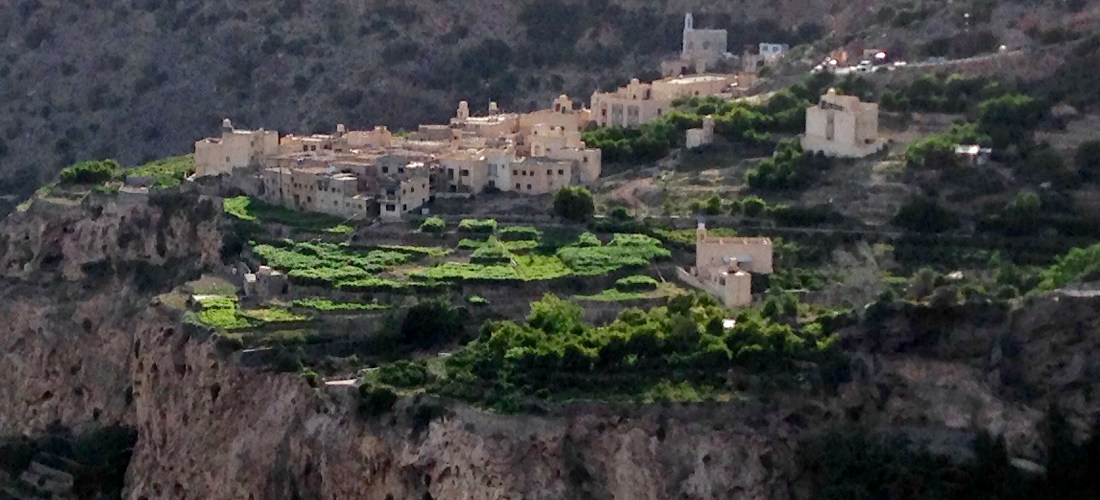
That evening, now rested and attuned to the peaceful vibe of the hilltop hotel, we are invited to join Thani at his house in a hamlet we can see from the hotel is a white limpet stuck fast to the rock of the canyon far below. As sundown painted the land around in pale pastels while the valley floor far, far in the distance still burned like a ember, a diaphanous shroud of white cloud brought the temperature down further still.

He came for us in his jeep, such was the host he was and the host I would hope one day to become. Before retiring to a majli (like a drawing room in an old Victorian house) in the presence of his brother and adorable daughters – but notably not his wife – to eat dates and dahl and sip Arabic coffee and tea, he led us down to the wadi where only a month previous the waters had been cascading down from the mesetas, taking every loose thing in their unstoppable path. This is how things work here. The rains make infrequent visits to this parched and scoured corner of Asia, but when they do, they come with a force and a magnanimity matched only by that of the locals toward us, the outsiders, who are as thirsty, helpless and in need as the land itself.
 

What’s Not Meant To Be Will Be.

Uncategorized

No easy thing accepting the inevitable. No easy thing rejecting the instinct to hold on. It’s here and then it’s gone. It was never here nor there at all. Some campaigns are not worth marching on an empty stomach to fight. The retreat to the place beyond the pines will be as ignominious in its homecoming as two hundred and fours years ago when Napoleon decided to seize back Lady Russia into the wedlock of his continental system and came home empty-handed. Early winter of a summer campaign, he should have come prepared for the prospect that she would not return willingly. For all that money and prestige, the least Emperor Bonaparte could have done was to requisition good quality overcoats and bearskin hats for every brother in that Grande Armée. He did not because men are hasty in their march to folly.

The little Corsican with the tenacity to hold on long after others relinquished grip had no predecessor to go on, but Hitler should have known better. He had Napoleon’s experience to act as a sobering reminder. Another man of history who thought he could take back what was never his, the Reich chancellor would learn to his eternal damnation that just because the season was summer didn’t mean necessarily that Russia was the place to make a lasting impression.

Love and hate, two sides of the same coin forged in the fires of obsession.

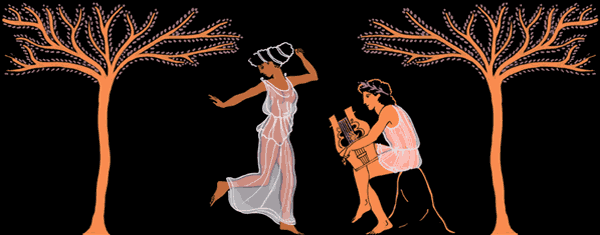
Of history’s litany of star-crossed lovers, it is Orpheus and Eurydice who endure as a symbol to the pain of lost love and its subsequent descent into obsession. In the myth, death snatches Eurydice from Orpheus. A tale engrossing (and personally touching) enough to upset the game plans of history’s master tacticians is stopped in its tracks by a snake in the grass that doesn’t care for love to succeed. Devastated by her early departure from this life, Orpheus’ disconsolate strings play on until his ballads reach the gods themselves. As for the nymph Eurydice, we lovers of true fable will never know how well she Took her cursed luck, for her heart, if it be broken, lies shattered in pieces in the Hadean recesses.

So heartfelt and melodious is the voice of Orpheus, so sweet his lyre, that he secures a second chance to have her again. His subterranean journey past homeless, fleeting souls and dark hellish spires brings Orpheus to the court of Hades, who on hearing him play the lyre is moved to grant her a second crack at life, on the precondition that until both emerge into the daylight he must not look back. In the spirit of Hellenic myth tragedy he does. He is no different from all humans who have loved, for their greatest weakness is to glance back at the helpless, receding apparition of Eurydice, their Eurydice, whom they battled for years to get over.

I think the myth of Orpheus endures as a telling reminder not to look back on things that time has eclipsed; that the instant one casts a retrospective eye on a lost love, the more intangible, the more irretrievable the loss becomes. Nevertheless, tis easier said than done to evict she who resides permanently in a ventricle of the heart.

Hades’ ploy was to issue his writ to Orpheus knowing full well the lovesick boy would fail because men are weak and cannot forget.

Hades was never going to relinquish Eurydice to the material world because only gods know when what is done is done. Finding courage to change the things one can lies within the reach of mortal men, but having the wisdom to know the difference, now that’s the preserve of the gods.

Where Prayer Flags Fear Not to Flutter

Uncategorized

Sometimes a memory jogged by an old photograph can be just enough to defibrillate the heart back to a steady rhythm.

Freed from binary chains deep in the dungeon of that hard disk, a lost JPEG came to light recently. And I mean light. The picture was of a man looking self-satisfied, on top of the world. Literally on top of the world. He was standing amid the flutter of prayer flags by a stupa somewhere in the high Himalaya. The sky was topaz blue above the ridge line, graduating almost to black as the air thinned into stratosphere. Away to the west lay the Langtang massif. To the north, China, Tibet, call it what you may. Shishapagma, the last of the fourteen 8,000m mountains bagged and tagged as long ago as 1964, was somewhere in the midst but no one could tell exactly where in that crowd of tall, strapping physiques. This was political China, peopled by as many mountains as men and women. So the theory went, if you were to melt Canada the selfish dragon (as its neighbours knew China) would become the world’s second largest self-governing landmass. And so it went, to be able to defy perspective from his high-point on that photograph by reaching out a hand and gathering up Tibetan China must have felt like Buddha cradling the whole world in his hands.

So there he was standing on Kanjing-Ri amid the flutter of prayer flags, colourful as bikinis on a line, pegged out taut as guy ropes holding rigid a trillion tonne mountain. At 4,850 metres above the clicking of the high heels and the ebb and flow of shit at sea level, his demeanour was one of a guy who had inhaled a lungful that was unlike anything he had hitherto drawn into his lungs, including the suspicious looking item clamped between index and middle finger he was toking on by way of celebration. His blacked out sunglasses hid the eyes but not the elation in them. This you could infer from studying both his posture and the unstoppable smile on his face. Here was a smile that boasted, ‘I have ascended. Nothing tops this.’

Rewind the sequence to its beginnings and Act I Scene I is an arduous drive to the head of a remote trail. Given the choice of nine bouncing hours on a packed bus for five dollars or his own jeep driver for one hundred and twenty five, he puts his natural parsimony aside and pays the man. So there he is, king of the wild frontier, another adventurer with too much money and not enough time.

The road deteriorates on the final third to the trail head. It is no coincidence that this deterioration occurs at the crumple zone where the foothills come into their own. En route, he sees the bus in front on a mountain road that is chiselled out of the steep slope itself. The route is crumbling over the edge. The ravine bottom is an awful long way down. The bus is kicking up the dust, which is itself masking the parlousness of their situation. Overladen, it loses power and traction and starts rolling back on a nasty little switchback, rolling back to its doom. Passengers, looking from a distance like scarab beetles scurrying out from a mummy’s tomb, spill off the roof racks. They see the danger that is imminent. The bus grinds to a halt feet from the overhang.

He sees all this from his jeep. Passengers who were moments before fleeing in fear of their lives have now reassembled for the onward voyage. Unfazed, they laugh the whole near death experience off like it’s a normal occurrence, which of course it is. In fact, being Hindus they have probably plunged into that ravine dozens of times in the past, first on hooves, then with wings, then on foot, then on mules, then as mules, then rickshaws, now buses.

Once in the trekking hub town of Syabrubesi, he rests. Tomorrow will be long, winding and full of dangers, real and imaginary. Naturally, blessings need to be delivered. Yes, he is deep in Mahayana Buddhist hill country, but where are the prayer wheels when he needs the cosmos by his side? Om mani padme hum. In the absence of blessed spindles to roll, he apprehends three schoolboys coming the other way. Demanding tithe payment in the form of melting Snickers bars, they deliver their benediction wearing chocolate lipstick. Up and up he goes, ticking off pit stops and many a traveller’s inn along the way.

The ecology is stratified. What begins as uncultivated stands of cannabis sativa stops at around 2,000 metres. Now no longer subtropical, the bush carpeting the valley slopes gives to deciduous forest of maple and oak, and everywhere the blood-soaked flowering of rhododendron. Where the temperate zone ends the sub-alpine zone begins, and all within a day’s walking. Vegetation keeps a low profile. Grass and heath predominate. He keeps walking until he reaches the alpine town of Kyanjin Gompa. Up here the mountains are thrones but this is no game. Up here, Jim, it’s life, but not as most of us know it. He and others have now gone where golden eagles dare.

Not that anyone poring over the photo could tell but behind his left trouser leg his knee is strapped up heavily. Ten days prior to the taking of that shot, he had undergone keyhole surgery to remove torn cartilage from his tibia. The prospects looked bleak but nevertheless he persisted on two poles and a lot of grit in his determination. On day three or four where the going got steep and not even the hardwoods would lend a limb, he had pulsed the trail in an ebbing and flowing motion with an Indian engineer. Turbines, it manifested, were the man’s specialty. Being Gujarati, the man ate high temperatures for breakfast, yet nevertheless the track at that point was proving gruelling, the sunshine intense. An enquiring man with a prodigious command of the Queen’s own and profuse with sweat, the Gujarati was about bowled over when the man in the photo let slip that he had been on an operating table just days before, having the bones behind his knee cap scraped.

‘Even though you’re the walking wounded, you can still outpace me,’ he said between his puffing and panting.

‘How far do you intend to go?’

‘Kanjing Ri, and not an inch less,’ the man replied.

‘You’re not giving up until you get there, aren’t you?’ he Gujarati said in turn.

The man from Gujarat was visibly moved, to the extent that the man in the photo thought that mention of his plight might be driving his newfound trekking buddy onward and utterly upward. A little spark of inspiration had been seeded, he thought. And that in itself can go a long way in this rarefied air.

Snow has crimped the near vertical slopes. How it hangs on is anyone’s guess. But the sun is undermining the snow’s tenuous hold. He hears the drum roll of snow tumble down a couloir on Langtang Lirung. The rock walls amplify the avalanche. The sound of a small cascade is exaggerated. This is nature’s ventriloquy bringing a lion’s roar from the mouth of a kitten. It must have been deafening when the great earthquake struck this very region nine months hence, flattening everything put up by man except for the giant H spelled out in whitish pebbles.

A helicopter buzzes in to a rapturous welcome from the entire village who have come out in force to feel its downdraught. Hypnotic they stand watching the pilot stoop under the whirring blades, rushing forward to grab two lucky locals then two wealthy Russians by the arm. This event has all the makings of Close Encounters of the Third Kind meets the coming of the conquistadors on the coast of Mexico. Quetzalcoatl, the prophesy of Spielberg told.

It is a perfect day to stand higher than he has ever stood. Some photographs were meant to be kept. Some memories meant to be jogged.