
The Man-Cub Howls Back

Uncategorized

If a little oozing of enchantment is what you seek, then you could do worse than tune into John Favreau’s revamped Jungle Book. It’s not only the husky sibilance of Scarlett Johannson playing Kaa, the reticulated python, that has the power to seduce. The film is a joy the equal of the 1967 classic, but behind its tableaux of trees, vines and strangler figs there is wood to be seen. And much of it is has been either trimmed and replanted or else sawn and turned to pulp. Global population has doubled since 1967, as has India’s population. This effect on India’s jungle forests has been inversely proportionate, giving a new spin on the book and a whole lot more import. There’s a lot of book to be had from this story but, tragically, not a lot of jungle.

It’s hard to conceive of a better tonic to cure the sickness of the postmodern soul than to pop those 3-D glasses on and sit back while Mowgli romps through a wild and woolly wilderness dreamed up to great effect in a room somewhere in downtown LA.

Whether you happen to be eight years old and have yet to reach the age of consent, or forty-eight years old and have reached consent but not yet the state of content, it matters not a jot. This is a film for sharing, for panthers and tigers alike. The Jungle Book has a universal mandate to bring us back to where we once belonged. Fifty years after the original hit the screens, seeing the remake is a summons to the dormant Mowgli within, to the you who used to make rope swings on tree boughs before manhood tied a noose around the end.

If teasing out the lost primordial within ain’t motive enough, then the prosecutors of the film can offer another two: CGI technology allowing the filmakers to take anthropomorphism to heights that are credible to the mind and soaring to the heart; and an ecological subtext which could not be more timely, even if you called Colombo in to investigate. Let’s face facts, there is not one among us who is not a zoophilic somewhere in an interred stratum of his being, who doesn’t love animals that can lip synch, who doesn’t secretly dream of being raised by wolves and still emerge as a well-adjusted little looker. I mean, how unbelievably cool would it be to have a sentinel of a dog dad laying down the law of the jungle to the pack from atop a rock, a little brother called Grey whose lupine beauty could steal the heart of even the ardent of hunters, and two guardians, one a schoolmasterly panther of lithe proportions and the other a honey-loving sloth bear with a sense of wryness reminiscent of Bill Murray. Flanked by those homies you have more of a dream team, the jungle’s very own Harlem Globetrotters. What ten year-old boy could ask for more?

In our age of conscious uncoupling from the forest that mothered us through our species infancy, the very sight of Mowgli’s pandora-like world is enough to stir the Eden child in all of us. It was not all that long ago that such jungles did extend across the Indian subcontinent and right around the entire girth of the planet. The reality, nonetheless, is not quite that depicted in the film, for the Indian wilderness no longer envelops isolated villages, and fire is not the last line of defence against an overwhelming opponent in the all-creeping, all-conquering form of nature. Probably the inverse is true nowadays. The wilderness comes in pockets protected by law while the urban jungle does the marauding. The man-cub has come of age as the wolf, but not the kingpin of natural harmony who does the trophic cascading in Yellowstone NP. No. Rather this wolfman has Shere Kahn on the run. Wildlife groups report an upturn in the fortunes of the Bengal tiger, but those increases in numbers reported may be attributable merely to better detection. Again, wherein the Shere Khan of the Jungle Book shirks from no man, the truth is that our tiger-spotting techniques are only as ineffective as the real Shere Khan’s effectiveness in using those tiger stripes to blend in with the elephant grass; to stay the f**k away from us if he knows what’s good for him.

When Kipling wrote his batch of stories in the 1890’s, the British Raj were bagging big cats quicker than they were bagging countries on their imperial monopoly board. The difference being, though, in the 1890’s India’s wilderness was deep as it was pervasive. The civil engineers trying to cut the Indian railway system across near-impenetrable forest, and the track-laying coolies frequently the victims of ambush by Bengal tigers will bear dead witness to that fact. The trigonometry of mapping India was amazingly complex not because of the calculations involved but because of the logistics needed to cut a swathe through such dense jungle-forest to triangulate the readings in the first place.

The philosophical themes around civilisation and savagery alive in Kipling’s Victorian environs would have juxtaposed man and nature and where possible would have allowed a vibrant and imaginative literature to jemmy open the shut case of man and nature as separate and mutually inimical, as well as civilisation as equalling that which is built on, and savagery as what is let be. Again, it was literature’s role to gainsay these crudely dichotomous worldviews. Savagery could be noble, and none more so than when it came in the guise of the great beasts. When we find a common tongue between man and the beast, does man elevate them to his noble-born stature or, like the inexorable march of all things organic, is he subsumed down to their base level? These questions the Jungle Book raises.

One hundred and twenty years on, and the questions of ontology, of man’s place in nature, remain. Except now, man’s red fire really is burning out of control (as Kipling’s animals prophesized). A water truce has been declared by all jungle creatures great and small, and not because of lack of rain, but because of lack of space. Their world is shrinking and with it ours. For this reason, among others, the Jungle Book continues to exert such a magical, if haunting, presence in the core of us. With the auto-destructive power of the tiger, the cunning ingenuity of man, and the ultimate restoration of natural balance as the story’s leitmotif, its themes are as redolent of the world of today as they were in the heyday of the Victorians, whose imagination immortalized this unforgettable cast of characters. And boy, do they look good. But beyond the magic of the characters, there lies the sorcery of modern economics, doing the devil’s work deep in the forest of the boy’s imagination.
From Ingenious to Helpless

Uncategorized

How Oil Has Turned a Resourceful Desert People into Overdependent Recipients of Vast Resource Wealth.

Considering how innovative they were to survive the harshest, most unforgiving of natural environments for so long, these days it’s hard to see how the heirs of the great Arab conquest of 632AD could survive in this desert they once mastered, far less innovate in this ultra-modern society they now govern.

The discovery of vast, easily extractable reserves of oil in the 1960s transformed a preindustrial society into one whose all-round development was so rapid as to be unparalleled anywhere, including China. Yet, in all this frenzy of socioeconomic transformation a link crucial to historical identity has been lost and with it the skills and resourcefulness to eke out a living on the bare minimum that nature provides in this most arid of regions.

And so the spectre of the desert looms again. For tribes to claim it as home, an environment consisting of a combination of desert climate and geography tolerates nothing less than a winning formula of mental agility and physical hardiness from its few inhabitants. This innovation to survive on the margins of habitable ecology has been squandered in relatively short time, however, by the purchasing power of oil. If these dwellers of the great desert, here known in a loose grouping as the Bedouin, are to make themselves future-proof it is to the desert they must look, and not to global investment banking, Western innovative engineering and Indian graft that has become the mainstay of their social and economic development over the past two generations. They need to rediscover that fortitude, that stamina and that simple genius of innovation – in short the survival skills of desert life – if they are to emulate their illustrious forebears.

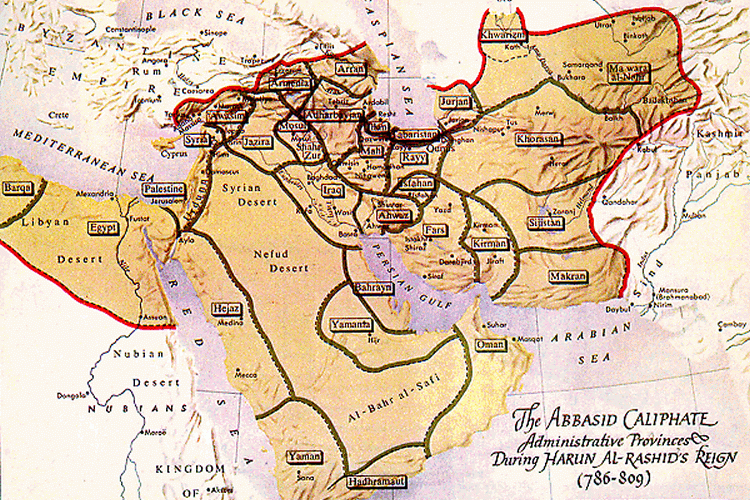
Back in the day, they blazed a zealous trail out of Mecca in an expansion dovetailing west as far as the the Atlantic coast of Al-Maghreb and east as far as the Pamirs. The distance covered on horseback, the lands subdued, within such a short spread of time, was nothing short of breathtaking. With sword in one hand and the book in the other, they bore down on every Berber and every Pathan and every hardy native in between.

These North African and Central Asian tribes, described by historians such as Polybius and Livy in their writings on Alexander, were hardly pushovers. But no ancient Roman or Greek could have seen the Bedouin Arabs coming. In rapid succession, a new rising overshadowed the cities of the Byzantine empire: of Damascus, Jerusalem, Alexandria, and other important staging posts of the Near East. They crushed the heirs of Constantine as if the citadel walls were not of Roman cement but of sand! The fearsome Armenian warriors they took to task. Persians, the Arabs subdued them as if their thousand-year empire had never existed. The Parthian heartlands folded more like paper than like the mountains that made them men of stone. Khwarizm, Khorasan, Transoxania all toppled like dominoes. Roderick’s Visigoths might as well have given up Spain as tribute before the fight. Hell, even the Nile itself seemed to narrow to let them cross on their way past the worthless Pyramids. Destination unknown, the desert warriors would take their jihad however far the sunset would take them. They would stop along the way only to make inroads in ancient Roman provinces like Cyrenaica and beyond to Mauretania where Islam would be consecrated for once and for all in Kairouan in modern day Tunisia.

Emboldened by faith and destiny, from there these simple desert folk swept over the Rif mountains of latter-day Algeria and Morocco, breezed across straits their man Tariq named along the way, coveted the fair lands they saw en route through Visigoth Spain, retraced Hannibal over the well-watered Pyrenees, then continued unaided all the way to the Frankish stronghold of Poitiers where they met the uncompromising figure of Charles Martel. If not for him and his Frankish army, all of Christendom would have become the greenest province of the Caliphate.

Those 7th century Hijazi Arabs – Meccans and Medinites – were a resourceful lot. Of that there is no doubt. Within a mere 50-odd years from the death of their prophet Muhammad in 632AD, the first caliphate of the Umayyad had broken free from the clutch of the desert to unleash like a fever. Like the Mongols and Conquistadors centuries later, the Arabs might have had divinity in the sky and horses on the ground to manifest their destiny, but they had not much else to go on. Rather, it was mastery of the world’s most inhospitable terrain – namely, the deserts of rock, sand and scrub – that made all the difference. No one, but no one, could solve a problem like aridity in the way they could. Few, if any, could make a living, far less mount complex military campaigns, in temperatures brazen enough to cook a man’s brain into delirium within hours.

From dwellers of the desert worshipping rocks and things, within a hundred years history elevates them to heights hitherto unrivalled in their world, arguably unseen since the beauty of Achaemenid Persia or classical Rome. From finding ways of keeping cool in summer temperatures topping 50°C to finding ways of being cool through fractal geometry in structures designed by man in the mind of God, a people from a harsh land came a long way in a short period by taking the resourcefulness of desert living all the way to its physical and metaphysical end.

The golden age was in the reign of the Abbasid. Libraries that today adorn the present seats of civilisation – of London, Paris and New York – are reminders that once there was Baghdad and its House of Wisdom. In that house much thinking was done. Much that had been lost was found. If in that epoch Europe’s was an age of darkness, Al-Kindi and his housemates of wisdom resurrected classical Greek teaching, fusing it with their own in an age of light.

Where the rough and ready nomadism of the Bedouin Arabs had laid foundations, the more urban and urbane descendants of the Muslim expansion could turn their hands and minds to a new and golden age. That age required an intellectual climate that was temperate. Ironic when you imagine that to arrive at this cultural zenith – epitomized by the first universities in Cairo, Fez and Cordoba – one has to start the historical and geographical odyssey in a climate which was anything but temperate with tribes that were anything but learned: in the empty, blistering desert with the camel-driving Bedouin.

What the desert giveth the desert taketh away. To survive it takes more than faith. It requires supreme resourcefulness, and complete independence from the outside world.

Today, the Arab world is a paradox of helplessness and enormous resilience; of dazzling wealth and yawning poverty; of incredible stability and disintegration; of building the world’s tallest buildings but not having a clue how to do it. They were, only two generations ago, a wholly different animal, lacking even infant schools and field hospitals, eking out a living in the most inhospitable places, cultivating vegetables and palms on soils that received less than a few millimeters of rain per annum, mastering the flow of artesian water, getting by. Look at them now: hiring resourcefulness from outside, paying top dollar for expertise, getting others to find water for them, hiring an army of impoverished labour to pick up after them. Ambitions outweighing abilities, commissioning others to build them a world of comfort that they managed largely themselves for so long in their own modest ways. In short, using oil money to buy helplessness.

So is the discovery of an ocean of oil beneath their timeworn feet a blessing or a curse? With each petrodollar these Bedouins are taking the harsh out of living and themselves out of the desert which had made them uniquely adapted to conquer and consolidate half the known world fourteen hundred years ago. Unforeseen events in the coming century or two might give cause for a hard landing, even among those who appear most financially disposed right now to avoid it. But when a people go soft and lose the resourcefulness and simple innovation that kept them one step ahead of the desert and its punishing cycle of heat and hardship for so long, what insurance policy will shore them up and what investment banker will bail them out then?


A Paean to Nobody

Uncategorized

“Tolstoy?”

“Privyet, proto-comrade.”

“Got a minute?”

“For you, I’ve got two.”

“Indebted to you. Can you tell me, in that case, how to write a poem around a single, memorable, line from a Smiths song?”

“Come again, comrade?”

I am the sun and air, of nothing in particular.”

“What is that pretentious crap?”

“It’s an allusion to, like, the sun and the air being, like, nothing…in particular.”

“But they are something. In fact, they are everything, for without them you would not be here asking me these pointless questions.”

“It’s just that I’m emotionally repressed. I’ve got unresolved issues stemming from a one-time thing that didn’t quite go my way. I fell hard, right, and I want to say something dark and brooding about the way it left pustules of resentment all over my soul. You know? The anger should be directed at me, but I’m too narcissistic to do that to myself.”

“Your two minutes are up. Do-svidaniya.”

“Be like that. Who needs a dead writer to speak for their feelings, anyhoo?”

20 minutes later……

I am a volcano about to go dormant.

I am the sun and air of nothing in particular. I am prisoner in your niggardly arms, hostage to your nether beating pulse. 

You sap the life from me when it suits you and when it doesn’t you sap the lifeblood from me all the same. 

You are a ghost that doesn’t deserve my afterlife, a memory that bullied your way in. You whine through the ventricles of my heart, groan in the pit of my stomach. 

You are the moon and water, of nothing in particular, dead light and choking waves. 

Take that, Tolstoy, and lodge it where the sun don’t shine. In your cold Tsarist heart, for instance.