The Stuff of Life

Uncategorized

“Oh Tolstoy, where to look in this great world of ours?”

“Start by knowing what it is you seek.”

“I don’t know what it is I seek.”

“If you don’t know what you seek, how will you find it?”

“I don’t know.”

“Then stop bothering me.”


Just when it felt safe to go overboard on the Mastercard, a leviathan rises from the inky depths and takes you whole. Okay, we’re talking more juniper than Jonah, more green oasis than white whale. Nevertheless, a leviathan’s a leviathan. It’s bigger and smarter than your average bear.

Being devoured by mother nature is a death most noble. Shoppers take note, being swallowed by another kind of creature from the deep – the 14,000-space underground car park – might not be. To be spared an eternity of roaming formless under the roof of air-cooled consumerist paradise with your keys jangling does strike fear into the heart of those in our rank and file averse to retail.

Some claim the real leviathan of this day and age is the super-mall, but that’s cobblers. Hardly of biblical proportions for our new age Jonah to repent inside the belly of Victoria’s Secret only to be regurgitated three days later wearing stockings and a diaphanous bra. Malls might be built with a passing reference to the oasis in mind, but try as they might to be the last refuge of life, they don’t quite throb with the same pulse. Unlike the perennially resourceful oasis with its magical ecology, the resilience of the super-mall to creeping desertification and oil’s extinction remains in doubt. No, the thing that devours you in a place like this is the very same thing that holds out some hope amid the hopelessness of the dust and the dunes: the plants that survive. Nothing else comes close.

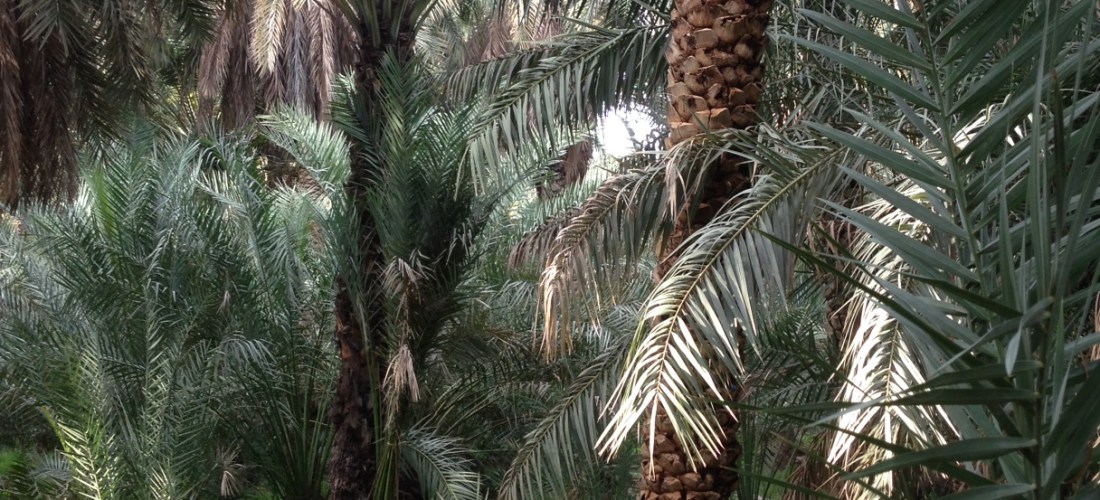
Oases loom in the Western mind for being frail as they are foolhardy, but one or two are much more than mere outposts consisting of a few raggedy palms beside a receding pool of water only a camel would drink. In fact, one in particular is a leviathan, come from the depths of the water table to commandeer an area of 3,000 acres. The super oasis of Al Ain is a climate-controlled paradise the likes of which Dubai Mall could only dream of. Functioning beautifully by means of an ancient system of irrigation veins, known in Arabic as Aflaj, this oasis has to be seen to be believed. The channels and water margins that run and run with artesian water through 5,000 years of Man ensure the prosperity is ongoing on two counts: by enriching the dozens of varieties of endemic flora with life-affirming water, as well as gifting the visitor with a labyrinth of paths that spread like loving fingers between those iconic trees.

Cut to the tree that keeps fruiting in soil good for nothing: the mall. In terms of variety, climate control, and insulation from these harsh and enveloping climes, the super-mall offers a good juxtaposition with the oasis. Providing tepid relief from scorching sands, from day one the mall seems the only option. One look inside and any old fool can feel the birth of a newish religion underway. A Gulf tourist destination par excellence, the mall is where multitudes forget there’s a world outside that is not overtly pretty. Whereas out there the climate screams F#&k You!, indoors it has no such free reign to wreak heatstroke havoc. The difference means that never have the wide open spaces felt so alone, so unwanted. As for the malls, demand is high. To describe them as an event, a day out at the beach, would not be far-fetched.

Having already integrated reef aquariums, ski slopes, ice rinks, waterfalls and rainforest recordings into the sensory experience, indoor dunes might be the next step. Verisimilitude is a powerful tool for retail industrialists. Turning the outside inside tricks the mind into oozing endorphins normally triggered by oneness with the great outdoors. Bringing in the sand will be cost-effective, too. It’s not as if there’s not enough to go round. Why enjoy nature for free when you can pay for it?

In contrast to the stripped-down nature of the surrounds, the investment cartels that bankroll £niverses have brought an entire rainforest of emporia under one roof. We’re talking a biodiversity, non-biodegradable hotspot. In a desert ecology where one needs to find the devil to find the detail, retail is diversity incarnate: Japanese aesthetics, German kraftsmanship, French panache, English tailoring, Swiss horologists, Fifth Avenue pizzazz. The old souq within the new souq adds a Arabesque centrepiece.

In the Dubai Mall, money spinning mother lode of revenue, New York vies with Paris. Three stories of Galeries Lafayette rise like Optimus Prime on the Westside while on the Eastside Bloomingdales retrofits itself into Megatron. This clash of titans creates such a sandstorm of public interest that it’s hard for the much-maligned desert ecology to get a look in. The best the dunes can do, by comparison, is to let the buggies score them with aimless tread marks. But appearances can be deceiving, none moreso than the good old mirage, so elusive we had to raid another language to describe it. For eons it formed from shimmering lakes and slinking, buckling palms. These days the mirage in these oil sheikhdoms is the mall. The thirst-maddening quest for the real oasis, it turns out, is worth the wait.

If you look hard enough you’ll find it. From the Monaco-size principality that is the mall’s basement car park head south as the camel blows. Keep the great rust desert in the corner of your right eye. Don’t venture in now. At the Hotel Rub Al-Khali you can check in but you can’t check out.  Seven days hard travelling and you’re there in the cradle of civilisation from where Moses sailed his reed basket. The Al Ain oasis truly is a champagne supernova in the sand.


“To the eyes of the man of imagination, nature is imagination itself.”


Where The Streets Have No Name

Uncategorized

Drive down the E11 in Dubai and you will see a profusion of urban development as rabid and utterly transforming as anywhere. In the space of forty-four years – half a lifetime for the long-lived – this geographical dot in spacetime has gone from pearl fishing village, coveted by Bedouin rulers for its natural inlet, to a thinned-out Fritz Lang Metropolis without the b&w medium.

This city-state fancies itself as the next in a long line of challengers ready to take the mantle from the reigning champion, the desert. Up the buildings go, floor by floor, day by day. Legions of hired labour, almost exclusively from the sub-continent, toil and bubble for a relative pittance under seven months per annum of broiling sun. Here in the new Egypt their paymasters drive them hard. The law states that when the mercury tops 48 Celsius work comes to a standstill. To say they get to go home early would contradict the fact that they have no homes to go to. In neighbouring countries little regard for the lives of countless coolies means that 48 hovers and 49 never comes. These Indescribable conditions represent the work of progress: the majority serving the machine so the few may serve themselves.  This kafala nightmare has trapped many a poor Nepali migrant worker on the death march to work on various outdoor projects for World Cup 2022. For to realise ambition in such short time, home comforts need side-stepping.

Here in all fairness, 48 means 48 . Work has been known to stop. Nevertheless, 47 is hot enough. Try watching concrete dry on the 55th floor of some new, yet to be defined, development. It’s almost midday. Stand for a while under the late May sun. Now put on a hard hat and remain sun-soaked a bit longer. Now force an exterior fixture into position while men babble Bengali all around you. Finish a 12-hour shift without contracting heatstroke and you know you were designed to withstand a hard life.

The higher the floors go, the more desert reveals its vastness on the eastern horizon. It is an unremitting work the work of progress and none more so when man, the relentless pursuer of progress, has no option but to endeavour in the most hostile and most insuperable of natural environments. Mesopotamian man started it first of all with his Ziggurats. Then came the Egyptians with their pyramids and their Alexandrian Faro. The Greeks followed with their colossus and then architectural vanity stepped aside a notch to build perpendicular for a better hand up from the Almighty. We had the cathedrals of Lincoln, of St Paul’s, of Strasbourg and Vienna, all arisen with exquisite craftsmanship within a mid to late medieval period. And so the story goes, of man. Nothing, but nothing, could surpass New York when it rose from five boroughs no higher than the parabola of spit, to a Gotham of awesome proportions within a thirty-year period at the start of the 20th century. Most of these attempts to outgrow the sequoia tree have failed in their unstated mission to outlive that most celebrated of pines. New York still shines like a beacon, but even it was put to the test fifteen years ago when its two towering sentinels sank in less time than the Titanic. Unremitting is the work of man and his damned progress; unsentimental is the certainty of end that stops him in his tracks.

The city swells, the city protrudes. It even burrows down beneath the eons of sand to bedrock that last saw the light one-hundred million years ago. The young city is a self-actualizing personality looking to become. But it is not a self-regulating mechanism – unlike that of nature herself – free from tributes to the silent, omnipotent landlord. Meantime the roads grow fat and the main arteries clog, and the heart that beats sounds out a warning: that there is no real heart to it. The pulse is an echo of somewhere else, some place that hung on, like Paris or Tokyo or New York. These road names are no more significant than as coloured flags semaphoring the motorist to proceed from A to B to A. And proceed he will but ever slower on these clogged highways that lead nowhere but back to the desert that looks on ever patient for the comedown, for our demise and its re-rise.

We bite the hand that doesn’t feed. Wounded, the hand bites back. But not before the world looks on in awe at how all this nouveau architecture could emerge from what, forty years ago, was not much more than villages, date palm groves, one-man mosques, and wave after wave of rust-red sand abutting rocky mountains; a truly Martian landscape. Yet the physical transformation is far from complete. Until it shrinks it will grow; it’s that kind of place. Stagnation cannot live on a bed of shifting sands.

They say the taller they stand the harder they fall. It’s the spiral of the sky-piercing Burj Khalifa that will be time’s sole survivor, too tall to be ignored by the passage of time; too shard-like to be toppled and too Arabian to be attacked by the four seasons. Man will in time be brought down a peg or two. Not, though, his greatest of works. They will endure the geological age named in dishonour of us. Cushioned by pillows of sand sloping up to the fortieth floor, its 25th century fall will be a soft one. By then the foreigners won’t be around to witness it, though you can bet the autochthonous Bedouins, falcon in hand, will be. Children of the desert and its Qur’an, they were the ones who prophesied the end of the present. In spite of their avid embrace of hyper-consumerist ways, a few saw beyond the now to the transience of it all. Native contentment rested on the belief that the best was yet to come. Those nouveau riche of the oil kingdoms, who from nothing found themselves overflowing with imports beyond their grandparents’ wildest imaginations, might spend a lifetime taking the ebb of progress with the flow of sand but it will be worth all the threats from the encroaching desert when their long voyage on the ocean of oily sand leads straight to eternity’s shores on paradise island. The rest of us meanwhile, will have to settle for the plane home.