Supervolcanic Blackhole

Uncategorized

What in the world is going on in this world? While it spins around without much sign of slowing down, the little self-appointed beings it spawned from a soup of mitochondrial DNA in some primordial rock pool gear up for the end of days in a dizzying headf**k of joyless Jihadism, treeless technoscape and future uncertain.

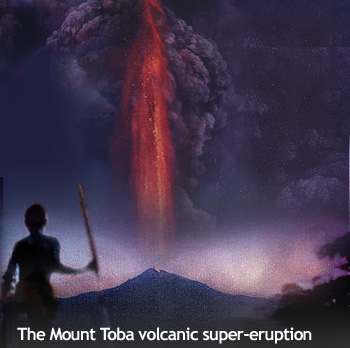
How did we come to be in the state we are in today? They say that when the Lake Toba supervolcano erupted on the island of Sumatra 76,000 years ago, our numbers crashed to a mere handful. Those few good men and women, hardy hunter-gatherers in tribes unswayed by a little thing called disaster, survived a die back under epic skies choked with a change in chemistry. So how did we go from a few thousand living under the ward rules of Matron Nature – she of the curfew who ordered ‘Lights off ’ by 7pm – to fourteen billion feet and galloping? To use the parlance of the new age: W.T.F.?

It’s all down to the night lights. You cannot go practically overnight from tallow candles and oil lamps that barely bite into the darkness to an interconnected grid that delivers so much generated light to so many planetary places that the earth is inviting an invasion of the body snatchers. We are sleepless in everywhere but Seattle. Hello, universe? Can you see me now?

The lights are on, alright, but nobody upon nobody is home. Well, actually, there are so many of us home we’re positively busting down the door. In those hearts that self-combust in a mass suicide pyre, that’s where we are. It’s the absence of mind that is cause for concern. Social and political psychiatrists prepare to deploy….

Brussels bombed under the watchful nose of the EU/UN/NATO and any other shady acronym you can fit together. Does this bring new gag fodder to a generation of comedians hungry for explosive material? Three men walk into an airport…. Boom, boom. The time bomb is ticking until another atrocity is committed by young radicals seeking redemption, but not the kind that either Jesus or Bob Marley advocated. Dressed for dystopia like the Village People in the their figure-hugging vests, when it goes off – and you’ll know about it when it does – their redemption will send shock waves through the immediate vicinity. When the pieces are gathered up for a religious burial, the flesh&bone collectors will know at least they’ve been honest in their cause, for those martyrs will be wearing their hearts quite literally on their sleeves. Not that their sleeves will be attached at the elbow.

Why did the Toba supervolcano leave a few of us as a human seed bank? It’s all wrong. Since when did martyrs feel the need to make martyrs of those standing next to them when they never even stopped first to introduce themselves? And to call them nihilists. At least if they believed in nothing, as true nihilists do, they wouldn’t bother getting out of bed to take up arms and bomb belts in the cause of making a good impression on God (like He hasn’t enough sorting to do as it is).

A black man about to leave a White House who has done more to decorate the walls wise than any other since the president in the wheelchair who taught the world to get on its feet again. Oh, yes, that White House, HQ of our last, best hope. Its Oval Office draws all manner of term-appointed residents, from the sublime to the ridiculous. Any schmuck with money  can run for the Oval Office but it takes a special kind of schmuck to throw his hat into the Republican Party ring, thus leaving the hair on his head quite as ridiculous as the man himself. With Obama exiting stage left, the next to enter stage right might be a different kind of player, specifically the type that would mate with his offspring if only she wasn’t so inconveniently chipped off the old block. Then again, America can’t have lost the plot to the extent of letting in a juggler-cum-clown with incest in his balls, surely?

Brexit, schmexit. Dominoes topple, Brexit onto Frexit, Frexit onto Tragix. Rome sacked by itself. When finally we Europeans, for the most part, are getting along like a tribe on fire, we toy with the idea of tearing apart the family. And why? Because, Daddy EU Commissioner, you’re cramping my style. We’re through. I need to find myself, my lost identity. Deep down I’ve always hated you. With you bearing down my neck I’ll never achieve the…self-actualization…I so deserve. I’ll expect a favourable settlement, of course. Forget Tolstoy. He can’t help you now. It’s Freud’s narcissism of minor differences we need turn to, all over again. That’s what’s fuelling it. Narcissism, and history’s habit of repeating on itself. 476AD, 1618AD, 1914AD, 2016AD, 1812 Overture. Those among us who don’t think a well-timed terrorist atrocity won’t be the tail that wags the dog in the referendum stakes. Lest we forget, lest we forget.

History repeating itself first as tragedy, second as farce. It really is. If it wasn’t so farcical it would be tragic. Humanity busy making mountains of PVC garbage out of molehills of common sense, common sense that reads: you cannot keep trashing the house and still expect the landlord to renew your lease. Baby green turtles garrotted by a plastic ring from a six-pack tossed away in Botany Bay, washed up in Valparaiso, Chile. 100,000,000 sea creatures killed by plastic and chemical effluent each year. Primary forest culled to make way for palm oil to make the food that makes industry penny-wise and fat consumers pound foolish.

There’s one born every minute, but is this the best moment in history to be living? You cannot be looking up at the stars in the galactic medium when half the world is nose down in Samsung’s Galaxy at the stars of the social medium. We’re looking at someone else looking at someone else looking at someone else; mocking, pitying, ridiculing them, never a kind word spoken in jest. There are more filmmakers than there are films worth filming. There is real loving to be had but it’s always the guy next door who’s the one getting it. At least the Band plays on with Bob Dylan doing the freewheelin’. There has to be some redemption in that, still none that our Jihadi Joes would ever appreciate.

What in the world is going on in a world going off? And what would our proto-parents, who survived the Toba supervolcano of 76,000BC, make of it?


A Time to Plant

Uncategorized

There’s not much pollen rattling the air out there. Not even heat convection can excite the molecules. The ear strains to hear the drumbeat of hooves clomp in a rising crescendo. While not an avid race goer, I’m sure it’s not like this when geldings go galloping on English turf.

A plume of the finest sand kicked up by the softest, broadest pads of all two-toed animals envelops the herd in a dust bubble. Little else competes with their approach other than the owner relaying orders to the jockey from the comfort of an all-terrain vehicle crawling alongside the track on a highway laid specially for the moving spectator.

Tall, lean dromedaries lope along on sand in teams of six. On legs taller than a man, their stride is almost exaggerated. Wearing fawn and cavalry blue Shalwar Kameez, the trainers mounted front and rear look Pakistani. Or possibly Afghani, continuing a proud tradition that began with the Afghani camel drivers who were brought to Australia in the 19th century to penetrate deep into the Outback. Nimble little stalwarts riding bareback, these trainers crouch in the brace position on the hind slope of the animal’s hump. Any more bumping and grinding and they will slip down its steep gradient and onto a painful dumping on the coccyx. Yet, few if any do.

Seeing that today’s camel jockey is a race day robot, these trainers fall short of being silicon enough to see action on the furlongs. He’s on it most of the week, because through his nurturing abilities the trainer avoids obsolescence. There to groom the dashing dromedary in a pampering exercise regime, his loving care shows in the health and well-being of this most venerated of beasts.

Camels are coated in colourful blankets with bundles for humps, great long legs made for striding and necks bowed for pipping other necks to the post. If the age of oil and the fame of the sheikhdom cities that flowed from the wells had not already put the rest of the world conveniently in the iconic frame of the Bedouin in his white robes sailing his ship of the desert, anyone would be forgiven for thinking that what they were witnessing on that track was a George Lucas re-imagining of a horse race. Weird, prehensile lips flapping at the end of impossibly outstretched necks in this all-encompassing sandscape that glares more powerfully than any bank of studio lights ever could, Lucas’ planet Tatooine was obviously a borrowed creation. A crushing reality check for anyone who remembers being a kid in 1977 when Star Wars first hit the screens.

To suck the marrow out of life first you need to splinter a few bones. If that means extending the love and attention that organic compounds have long denied the desert, then so be it. They say nothing good can come from nothing, that no good thing can grow in a desert. But they didn’t reckon for creations that don’t need a steady supply of rainwater: like memories, experience and the trickery of light on red satin snow as the sun makes its descent. There’s shrubbery in planting on these margins of life. While not a religious man, I am a devout worshipper of 60’s psychedelic rock. Here’s the book of Ecclesiastes doing The Byrds, Turn, Turn, Turn:

To every thing there is a season, and a time to every purpose under the heaven:

A time to be born, and a time to die; a time to plant, and a time to pluck up that which is planted.

The spectre of winter can fall on places never touched by frost. This lull in the long summer gives pause to plant. In the desert of our day-to-day we plant for a tomorrow when we may uproot, the day when finally we emerge from the sea of sand with what gift of experience the Bedouin in their majlis send us away with. From dust we come, into dust we shall return. But not before we glow a little, out there in the dancing dust and singing sands where natives come for the day to relearn the custom of being at ease with their former selves in the company of the animals to whom they owe their everything; where incomers visit just to feel alive.

Sitting in a majli twirling ceremonial sticks, or standing in line in a dance ritual launching antique rifles into the air, then crouching back down on their haunches to rest against cushions and look on motionless and indifferent at the comings and goings of others, not their own, those Bedouin eyes fix watchful over their true love, the only thing capable of upstaging them in their domain: Jamal (camel to you and me).

There has to be a reason for these chance encounters. We’ll glance back over the shoulders of time one day and there he’ll be, resplendent in rags.

Tolstoy?

we’ll entreat him.

What did it mean to be there all that time ago? Why this boy of all people?

And he’ll answer, dressed head to toe in his scruffy greatcoat, worldly belongings stuffed into a haversack that makes him camel in all but name. He’ll answer:

Where was this? Who was there?’

It was a desert, and it was me. I was there. I was there.

And he’ll say, Then that’s what it meant. There’s your answer.

And we’ll entreat him again.

Why me? Me of all people?

And he’ll consider the question, but this time answer with less patience.

Why not you? Did you think you were the only one not meant to be in places you never thought you’d be? Does a tree have a choice in where it puts down roots? No! Only if and when.

So Tolstoy, did it mean something in the long run? To have been there?

If it didn’t you wouldn’t be asking me this question years later. Now leave me be. It’s a long way back on foot to the village from here and I have beet seeds to plant before it’s too late.


The Stuff of Life

Uncategorized

“Oh Tolstoy, where to look in this great world of ours?”

“Start by knowing what it is you seek.”

“I don’t know what it is I seek.”

“If you don’t know what you seek, how will you find it?”

“I don’t know.”

“Then stop bothering me.”


Just when it felt safe to go overboard on the Mastercard, a leviathan rises from the inky depths and takes you whole. Okay, we’re talking more juniper than Jonah, more green oasis than white whale. Nevertheless, a leviathan’s a leviathan. It’s bigger and smarter than your average bear.

Being devoured by mother nature is a death most noble. Shoppers take note, being swallowed by another kind of creature from the deep – the 14,000-space underground car park – might not be. To be spared an eternity of roaming formless under the roof of air-cooled consumerist paradise with your keys jangling does strike fear into the heart of those in our rank and file averse to retail.

Some claim the real leviathan of this day and age is the super-mall, but that’s cobblers. Hardly of biblical proportions for our new age Jonah to repent inside the belly of Victoria’s Secret only to be regurgitated three days later wearing stockings and a diaphanous bra. Malls might be built with a passing reference to the oasis in mind, but try as they might to be the last refuge of life, they don’t quite throb with the same pulse. Unlike the perennially resourceful oasis with its magical ecology, the resilience of the super-mall to creeping desertification and oil’s extinction remains in doubt. No, the thing that devours you in a place like this is the very same thing that holds out some hope amid the hopelessness of the dust and the dunes: the plants that survive. Nothing else comes close.

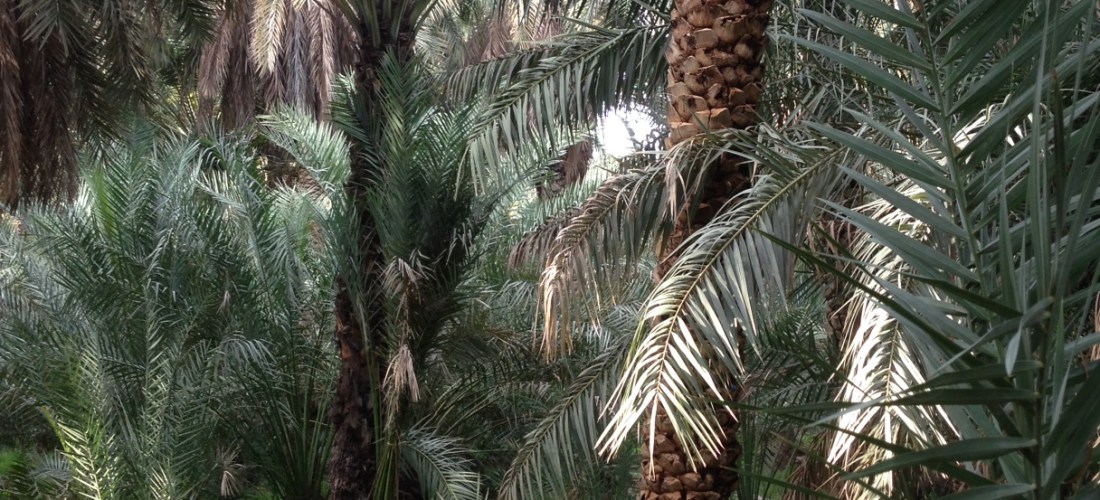
Oases loom in the Western mind for being frail as they are foolhardy, but one or two are much more than mere outposts consisting of a few raggedy palms beside a receding pool of water only a camel would drink. In fact, one in particular is a leviathan, come from the depths of the water table to commandeer an area of 3,000 acres. The super oasis of Al Ain is a climate-controlled paradise the likes of which Dubai Mall could only dream of. Functioning beautifully by means of an ancient system of irrigation veins, known in Arabic as Aflaj, this oasis has to be seen to be believed. The channels and water margins that run and run with artesian water through 5,000 years of Man ensure the prosperity is ongoing on two counts: by enriching the dozens of varieties of endemic flora with life-affirming water, as well as gifting the visitor with a labyrinth of paths that spread like loving fingers between those iconic trees.

Cut to the tree that keeps fruiting in soil good for nothing: the mall. In terms of variety, climate control, and insulation from these harsh and enveloping climes, the super-mall offers a good juxtaposition with the oasis. Providing tepid relief from scorching sands, from day one the mall seems the only option. One look inside and any old fool can feel the birth of a newish religion underway. A Gulf tourist destination par excellence, the mall is where multitudes forget there’s a world outside that is not overtly pretty. Whereas out there the climate screams F#&k You!, indoors it has no such free reign to wreak heatstroke havoc. The difference means that never have the wide open spaces felt so alone, so unwanted. As for the malls, demand is high. To describe them as an event, a day out at the beach, would not be far-fetched.

Having already integrated reef aquariums, ski slopes, ice rinks, waterfalls and rainforest recordings into the sensory experience, indoor dunes might be the next step. Verisimilitude is a powerful tool for retail industrialists. Turning the outside inside tricks the mind into oozing endorphins normally triggered by oneness with the great outdoors. Bringing in the sand will be cost-effective, too. It’s not as if there’s not enough to go round. Why enjoy nature for free when you can pay for it?

In contrast to the stripped-down nature of the surrounds, the investment cartels that bankroll £niverses have brought an entire rainforest of emporia under one roof. We’re talking a biodiversity, non-biodegradable hotspot. In a desert ecology where one needs to find the devil to find the detail, retail is diversity incarnate: Japanese aesthetics, German kraftsmanship, French panache, English tailoring, Swiss horologists, Fifth Avenue pizzazz. The old souq within the new souq adds a Arabesque centrepiece.

In the Dubai Mall, money spinning mother lode of revenue, New York vies with Paris. Three stories of Galeries Lafayette rise like Optimus Prime on the Westside while on the Eastside Bloomingdales retrofits itself into Megatron. This clash of titans creates such a sandstorm of public interest that it’s hard for the much-maligned desert ecology to get a look in. The best the dunes can do, by comparison, is to let the buggies score them with aimless tread marks. But appearances can be deceiving, none moreso than the good old mirage, so elusive we had to raid another language to describe it. For eons it formed from shimmering lakes and slinking, buckling palms. These days the mirage in these oil sheikhdoms is the mall. The thirst-maddening quest for the real oasis, it turns out, is worth the wait.

If you look hard enough you’ll find it. From the Monaco-size principality that is the mall’s basement car park head south as the camel blows. Keep the great rust desert in the corner of your right eye. Don’t venture in now. At the Hotel Rub Al-Khali you can check in but you can’t check out.  Seven days hard travelling and you’re there in the cradle of civilisation from where Moses sailed his reed basket. The Al Ain oasis truly is a champagne supernova in the sand.


“To the eyes of the man of imagination, nature is imagination itself.”