
La Terre Est Bleue Comme Une Orange

Uncategorized

What note should we start playing to get this riff going? A few major milestones have been reached this week, both personal and impersonal. We’ll start on a personal note then.

It’s funny how nature wastes nothing, even in the recurrence of words both delivered and received in the course of our lives. A case in point, five years ago – years that feel to this writer like they belong to another dimension of reality – a quite splendiferous woman loomed over my recumbent frame, held out her clasped fingers and, in a theatrical rendition every inch Hamlet holding Yorick’s skull, said La Terre est Bleue Comme une Orange. She then repeated it with added French verve, La terrrre (actus dramaticus – herein she made the letter ‘r’ in terre sound sexily gutteral) est bleue (for this word, her lips were pursed to bursting) comme une orange. Et voilà!

If the phrase weren’t so nonsensical it would be irresistible. Coined originally by the formative surrealist, Paul Eluard, the sentence translated as The earth is blue like an orange. A phrase still etched into the cultural subconscious decades later, it became a motif for the surrealist movement. And I mention this because I picked up a Guardian article this week on surrealism and lo and behold there it was printed plain as day. La Terre est Bleue Comme une Orange. And at moment those memories of that girl whose natural self-effacement and feelings of not ‘être a la hauteur’ – being ‘good enough’, in other words – derailed her dreams of the stage, were brought back to me in a flood of blues and oranges. As she, like Eluard’s blue planet of citric fruit, never really disappeared from consciousness, I thought of the untimeliness of recurrence. It all comes back, but where and when who can tell. The waking dream that is life, now there’s the essence of the earth blue as an orange. What better way to make real what is surreal?

In other news, Paris is drowning. As the mighty Seine creeps higher and higher, even the doors of the Louvre have been sealed and the priceless artefacts contained therein boxed and evacuated. When the Luftwaffe reigned the skies back in the summer of 1940, the British Government did likewise by stuffing the Royal family into crates cushioned by scrunched newspaper, ready to ship them out to the Canadian Arctic where they could chill a while until Churchill had downed enough of their VSOP brandy to come good on his oratory.

The central European whirlpool of rain has been biblical. Cars bobbing on a rushing torrent of brown, churning water like they were rubber duckies. Although Europe has been on the receiving end throughout recorded history – think the rains that turned the 100 years war between England and France into a mud-bloodbath – there’s something disquieting about the extreme force with which mother nature is throwing atmospheric phenomena at us. Newton’s Third Law is exaggerated with these rains. For every man-made action there is an unequal and disproportionate reaction on the part of nature. The more we push her, the harder she’ll push back. Environmental provocateurs beware.

Speaking of counterbalancing forces, the holy month of Ramadan falls this year on the eventide of the 6th or 7th June, depending on the appearance of the moon. From the elliptical sighting of the new moon early next week, that being the start of the ninth month of the Hijara calendar, to the elliptical closing a month later, the overwhelming majority of Muslims will let nothing, other than words, pass their lips between suhoor (sunup, about 4am) to iftar (sundown, about 7pm). Wherein most of the Islamic world exists between the horse latitudes of twenty to thirty degrees north of the equator where deserts proliferate, the 40-45 Celsius heat at this time of the year by any reckoning makes 13 hours of abstinence a feat worthy of respect. That is, until you factor in the little problem that in the present reign of King petrodollar the benefactors no longer live a life which involves stepping outside for all but the briefest of moments.

In the oil-rich region known in Arabic as Khaleej (the Gulf), the economics of affluence and the concomitant greed that ensues throws dim light on the whole notion of self-sacrificing acts of the magnitude of Ramadan. Admittedly it’s only a small corner of an Ummah (Muslim community) extending from Java to Morocco, yet the Gulf, by virtue of no longer being a humble place, is a destabilizing influence in terms of the authenticity of these religious acts of poverty and humility. 

Unlike the rest of the Ummah, dispersed as it is throughout lands described at best as developing, at worst as failing, the native population of the mega-wealthy Gulf has gotten so used to being served hand over fist since the fruiting of oil in the 1980s that to perceive many of them serving anything but themselves is a tricky proposition. So accustomed to having others do their cleaning up after them, even if Ramadan remains an important force to moderate human excess, you wonder if during the month of remembering the plight of the poor, self-purification for some might be a bridge too far. The cloak of obligation suddenly feels a whole lot heavier. 

Not to exaggerate the point, Saudis themselves testified to these very ears that they cram more into their beaks every night of Ramadan than any other time of the year. They actually put weight on in a time of fasting, if you can see the paradox in that.

Enjoying excessive spending power has an endgame, which is crass consumerism for consumerism’s sake. Adopting the de facto title of ‘home of the mega mall’ belies a deeper irony come the month of Ramadan. Floating free in a bubble of wealth, confusing lucky oil money with rights of entitlement, is inimical to the earthiness of Ramadan, and the moral hypocrisy that flows from the disjuncture is not lost on some. For they know that to make any sacrifice that requires extreme self-denial you’ve got to to feel it in your bones, and passionately. Doing it as a necessary duty, because not to would land you outside the community bounds of acceptance, isn’t enough. Remembering the plight of the hungered is a memory that is bound to fade the more complacent a people become through having affluence which can only be described as surreal.

For all the sense it makes, the earth might as well be blue like an orange.

Marching to Stand Still

Uncategorized

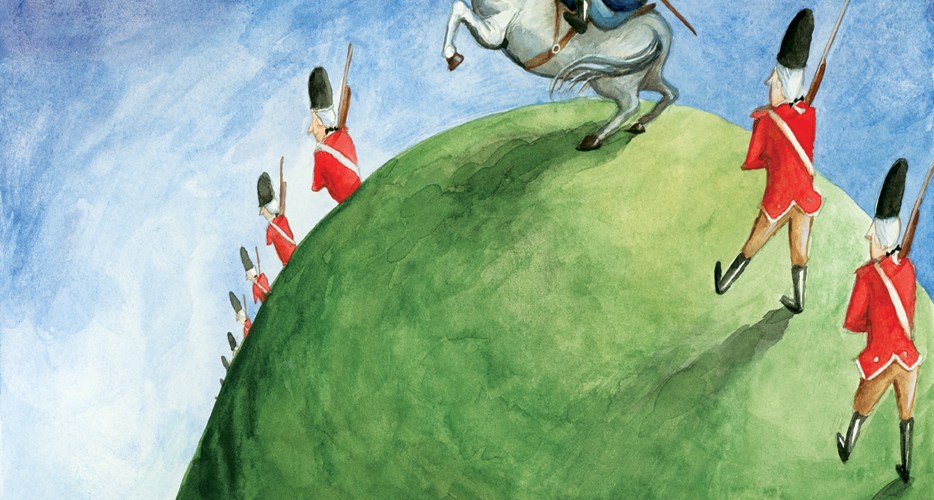
We know something about the unconscious symbols at play in nursery rhymes. We’ve probably had an inkling since we were children that there was something dark and deeply troubling about them, even back then. Have you ever had the impression that nursery rhymes were written by adults for adults? The masque of innocence uncovered, the face of the grown-up beneath is etched in toil and trouble, revealing the awful and inescapable reality that we adults have had to live inside our minds for much longer than the children who chant these rhymes with such abandon. Minds collect bric-a-brac. They grow top-heavy with the accretion of let downs, compromises and all the hangups that give our maturing minds their characteristic chemistry. Whether we occupy them or they us, our minds one way or another need taming. Like redcoats, they need a good dose of disciplining. That, though, is easier said than done.

Speaking of redcoats and nursery rhymes, let’s take the Grand Old Duke of York, as an exemplar. As every child knows, he had ten thousand men. He marched them up to the top of the hill, and he marched them down again, and when they were up they were up and when they were down they were down, and when they were only half way up they were neither up nor down.

If that’s not a metaphor for the psyche, I don’t know what is. If marching foot soldiers uphill and downhill isn’t mood swings at their mildest or bipolarity at its most severe then I’ll be a cock-a-doodle do. Yet, it’s the bit in the middle where the rearguard bump into the vanguard and all ten thousand of them end up neither here nor there, that’s the part most psychologically revealing. For what is that if not a euphemism for ennui? What other language but French could coin a word for every turning of the emotional screw? Ennui: the condition which has a stranglehold on all ages but none more so than these queer middle years.

Neither up nor down – feeling nothing but listlessness and that persistent feeling that even though life is there for the living, we bumbling redcoats are not bearing up to the living part as briskly as we are to the existence part, a part, which by the way is incidental to living, as the heart beats whether we are truly living or not.

I remember Kevin Spacey’s character, Lester Burnham, in American Beauty. A lame-o whose highlight of the day was jerking off in the shower; who has lost something, although he cannot quite trace where the tributaries of that loss come from; a man – crucially – who didn’t always feel this sedated.

Tapping on the door of forty-four. Tis a funny age to call an age. At the juncture we’re squeezed between competing me-s: the rational me, the aspirational economic man; the irrational me, the passionate man. Those mental mudslingers wage a titanic shitfest struggle in the dual mind of me-me (the organism who is trying to make sense and meaning of it all) to claim the undisputed crown of quintessence, quintessence being the fifth element, the alchemy of true living. Was the choice to incubate the living part of life for X years to chase the $$$liquidity$$$ that seduces one into thinking that ‘you can do anything, go anywhere with money in the pocket and in the bank’ worth it? Hardly surprising given the ramped up role that monetarism plays in the lives of the average you and me. Better to be a rich man in a poor environment? Or a poor man in an enriched environment? No brainer – tis better to be a man of adequate means who is enriched by his environment.

How to assuage the nagging doubt that profound life choices we deem at some point along life’s journey to be far-reaching are actually really blinkered. Or that life choices that satisfy immediate needs are really the most visionary of all? To thine own self be true. That truism is as discerning in the New age as it was in the Elizabethan. Yet, when are we supposed to begin to do that, to be true unto ourselves, to wear the cap that fits? At what point do we know that we are really marching (whether up or down is irrelevant) rather than – like the Grand Old Duke’s Men – standing still?
 

The Kindness of Strangers

Uncategorized

Life’s quirky that way. What begins as calamitous in the making can end on a high. Not to put too fine a point on it, when misfortune starts befalling, serendipity has a reassuring habit of calling. And all this in a landscape so otherworldly you couldn’t make it up.

There we were, minding our own business, motoring up a 35km stretch of mountain road to a place of legend in central Oman. The car, with a reputation for inspiring confidence, had in these trying circumstances lost its bottle. Struggling to haul its five tonne ass up 2,000 metres from pillar to post, its passengers could feel its hurt. Relentless as alpinists pushing their weary porters on, we tried ignoring the signs. Over the apex, within sighting distance of our destination, the oil temperature drops and we quietly celebrate the triumph of the machine over the trials of nature. And then, as if taunting us all along, the VW goes clunk, clunk, clunk from the near-side wheel and judders to a standstill.

No amount of willing the thing to rouse itself does the trick. Like a feisty filly at the race stalls, she refuses to go on.

The air temperature gauge has decreased from 115 degrees Fahrenheit at sea level to a tolerable 82 Fahrenheit at 2,000 metres, small consolation in an otherwise disastrous showing.

The myth of German invincibility shattered, yours truly lets go a despondent cry followed by a petulant thump on the wheel. Oh God of Wolfsburg! How can you repay us for the faith we have instilled so unfailingly in you?

And then, like a handmaiden riding in from the wings in a stage production of Wagner’s Ring Cycle, our Omani Valkyrie in his starch-white dishdasha turns up to save our sorry souls.

Introducing himself as Thani, as if that’s not a name straight out of the mythological past, he smiles benignly and offers a gentleman’s hand. Wearing his custom-built headgear tipped forward (for the benefit of the blind reader, a kind of white embroidered fez minus the tassles), his nose is, all four inches of it, Semitic (or maybe Gallic), and his facial features not unpleasant. He refers to each of us as brother, even though one of us is categorically female. In the time it takes to make a quick phone call then whoosh his wand (Oman’s puritan neighbours in the Gulf always did accuse this fiercely independent nation of conjuring the djinns with their malevolent scorcery), the fate of the car – and more importantly of us – is sealed. It will live to see another day, and we burned-out pilgrims will live to savour this very day. But not as we had imagined.

It’s action stations, but not in the way a Westerner with neurotic tendencies might think. Defcon-4 this is not. That said, this guy is a natural when it comes to handling human and mechanical breakdowns. Whisked into town to raise a posse to return to the mountain top (well, actually, two Indian mechanics – one known affectionately as the Professor, personal friends of Thani), we’re back within minutes to patch the car up and take it back to the workshop for a bit of loving restoration. As a show of trust, Thani drives our car, and we follow in his. Halfway into town his arm extends out the driver’s window and a thumb is raised. This, we take, as an auspicious sign.

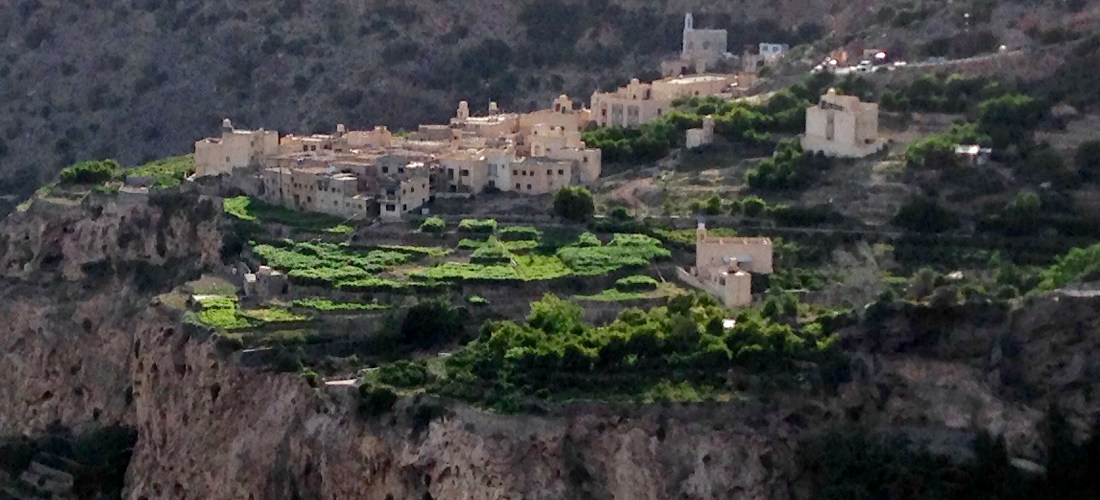
As places to break down go, Jebel Al Akhthar is both a blessing and a curse. A plateau of hanging gardens, elevation a God-merciful 2035 metres above broiling sea level, the green mountain (akhthar means ‘green’ in Arabic, and Jebel ‘mountain’) is a veritable Babylon to the insufferable and breathtaking heat of old Arabia surrounding it. Not only that, the green mountain is a heaven sent 27 Celsius. By the providence of geology, this high plateau (the Sayq in case you’re interested) of climate temperance rises above the basement levels of hell where nothing other than date palm and acacia can handle temperatures that top 50 degrees in June. In fact, its altitude-assisted climate is so perennially perfect that fruits more at home in the Mediterranean grow fat and juicy in midsummer. They’ve got pomegranate. They’ve got peach, fig, apricot and grape. They’ve got life in relative abundance, and not many places in the region can make that claim without complex agronomy, such as irrigation from desalination plants.

So you climb and climb and watch in sheer relief the car’s altimeter go up and up and its thermometer correspondingly go down and down. This all makes mechanical mischief a fact of life one could get used to, at a push. One can think of few other places in the vastness of Arabia where breaking down means not merely surviving but prospering, too, from the experience (other than the repair bill).

That evening, now rested and attuned to the peaceful vibe of the hilltop hotel, we are invited to join Thani at his house in a hamlet we can see from the hotel is a white limpet stuck fast to the rock of the canyon far below. As sundown painted the land around in pale pastels while the valley floor far, far in the distance still burned like a ember, a diaphanous shroud of white cloud brought the temperature down further still.

He came for us in his jeep, such was the host he was and the host I would hope one day to become. Before retiring to a majli (like a drawing room in an old Victorian house) in the presence of his brother and adorable daughters – but notably not his wife – to eat dates and dahl and sip Arabic coffee and tea, he led us down to the wadi where only a month previous the waters had been cascading down from the mesetas, taking every loose thing in their unstoppable path. This is how things work here. The rains make infrequent visits to this parched and scoured corner of Asia, but when they do, they come with a force and a magnanimity matched only by that of the locals toward us, the outsiders, who are as thirsty, helpless and in need as the land itself.