One Born Every Minute

abandonment, animals, Cities, conservation, cruelty, developing world, dogs, neglect, sadness, stray dogs, street dogs, streetlife, third world, Uncategorized

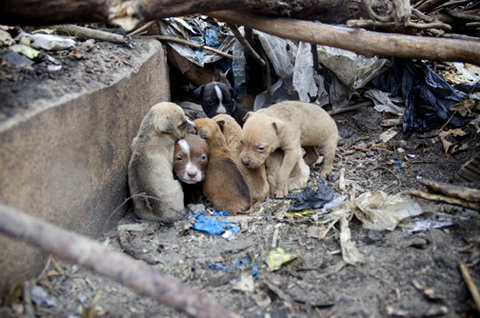
Somewhere, everywhere, in the world, there’s one born every minute. Camouflaged amid rubbish heaps, squeezed under abandoned vehicles or lodged deep inside sewerage pipes – just about any place they can watch our movements without being judged too harshly – they come into this world a bundle of playful joy. To survive a few seasons, each is tasked with dodging the cars, the emaciation, the heart worm, the wardens, or if unlucky enough to be born in SE Asia, the meat traders. Paw pads worn down on the wheel of misery, the average life can be considered so hard as to be endurable for a paltry half the span of their cosseted, houseproud cousins. Set within this Hobbesian world of short-livedness, nastiness and urban decay, the epithet of man’s best friend to them does not apply.

Welcome to the world of canine caste. If coiffed Afghan hounds are the Brahman caste then these scruffy mutts roaming trash-can alley are the untouchables, drowned by weight of numbers, dealt a duff hand by the karma croupier. They might live on the fringes, but stray dogs have since moved into centre stage in the sprawling un-developments of the developing world. The homeless canine population grows unchecked, for the most part. Some estimates put their numbers at upwards of half a billion. Even the thousands of Africans and Asians who die from rabid bites each year, by comparison, won’t put a dent in human population.  Like the mange that ravages their pelt, stray dogs won’t start to disappear any time soon, unless we set the trend first. Ranging from Manila to Mandalay, Lima to Lusaka, Riyadh to Rawalpindi, Bali to Bucharest, few places remain untouched by their grim determination to hang on. Fourth place in the Third World, these urban shadow puppets salvage the human wreckage. What feels worthless to us is treasure to them. These lowborn dogs suffer a form of warped dependency on what the world’s poorer quarters have to offer: in rubble and fetid foodstuff, chicken bones and dried sanitary towels; scarred, plastic-strewn urban wastelands where production of waste exceeds the national capability to capture and process it.

Another plump little alley pup was born from the skin and bones of its street mama the other week. At first it hesitated at the mouth of the sewer pipe, then coaxed by its junky single parent, emerged into the dusk. The newest addition to those born every minute had no inkling of what it was getting into: its pariah status; the incipient heat; the parched land and not forgetting the dust devils mocking them for taking a wrong turn on their long trek from wild wolves, proud and independent, to failed domesticity. Aye, it’s tough at the top of the heap.

Where The Streets Have No Name

Uncategorized

Drive down the E11 in Dubai and you will see a profusion of urban development as rabid and utterly transforming as anywhere. In the space of forty-four years – half a lifetime for the long-lived – this geographical dot in spacetime has gone from pearl fishing village, coveted by Bedouin rulers for its natural inlet, to a thinned-out Fritz Lang Metropolis without the b&w medium.

This city-state fancies itself as the next in a long line of challengers ready to take the mantle from the reigning champion, the desert. Up the buildings go, floor by floor, day by day. Legions of hired labour, almost exclusively from the sub-continent, toil and bubble for a relative pittance under seven months per annum of broiling sun. Here in the new Egypt their paymasters drive them hard. The law states that when the mercury tops 48 Celsius work comes to a standstill. To say they get to go home early would contradict the fact that they have no homes to go to. In neighbouring countries little regard for the lives of countless coolies means that 48 hovers and 49 never comes. These Indescribable conditions represent the work of progress: the majority serving the machine so the few may serve themselves.  This kafala nightmare has trapped many a poor Nepali migrant worker on the death march to work on various outdoor projects for World Cup 2022. For to realise ambition in such short time, home comforts need side-stepping.

Here in all fairness, 48 means 48 . Work has been known to stop. Nevertheless, 47 is hot enough. Try watching concrete dry on the 55th floor of some new, yet to be defined, development. It’s almost midday. Stand for a while under the late May sun. Now put on a hard hat and remain sun-soaked a bit longer. Now force an exterior fixture into position while men babble Bengali all around you. Finish a 12-hour shift without contracting heatstroke and you know you were designed to withstand a hard life.

The higher the floors go, the more desert reveals its vastness on the eastern horizon. It is an unremitting work the work of progress and none more so when man, the relentless pursuer of progress, has no option but to endeavour in the most hostile and most insuperable of natural environments. Mesopotamian man started it first of all with his Ziggurats. Then came the Egyptians with their pyramids and their Alexandrian Faro. The Greeks followed with their colossus and then architectural vanity stepped aside a notch to build perpendicular for a better hand up from the Almighty. We had the cathedrals of Lincoln, of St Paul’s, of Strasbourg and Vienna, all arisen with exquisite craftsmanship within a mid to late medieval period. And so the story goes, of man. Nothing, but nothing, could surpass New York when it rose from five boroughs no higher than the parabola of spit, to a Gotham of awesome proportions within a thirty-year period at the start of the 20th century. Most of these attempts to outgrow the sequoia tree have failed in their unstated mission to outlive that most celebrated of pines. New York still shines like a beacon, but even it was put to the test fifteen years ago when its two towering sentinels sank in less time than the Titanic. Unremitting is the work of man and his damned progress; unsentimental is the certainty of end that stops him in his tracks.

The city swells, the city protrudes. It even burrows down beneath the eons of sand to bedrock that last saw the light one-hundred million years ago. The young city is a self-actualizing personality looking to become. But it is not a self-regulating mechanism – unlike that of nature herself – free from tributes to the silent, omnipotent landlord. Meantime the roads grow fat and the main arteries clog, and the heart that beats sounds out a warning: that there is no real heart to it. The pulse is an echo of somewhere else, some place that hung on, like Paris or Tokyo or New York. These road names are no more significant than as coloured flags semaphoring the motorist to proceed from A to B to A. And proceed he will but ever slower on these clogged highways that lead nowhere but back to the desert that looks on ever patient for the comedown, for our demise and its re-rise.

We bite the hand that doesn’t feed. Wounded, the hand bites back. But not before the world looks on in awe at how all this nouveau architecture could emerge from what, forty years ago, was not much more than villages, date palm groves, one-man mosques, and wave after wave of rust-red sand abutting rocky mountains; a truly Martian landscape. Yet the physical transformation is far from complete. Until it shrinks it will grow; it’s that kind of place. Stagnation cannot live on a bed of shifting sands.

They say the taller they stand the harder they fall. It’s the spiral of the sky-piercing Burj Khalifa that will be time’s sole survivor, too tall to be ignored by the passage of time; too shard-like to be toppled and too Arabian to be attacked by the four seasons. Man will in time be brought down a peg or two. Not, though, his greatest of works. They will endure the geological age named in dishonour of us. Cushioned by pillows of sand sloping up to the fortieth floor, its 25th century fall will be a soft one. By then the foreigners won’t be around to witness it, though you can bet the autochthonous Bedouins, falcon in hand, will be. Children of the desert and its Qur’an, they were the ones who prophesied the end of the present. In spite of their avid embrace of hyper-consumerist ways, a few saw beyond the now to the transience of it all. Native contentment rested on the belief that the best was yet to come. Those nouveau riche of the oil kingdoms, who from nothing found themselves overflowing with imports beyond their grandparents’ wildest imaginations, might spend a lifetime taking the ebb of progress with the flow of sand but it will be worth all the threats from the encroaching desert when their long voyage on the ocean of oily sand leads straight to eternity’s shores on paradise island. The rest of us meanwhile, will have to settle for the plane home.

Love and Latitude in an Age of Anxiety

Uncategorized

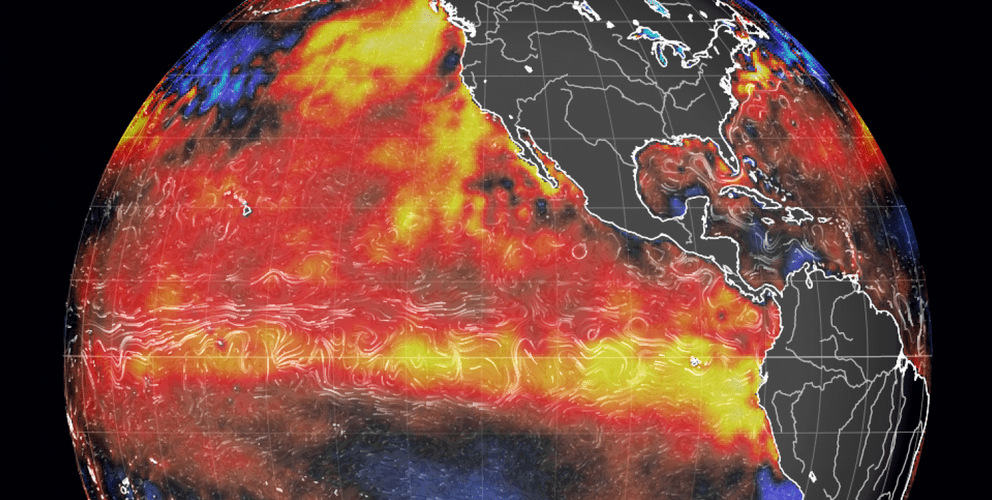
What is going on? Whoever possesses the answer, would they please stand up and be counted? El Niño is busting out after lazing on its massive south Pacific lilo for the past few years. It never rains in Southern California goes the 70’s classic pop-tastic number. Well now it does. So much so, they’re going to need an ark the size of Rhode Island to evacuate all God’s animals from the jungles of South Central LA. Spotlight on Oz: Moses might have looked on the burning bush as a divine signal, but that’s probably not how Mick Dundee sees it from a fire-ravaged Down Under. 11,000 diametric miles away from the planetary posterior, Scotland is lashed by the Atlantic’s own cat-o’-nine-tails, as if she – brave little Scotland, nearly but not quite ready to break free and run from that mean old union of 1707 – deserves nature’s lockdown treatment, as if her enclosed glens were not already filled to brimming, her peaty soils already maxed out on efforts to conceal the horrible truth of her climate. New York, meanwhile, all but realises Hollywood’s disaster prophecy foretold in The Day After Tomorrow. Times Square abandoned but for a snowman and a wacky waitress-cum-sculptor serving its face with salad, giving its midriff and ass that Dunkin Donut rotundness of an N.Y.P.D. officer directing non-existent traffic. What else can we add? The Middle East a balmy 25 degrees c – the perfect winter’s day. So perfect, indeed, that while its climate displays the clemency of South Africa’s Truth and Reconciliation Tribunal, its political climate is hell bent on restoring the yin-yang balance by fostering a political and humanitarian shit storm. Then we’ve got Africa. Oh! Africa, My Africa. Dr Livingstone’s beloved open sore of the world. It matters not what the weather is doing there, because a) it’s doing about everything weather can do, short of what weather does in Russia; and b) no one gives a toss. Hell, the only patch of snow Africa ever had is receding faster from the crater rim of Kilimanjaro than, oh, Prince William’s hairline.

Record temperatures forecast for summer 2016. Another glorious summer of ’69 is emphatically not on the cards, unless you consider the possibility that 69 refers entirely to Kuwait’s 2016 midsummer temperature in degrees Celsius. Cut to Syria and a summer of gory as opposed to glory might be more apposite. So what’s is going to be and why are we all somewhat jittery about the weeks and months to come?

There was one of those digital proverbs posted on an anonymous internet forum the other day. You know the ones? They exist to restore a little bit of aah!!!, a little laaaah-titude to our vertiginous lives. They are Xanax pills, swallowed in word form to ease our growing anguish. They are Novocane for the soul, to take The Eels of of context. The rise of these latter-day koans, cliched as they are, comes to highlight the puzzle and paradox of being YOU in this, our age of anxiety. Throw in a shit load of bad weather then lay it on thick with an impending economic collapse (brought on by a China dragon about to swallow its tail) and you’ve got the perfect psychological storm.

The proverb went like this:  As sex got easier to get, love got harder to find.

If you strain your eyes hard enough on a low res image, you can see the words in microscopic form. Each one is a pixel forming a mosaic. That mosaic is us, all standing shoulder to shoulder on a crowded Gaia spinning at 67,000 mph around the sun. Seen from space, it all flows together beautifully. However, seen from close up, the pixels are so not together.

And as for the proverb: sure, love was never easy to find; as for the bountiful sex part, says who? I mean, yours truly ain’t getting his share. That’s why he is writing this…this, whatever this is…in bed on a weekend morning, instead of…you know, getting it?